


Local rules and safety
Possums in the garden: the rules and humane fixes
By the Action Garden team · Updated · 15 min read
Checked against: Wildlife, Victorian Government, Victorian Government, Agriculture Victoria, Wildlife Victoria
TL;DR
- Both common possums are protected wildlife in Victoria: it is illegal to harm, harass or relocate them.
- Trapping is only allowed for brushtail possums living in buildings, released after sunset within 50 metres on the same property; ringtails need a permit.
- Barriers work better than sprays: cover plants at night, fit 60 cm trunk collars and add a floppy top to fences.
- Household fruit netting must have a mesh of 5 mm by 5 mm or less at full stretch, a rule in force since 1 September 2021.
- A nest box at least 3 metres up gives a resident possum a home, and a territorial possum keeps others away.
| Topic | The rule | Detail |
|---|---|---|
| Protection | Wildlife Act 1975 | Possums must not be harmed, kept or interfered with without approval |
| Trapping | Brushtails in buildings only | Release on the same property, within 50 metres, after sunset on the day of capture |
| Ringtail possums | Permit needed | It is illegal to trap a ringtail possum without a permit |
| Relocation | Prohibited | Most relocated brushtails die soon after release, according to a Melbourne study |
| Fruit netting | 5 mm by 5 mm or less | Measured at full stretch, for household fruit trees, vegetable gardens and frames |
| Trunk collars | 60 cm wide | Sheet metal or Perspex, fitted 60 cm above the ground |
Are possums protected in Victoria?
Yes. Both common Melbourne possums, the brushtail and the ringtail, are protected under the Wildlife Act 1975. They must not be harmed in any way or kept without approval, and the Victorian Government (opens in a new tab) states plainly that it is illegal to harass or interfere with them.
That protection does not disappear when a possum strips your roses or eats the new growth on a hedge. The rules allow very limited control of brushtail possums living inside buildings, and nothing else without a permit. For a possum that lives in a tree and feeds in your garden, the law leaves you with humane, physical fixes.
The good news is that those fixes work better than most people expect. Possums are creatures of habit that follow the same routes every night, so blocking a route or covering a favourite plant changes their behaviour quickly.
Which possum is in your garden, and what does it eat?
Most garden damage in Melbourne comes from the common brushtail possum, though ringtails also browse. Knowing which one you have matters, because the rules and the fixes differ slightly.
| Common brushtail possum | Common ringtail possum | |
|---|---|---|
| Size | About the size of a cat | About half the size of a cat |
| Look | Large pointed ears, grey fur, bushy black tail | Round ears, grey back with rusty sides, curled tail with a white tip |
| Where it sleeps | Tree hollows, and often roof spaces | A nest of twigs and leaves, called a drey, several metres up |
| Enters roofs? | Often | Rarely |
| Young | One, born in autumn or spring | One to three, mostly twins, in autumn or winter |
Source: Victorian Government, Possums.
Possums eat the leaves, flowers and fruit of a wide range of native and exotic trees and shrubs. The brushtail also eats grass, fungi, bird eggs and baby birds. The typical signs are chewed tips on new shoots, roses and hibiscus stripped overnight, fruit with bites taken out, and droppings on paths and fence tops.
Possum or rat? How to tell from the damage and the noise
The official advice for roofs is to check the animal before doing anything: rats make light scampering and gnawing sounds, while possums make a throaty hiss and heavy thumping.
In the garden, possum damage is usually high up and on soft new growth, with whole flowers and shoots gone overnight. Rats tend to work near the ground, around compost, bird seed and fallen fruit, and leave gnawed fruit still hanging low. A quick look with a torch after dark settles most doubts, because possums are slow to bolt and easy to spot in a tree.
What are you allowed to do about a possum?
You can block, cover, collar and deter, but you cannot harm, trap or move a possum that lives outdoors. Trapping is only permitted for brushtail possums living within buildings, under a Governor in Council order made in 2003.
The conditions on that order are strict:
- Who can trap. Home owners or occupiers and their families, building managers or their staff, and licensed wildlife controllers.
- The trap. A cage trap designed to avoid injury, with nothing that grips the animal. Mesh under 19 mm square is ideal. Some councils lend or hire traps.
- Checking. Every trap must be checked no more than two hours after sunrise, and a trapped possum kept quiet and covered.
- Release. On the same property, no more than 50 metres from where it was caught, after sunset on the day of capture.
- No relocation. Moving a brushtail further away or off the property is prohibited.
Lethal control needs an Authority to Control Wildlife from the Department of Energy, Environment and Climate Action, issued only when the department agrees it is necessary and all practical non-lethal options have been exhausted. Ringtail possums cannot be trapped at all without a permit.
Quick decision guide
You have a possum problem
- Is the possum injured, orphaned or caught in netting? Do not handle it. Call Wildlife Victoria (opens in a new tab) on 03 8400 7300.
- Is it living inside the roof or a shed? See the one-way flap approach in our article on birds, possums and wasps in gutters and roofs; trapping is only for brushtails, under the rules above.
- Is it eating fruit? Use compliant netting, fruit bags or shade cloth, fixed tightly.
- Is it eating ornamental plants or new growth? Cover plants at night, add trunk collars and a floppy fence top, and rethink the planting.
- Is it just passing through? Leave it be. Prune branches back from the roof and put up a nest box so it stays a neighbour, not a tenant.
How do you stop possums eating your plants?
Physical barriers are the only reliable fix. The official advice is to collar trees, fence the garden with a floppy-top fence and cover plants, because sprays have a poor record.
Cover the plants they target
Cover young plants, seedlings and favourite shrubs at night with shade cloth or white, wildlife-safe netting. Fix the cover firmly at the base so a possum cannot crawl under it, and take it off during the day if the plant needs light and air.
New plantings suffer most, because soft new growth is exactly what possums seek out. A light frame over a new bed for its first season, while the plants harden up, is often all that is needed.
Collar the trunks
A collar of sheet metal or Perspex 60 cm wide, fitted 60 cm above the ground, stops possums climbing a tree. It suits fruit trees and any tree that stands alone, with no branches touching a fence, roof or neighbouring tree. If another route exists, the possum simply uses that instead.
Give the fence a floppy top
Possums travel along fence tops. The Victorian Government suggests a 30 cm floppy fence on top of an existing paling fence, and for a fenced garden area, 80 cm wide heavily galvanised chicken wire with 20 cm buried in the ground, held on flexible high-tensile wire and bent outwards at the top. When a possum climbs, the wire bends over and springs back.
Rethink the planting
Plants with soft, sweet new growth, such as roses, many fruit trees and some flowering shrubs, are the usual targets. No plant is possum-proof, but tough, aromatic or prickly foliage tends to be browsed less. If one shrub is stripped every spring, moving it under cover or replacing it with something tougher saves a lot of frustration.
If you are replanting after damage, water new plants in properly. A drip or sprinkler system may only run from 6pm to 10am under the permanent water saving rules, while hand watering with a trigger nozzle is allowed any time; our article on Melbourne's water rules for gardens sets out the details.
What the research says about repellents
The Victorian Government's possum repellents fact sheet says the department is not aware of any reliable, universal repellent. It lists products and home mixes that people report working, but describes their effectiveness as not proven.
A Deakin University trial summarised in that fact sheet tested 14 products. When possums were hungry, none of the taste-based repellents stopped them eating treated apple. Some smell-based products showed some degree of repellency. A separate government page notes that tests found none of 15 common repellent compounds effectively prevented damage to ornamental trees or fruit, and that ultrasonic devices do little.
If you try a repellent, follow the label exactly, test it on a small part of the plant first, and reapply after rain. Anything used must be lawful: the fact sheet reminds readers that animal cruelty is an offence under the Prevention of Cruelty to Animals Act 1986.
What are the rules for netting fruit trees?
Since 1 September 2021, any netting used over household fruit trees, vegetable gardens or other fruiting plants in Victoria must have a mesh of 5 mm by 5 mm or less at full stretch. The rule sits in the Prevention of Cruelty to Animals Regulations 2019 and covers netting on frames too.
Large-mesh netting entangles birds, possums and flying foxes, and Agriculture Victoria (opens in a new tab) describes the struggle that follows as causing deep cuts and strangulation. The regulation applies to both the use and the sale of household netting, and fines apply. Old netting that does not comply has to be replaced.
Agriculture Victoria and the Victorian Government's wildlife pages recommend:
- White netting, which nocturnal animals can see and avoid.
- A thicker strand (over 500 microns) or a cross-weave design.
- Netting fixed tightly to branches or tied onto the trunk, never thrown loosely over a tree or left lying on the ground.
- Netting selected branches instead of the whole tree, or fruit bags over individual clusters.
- 30 percent blockout shade cloth as an alternative, which is wildlife-safe and does not stop fruit ripening.
- Checking netted trees daily, and taking the net off once the fruit is picked.
A tree kept low is far easier to net properly, which is one more reason to keep fruit trees at a manageable height with regular pruning. When you throw out old netting, Agriculture Victoria suggests putting it in a strong biodegradable bag first so it cannot tangle wildlife at the tip.
How do you keep possums from getting from the garden onto the roof?
Cut off the routes. The Victorian Government advises pruning every branch that leads to the roof to leave a gap of at least 1.5 metres, because possums can jump a long way down but not far across.
Then close the other routes:
- Collar trees that touch the roof line, as above, where pruning is not enough.
- Add a floppy top to fences that run up to the house.
- Check climbers on walls, pergolas and downpipes, which work as ladders.
- Ask your electricity or telecommunications company about possum-proofing cables that run to the house, as the official page suggests.
What happens once a possum is already inside the roof, including one-way flaps and gutter fixes, is covered in our article on birds, possums and wasps in gutters.
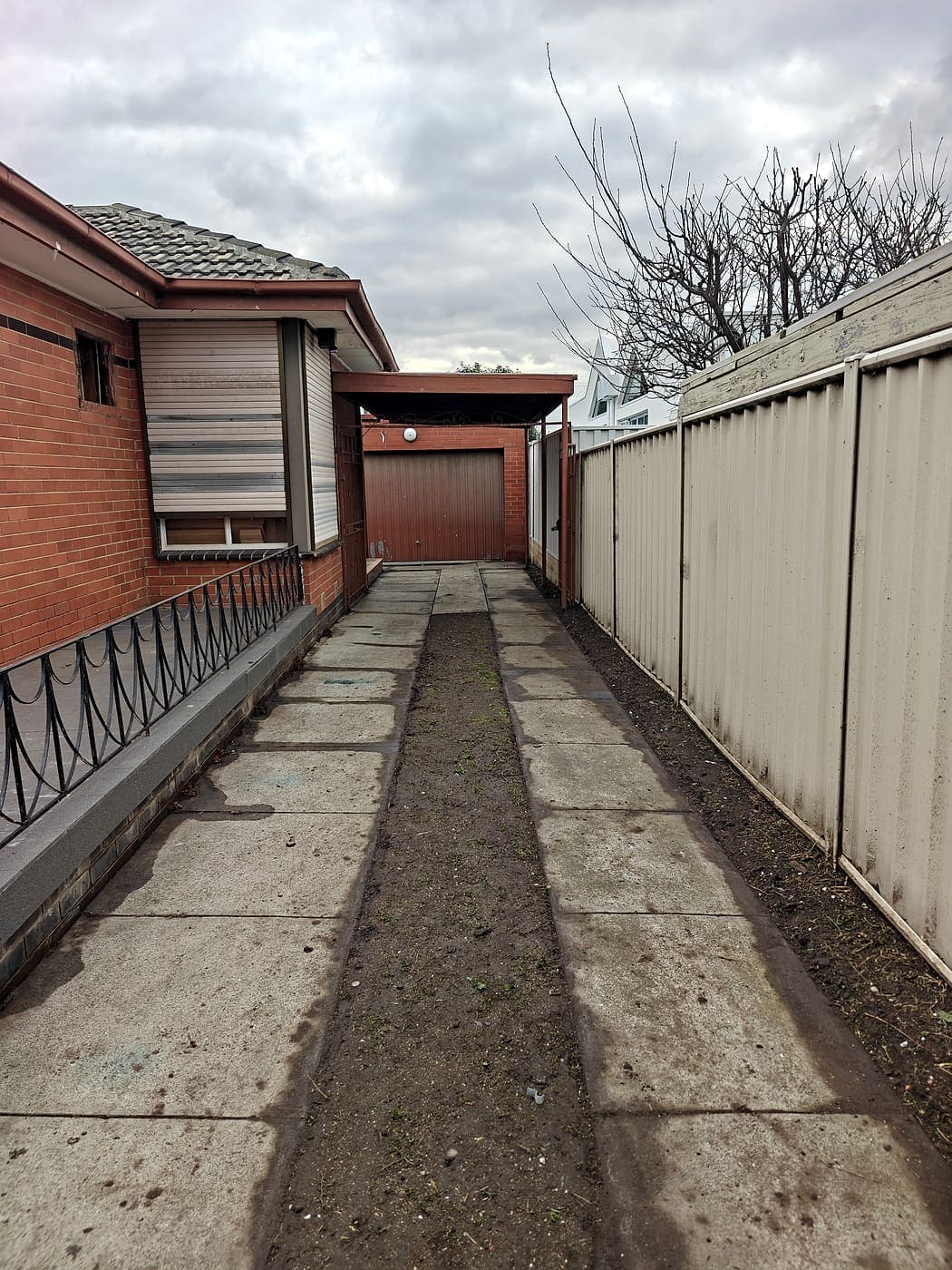
A side view of a house, a fence and two trees, built up in four steps. First, a branch reaching over the roof is cut back, and a dimension line shows a 1.5 metre gap between the new branch tip and the gutter. Second, a band 60 cm wide wraps the trunk of a fruit tree, with a dimension line showing it starts 60 cm above the ground; a possum icon climbs to the band and slides back. Third, a 30 cm wire extension on top of the paling fence bends outwards and flexes as a possum tries to cross. Fourth, a nest box appears on the trunk of a second tree, at least 3 metres up, and the possum icon settles into it.
Pruning branches near the roof line means working at height, often with a ladder and saw, and sometimes near the power line to the house. Leave that to a professional, and never climb onto a roof to chase a possum. Large trees, branches over the house and anything near power lines are jobs for tree professionals; the Action Garden team handles bigger tree work. An injured or entangled possum is a job for a wildlife rescuer, not for you.
Do possum nest boxes work?
Yes, as part of the fix. Possums are territorial, so a possum that adopts a nest box in your garden tends to keep other possums away from your roof and garden.
The Victorian Government gives clear guidance on building and placing one:
- Timber 19 to 25 mm thick for insulation, ideally rough sawn.
- No treated timber, toxic paints, chipboard or smelly glues, and no sharp edges or protruding nails and screws.
- Mount it in a stable, upright position at least 3 metres above the ground.
- Check it regularly and remove nesting material left by introduced birds such as mynas, sparrows and starlings.
A nest box does not change what a possum eats. It works best alongside the barriers above: the possum has a home, the roof is shut off, and the plants it loves are covered or collared.
Ringtail dreys in hedges and climbers
Ringtail possums build a drey, a ball-shaped nest of twigs and leaves, in dense foliage several metres up. Thick hedges, climbers and shrubby trees in older gardens are typical spots.
Before heavy pruning or removing a dense plant, look for a drey and for possums sleeping in the foliage during the day. Disturbing wildlife is an offence, so if you find an occupied nest, leave that section until it is empty, or ask for advice. Our article on nature strips and what the council expects is worth a read if the plant in question sits on council land, because street trees and verge plantings come under council rules.
What if a possum is injured, orphaned or caught in netting?
Do not handle it. Call a wildlife rescue group, such as Wildlife Victoria's emergency line on 03 8400 7300, and keep children and pets away while you wait.
Agriculture Victoria's advice for animals caught in netting is clear: do not try to handle or rescue the animal yourself. Possums bite and scratch when frightened, and cutting the net can injure them further. Wildlife Victoria also advises not to give food or water, and that a possum brought in by a cat needs a vet even if it looks unhurt.
A baby possum on its own is not always an orphan; its mother may be nearby. Ring the rescue line and describe what you see before moving it. If you witness or suspect cruelty to wildlife, the Victorian Government asks you to call 136 186.
What mistakes make a possum problem worse?
The most common mistake is trying to remove the possum instead of changing the garden. Another possum moves in, and the damage starts again.
- Trapping a possum that lives outdoors. It is not allowed, and the order only covers brushtails in buildings.
- Driving a possum to the bush or a park. Relocation is prohibited and usually fatal for the possum.
- Feeding possums. Human food harms them and brings more to the garden.
- Using old, wide-mesh netting or throwing nets loosely over a tree, which entangles wildlife and breaks the netting rules.
- Relying on sprays alone. The evidence for repellents is weak.
- Pruning hard without looking for dreys and sleeping possums first.
- Leaving fallen fruit and rubbish piles that keep possums and rats coming back.
Fallen fruit, prunings and leaf piles also matter in summer for another reason: they add fuel around the house. On the urban fringe, our fire season property checklist and the article on council fire prevention notices explain what to clear and when.
If the team finds a possum, a drey or an occupied nest box during pruning or hedge work, they pause work on that section, tell you, and contact the local authority or a licensed wildlife professional if it needs to be moved. Work continues once it is safe.
When is it worth handing the job over?
When the fix means pruning near the roof, netting and checking fruit trees through the season, or covering and tidying beds every few weeks, it is worth handing over. Our gardening services cover pruning, planting, seasonal care and clean-ups, and a regular maintenance programme keeps branches clear of the roof before they become a possum bridge. The complete guide to garden maintenance in Melbourne explains what each season needs, and there are more council and safety topics in the local rules and safety section of our blog. You can get a free quote whenever it suits you.
Your Garden. Our Promise.
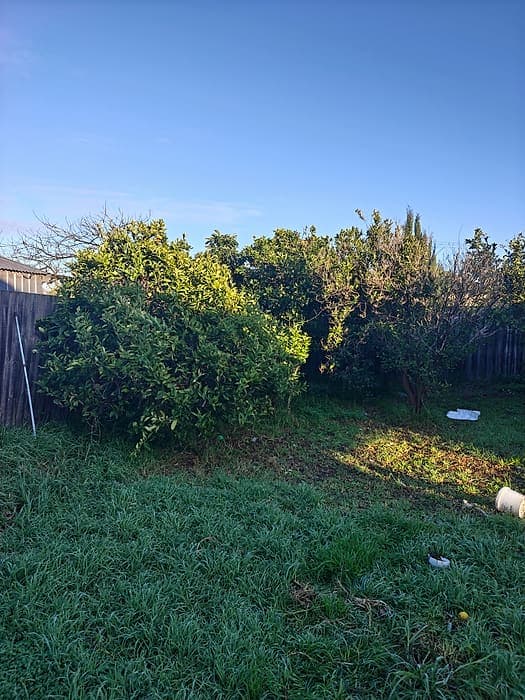
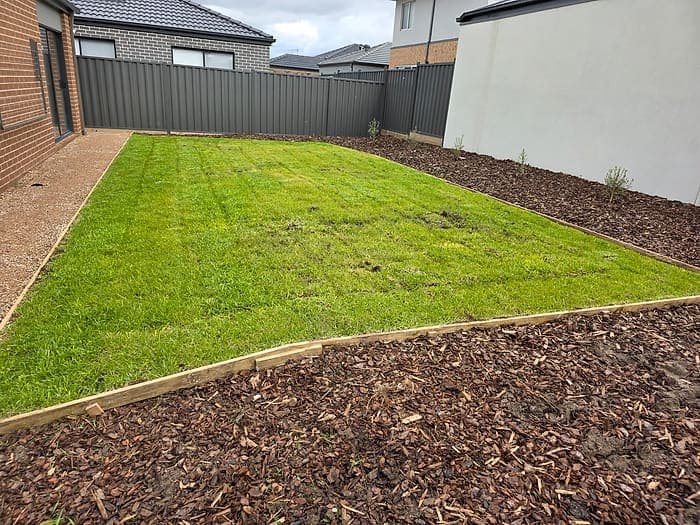
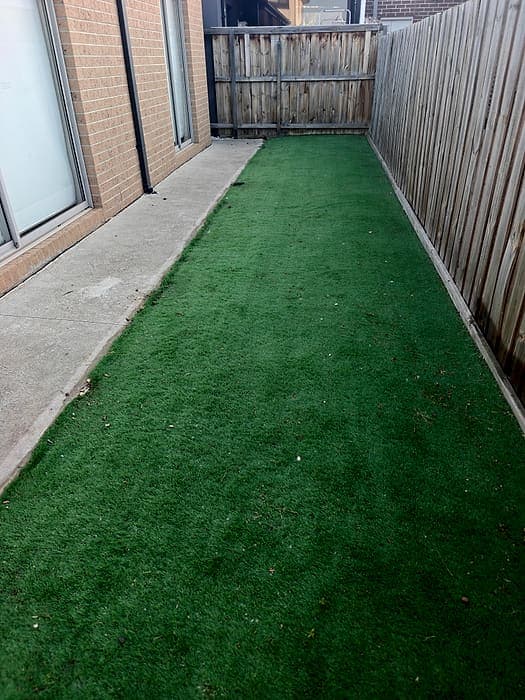
From our jobs
Frequently asked
Can I trap a possum that is eating my garden plants?
Are ringtail possums treated differently from brushtails under Victorian rules?
Should I leave food out for the possums in my garden?
What mesh size must fruit tree netting be in Victoria?
Do possum repellent sprays stop possums eating plants?
What should I do if a possum is caught in garden netting?
Will a nest box stop possums eating my garden?
Can I cut back a tree that possums use to reach my roof?
Sources and further reading
- Possums (Wildlife, Victorian Government)
- Brushtail possum wildlife management methods (Victorian Government)
- Use of fruit netting, harvest without harm (Agriculture Victoria)
- Wildlife and fruit trees (Wildlife, Victorian Government)
- Possum repellents fact sheet (Wildlife, Victorian Government)
- Report a wildlife emergency (Wildlife Victoria)
Caring for Melbourne gardens since 2019. Updated 18 November 2026.