


Gutters and roof line guide
How to clean gutters safely
By the Action Garden team · Updated · 15 min read
Checked against: WorkSafe Victoria, Energy Safe Victoria, Better Health Channel, Water Victoria, EPA Victoria, CFA
TL;DR
- Decide first whether the job is safe to do yourself; height, roof type, power lines and ground conditions matter more than the leaves.
- Set an extension ladder at a 4 to 1 angle, extending 1 m above the gutter if you step off, secured top and bottom, with a helper at the base.
- Scoop by hand into a bucket, working away from each downpipe outlet, and move the ladder rather than reaching sideways.
- Test each downpipe with a bucket or a trigger nozzle hose, and keep the sludge out of the stormwater drain.
- Do not walk on the roof, do not pressure wash or blow suspect fibro, and stay well clear of the power line to the house.
Can you clean your gutters yourself?
You can clean your own gutters if the house is single-storey, the ground under the ladder is firm and level, no power lines run near the work, the gutters can be reached from a ladder without walking on the roof, and someone is there to help. If any of those is missing, the safe answer is to book a professional. Most of this guide is about the ladder, because the ladder is where people get hurt.
WorkSafe Victoria (opens in a new tab)'s guidance for workplaces is blunt about ladders. It puts working from the ground or a solid platform at the top of its fall prevention hierarchy and a ladder at the bottom, and it says anyone on a ladder is at risk of falling, even below 2 metres. Those rules are written for employers, but they are a sensible standard at home too.
A two-minute safety check before you start
| Question | Go ahead if | Stop and call a professional if |
|---|---|---|
| How high is the gutter? | Single-storey eaves | Two storeys, split level or high gables |
| What is under the ladder? | Firm, level paving or lawn | Soft beds, slopes, steps, pool edges |
| Any overhead lines? | None near the work | The service line or power lines near the gutter |
| Do you need to go on the roof? | No, everything is reachable from the edge | Yes, for valleys, box gutters or the far side |
| What is the roof made of? | Sound metal sheets or tiles | Brittle tiles, or cement sheet that may contain asbestos |
| Who is helping? | A second adult at the base | Nobody |
| What is the weather? | Dry, calm, mild | Wet, windy, hot or a total fire ban day |
For when and how often to clean, see the complete guide to gutter cleaning in Melbourne. This page is the hands-on method.
What tools and safety gear do you need?
You need a sound ladder, a helper, grip gloves, eye protection, a plastic scoop, something to catch the debris and a way to test the downpipes with a little water. That is it. Gadgets that promise to clean gutters from the ground can help on low, simple gutters, but they do not let you inspect what you have cleaned.
The kit, and why each item matters
- Extension ladder in good condition. Check the feet, rungs, locks and stiles before every use. A bent stile or a missing foot is reason enough to stop.
- A helper. Someone to foot the ladder, pass tools and call for help.
- Ladder stabiliser or stand-off. It holds the ladder off the gutter so it does not crush the gutter or slide along it.
- Gloves with grip. Gutter debris can hide broken glass, sharp metal edges, wasp nests and bird droppings.
- Safety glasses. Wind blows grit straight back off the roof.
- Closed, non-slip shoes. Soft soles with good grip on the rungs.
- Plastic scoop or small trowel. Plastic is kinder to the gutter's coating than a metal tool.
- Bucket with a hook, or a tarp. Debris goes into the bucket, not onto garden beds or paths.
- Trigger nozzle hose or a bucket of water. For testing the downpipes, not for blasting debris along the gutter.
Hang the bucket on the ladder or the gutter bracket with a proper hook, and carry the scoop in a pocket or tool belt. WorkSafe's ladder alert calls for three points of contact at all times when using a ladder, which is impossible with a bucket in one hand and a scoop in the other.
How do you set up a ladder safely for gutter work?
Set an extension ladder on firm, level ground at a 4 to 1 angle, secure it at the top and bottom, and have a helper hold the base while you climb with three points of contact. If you need to step off onto a lower roof, the ladder should extend 1 metre, or 3 rungs, above the step-off point. These figures come from WorkSafe Victoria's guidance on portable ladders.
The 4 to 1 rule
For every 4 metres of height up to where the ladder rests, the foot of the ladder goes 1 metre out from the wall. Too steep and the ladder can tip backwards as you lean in. Too flat and the feet can slide out.
A side view of a single-storey house with an extension ladder leaning against the eaves. The height from the ground to where the ladder rests is marked as 4 units, and the distance from the wall to the ladder's feet as 1 unit. The top of the ladder extends above the gutter line, the feet sit on level paving, a helper stands at the base with both hands on the stiles, and the climber's belt buckle stays between the stiles.
Ladder rules that prevent most falls
- Firm and level ground. Paving or flat, dry lawn. Never set feet on a garden bed, a sloping path or loose gravel without a stable base.
- Secured top and bottom. Tie off at the top where you can, and have the helper foot the base.
- Three points of contact. Two feet and one hand on the ladder whenever you are on it.
- Stay between the stiles. Keep your body centred. If you cannot reach, climb down and move the ladder.
- Do not stand too high. On an extension ladder, do not climb so high that you lose a handhold. On an A-frame ladder, WorkSafe says never stand on or above the second step from the top, and do not straddle it.
- Do not rest the ladder on the gutter itself. Use a stabiliser that bears on the roof or wall, or rest it where the gutter is supported.
- Look up first. Find the service line from the pole to the house before you lift the ladder, and keep the ladder well away from it.
Choosing the right ladder
WorkSafe describes A-frame, straight and extension ladders as the least stable kind of ladder and suitable only for access or light, short-duration work. An A-frame ladder is often too short for gutters and cannot be leaned against a wall. An extension ladder rated for the load, with levelling feet if the ground is slightly uneven, is the usual choice for single-storey gutters. Platform ladders give a more stable standing position for longer work.
Power lines
Energy Safe Victoria (opens in a new tab) advises keeping metal ladders well away from power lines and being aware of the lines attached to your house or shed when you work around the home. The service line usually meets the house at the roof line, right where gutter work happens. If any part of the job brings you or the ladder near that line, stop and leave it to a professional.
How do you clean gutters step by step?
Clean gutters by hand, a section at a time: scoop the debris out into a bucket, starting beside a downpipe and working away from it, then move the ladder and repeat. Leave the water test until the gutters are empty, so you do not wash sludge into the downpipes.
- Lay a tarp under the first section. Anything you drop lands on the tarp, not in the garden bed.
- Climb to a comfortable working height. Your hips should stay below the gutter line so the ladder carries your weight, not your arms.
- Start at the downpipe outlet. Lift out the debris sitting on and around the outlet first, so nothing gets pushed into it.
- Work away from the outlet. Scoop towards yourself in short strokes, about an arm's length either side of the ladder.
- Bag as you go. Empty the bucket into green waste bags when it is half full; a full bucket on a hook pulls the ladder sideways.
- Move the ladder. Climb down, shift the ladder along, check the footing and the angle, and climb back up.
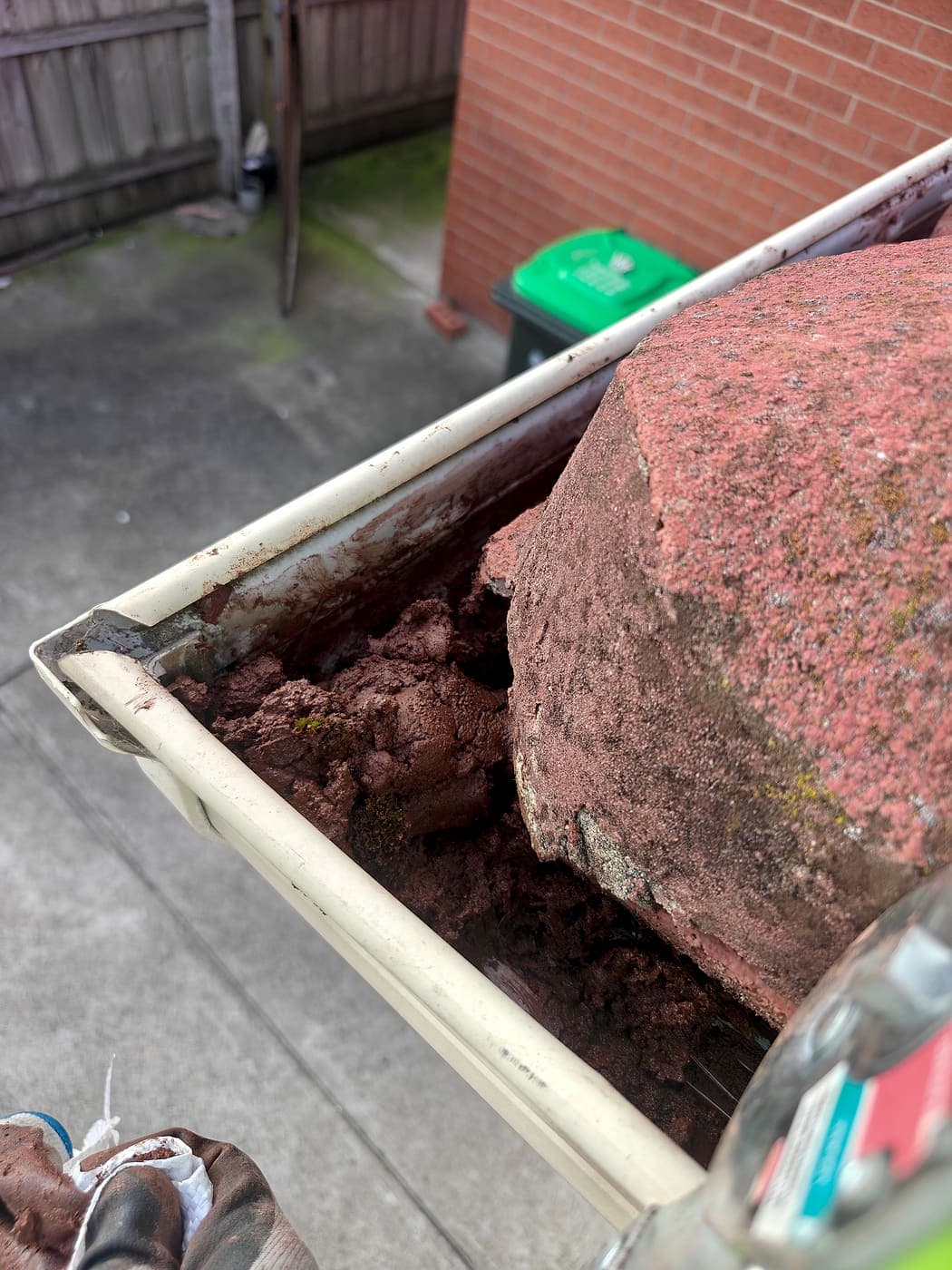
- Check the ends and corners. Debris packs tightly at stop ends and internal corners.
- Look at the condition as you go. Note rust spots, holes, loose brackets and any section that holds water.
What a full gutter usually contains
Expect a mix of dry leaves on top, dark wet sludge underneath and grit from the roof surface. Under eucalypts there will also be bark strips, gum nuts and twigs that knot together. Our post on cleaning gutters under gum trees covers why those homes fill faster and when to clean them.
Gutters with guard fitted
If mesh guard is fitted, brush the debris off the top of the mesh first. Then lift one section near a downpipe to see what has built up underneath. Fine material often collects under the mesh, and if it has, the whole run needs lifting and clearing. Refit each section exactly as it was, so the fixings and any tile edges are not disturbed.
How do you clear and test a blocked downpipe?
Clear the outlet at the top by hand first, then pour a bucket of water, or run a trigger nozzle hose briefly, into the outlet and watch the bottom of the pipe. Steady flow at the bottom means it is clear. Slow flow, water backing up into the gutter or no flow at all means a blockage further down.
Working through a blockage
- Remove what you can reach. Pull leaves and gum nuts out of the outlet and the first part of the pipe with a gloved hand.
- Tap along the pipe. A dull sound marks where debris has packed in, often at a bend.
- Check the bottom. Some downpipes have a joint or inspection opening near ground level, and the bend into the stormwater pipe is a likely spot for debris to lodge.
- Flush gently. Feed the hose into the pipe from the top or the bottom with short bursts, not a long run.
- Know when to stop. If water backs up from the underground connection, the blockage is in the stormwater line and needs a plumber.
Using water within the rules
Victoria's permanent water saving rules (opens in a new tab) require that "hoses must be leak free with a trigger nozzle for all uses". Use the smallest amount of water that proves the downpipe flows. The aim is a test, not a wash, and nothing you rinse should carry leaf sludge into the street drain.
EPA Victoria (opens in a new tab) reminds households that stormwater travels through gutters and drains straight to our waterways, and that sweeping waste into a bin beats washing it away with a hose. Bag the gutter sludge, put it in the green bin or compost, and sweep the paths instead of hosing them.
What mistakes should you avoid when cleaning gutters?
The mistakes that cause injuries are leaning out, climbing alone and walking on the roof; the mistakes that cause damage are blasting with water, using metal tools and pushing debris into the downpipes. Avoid all of them and the job is slow but safe.
Mistakes that hurt people
- Overreaching. If your belt buckle leaves the space between the stiles, you are too far out. Move the ladder.
- Climbing alone. Nobody to foot the ladder, and nobody to call for help.
- Standing on the top rungs. You lose your handhold and your balance point.
- Walking on the roof. Tiles crack, sheets get slippery with moss or dew, and cement sheet roofs can give way.
- Working in wind or rain. Wet rungs and gusts turn a routine job into a dangerous one.
- Carrying loads up the ladder. Hands belong on the ladder; tools belong on a hook or belt.
Mistakes that damage the house
- Pressure washing the gutters. High pressure can drive water under roof edges and flashings and spray sludge over walls and windows.
- Pushing debris towards the outlet. It packs into the downpipe and creates the next blockage.
- Metal tools. Scraping with a metal trowel scratches the coating and starts rust.
- Standing the ladder on the gutter. The gutter bends, the joints open and the ladder can slide.
- Hosing debris into the drain. It pollutes waterways and blocks the street drain.
Older homes and asbestos
Victoria's Better Health Channel (opens in a new tab) says Australian homes built before 1990 may contain asbestos, and lists eave linings and corrugated cement roofing among the places it is found. As a guide, homes built before the mid-1980s are highly likely to contain asbestos products. If the eaves, roof or gutters on an older house might be cement sheet, do not scrape, break, drill, blow or pressure wash them; have them assessed, and use a licensed asbestos removalist for any removal.
When should you not clean the gutters yourself?
Do not do it yourself on two-storey or split-level homes, on steep or fragile roofs, near power lines, where the roof may contain asbestos, or whenever you would need to walk on the roof. Those are the jobs where a fall or an electric shock is a real possibility. They need the right ladders, height safety equipment and experience.
Book a professional if: the gutter is above single-storey height; you would need to step onto or walk across any roof; the roof is steep, wet, mossy, tiled with brittle tiles, or may be cement sheet; the service line or power lines run near the gutter; the ground under the ladder is soft, sloping or crowded; you have no helper; there are box gutters or valleys to clear; or the gutter is sagging, rusted through or pulling off the fascia.
Other times to stop
- Wasps, bees or a bird's nest. Back down the ladder and deal with it from the ground or call a pest controller.
- A snake or a rat in the debris. Leave it alone and give it space.
- Rot or rust you did not expect. A fascia that is soft, or a gutter rusted through, is a repair job.
- Feeling unsteady. Fatigue, heat or nerves are all good reasons to stop.
Professional cleaners also bring things most homes do not have, such as ladders sized for two storeys, stand-offs and height safety gear. Action Garden's gutter cleaning service clears the gutters and downpipes, flushes the downpipes, checks the roof line and leaves a photo report.
What should you do after the gutters are clean?
After the clean, deal with the debris, record what you found and set the date for the next one. Ten minutes on these three things saves the next clean from being a surprise.
Dispose of the debris properly
Leaves and twigs go in the green bin or the compost. Do not dump sludge in a pile against the house, where it holds moisture against the wall, and do not sweep it into the gutter at the kerb. If you have more green waste than the bin will take, our rubbish removal service takes garden waste away.
Record what you saw
Photos of any rust, sagging, loose brackets or gaps at the fascia make it much easier to get repairs quoted. Keep them with the date of the clean so you can see how quickly the gutters fill.
Plan the next clean
Most Melbourne homes need a clean twice a year, and homes under gum trees more often. The CFA (opens in a new tab) also asks households to clear gutters before bushfire season starts and to keep them clear through it. If branches overhang the roof, cutting them back reduces the leaf load; the Action Garden team does tree trimming too.
For the bigger picture on gutters, read the gutters and roof line guides. And if the ladder work is not for you, it is worth handing the job to Action Garden: request a free quote and send a photo or two of the roof line.
Your Garden. Our Promise.
From our jobs
Frequently asked
What tools do I need to clean gutters?
Is it safe to clean gutters from a ladder on my own?
Can I walk on my roof to reach the gutters?
Should I use a leaf blower or pressure washer on gutters?
How can I tell if a downpipe is blocked?
What should I do if my roof or gutters might contain asbestos?
Can I clean gutters near the power line to my house?
Sources and further reading
- Using portable ladders in the workplace (WorkSafe Victoria)
- Employees seriously injured from falls when using ladders, safety alert (WorkSafe Victoria)
- Electrical safety outdoors (Energy Safe Victoria)
- Asbestos in the home (Better Health Channel)
- Permanent water saving rules (Water Victoria)
- Stormwater (EPA Victoria)
- Preparing for bushfire season (CFA)
Caring for Melbourne gardens since 2019. Updated 17 November 2026.