


Gutters and roof line · Complete guide
Gutter cleaning in Melbourne: the complete guide
By the Action Garden team · Updated · 18 min read
Checked against: Bureau of Meteorology, CFA, Rental Dispute Resolution Victoria, WorkSafe Victoria, Better Health Channel, EPA Victoria
TL;DR
- Twice a year suits most Melbourne homes; under large trees, plan on three or four cleans and a check after strong wind.
- October is Melbourne's wettest month on long-term BOM records, so a late spring clean gets the roof line ready for the wet and for fire season.
- A blocked gutter overflows against walls and footings, rots fascia boards, holds water for mosquitoes and keeps dry leaves on the roof.
- The CFA lists clearing gutters with pruning overhanging branches, keeping grass under 10 cm and moving woodpiles away from the house.
- Single-storey roofs with good ladder access can be a DIY job; two-storey homes, steep or fragile roofs and anything near power lines are not.
| Season | Gutter job | Why |
|---|---|---|
| Autumn (March to May) | Main clean after the leaves fall | Deciduous trees drop most of their leaves; clean once the bulk is down, not halfway through. |
| Winter (June to August) | Check downpipes after heavy rain | Melbourne has the most rain days of the year; overflow shows quickly. |
| Spring (September to November) | Second clean, late spring | Clear the roof line before the Fire Danger Period, which can start as early as October. |
| Summer (December to February) | Check after windy days | Eucalypts shed most heavily now; the CFA says keep gutters clear in the warmer months. |
Why does gutter cleaning matter for a Melbourne home?
Gutter cleaning matters because gutters only protect a house while water can move through them. A clear gutter catches rain from the roof and sends it down the downpipes into the stormwater system. A blocked one tips that water over the edge, onto walls, windows, paths and footings.
Melbourne's rain makes this a year-round job rather than a once-a-year chore. On long-term Bureau of Meteorology (opens in a new tab) (BOM) records for the Melbourne Regional Office, the city averages about 648 mm of rain a year spread over around 100 days of 1 mm or more. That is plenty of steady, moderate rain, plus summer downpours that arrive faster than a half-blocked downpipe can handle.
What goes wrong when gutters block
- Overflow at the wrong place. Water spills along the wall instead of into the downpipe, staining render and brick and soaking garden beds against the house.
- Wet footings. Repeated overflow at the same point puts water beside the slab or stumps. On Melbourne's reactive clay soils in the north and west, wetting and drying cycles near the footings are worth avoiding.
- Rotting timber. Timber fascia boards and eaves linings stay damp behind a full gutter and start to rot or peel.
- Rust and sagging. Wet leaf sludge sits against the metal for months, speeds up corrosion and adds weight that bends brackets.
- Pests. Standing water suits mosquitoes, and a gutter full of soft debris suits birds, rats and plants that take root.
- Fire risk. Dry leaves in a gutter are fuel sitting on the roof, which is why the CFA (opens in a new tab) puts gutters near the top of its property preparation list.
If you want the hands-on method, our step-by-step guide to cleaning gutters safely covers the ladder setup, tools and technique. This pillar guide covers the bigger picture: timing, warning signs, special roof shapes, gutter guard, bushfire, rentals and when to bring in help.
How often should Melbourne gutters be cleaned?
Twice a year is the right starting point for most Melbourne homes: once after the autumn leaf drop and once in late spring. From there, the number goes up with the trees around the house, and it goes up most under eucalypts. The table below is a practical starting schedule, not a rule; the first year of checks tells you what your roof really needs.
| Property situation | Suggested cleans a year | Extra checks |
|---|---|---|
| No large trees within reach of the roof | 1 to 2 | After big storms |
| Deciduous trees nearby (plane trees, elms, oaks, fruit trees) | 2 | Late autumn, once the leaves are down |
| Eucalypts or other evergreens overhanging the roof | 3 to 4 | After strong wind, and before fire season |
| Bushland edge or high fire risk area | 3 to 4 | Before bad fire days, as the CFA advises |
| Roof feeding a rainwater tank | 2 to 4 | Inlet screen and first flush each season |
| Gutter guard fitted | 1 to 2 | Look for debris sitting on top of the mesh |
Why spring matters as much as autumn
Autumn gets the attention because deciduous leaves are easy to see. Late spring matters just as much because it sets the house up for two things at once: the wettest stretch of the year and the start of fire season. The BOM figures below show October as the wettest month on the Olympic Park record, and the CFA notes the Fire Danger Period can begin as early as October.
Melbourne rain by month: when gutters work hardest
| Month | Mean rainfall (mm) | Days with 1 mm or more |
|---|---|---|
| Jan | 53.3 | 5.4 |
| Feb | 26.3 | 3.6 |
| Mar | 36.4 | 5.2 |
| Apr | 63.0 | 7.5 |
| May | 46.5 | 8.5 |
| Jun | 42.1 | 8.6 |
| Jul | 41.0 | 9.0 |
| Aug | 47.0 | 9.3 |
| Sep | 41.0 | 7.9 |
| Oct | 68.0 | 9.1 |
| Nov | 64.4 | 8.0 |
| Dec | 50.2 | 6.3 |
Source: Bureau of Meteorology, climate statistics for Melbourne (Olympic Park), station 086338, records from 2013. Means over a short record move from year to year; the long-term Melbourne Regional Office record (1855 to 2015) also shows October as the wettest month.
Read the table two ways. The number of rain days peaks in winter, so overflow and blocked downpipes show up then. The heaviest monthly totals arrive in mid spring and early summer, often as storms, so a gutter that was just coping in winter can overflow badly in November.
For homes under gum trees, the timing shifts again, because eucalypts shed most of their leaves in the warm months rather than in autumn. Our post on how often gutters need cleaning near gum trees sets out a month-by-month programme for that situation.
What are the signs your gutters need cleaning now?
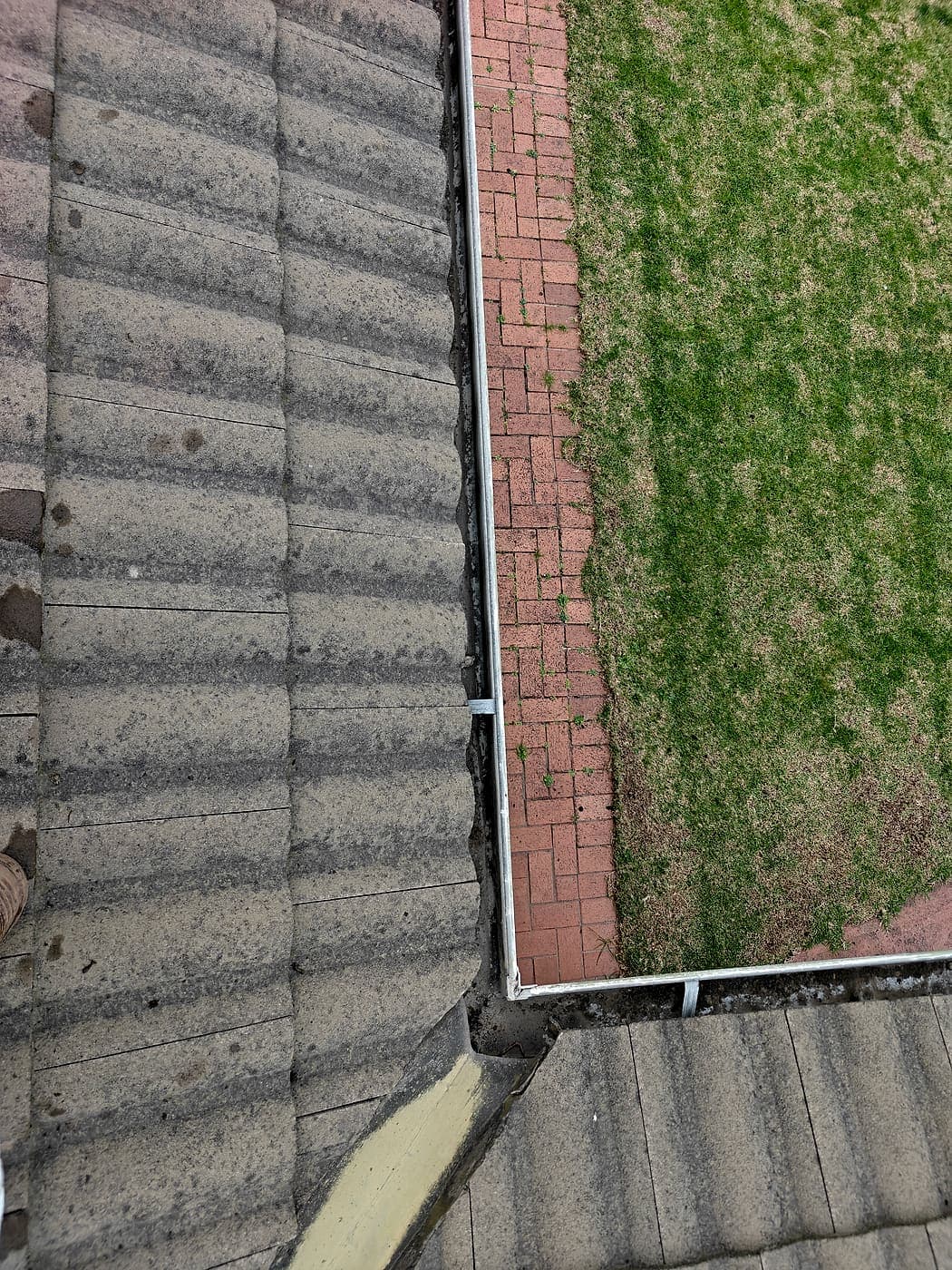
The clearest sign is water going where it should not: over the front edge of the gutter in rain, or out of a joint instead of down the downpipe. You can spot most problems from the ground with nothing more than a look during and after rain. Walk around the house once each season and check for the signs below.
Signs you can see from the ground
- Overflow in moderate rain. A sheet of water over the gutter edge in ordinary rain means a blockage, not just a heavy downpour.
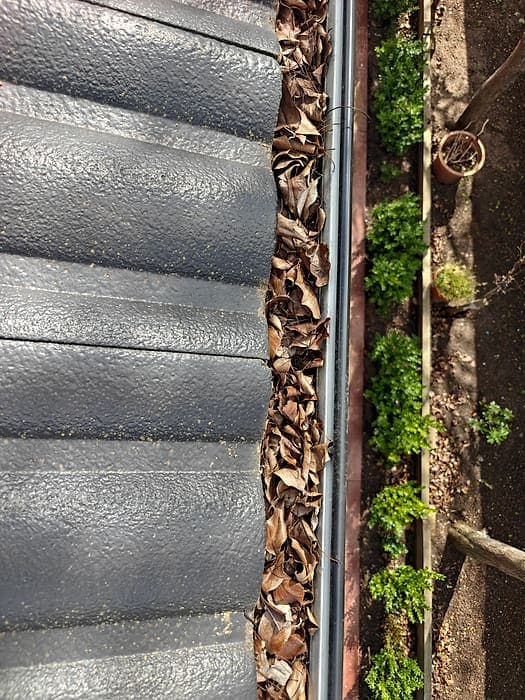
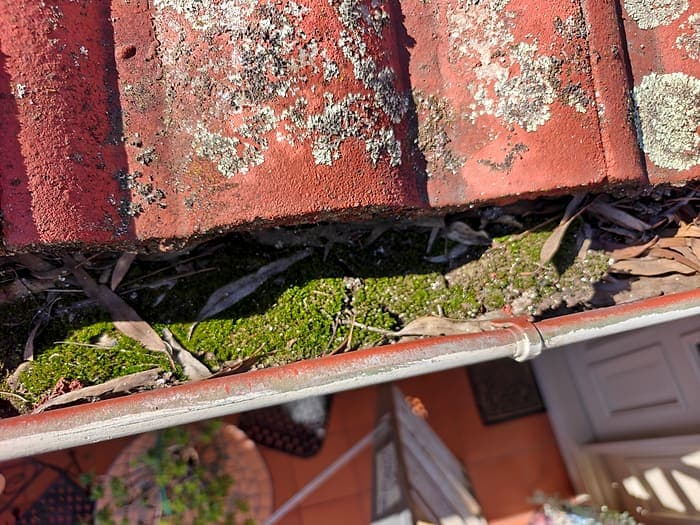
- Plants or grass in the gutter. Seedlings need soil, and soil in a gutter means months of rotted leaves.
- Stains and streaks. Dark lines down the fascia or the wall under the gutter mark the overflow points.
- A dry downpipe in rain. If the gutter is full and the downpipe is quiet, the blockage is at the outlet or inside the pipe.
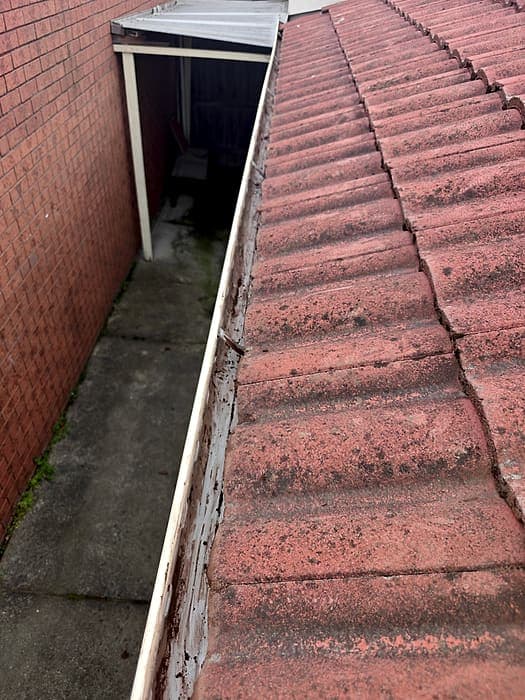
- Sagging runs. A gutter that dips between brackets holds water and sludge, and the extra weight makes it worse.
- Birds and pests. Birds picking in the gutter or nesting at the roof edge usually means there is plenty of debris to work with.
- Damp inside. Damp patches high on an inside wall or in a ceiling corner can trace back to an overflowing gutter or a box gutter leak.
On a dry day, look at each downpipe where it meets the drain at ground level. A pipe that is cracked, disconnected or full of leaves at the bottom is easy to fix before the next storm, and you do not need a ladder to find it.
If you see staining or damp inside, treat it as more than a cleaning job. The cause may be a blocked box gutter, a rusted joint or a lifted flashing, and it is worth having the roof line inspected while the gutters are being cleared.
What does a thorough gutter clean involve?
A thorough clean removes everything from the gutters and downpipe outlets, proves the water flows, and records the condition of the roof line while someone is up there. Blowing the top layer of leaves off a roof is not the same job. The sequence below is the professional standard; the how-to guide explains how to do each step yourself on a suitable single-storey roof.
- Assess before climbing. Roof height, pitch, roof material, power lines, ground surface and weather all decide how the job is done.
- Protect the area below. Paths, beds and windows are covered or cleared so falling debris does not land on them.
- Clear by hand. Leaves, seed pods, bark and sludge are scooped out and bagged, working away from each downpipe so nothing is pushed into the outlet.
- Clear the outlets and downpipes. The outlet is emptied by hand, then the pipe is cleared and tested with water until it runs freely.
- Check the fall. Water left standing after the test shows a low spot where a bracket has dropped.
- Inspect. Rust, holes, loose brackets, leaking joints, gaps at the fascia and lifted roof edges are noted, ideally with photos.
- Clean up. Everything that fell is collected and taken away as green waste, never washed into the street.
A side view of a roof edge. Rain runs down the roof sheets or tiles into the gutter, which slopes gently towards the downpipe outlet. The water drops through the outlet, down the downpipe and into the stormwater connection at ground level. A second panel shows the same gutter blocked with leaves near the outlet: water backs up, spills over the front edge and runs down the wall to the footings.
What Action Garden includes
Our gutter cleaning service covers gutters and downpipes cleared, debris bagged and removed, downpipes flushed, a visual roof and gutter check, a photo report and a clean-up below. Gutter guard installation and pressure washing of eaves are available as add-ons. Repairs are a job for a licensed plumber. If paths and walls below are stained from years of overflow, our high-pressure cleaning service can follow the gutter job.
Where the debris goes
Gutter debris belongs in green waste or compost, not in the drain. EPA Victoria (opens in a new tab) reminds households that stormwater travels through gutters and drains straight to waterways, and that sweeping waste into a bin beats hosing it away. Leaf sludge is rich in nutrients, which is exactly why it should not reach the creeks and the bay.
Which parts of the roof line need extra care?
Box gutters, valleys, two-storey runs and downpipe connections need the most care, because a blockage there either hides from view or sends water inside. Standard eaves gutters on a single-storey house are the easy case. Everything else deserves a closer look at each clean.
Box gutters
A box gutter sits within the roof, often between two roof sections or behind a parapet wall. When its outlet blocks, water rises and can spill into the roof space or wall cavity rather than over an edge you can see. Box gutters should be cleared and their outlets and any overflow outlets checked at every clean, and after any storm that brings down a lot of leaves.
Valleys and roof junctions
A valley is the channel where two roof slopes meet. Leaves collect in valleys and act like a dam, pushing water sideways under tiles or sheets. Clearing a valley usually means working on the roof itself, which is roof work rather than ladder work and should be treated that way.
Two-storey and split-level homes
The gutters on a two-storey home are high enough that a fall from a ladder at that height is life-threatening. Access often crosses a lower roof, and downpipes from the upper roof can discharge onto the lower roof and block it too. These homes are a job for people with the right ladders, height safety equipment and experience.
Downpipes and stormwater connections
Blockages that cause overflow often sit at the outlet or in the first bend of the downpipe. Clear the outlet by hand, then test with a little water. If water backs up from the stormwater connection at ground level, the blockage is underground and may need a plumber.
Rainwater tanks
If the roof feeds a tank, the gutters are part of the water supply. Keep them clear, check the inlet screen each season and empty any first flush device so leaf sludge does not sit in the tank. Victoria's Better Health Channel (opens in a new tab) advises regularly cleaning gutters and drains so water runs freely, partly to stop mosquitoes breeding.
Is gutter guard worth it, and what does it change?
Gutter guard is worth considering where leaf fall is heavy, but it reduces the cleaning rather than ending it. A guard keeps most large leaves out. Fine debris, bark strips, seed pods and dust still collect on top of the mesh and underneath it, and the guard itself needs checking and clearing.
| Question | Gutter without guard | Gutter with mesh guard |
|---|---|---|
| What gets in | Everything that falls on the roof | Fine material, dust and small seeds |
| What builds up on top | Nothing; it all falls in | Leaves and bark strips that lie on the mesh |
| How often it needs attention | Matches the leaf fall, often 2 to 4 times a year | Usually less often, but rarely never |
| How hard each clean is | Scoop out and flush | Clear the mesh, lift sections to check below, flush |
| Inspection | Easy to see the gutter condition | Harder to see rust or sagging under the mesh |
Where guard helps most
Guard tends to earn its place on homes with heavy, broad leaf fall from a few big trees, on roofs that are hard to reach, and where the owner simply wants fewer cleans. Under eucalypts, results vary because long, narrow gum leaves and ribbons of bark can lie flat on the mesh and slide along it. We cover that case in the gum tree post.
Questions to ask before fitting guard
- What mesh material and gap size is it, and is it suitable for a bushfire prone area?
- How is it fixed to the roof, and can sections be lifted for cleaning?
- Does it suit the roof type (tiles or metal sheets) without lifting tiles?
- Who will check and clear it, and how often?
Action Garden offers gutter guard installation as an add-on to a gutter clean. We do not recommend a particular brand; the right choice depends on the roof, the trees and the bushfire setting.
How do gutters fit into bushfire preparation?
In bushfire preparation, clear gutters are one of a small set of jobs that stop embers finding fuel on and around the house. The CFA's advice for preparing for bushfire season puts it alongside cutting back branches that overhang the house, keeping grass short and moving woodpiles away. Embers landing on or near the house are the most common way houses catch fire, according to the CFA, and a gutter full of dry leaves is an easy place for them to land.
The CFA preparation list, in short
| CFA advice | What it means for the roof line |
|---|---|
| Clear gutters of leaves, twigs and rubbish before the season, then regularly | Late spring clean, then summer checks, especially after windy days |
| Cut back branches that overhang the house; no branches within 10 m of buildings | Fewer leaves land on the roof in the first place |
| Keep grass trimmed to between 5 cm and 10 cm during the season | Less fuel close to the walls under the gutters |
| Keep woodpiles away from the house | Move the winter woodpile before summer |
| Remove fallen leaves from where they gather around the home | Clear corners, doorways and the base of downpipes |
The CFA advises completing preparation tasks in early spring, before bushfire season starts and the Fire Danger Period is declared, and checking gutters again before bad fire days. Some of these tasks may need repeating every week, fortnight or month through summer if you live in a high fire risk area.
Gutters fill fastest under branches that overhang the roof. If branches need cutting back, the Action Garden team does tree trimming too, and the gutters can be cleared after the pruning so the job is done once.
Bushfire risk is not limited to the outer suburbs. Plenty of Melbourne homes back onto creek reserves, parkland or bush corridors, and the CFA's advice on clearing leaf litter applies wherever embers could reach.
Who looks after gutters in rentals, strata and commercial properties?
In a Victorian rental, gutter cleaning usually sits with the rental provider, not the renter. Rental Dispute Resolution Victoria (opens in a new tab) states that renters are not responsible for gutter maintenance but should tell the rental provider about blockages, overflow, water stains or sagging. The rental provider is responsible for clearing leaves and debris and repairing or replacing damaged gutters and downpipes, and gutter disputes often rise in autumn.
Renters and rental providers
| Who | Gutter job |
|---|---|
| Renter | Report blockages, overflowing water, stains on walls, sagging or rusty gutters |
| Rental provider | Clear leaves and debris, repair leaks and rust, fix or replace broken gutters and downpipes |
The lease and the specific facts can change things, so treat this as a summary and check the official guidance from Rental Dispute Resolution Victoria and Consumer Affairs Victoria for your situation. Our property care guides cover the wider garden side of renting, sales and strata.
Owners corporations and commercial sites
For apartments and townhouses, check whether the roof and gutters are common property in your plan of subdivision, and raise blocked gutters with the owners corporation manager. Commercial and strata sites benefit most from a fixed programme, because nobody notices a blocked box gutter on a building they do not live in until water comes through a ceiling.
Keeping records for a rental or strata property
A dated photo report from each clean is useful evidence that the roof line has been maintained. It helps when a renter reports a leak, when an insurer asks about maintenance, or when a committee is planning repairs. Keep the reports with the property file and note which downpipes and box gutters were checked.
Regular gutter cleans can be set up as part of a regular maintenance plan alongside lawns, gardens and hedges, so the gutter clean happens at the right time each year without anyone having to remember it.
Should you clean gutters yourself or book a professional?
Clean them yourself only if the roof is single-storey, the ground is firm and level, there are no power lines near the work area and you are confident on a ladder with someone to help. Everything else is a job for a professional. WorkSafe Victoria (opens in a new tab)'s guidance for workplaces treats a ladder as the lowest level of fall protection and notes that anyone on a ladder is at risk of falling, even below 2 metres.
| Factor | Reasonable DIY | Book a professional |
|---|---|---|
| Height | Single-storey eaves | Two storeys, split level or high gables |
| Roof | Low pitch, sound tiles or metal | Steep, slippery, brittle tiles or possible asbestos cement |
| Access | Firm, level ground all round | Slopes, garden beds, pools or steps under the ladder line |
| Hazards | No overhead lines nearby | Power lines or the service line near the work area |
| Gutter type | Standard eaves gutters | Box gutters, valleys, gutter guard to lift |
| Condition | Light leaves, sound brackets | Heavy sludge, plants growing, sagging or rust |
Call a professional if any of these apply: the home is two storeys or more; you would need to walk on the roof; the roof is steep, wet, tiled with brittle tiles or may contain asbestos cement (homes built before 1990 may contain asbestos); power lines or the service line run near the gutter; the ground under the ladder is soft or sloping; or you are working alone. No gutter is worth a fall.
What affects the quote
Every gutter job is quoted after we understand the property. The main factors are the roof size and number of storeys, the trees nearby and how much leaf is in the gutters, whether gutter guard is fitted, and whether downpipe flushing is needed. Photos of the roof line sent with a quote request help us quote accurately.
Make it part of the year
The simplest approach is to book the gutters at the same two or more points each year, so they never reach the stage where plants grow in them. For more reading, the gutters and roof line guides and the gutters and exterior articles cover the related jobs.
If the roof is high, the trees are big or you would simply rather stay on the ground, it is worth handing the gutters to Action Garden: we clear them, test the downpipes, photograph what we find and leave the ground below tidy.
Your Garden. Our Promise.
From our jobs
Frequently asked
What does a professional gutter clean include?
Which month is best for gutter cleaning in Melbourne?
Can blocked gutters cause damp or mould inside the house?
Do blocked gutters attract mosquitoes?
Who arranges gutter cleaning in a Victorian rental?
Do box gutters need more attention than standard gutters?
Should gutters be cleaned before the Fire Danger Period?
Does a rainwater tank change how often I clean gutters?
Sources and further reading
- Climate statistics for Melbourne (Olympic Park), monthly rainfall (Bureau of Meteorology)
- Climate statistics for Melbourne Regional Office, long-term rainfall (Bureau of Meteorology)
- Preparing for bushfire season (CFA)
- Preparing for bad fire days (CFA)
- Who maintains gutters, gardens and pools in a rental (Rental Dispute Resolution Victoria)
- Using portable ladders in the workplace (WorkSafe Victoria)
- Mosquitoes, protect your home checklist (Better Health Channel)
- Stormwater (EPA Victoria)
Caring for Melbourne gardens since 2019. Updated 17 November 2026.
Related reading