


Gutters and roof line guide
Box gutters, valleys and leaf traps explained
By the Action Garden team · Updated · 14 min read
Checked against: Victorian Building Authority, now the Building and Plumbing Commission, Department of Health, Victoria, Consumer Affairs Victoria, Better Health Channel, Asbestos in Victoria
TL;DR
- A box gutter sits inside the roof line, so when its outlet blocks, water can overflow into the building instead of over an edge.
- Box gutters rely on sumps, rainheads and overflows; the overflow must stay open, because it is the safety valve when the outlet blocks.
- Valleys collect leaves where two roof slopes meet, and a dammed valley can push water under tiles or sheets.
- Leaf traps, such as rainhead diverters, downpipe strainers and tank screens, work only if someone empties them.
- Cleaning box gutters and valleys is roof work; repairs and changes to them are plumbing work for a registered or licensed plumber.
| Part | What it does | Check at each clean |
|---|---|---|
| Box gutter | Carries water inside the roof line to an outlet | Clear debris, check for ponding, rust and lifted joints |
| Sump | A deeper box at the outlet that feeds the downpipe | Clear the outlet and the overflow |
| Rainhead | An open head on the wall that takes water from the box gutter | Keep the overflow weir and open front clear |
| Valley | Channel where two roof slopes meet | Remove leaf dams; look for cracked or lifted tiles |
| Leaf diverter or strainer | Catches leaves before the downpipe or tank | Empty and rinse the screen |
What is a box gutter?
A box gutter is a graded channel that carries rainwater within the building footprint, usually beside a wall or parapet, to an outlet. That is close to the wording in the Victorian practice note on box gutters, which defines one as "a graded channel, generally of rectangular shape, for the conveyance of rainwater within the building footprint, typically adjacent to a wall or parapet".
The key words are "within the building footprint". An ordinary eaves gutter hangs on the outside edge of the roof, so when it overflows the water falls outside. A box gutter sits inside the roof line, so when it overflows the water can go into the ceiling, the roof space or the wall cavity.
Where you find box gutters in Melbourne
- Victorian and Edwardian terraces, where a box gutter runs behind the front parapet or between two roofs on a shared wall.
- Older homes with a valley between two roof sections finished as a flat-bottomed channel.
- Modern homes and extensions with skillion or low-pitch roofs that run to a parapet wall.
- Townhouses and apartment blocks, where box gutters sit between roofs or behind parapets out of sight.
- Commercial and industrial buildings with large metal roofs.
If you can see a parapet wall standing above the roof line at the front of a house, there is a good chance a box gutter sits behind it.
How does a box gutter drain, and why does the overflow matter?
A box gutter drains to a sump or a rainhead, which feeds the downpipe, and each one must have an overflow that lets water escape to the outside if the downpipe blocks. The overflow is the safety valve. Without it, a blocked outlet fills the gutter until the water finds its own way into the building.
The Victorian practice note puts it plainly: "Overflow devices are critical to a box gutter installation. Failing to install appropriately sized and positioned overflow devices can lead to serious damage to buildings and contents, often resulting in high-cost insurance claims."
| Part | Where it sits | How it overflows |
|---|---|---|
| Sump | A deeper box at the low end of the box gutter, over the downpipe | A side overflow channel or a high-capacity overflow device |
| Rainhead | An open box on the outside wall at the end of the box gutter | An overflow weir across its full width, open above at the front |
| Overflow outlet | Through the wall or parapet | Discharges to the outside, within the property |
The practice note sets out several deemed-to-satisfy rules that are useful for a homeowner to know, even though design and repair are a plumber's job:
- Minimum width. A domestic box gutter must be at least 200 mm wide (300 mm on commercial buildings).
- Straight runs. Box gutters must be straight, without a change of direction, and discharge at the downstream end.
- No V shapes. V-shaped box gutters are not permitted, because debris collects in the crevice and the gutter can pond and corrode.
- Rainhead overflow. The overflow weir must run the full width of the rainhead, sit 25 mm below the box gutter sole, and the rainhead must be fully open above the weir at the front.
- Overflow discharge. Overflows must discharge to the atmosphere, clear of neighbouring properties and public areas.
A cross-section of a terrace roof with a parapet wall at the front. Two roof slopes fall towards a flat-bottomed box gutter behind the parapet. Arrows show rainwater running along the box gutter to a rainhead fixed to the outside of the side wall. In the normal state, water drops from the rainhead into the downpipe. In the second frame, leaves block the downpipe outlet; the water level rises in the rainhead and spills over the overflow weir and out of the open front, falling outside. A third frame shows the same blockage with the rainhead front covered by mesh: water backs up along the box gutter and runs over its side into the ceiling space, marked with a warning.
Why do blocked box gutters cause leaks inside?
Blocked box gutters cause leaks inside because the water has nowhere visible to go. Leaves, seed pods, grit from tiles and moss wash along the gutter to the outlet and pack into the sump or rainhead. If the overflow is also blocked, missing or undersized, the water level rises over the side of the gutter and into the building.
Typical signs of a box gutter problem:
- A ceiling stain near a parapet wall or under the line where two roofs meet.
- Water spilling from the overflow in ordinary rain, not just in a downpour.
- Damp patches or bubbling paint high on an inside wall below a parapet.
- Water pouring over the front of a rainhead while the downpipe below is barely running.
- Ponding that stays in the gutter long after rain, often with rust staining.
- Plants growing from the gutter or the top of the parapet.
The guide to signs of blocked or overflowing gutters covers what to look for on standard eaves gutters too. If water has come inside, treat it as more than a cleaning job and have the roof line inspected.
What is a roof valley, and why does it block?
A roof valley is the channel where two sloping roof sections meet at an inside corner, lined with a valley gutter or valley iron that carries water down to the eaves gutter. Valleys collect leaves because water from two slopes funnels into them, and debris settles where the flow slows.
When leaves build up, the valley acts like a dam. Water rises and runs sideways under the tiles or roof sheets on either side, and can appear as a leak well away from the valley itself. In tiled roofs, the mortar or flexible pointing on the tiles beside the valley can also crack, letting water in.
| Valley problem | What you might notice | What it usually needs |
|---|---|---|
| Leaf dam | Water spilling over the eaves gutter at the valley foot in rain | Clearing the valley and the gutter below |
| Rusted valley iron | Rust staining, pinholes, leaks in heavy rain | Repair or replacement by a roof plumber |
| Cracked tiles beside the valley | Ceiling stain near an internal roof corner | Roof repair |
| Moss and grit | Slow flow and silt at the valley foot | Clearing, and checking the gutter below |
Why valleys are roof work, not ladder work
The top of a valley is often several metres up the roof from the gutter, so it cannot be reached from a ladder at the eaves. Clearing it means working on the roof itself, on tiles that may be brittle or metal sheets that are slippery when damp. The Better Health Channel (opens in a new tab) advises care when pulling items from gutters and roofs, because it can throw you off balance. On a valley, a loss of balance means a slide towards the edge. Treat valley clearing as a job for someone with the right roof safety gear.
What are leaf traps, and how do they work?
Leaf traps are devices that catch leaves and debris before they reach the downpipe, the stormwater drain or a rainwater tank. They do not replace gutter cleaning: they move the collection point to somewhere easier to empty, and they only work if someone empties them.
- Rainhead leaf diverters. A sloping mesh screen in a rainhead or a head fitted to the downpipe. Water falls through the mesh into the pipe, and leaves slide off the front.
- Downpipe leaf strainers. A dome or basket of mesh pushed into the gutter outlet to stop leaves entering the downpipe.
- In-line leaf eaters and filters. A mesh unit partway down the downpipe, often fitted where the pipe heads to a tank.
- Tank inlet screens. Mesh over the tank inlet and overflow to keep out leaves, mosquitoes and animals.
- First flush devices. A chamber that diverts the first, dirtiest water off the roof away from the tank.
The Victorian Department of Health's advice for rainwater tanks includes "regularly checking that the inlet and overflow screens are secure, in good condition and clean", "opening and cleaning first-flush devices after rainfall" and "keeping your roof clear of large tree branches".
The trouble with downpipe strainers
A dome strainer in a gutter outlet keeps leaves out of the downpipe, but it moves the blockage up into the gutter. Leaves pile around the dome, water backs up along the gutter and spills over the front. On a box gutter, that backed-up water is inside the roof line. Strainers suit gutters that are checked often. In a box gutter sump, they should never stop the overflow working.
Which leaf trap suits which problem?
| Problem | Leaf trap that helps | Watch out for |
|---|---|---|
| Leaves blocking the downpipe | Rainhead diverter on the downpipe | Needs emptying after leaf drop |
| Leaves reaching a rainwater tank | Diverter plus tank inlet screen and first flush device | Clean the first flush after rain |
| Mosquitoes in the tank | Fine mesh on inlet and overflow | Screens must be intact and fitted |
| Leaves filling the gutter itself | Gutter guard, not a strainer | Guard still needs checking |
Whether gutter guard is worth fitting over standard gutters is covered in our guide to whether gutter guard is worth it.
How often should box gutters, valleys and leaf traps be checked?
Check box gutters, valleys and leaf traps at every gutter clean, usually twice a year for most Melbourne homes, and after any storm that brings down a lot of leaves. Properties near large trees need more frequent checks, because box gutters and valleys hide their blockages until water comes inside.
| Situation | When to check |
|---|---|
| Most homes | Autumn after the main leaf drop, and late spring |
| Deciduous street trees or garden trees | Late autumn and early winter, when leaves finish falling |
| Gum trees nearby | More often; leaves, bark and gum nuts fall through the year |
| Rainwater tank fitted | Screens and first flush after rain, as well as each clean |
| After a big storm | Look for overflow use, stains inside and debris on the roof |
Late autumn is the busiest time for these parts of the roof. Our post on autumn leaf season covers lawns, gutters and paths together, and how often gutters need cleaning near gum trees looks at eucalypt leaf drop in detail.
Can you clean box gutters and valleys yourself?
Most homeowners should not clean box gutters or valleys themselves, because reaching them means working on the roof, often behind a parapet or high up between two roof sections. That is roof work rather than ladder work. On a two-storey home it is higher again, and our guide to gutters on two-storey homes explains the access options.
Leaf traps at ground level are different. A rainhead diverter or in-line filter you can reach from the ground, or from a short step ladder on firm ground, is a reasonable job to empty yourself.
Call a professional to clean box gutters and valleys, and whenever water has come inside, an overflow runs in ordinary rain, or the roof is steep, brittle, wet or two storeys. Homes built or renovated before 1990 may have asbestos in roof sheets, gutters, downpipes or eaves, so do not walk on, scrape or break suspect materials. Repairs or changes to box gutters, sumps, rainheads, overflows or valley irons are roof plumbing work for a registered or licensed plumber.
What does a box gutter and valley clean include?
A thorough clean clears the debris from every box gutter, sump, rainhead and valley, makes sure each overflow is open, and proves the water runs to the drain. On a standard step-by-step gutter clean, the eaves gutters are the main job. With box gutters and valleys, the hidden parts are the main job.
- Assess access to each box gutter and valley, and the roof material.
- Clear the valleys from the top down so debris does not wash into the gutter below.
- Clear the box gutters along their length to the outlet, removing silt as well as leaves.
- Clear sumps and rainheads, including the overflow weir, side overflow or high-capacity overflow.
- Empty leaf traps and rinse their screens.
- Flush the downpipes and check the water reaches the drain.
- Photograph anything that needs a plumber: rust, ponding, lifted joints, blocked or missing overflows, cracked tiles.
Strata and commercial roofs
On apartment, townhouse and commercial buildings, box gutters are common and rarely seen by the people living or working below. Whether the roof is common property depends on the plan of subdivision. Consumer Affairs Victoria (opens in a new tab)'s guidance on owners corporation maintenance plans lists cleaning gutters among routine corrective work, so a fixed programme of cleans with a photo record suits these buildings well.
When is it worth handing box gutters and valleys to Action Garden?
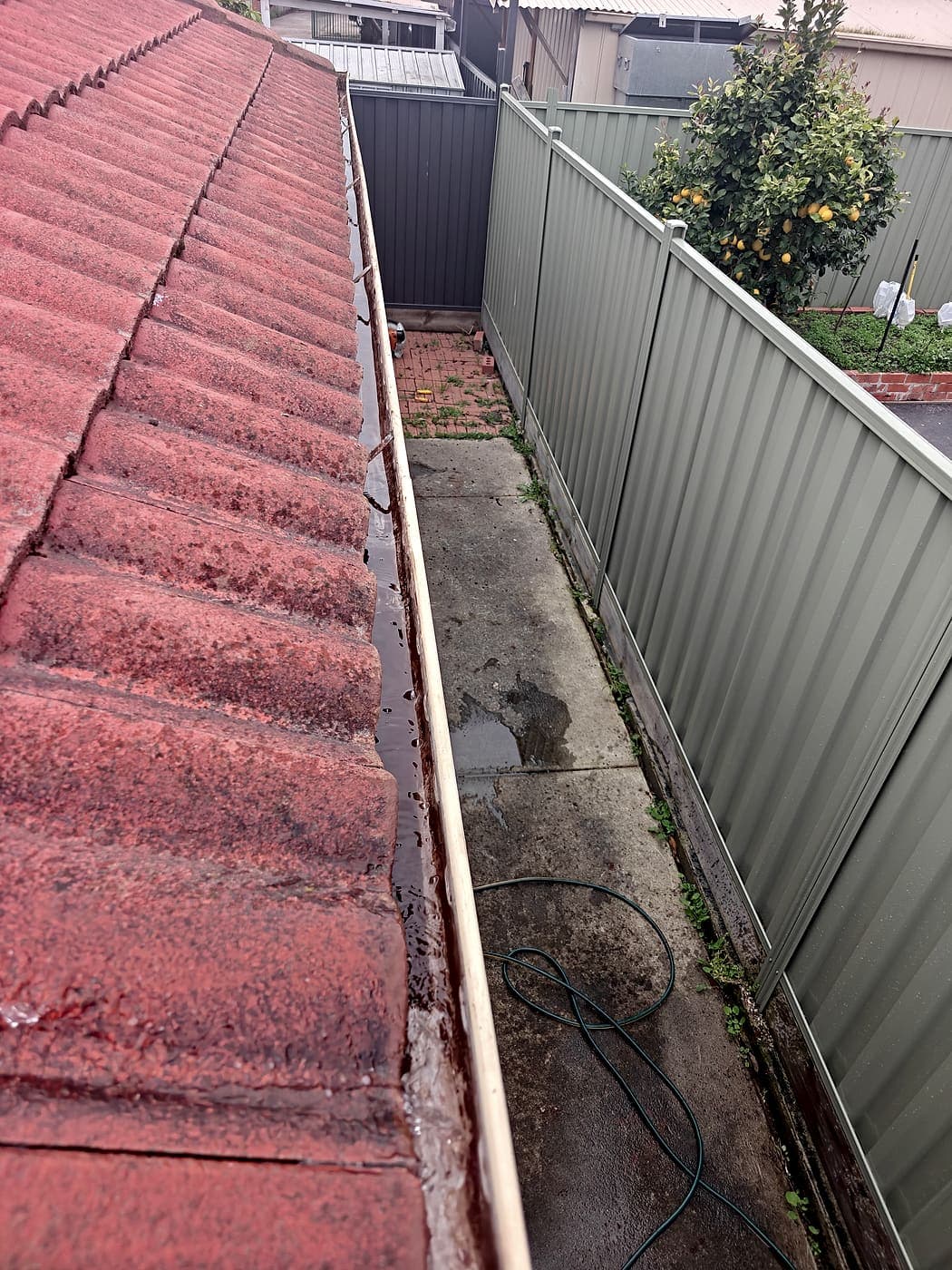
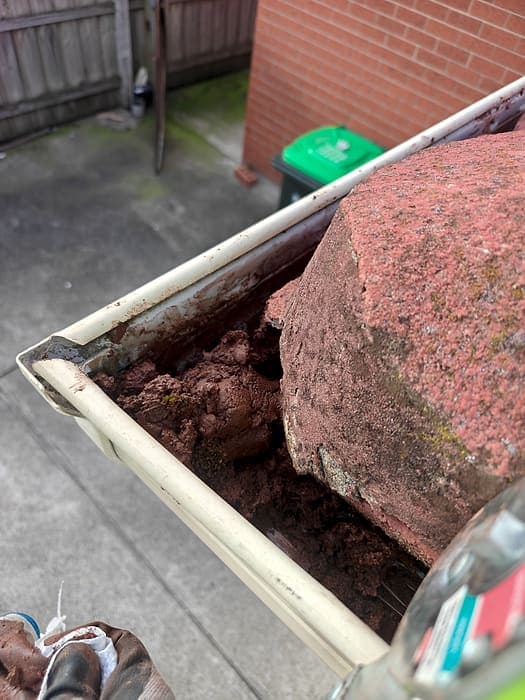
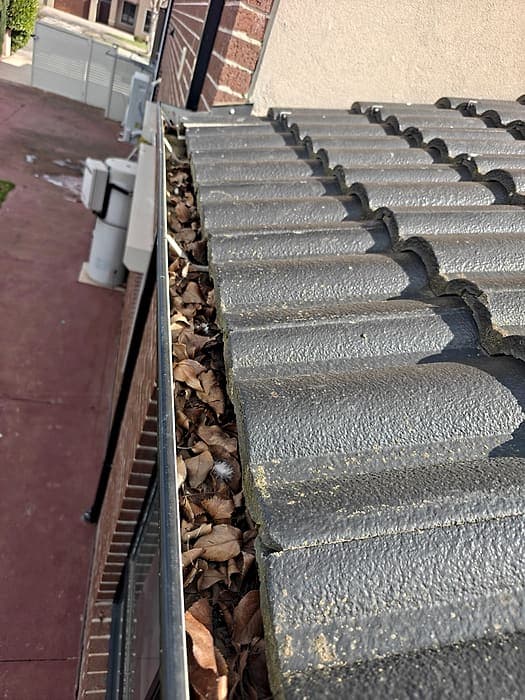
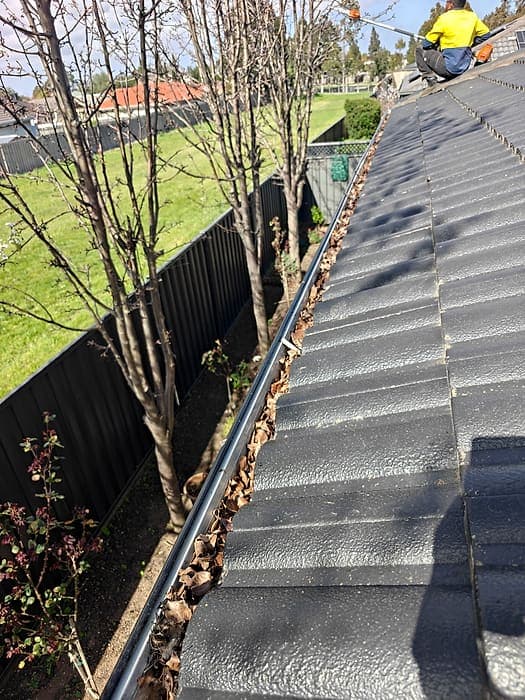
It is worth handing them over when they cannot be reached from a ladder, when water has come inside, or when you simply want someone to check the parts of the roof you cannot see. Every gutter cleaning visit includes gutters and downpipes cleared, downpipes flushed, debris bagged and removed, a visual roof and gutter check, a photo report and a clean-up below. Gutter guard installation can be added, and anything that needs a plumber is shown in the photos.
The complete guide to gutter cleaning in Melbourne covers timing and what a clean involves across the whole roof line, and the rest of our gutters and roof line guides cover downpipes, guard and repairs. When you are ready, send a few photos of the roof and request a free quote.
Your Garden. Our Promise.
From our jobs
Frequently asked
What is the difference between a box gutter and an eaves gutter?
Why is water pouring out of the overflow on my box gutter?
Can a blocked valley leak inside even when the gutters are clean?
Can I cover a rainhead with mesh to keep leaves out?
How often should a downpipe leaf diverter be emptied?
Is it normal for water to sit in a box gutter after rain?
Who pays to clean box gutters in an apartment or townhouse block?
Sources and further reading
- Plumbing practice note RP-02: Box gutters (Victorian Building Authority, now the Building and Plumbing Commission)
- Rainwater (Department of Health, Victoria)
- Owners corporation maintenance plan (Consumer Affairs Victoria)
- Ladder safety (Better Health Channel)
- Where is asbestos? (Asbestos in Victoria)
Caring for Melbourne gardens since 2019. Updated 18 November 2026.