


Gutters and roof line guide
Gutters on two-storey homes: access and options
By the Action Garden team · Updated · 15 min read
Checked against: Better Health Channel, WorkSafe Victoria, Energy Safe Victoria, Asbestos in Victoria
TL;DR
- Two-storey gutters sit roughly twice as high as single-storey ones, and a fall from that height can be fatal.
- The main access methods are long extension ladders with stand-offs, roof access with fall protection, scaffolds or lifts, and ground-based vacuum poles.
- The right method depends on ground conditions, roof pitch and material, the lower roof, power lines and what sits under the gutter.
- A lower roof, a balcony or a garden bed under the upper gutter changes the job completely; never stand a ladder on a lower roof.
- Ask any contractor how they will reach your upper gutters, and expect photos of the parts you cannot see from the ground.
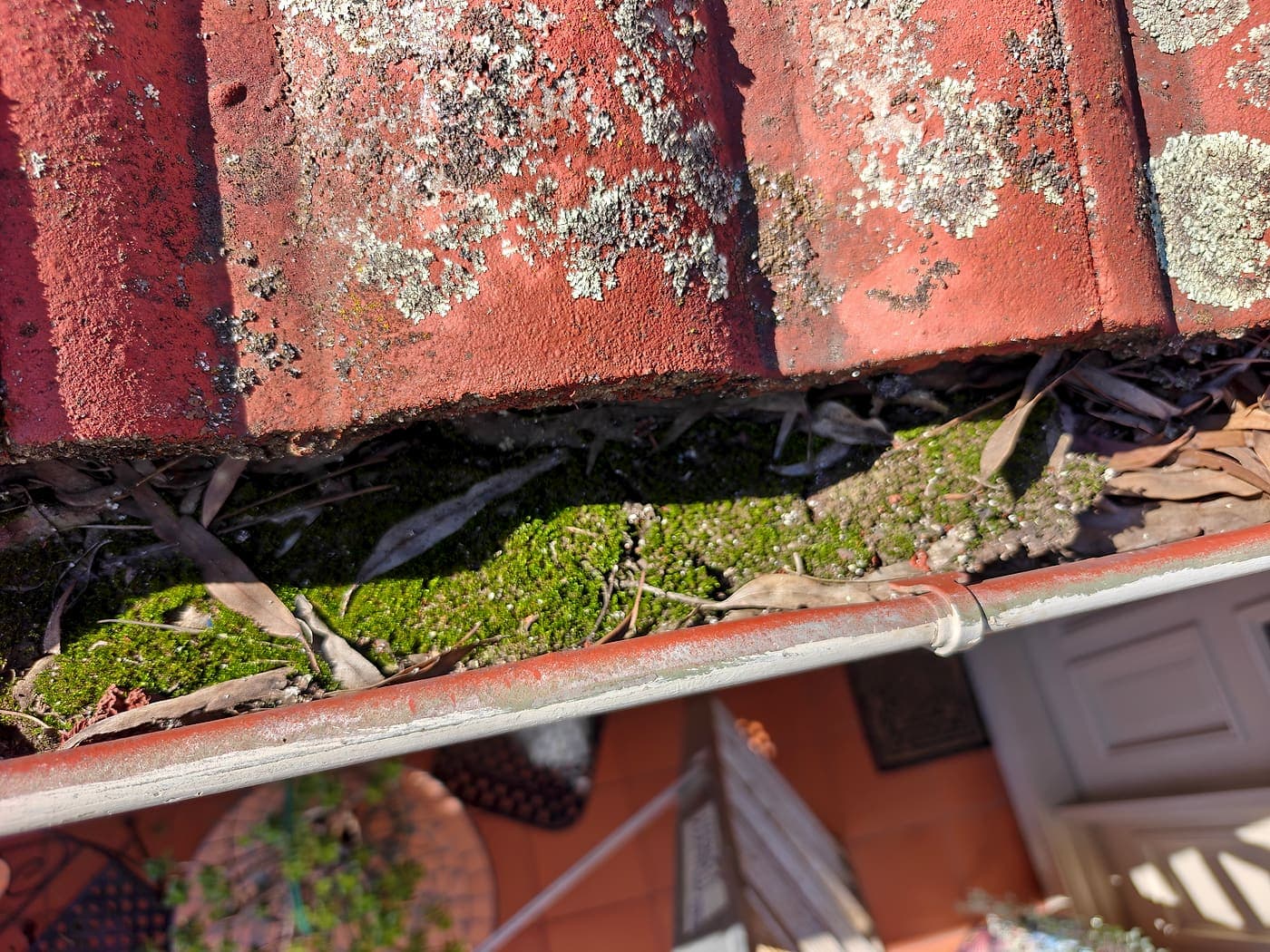
| Access method | Suits | Main limits |
|---|---|---|
| Extension ladder with stand-off | Firm, level ground; clear wall line | Needs a long ladder, a second person and no lines nearby |
| Roof access with fall protection | Low-pitch metal roofs, upper roofs reached safely | Roof work, not ladder work; not for brittle or steep roofs |
| Mobile scaffold or tower | Long straight runs, repeat work, repairs | Needs level ground and space to set up |
| Elevating work platform | Open sites with vehicle access | Trained operator; ground must carry the machine |
| Gutter vacuum with poles | Dry leaves in standard eaves gutters | Struggles with sludge; never near power lines |
Why are two-storey gutters a different job?
Two-storey gutters are a different job because the height turns a routine clean into high-risk work at height. A fall from an upper gutter line is a fall of 5 metres or more, often onto paving, a fence or a lower roof. The cleaning itself is the same: what changes is how you get there and how you stay there safely.
Height is only part of it. Two-storey homes in Melbourne also tend to have more complicated roof lines than a simple single-storey hip roof.
- A lower roof under the upper gutter, over a garage, a living area or a rear extension.
- Balconies and pergolas that sit right under the gutter you need to reach.
- Downpipes that discharge onto a lower roof through a spreader, so the upper and lower gutters work as one system.
- Narrow side setbacks on newer townhouse and infill blocks, often only a metre or so between the wall and the fence.
- Sloping blocks, where the gutter on the low side can be well above the usual two-storey height.
Ladder falls already put thousands of Australians in hospital. The Better Health Channel (opens in a new tab) reports that in 2017 to 2018, more than 5,600 Australians were admitted to hospital with injuries from falls from ladders, and that 36 people died from ladder falls in Australia in 2020, 11 of them Victorians. Our guide to when not to clean your own gutters covers those warning signs in full. This guide looks at the access options once you know the job is a two-storey one.
How high are the gutters on a two-storey home?
Most two-storey gutters sit roughly 5 to 7 metres above the ground. That figure moves with ceiling heights, the floor structure between levels, the eave design and the slope of the block. Before choosing any method, estimate the real height at the highest point you need to reach, not at the front door.
A quick way to estimate is to measure the height of the ground floor at a window or door frame, allow for the floor structure, and double it, then add the fall of the block on the low side. Upper gutters on a split-level home or a house built into a hill can be a good deal higher on one side than the other.
What ladder length does the height mean?
The ladder needed is longer than the gutter height, because it leans out at an angle and must extend above the gutter. WorkSafe Victoria (opens in a new tab)'s guidance sets straight and extension ladders on a height-to-width ratio of 4:1, and says the ladder should extend at least 1 metre above the surface it rests against. The Better Health Channel gives the same 1 metre rule for home ladders.
| Gutter height | Ladder base out from wall | Usable ladder length needed (approx.) |
|---|---|---|
| 3 metres (single storey) | 0.75 metres | 4.1 metres |
| 4.5 metres | 1.1 metres | 5.6 metres |
| 6 metres (typical two storey) | 1.5 metres | 7.2 metres |
| 7 metres (sloping block) | 1.75 metres | 8.2 metres |
These are usable lengths, worked out from the 4:1 angle plus the 1 metre above the gutter. An extension ladder loses length where its sections overlap, so the extended length printed on the ladder needs to be longer again. A ladder that long is heavy to raise and walk into place, and hard to control in any wind.
A side view of a two-storey house wall with the upper gutter marked at 6 metres. An extension ladder leans against the wall with its base 1.5 metres out, marked as the 4 to 1 ratio. The top of the ladder carries a stand-off that rests on the wall below the gutter, holding the ladder clear of the gutter itself, and the ladder extends 1 metre above the gutter line. A second, dashed ladder shows the unsafe option: its feet sitting on the sloping lower roof of a single-storey extension, with a cross over it. A note at the base shows firm, level paving and a second person footing the ladder.
What are the ways to reach two-storey gutters?
There are five main ways to reach upper gutters: a long extension ladder with a stand-off, access from the roof with fall protection, a scaffold or mobile tower, an elevating work platform, or a gutter vacuum worked from the ground with long poles. Each one suits some homes and rules itself out on others.
Long extension ladder with a stand-off
This is the most common method on a two-storey home with firm, level ground along the wall. A stand-off is a bracket at the top of the ladder that rests on the wall or roof edge instead of the gutter, so the ladder does not crush the gutter and sits clear of it.
- Good for: straight wall lines with paving or firm lawn below and no obstacles.
- Limits: the ladder is long and heavy, it has to be moved every few metres along the gutter, and it is unsafe on soft beds, slopes, decks and steps.
- Needs: a second person footing the ladder, a ladder rated for the work, and no power lines along the run.
Roof access with fall protection
On some homes the upper gutter is best reached from the roof itself, using anchor points, a harness and a restraint line so the worker cannot reach the edge, or edge protection set up along it. This is roof work, and it is planned that way.
- Good for: lower-pitch metal roofs, and box gutters and valleys that cannot be reached from a ladder.
- Limits: not suitable for brittle tiles, steep pitches, fibre cement sheets or skylights.
Scaffold or mobile tower
A scaffold or mobile tower gives a stable working platform along the gutter. It makes sense when the upper gutter is over a glass roof, a pergola or a steep bank, or when the clean is part of a bigger job such as gutter repairs, painting or fitting gutter guard.
- Limits: it needs level, firm ground and space to set up, and takes longer to put up than a ladder.
Elevating work platform
A boom lift or scissor lift raises the worker in a basket or on a platform to the gutter line. It suits open sites with vehicle access, such as commercial buildings and some larger homes.
- Limits: the machine needs a trained operator and ground firm enough to carry it, and it cannot get into most narrow side passages or rear gardens.
Gutter vacuum with poles
A gutter vacuum uses a powerful vacuum unit on the ground, a hose and a set of joined poles with a curved nozzle and a camera to clear the gutter from below.
- Good for: dry leaves in standard eaves gutters, and homes where no safe ladder position exists.
- Limits: slow on wet sludge and packed downpipe outlets, and it shows little of the gutter's condition beyond the camera view. Long poles, whether carbon fibre or aluminium, must stay well away from power lines and the service line.
What WorkSafe's falls code means for a homeowner
WorkSafe Victoria's compliance code on preventing falls in housing construction is written for employers and contractors, not householders. It splits fall risks into two groups, falls from more than 2 metres and falls from 2 metres or less, and sets out how each should be controlled. Upper gutter work on a two-storey home is well above that 2 metre line. For a homeowner, the useful point is simple: a contractor working at that height should be able to tell you how they are controlling the fall risk on your roof, not just that they own a long ladder.
Which method suits your home?
The method that suits your home depends on the ground below the gutter, the roof, what is in the way and what else needs doing. The table below shows why a contractor might choose one method at the front of your house and another at the back.
| What you have | Likely method | Why |
|---|---|---|
| Paving or firm lawn along the wall, no lines nearby | Extension ladder with stand-off | Stable footing and a clear wall line |
| Garden beds, steps or a slope under the gutter | Roof access, scaffold or vacuum | A ladder cannot be footed safely |
| Lower roof under the upper gutter | Roof access with fall protection, or scaffold | Never a ladder standing on the lower roof |
| Narrow side setback of about a metre | Roof access or vacuum | No room for the ladder angle |
| Balcony or pergola under the gutter | Scaffold, roof access or vacuum | No safe ladder footing |
| Power lines or service line near the run | Specialist advice before any method | Electrocution risk from ladders and poles |
| Clean combined with repairs or guard | Scaffold or roof access | Longer time at height, both hands busy |
What hazards are specific to two-storey roof lines?
The hazards that matter most on two-storey homes are power lines, lower roofs, older materials, wind and heat, and wildlife. All of them turn up on single-storey homes too, but height makes each one worse.
- Power lines and the service line. On two-storey homes the service line often reaches the house at or near the upper level. Energy Safe Victoria (opens in a new tab)'s guidance on working around power lines sets out no go zones for people and equipment near overhead lines. Ladders, poles and wands can all reach a line before you do.
- Lower roofs. A lower roof is not a platform. Tiles crack, metal sheets dent and get slippery with dew, and a slip runs straight to its edge.
- Older materials. Victoria's asbestos information site lists corrugated roof sheets, guttering, downpipes and eaves among the places asbestos is found in homes built or renovated before 1990. Do not walk on, scrape or break suspect materials.
- Wind and heat. A long ladder catches wind like a sail, and gusts around the upper corners of a house can be strong. Metal roofs and gutters get very hot on Melbourne summer afternoons.
- Wildlife. Birds nest in upper gutters and wasps build in eaves. Our post on birds, possums and wasps in gutters covers what to do when you find them.
Call a professional for any gutter work on a two-storey or split-level home. Also call one if the work would mean standing on or crossing a lower roof, if power lines or the service line run near the gutters, if the roof may contain asbestos, or if the only ladder position is on soft ground, a slope, a deck or a balcony. If a downpipe from the upper roof is overflowing onto a lower roof, have both roofs checked together.
What does a two-storey gutter clean involve?
A thorough two-storey clean covers the upper gutters, the downpipes and spreaders that drain them, and the lower gutters and roofs they discharge into, then proves the water runs. Clearing the upper gutter alone often just moves the problem down a level.
- Assess from the ground. Height, ground, lower roofs, power lines, the roof material and the weather decide the access method.
- Protect below. Paths, beds, windows and outdoor furniture are cleared or covered.
- Clear the upper gutters by hand or vacuum, working away from each outlet so debris is not pushed into the downpipe.
- Check the spreaders and lower roof. Upper downpipes that discharge onto a lower roof can leave a line of grit and leaves that blocks the lower gutter.
- Clear the lower gutters, and any box gutters and valleys.
- Flush every downpipe and watch the water reach the drain at ground level.
- Record the condition with photos of anything you cannot see from below: rust, sagging, joints, brackets and roof damage.
- Clean up the debris below and take it away.
If you are not sure your gutters need doing yet, the guide to the signs of blocked or overflowing gutters explains what to look for from the ground. On a single-storey part of the house, the steps in how to clean gutters safely apply.
Rainwater tanks fed by the upper roof
Many two-storey homes collect water from the upper roof into a tank, because it is often the larger catchment. That makes the upper gutters the ones that matter most for tank water quality. Leaves and sludge in those gutters wash towards the tank inlet and first flush device at the next rain. Our post on rainwater tanks and gutters covers screens, first flush devices and timing the clean around the tank.
How often do two-storey gutters need cleaning?
Two-storey gutters need cleaning as often as any other gutters on the same street, usually twice a year for most Melbourne homes and more often near large trees. Being higher does not keep leaves out. Upper gutters sit closer to the canopy of tall trees, so on leafy streets they can fill as fast as the lower ones or faster.
| Situation | Typical timing |
|---|---|
| Most homes, no large trees nearby | Autumn and late spring |
| Deciduous trees on or near the block | After the main leaf drop in late autumn, plus late spring |
| Gum trees nearby | More often; check after windy days |
| Bushfire-prone areas | Before the Fire Danger Period and through the season |
| After a big storm | A visual check from the ground, and a clean if water overflowed |
The complete guide to gutter cleaning in Melbourne covers timing in more detail, including leaf drop, gum trees and fire season.
What should you ask before booking two-storey gutter cleaning?
Ask how the contractor will reach each part of your roof line, and what you will get at the end. A good answer is specific to your home rather than a general promise.
- Access method. How will they reach the upper gutters at the front, the back and the sides? What happens over the lower roof?
- Equipment. Ladders long enough for the height, stand-offs, and height safety equipment where roof access is needed.
- Power lines. How do they deal with the service line and any nearby lines?
- Insurance. Ask whether they are insured.
- Scope. Does the clean include the lower gutters, the spreaders and every downpipe, or just the upper run?
- Evidence. Will you receive photos of the gutters and roof you cannot see from the ground?
- Box gutters and valleys. If your roof has them, ask whether they are included. Our guide to box gutters, valleys and leaf traps explains why they need extra care.
What affects a two-storey gutter quote
The things that change a two-storey gutter quote from a specialist are the number of storeys and the length of the roof line, how much of it can be reached from a ladder and how much needs roof access or other gear, the leaf load from nearby trees, whether gutter guard has to be lifted and refitted, and extras such as downpipe flushing or washing the eaves. Photos of each side of the house help make the quote accurate.
Does Action Garden clean two-storey gutters?
No. Action Garden cleans single-storey gutters only. Two-storey jobs, and any roof that is not safe to work on, are passed on to a specialist gutter cleaning company. It is worth handing two-storey gutters to a specialist whenever the height, the lower roof or the ground makes a ladder job risky, which on most two-storey homes is all of the time.
Every gutter cleaning visit includes gutters and downpipes cleared, downpipes flushed, debris bagged and removed, a visual roof and gutter check, a photo report and a clean-up below. Gutter guard installation and washing the eaves can be added to the same visit. The rest of our gutters and roof line guides cover guard, downpipes and repairs.
If you would rather nobody in the household climbs to the upper gutters, send us a few photos of each side of the house and request a free quote.
Your Garden. Our Promise.
From our jobs
Frequently asked
How high are the gutters on a typical two-storey house?
Can I reach my upper gutters from the lower roof?
What length of ladder do I need for a two-storey gutter?
Do gutter vacuum systems work on two-storey homes?
Do I need scaffolding just to clean gutters?
Why are my upper downpipes overflowing onto the lower roof?
Sources and further reading
- Ladder safety (Better Health Channel)
- Using portable ladders in the workplace (WorkSafe Victoria)
- Compliance code: Prevention of falls in housing construction (WorkSafe Victoria)
- No Go Zones, working around powerlines (Energy Safe Victoria)
- Where is asbestos? (Asbestos in Victoria)
Caring for Melbourne gardens since 2019. Updated 18 November 2026.