


Seasonal
After a Melbourne storm: a garden clean-up order of jobs
By the Action Garden team · Updated · 13 min read
Checked against: Victoria State Emergency Service, Energy Safe Victoria, Consumer Affairs Victoria, Asbestos Victoria, Victorian Government, EPA Victoria
TL;DR
- Safety comes first: treat every fallen powerline as live, stay 8 to 10 metres away and call your distributor, or 000 if life is in danger.
- Photograph everything before you move it, and talk to your insurer before major repairs.
- Get water moving next, by clearing gutters, downpipes and stormwater pits, because the next band of rain may be close behind.
- Small branches and debris are a garden job; trees on the house, large limbs and anything near wires are not.
- Sort the debris as you go into green waste, general rubbish and anything that might contain asbestos, which should not be touched.
What should you do first after a storm hits the garden?
Check that everyone is safe, then look for hazards before you touch anything. The three that hurt people after Melbourne storms are fallen powerlines, branches still hanging in trees, and damaged structures such as sheds, carports and fences that may still move.
Walk the property slowly in daylight, looking up as well as down. Keep children and pets inside until you have done it.
Call 000 if anyone's life is in danger. Call VICSES (opens in a new tab) on 132 500 if a tree has damaged your home or car, if the roof is damaged, or if a fallen tree blocks your way in or out. Treat every fallen powerline as live, stay more than 8 to 10 metres away and report it to your electricity distributor. Large limbs, trees under tension, anything touching wires and work at height belong with tree specialists or tradespeople, not a home clean-up.
Energy Safe Victoria (opens in a new tab)'s advice is to keep away from fallen lines and from anything they may be touching, such as a metal fence, a car or a pool of water. Its distributor contacts for Melbourne are CitiPower 13 12 80, Powercor 13 24 12, AusNet Services 13 17 99, Jemena 13 16 26 and United Energy 13 20 99.
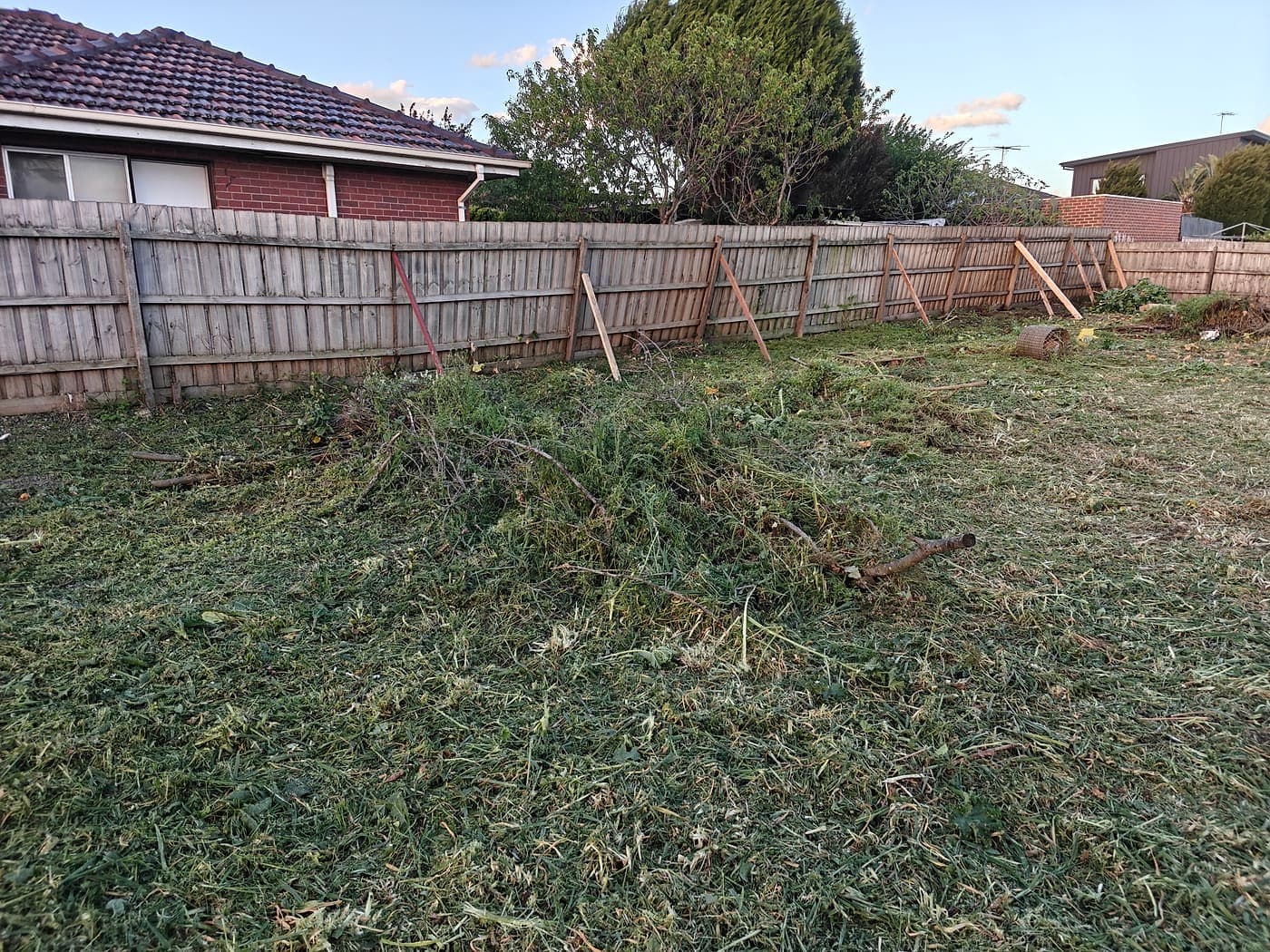
A vertical ladder of seven steps beside a house and garden after a storm, each step lighting up in turn. Step 1, a warning icon over a fallen powerline and a hanging branch. Step 2, a phone camera photographing a damaged fence. Step 3, water flowing again from a cleared gutter down a downpipe into a pit. Step 4, a path and driveway swept clear. Step 5, small branches cut and stacked, with a large limb flagged for a tree specialist. Step 6, a torn shrub branch cut cleanly and a leaning shrub staked. Step 7, three neat piles labelled green waste, general rubbish and do not touch.
Why should you photograph the damage before cleaning up?
Because once debris is moved, the evidence for an insurance claim is gone. Consumer Affairs Victoria (opens in a new tab) advises taking photos before cleaning up and making a list of everything that was damaged, and contacting your insurer to lodge a claim before you start any major repairs.
A quick record takes ten minutes:
- wide shots of each side of the house and garden, then close-ups of each item;
- fallen branches where they landed, showing what they hit;
- damaged fences, sheds, pergolas, gutters and outdoor furniture;
- water marks on walls, fences and garden beds after flooding;
- the date and time, which most phone cameras record automatically.
Clearing a path or removing a hazard straight away is reasonable, but photograph it first. If a branch must be moved for safety, take the photo, move it, and keep the pieces until your insurer says otherwise.
Why clear gutters, downpipes and drains next?
Because the next band of rain is often close behind the first, and water that cannot get away does more damage than wind. Storms strip leaves, twigs and bark into gutters, downpipes and yard pits in minutes, and a blocked system overflows into eaves, walls and garden beds.
From the ground, look for:
- water still spilling from the front of the gutter after the rain has stopped;
- a gutter pulled away from the fascia or sagging between brackets;
- leaves and twigs heaped around downpipe outlets and grated pits;
- pooling against walls, in sub-floor vents or at the garage door.
Lift the grates on yard and driveway pits and scoop out the leaves and silt. Sweep debris off paths and driveways into a bin rather than hosing it into the street drain, which EPA Victoria (opens in a new tab) notes carries stormwater straight to waterways.
How do you clear paths and access safely?
Clear a safe route from each door to the street first, then the driveway, then the rest. That gives you, visitors and any tradespeople a way in and out.
- Move small debris by hand or rake. Twigs, leaves and bark come off paths easily once they dry a little.
- Leave anything heavy or tangled. A branch caught in a fence or across another branch may be under tension and can spring when cut.
- Sweep, do not hose. Wet storm debris is slippery; a stiff broom clears it and keeps silt out of the drains.
- Mark hazards. Put a chair or cone beside broken paving, holes or protruding wire until they are fixed.
Branches under tension
A branch pinned under another branch, bent against the ground or caught in a fence stores energy like a spring. When it is cut, it can whip up or sideways with enough force to injure. This is the main reason storm clean-ups that look simple go wrong. If you cannot tell which way a branch will move when cut, leave it for someone trained to read it. Our guide on what to do after a storm damages a tree covers the tree side in detail.
Which fallen branches can you deal with yourself?
Small ones. Branches you can lift with one hand and cut with loppers or a pruning saw from the ground are a normal garden job. Anything bigger, anything still attached and hanging, anything on a roof and anything near wires is not.
| Debris | Usually a garden clean-up? | Who to call if not |
|---|---|---|
| Leaves, twigs and bark | Yes | n/a |
| Branches under a wrist-thick, on the ground | Yes | n/a |
| Large limbs on the ground, not under tension | Sometimes, with the right tools | A tree specialist or removal service |
| Hanging or partly attached branches | No | A tree specialist |
| A tree on the house, car or blocking access | No | VICSES on 132 500, then your insurer |
| Anything touching or near a powerline | No | Your electricity distributor, or 000 |
| A street tree on the nature strip or road | No | Your council |
Cut small branches into lengths that fit your green bin or tie them in bundles for a council branch collection. Stack them away from paths, fences and the house until they go.
Quick decision guide
Can I clear this myself?
- Is anything touching or near a powerline? Stop. Stay 8 to 10 metres away and call your distributor, or 000 if life is in danger.
- Has a tree or large limb damaged the house or blocked your exit? Call VICSES on 132 500, then your insurer.
- Is the branch still hanging, partly attached or under tension? Leave it for a tree specialist.
- Is it a street tree or on the nature strip? Report it to your council.
- Could broken sheeting be asbestos? Do not touch it; get advice from a licensed asbestos removalist.
- Is it small, on the ground and cut from the ground with hand tools? It is a normal garden clean-up job.
How do you treat storm-damaged plants?
Give them a few days, then make clean cuts. The first job is not to make things worse: torn branches heal poorly, but cutting in a hurry on the day often removes more than needed.
- Torn and split branches. Cut back cleanly to a healthy bud, side branch or the collar where the branch meets a larger one. Leave no stubs.
- Leaning shrubs. Ease them upright while the soil is still moist, firm the soil and stake loosely on the windward side. Remove the stake within a year.
- Shredded leaves from hail. Leave them for a week; they still feed the plant. Then remove the worst and let new growth take over.
- Broken hedges. Trim out snapped sections and let the hedge fill the gap over the season. A full reshape can wait until the usual trimming time.
- Flattened perennials and vegetables. Lift what will stand, stake what is worth saving and pull what is beyond help.
Hold off on fertiliser until new growth appears, and water only if the soil is dry below the surface. Waterlogged roots need air more than food.
What about the lawn and garden beds after heavy rain?
Stay off them until they firm up. Saturated clay compacts easily under feet and wheelbarrows, and the damage lasts far longer than the puddles.
Once the surface is firm, rake silt and debris off the lawn so the grass gets light, and lift any leaves or branches that would smother it. Where flood water washed mulch away, rake it back before the soil crusts. Lay planks over soft ground if you need to cross it with a barrow.
Silt and wash-outs in garden beds
Water running across a garden often strips mulch from one end of a bed and dumps silt at the other. A thin layer of silt can simply be forked in. A thick, smooth crust should be broken up once it dries, because it sheds water and stops air reaching roots. If the same bed washes out every big storm, the water path needs fixing, for example with a swale, a raised edge or better connection to a pit.
What happens to fences and structures?
Photograph them, then make them safe without repairing them yet. A leaning fence panel can be propped or tied back, and a loose sheet of roofing on a shed weighed down, until the insurer and a tradesperson have looked at it.
For dividing fences between neighbours, the Victorian Government (opens in a new tab)'s fencing page explains who is responsible and how costs are shared, and it is the place to start before agreeing on repairs. Talk to your neighbour early, because both properties may need to claim.
Older sheds, fences and garage walls may contain asbestos cement sheeting. Asbestos Victoria (opens in a new tab) says a home built or renovated before 1990 is likely to contain asbestos, and lists fences and external wall cladding among the places it is found. Do not break, sweep or bin pieces that might contain it; keep people away and get advice.
Where does all the storm debris go?
Sort it as you clear, into three piles: green waste, general rubbish and anything to leave alone. Sorting early makes every disposal option faster.
- Green waste: leaves, twigs and small branches go in the green or FOGO bin, and larger branches into council branch or hard waste collections where offered. Our guide to green waste disposal options in Melbourne compares the routes.
- General rubbish: broken furniture, smashed pots and damaged outdoor items go to hard waste or a transfer station. If the council collection is weeks away, our guide to council hard rubbish or private removal sets out the trade-offs.
- Leave alone: possible asbestos, chemicals from a damaged shed and anything near wires.
Do not leave storm piles on the nature strip unless the council has asked for it, and never put them in the street gutter. Our complete guide to garden rubbish removal in Melbourne covers volumes, access and what removal services take.
What is the full storm clean-up checklist?
Print it or keep it on your phone for the next storm season:
- Check for injuries; call 000 if life is in danger.
- Look for fallen powerlines and hanging branches; keep 8 to 10 metres from lines.
- Call VICSES on 132 500 for trees on the house or a blocked exit.
- Photograph all damage before moving anything.
- Call your insurer before major repairs.
- Check gutters, downpipes and pits from the ground; clear before the next rain.
- Clear a safe route from doors to the street.
- Cut and stack small branches; flag large or hanging ones for a specialist.
- Make fences and sheds safe without repairing them; do not touch possible asbestos.
- Wait a few days, then prune torn plants and stake leaning shrubs.
- Keep off waterlogged lawns and beds until firm.
- Sort debris into green waste, rubbish and leave-alone piles, and book disposal.
Storms in Melbourne often arrive on the cool change after a hot north wind, and spring is the windiest season. Our article on Melbourne's climate and your garden shows when to expect them, and autumn leaf season covers keeping gutters clear before the winter rain. More seasonal articles are in the seasonal section of the blog.
When is it worth handing the clean-up over?
If the pile is bigger than your bins, or the job needs a trailer, a chipper or more hands than you have, it is worth handing over. Our rubbish removal service clears storm debris, green waste and broken garden items and disposes of it responsibly, and you can get a free quote with a few photos of the damage.
Your Garden. Our Promise.
From our jobs
Frequently asked
Should I tidy torn shrub branches on the day of the storm?
Can I walk on a waterlogged lawn after a big storm?
How do I stand a shrub back up after the wind has pushed it over?
What should I do about hail damage on garden plants?
A storm broke an old fibro shed or fence. Can I clean it up?
Do councils run extra green waste collections after storms?
How soon should gutters be checked after a storm?
Sources and further reading
- When to call VICSES (Victoria State Emergency Service)
- Electrical emergencies (Energy Safe Victoria)
- Insurance, banking and financial hardship in a disaster (Consumer Affairs Victoria)
- Where is asbestos? (Asbestos Victoria)
- Fencing in Victoria (Victorian Government)
- Reduce stormwater pollution (EPA Victoria)
Caring for Melbourne gardens since 2019. Updated 18 November 2026.