


Gutters and roof line guide
Blocked or overflowing gutters: the signs and the causes
By the Action Garden team · Updated · 14 min read
Checked against: Bureau of Meteorology, Better Health Channel, EPA Victoria, Building and Plumbing Commission, Rental Dispute Resolution Victoria, WorkSafe Victoria
TL;DR
- Watch the roof line during steady rain; overflow in moderate rain means a blockage, not just a heavy downpour.
- Where the water escapes tells you where the problem is, from a full gutter run to a blocked outlet or a buried stormwater pipe.
- Plants, stains, sagging, standing water and birds picking at the roof edge are the dry-weather signs.
- Leaves are only part of the story; roof grit, moss, seed pods, nests and lost balls block outlets too.
- Some overflow is a gutter fault rather than a blockage, and repairs to gutters and downpipes are work for a registered or licensed plumber.
| Sign | Likely cause | Where to look |
|---|---|---|
| Water over the front edge along the run | Gutter full of leaves or sludge | The whole gutter between downpipes |
| Overflow at one spot only | Low point, sag or local build-up | Brackets and the fall near that spot |
| Full gutter, quiet downpipe | Blocked outlet or downpipe | The outlet hole and the first bend |
| Water bubbling up at ground level | Blocked stormwater pipe | The underground drain, not the gutter |
| Drips behind the gutter onto the fascia | Water backing up past the gutter | Gutter level, outlets and roof edge |
What are the signs your gutters are blocked?
The clearest sign is water going over the gutter edge in ordinary rain instead of down the downpipe. A gutter that copes with a summer downpour but spills in steady, moderate rain is blocked somewhere. Most of the other signs are visible from the ground, so you rarely need a ladder to know there is a problem.
The signs fall into three groups: what you see while it rains, what you see on a dry day, and what shows up inside the house. A quick walk around the property in each situation tells you most of what you need to know.
- During rain: water over the front lip, water dripping behind the gutter, joints leaking, a downpipe that stays quiet while the gutter fills.
- On a dry day: plants growing along the roof edge, dark streaks down the fascia, sagging runs, rust spots, stains on paths and walls below.
- Inside: damp patches near the ceiling line, peeling paint at the top of a wall, mould in a cornice on the shady side of the house.
This guide is about reading those signs and finding the cause. If you already know the gutters need a full clean, our complete guide to gutter cleaning in Melbourne covers timing, schedules and what a thorough clean includes.
What do blocked gutters look like during rain?
During rain, a blocked gutter shows itself by where the water escapes. Water should run along the gutter and drop down each downpipe without spilling anywhere else. Every other path the water takes is a clue.
Melbourne gives you plenty of chances to look. On Bureau of Meteorology (opens in a new tab) figures for Melbourne (Olympic Park), July and August each average about 9 days with 1 mm or more of rain, and October averages 9.1 days with the highest monthly mean total, 68.0 mm. Pick a day of steady rain rather than a storm, because almost any gutter can be overwhelmed by a cloudburst.
Five rain patterns and what they mean
- A sheet of water over the front edge along a whole run. The gutter between two downpipes is full of leaves or sludge, or the outlet at the end of the run is blocked.
- Overflow at one spot only. A local dam of leaves, a nest, or a low point where a bracket has dropped and the gutter has lost its fall.
- Water dripping behind the gutter. The gutter is full enough to spill over its back edge onto the fascia board, or the roof edge does not reach far enough over the gutter.
- Drips from joints and corners. Usually a failed joint or a rust hole. A blockage makes it worse, because the water sits against the joint for longer.
- A full gutter above a quiet downpipe. The blockage is in the outlet or the downpipe itself, usually at the first bend.
Take a short video of each overflow point during rain, with the downpipe in the same shot if you can. It records exactly where the water escapes, which saves time for whoever clears the gutters and helps separate a blockage from a fault.
What signs show up between storms?
On a dry day, the signs are the marks overflow leaves behind and the debris you can see from the ground. Walk around the house once a season, and look up from a few metres back so you can see the gutter line rather than just the underside.
| Dry-weather sign | What it usually means |
|---|---|
| Grass, weeds or seedlings along the roof edge | Months of rotted leaves have turned to soil in the gutter |
| Dark streaks or tide marks down the fascia | Repeated overflow at the same points |
| A gutter that dips between brackets | Weight of wet sludge, or a bracket that has failed |
| Rust spots or flaking on the gutter face | Wet debris sitting against the metal for long periods |
| A worn or washed-out patch in the garden bed below | Water falling from the gutter edge instead of the downpipe |
| Splash marks or mould on the wall above a path | Overflow hitting a hard surface and bouncing back |
| Birds picking at the gutter or nesting at the roof edge | Plenty of debris and insects to work with |
| Mosquitoes around the eaves | Water standing in the gutter for days |
Standing water matters for more than the gutter. Victoria's Better Health Channel (opens in a new tab) advises regularly cleaning gutters and drains so water runs freely, as part of protecting the home from mosquitoes.
What signs of blocked gutters show up inside the house?
Inside, the signs are damp, stains and mould near the roof line, usually directly inside an overflow point. They show up slowly, so by the time they appear the gutter has often been overflowing for a while.
- Damp patches or brown rings on the ceiling near an outside wall, especially after a wet week.
- Peeling or bubbling paint at the top of an inside wall.
- Mould in a cornice or corner on the cold, shady side of the house.
- Stained or sagging eaves lining outside, directly under the gutter.
- A musty smell in a room that sits under a box gutter or a valley.
Water inside the house can come from several places: a blocked box gutter, a lifted flashing, a cracked tile or a leaking roof penetration. A blocked gutter is a common cause, but it is not the only one, so treat inside damp as a reason to have the whole roof line checked.
Why box gutters show up inside first
A box gutter sits within the roof, behind a parapet or between two roof sections. When its outlet blocks, the water has nowhere to spill except into the roof space or the wall cavity, so the first sign is often a ceiling stain rather than visible overflow. If your home has box gutters, check the ceilings below them after every heavy rain and have the outlets cleared at every gutter clean.
What causes gutters to block?
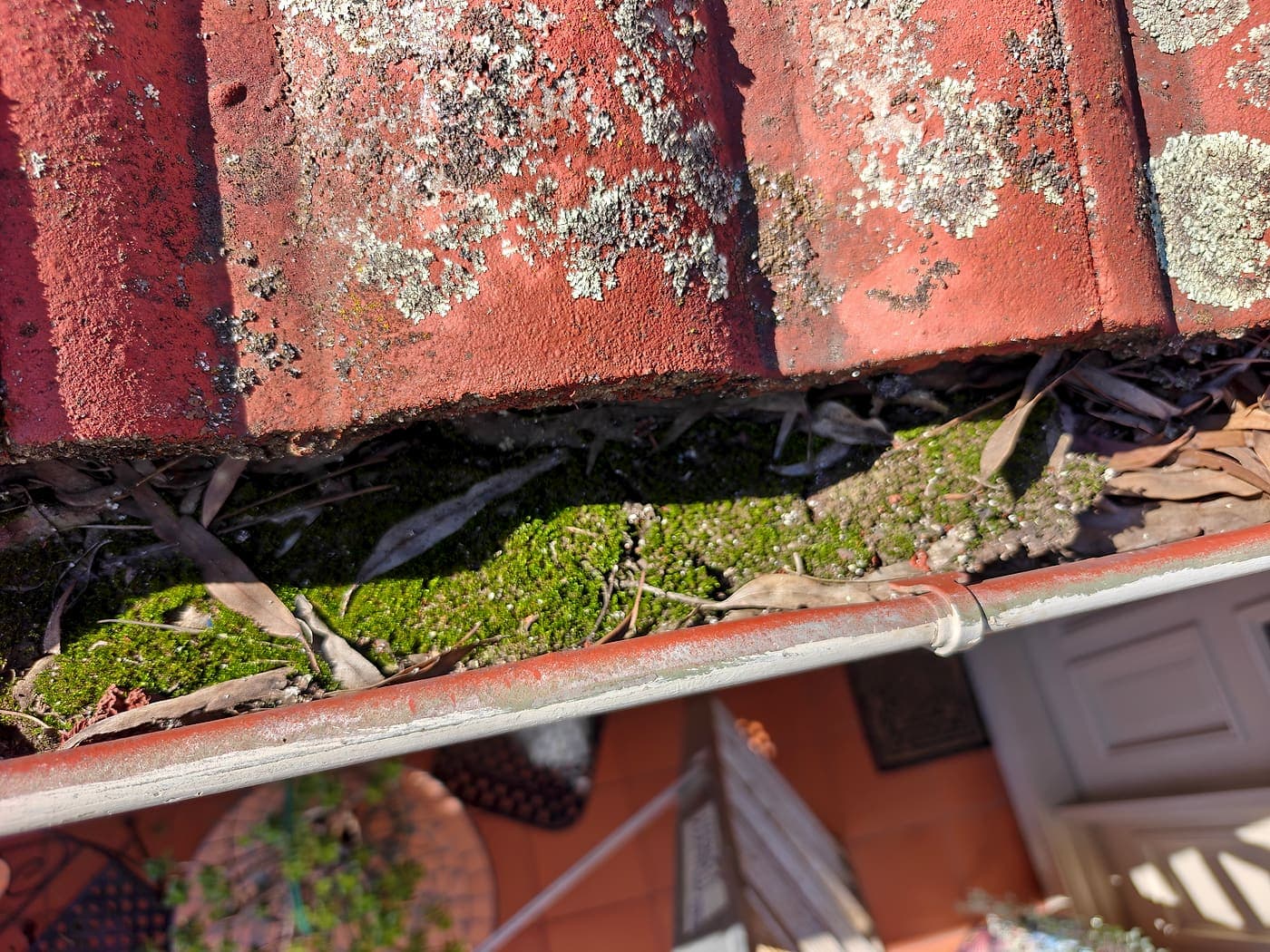
Leaves cause most blockages, but rarely on their own. A typical blockage is a plug of leaves bound together by sludge, roof grit and bark, sitting right at the downpipe outlet where the water is trying to leave.
The usual culprits
| Material | Where it comes from | Why it blocks |
|---|---|---|
| Deciduous leaves | Plane trees, elms, oaks, maples and fruit trees | Large volume in a few weeks of autumn, matting flat at the outlet |
| Eucalypt leaves, bark strips and gum nuts | Gum trees overhanging or upwind of the roof | Shed through the warm months; long bark strips span the outlet |
| Needles | Pines and she-oaks | Fine needles knit into a dense mat that holds water |
| Roof grit, moss and lichen | Older concrete and terracotta tiles | Settles as heavy sludge that binds everything else |
| Seed pods, flowers and fruit | Wattles, palms, jacarandas and fruit trees | Small, hard items that lodge in outlets and bends |
| Nests and nesting material | Birds and possums | Built at the roof edge, often right over the outlet |
| Balls, toys and wind-blown rubbish | The yard next door, the street, the kids | Fit the outlet exactly and seal it |
Our post on how often gutters need cleaning near gum trees explains why eucalypts fill gutters faster than most trees. If animals are the problem, the article on birds, possums and wasps in gutters covers what to do safely.
Causes that are not debris at all
- Lost fall. Gutters need a gentle slope towards the outlet. When a bracket drops, water pools in a low point and debris settles there.
- Too few outlets. A long run or a large roof area draining to one small outlet can overflow in heavy rain even when it is clean.
- Blocked stormwater pipes. If the gutter and downpipe are clear, the blockage may be in the underground pipe, often from silt or tree roots.
- Gutter guard holding debris. Leaves and bark can sit on top of a mesh guard and dam the water, and fine sludge still builds underneath.
How can you tell which part is blocked?
Follow the water. Where it escapes tells you where the blockage is, and that decides whether it is a gutter clean, a downpipe job or a plumbing job. Use the table below as a quick decision helper on your own roof line.
| What you see | Most likely location | Usually fixed by |
|---|---|---|
| Overflow along a whole run | The gutter itself, plus its outlet | A full gutter clean |
| Overflow at one spot, gutter otherwise clear | A local dam or a low point | Clearing the spot, then checking the brackets and fall |
| Full gutter, quiet downpipe | The outlet or the first bend of the downpipe | Clearing the outlet and flushing the downpipe |
| Downpipe overflowing at a joint or the bottom bend | Inside the downpipe | Flushing the downpipe from the top |
| Water bubbling up at the base of the downpipe | The underground stormwater pipe | A plumber |
| Drips behind the gutter in moderate rain | A full gutter or how it is fitted | A clean, then a check of the gutter height and roof edge |
| Damp inside under a box gutter | The box gutter outlet or overflow | A clean and an inspection; leaks need a plumber |
The downpipe is the most common hidden culprit. Our guide on how to clear a blocked downpipe walks through testing and clearing it.
A side view of a house roof line in rain, shown in three panels. In the first, the gutter is clear and water flows along it, drops down the downpipe and enters the stormwater pipe below the ground. In the second, a plug of leaves sits on the downpipe outlet: water fills the gutter, spills over the front edge and the downpipe stays dry. In the third, the gutter and downpipe are clear but roots fill the underground pipe: water rises back up the downpipe and bubbles out at its base.
Blockage or design fault?
If a gutter has just been cleaned and still overflows in moderate rain, the cause may be the gutter itself. Common faults include a run with no fall or a back-fall, too few downpipes for the roof area, outlets that are too small, and gutters fitted so high on the fascia that water spills behind them. These are not cleaning problems. Fixing them means altering or replacing gutters and downpipes, which is roofing (stormwater) plumbing work for a registered or licensed plumber; the Building and Plumbing Commission (opens in a new tab)'s online register lets you check a plumber before you book.
Is the overflow from a blockage or a damaged gutter?
If the overflow stops after a clean, it was a blockage. If water still escapes from the same place once the gutter and downpipe are clear, the gutter is damaged or badly fitted. A gutter clean is often the quickest way to find out, because it removes the debris that hides the condition of the metal.
Signs that point to damage rather than debris include rust holes along the bottom of the gutter, joints that drip in light rain, brackets pulled away from the fascia and a run that visibly sags when empty. A photo of each problem spot makes the next step easier, because rust holes, failed joints and replacement runs are work for a plumber rather than a cleaner.
In a Victorian rental, renters are asked to report these signs rather than fix them. Rental Dispute Resolution Victoria (opens in a new tab) says renters should tell the rental provider about blockages, overflowing water, water stains on walls or sagging gutters.
What happens if you ignore the signs?
Left alone, a blocked gutter turns a small fix into a bigger one. The water that should go down the downpipe goes somewhere else instead, and it goes to the same place every time it rains.
- Fascia and eaves rot where water spills behind the gutter.
- Garden beds and paths wash out under the overflow point, and paths stain.
- Footings stay wet where overflow lands beside the house, which is worth avoiding on reactive clay.
- Gutters rust faster with wet sludge sitting against the metal, and sag under the extra weight.
- Mosquitoes breed in water held behind leaves.
- Debris washes into the street. EPA Victoria (opens in a new tab) points out that stormwater flows through gutters and drains to waterways, so leaf sludge belongs in the green waste, not the drain.
A dry, leaf-filled gutter is also fuel on the roof in summer. If your home is near bush, grassland or a creek reserve, read our guide to gutters and bushfire season before the Fire Danger Period.
What should you do once you have spotted the signs?
Note where the water escapes, then clear the gutters and downpipes, or book a clean if the roof is not safe for you to work on. Do it before the next run of wet weather, not during it.
- Record the signs. Photos or a video during rain, plus any stains or damp inside.
- Check from the ground first. Look at the downpipe bases and the stormwater connections for loose or broken fittings.
- Decide whether you can do it safely. A single-storey roof with firm, level ground and no power lines nearby can be a DIY job for a confident person with a helper.
- Clear the gutter and outlet, then test. Our step-by-step guide to cleaning gutters safely covers the method.
- Watch the next rain. If the overflow is gone, set a cleaning schedule. If it is not, look for a fault.
Call a professional if the home is two storeys, if you would need to walk on the roof, if power lines or the service line run near the gutters, if the roof may contain asbestos cement (homes built or renovated before 1990 may) or if the ground under the ladder is soft or sloping. WorkSafe Victoria (opens in a new tab) notes that anyone on a ladder is at risk of falling, even below 2 metres. Our guide on when not to clean your own gutters explains the warning signs in detail.
What we check when we find a blockage
When we clear a blocked gutter, we look at what caused it as well as clearing it: which trees are dropping into it, whether the outlet looks undersized, whether a bracket has dropped and whether the downpipe runs freely after a water test. Every gutter cleaning visit includes a visual roof and gutter check and a photo report, so you can see what was found without going up yourself.
For more on the roof line, the gutters and roof line guides cover gutter guard, safety and bushfire preparation. If your gutters are showing more than one of these signs, or the roof is one you would rather not climb, it is worth handing the job to Action Garden: we clear the gutters and downpipes, test the flow and photograph what we find. You can request a free quote with a few photos of the roof line.
Your Garden. Our Promise.
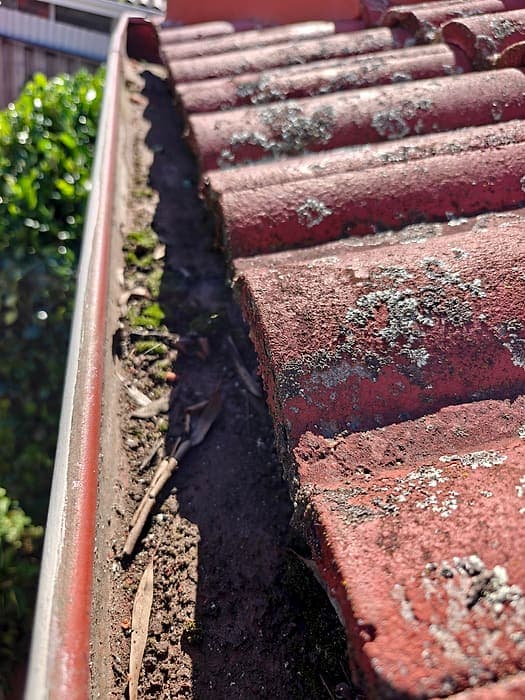
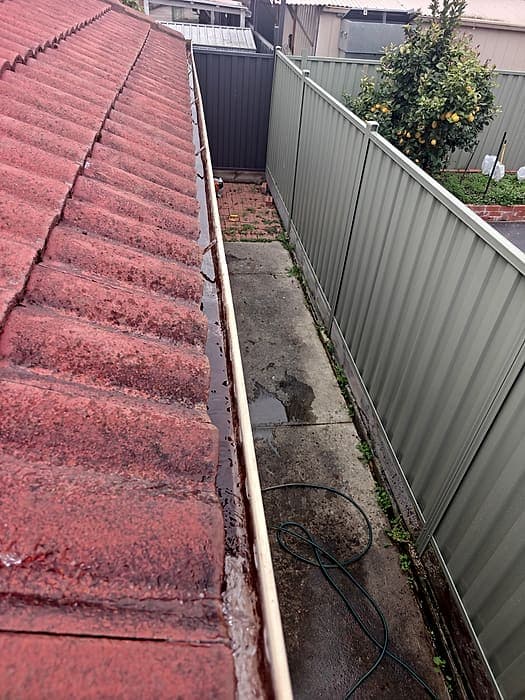
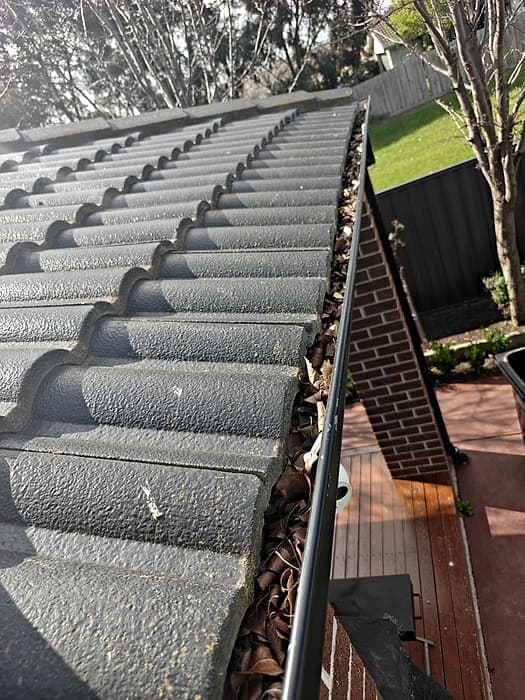
From our jobs
Frequently asked
Why do my gutters overflow even though they look clean from the ground?
Why is water running down behind my gutter instead of over the front?
Is water left standing in a gutter after rain a sign of a blockage?
Can moss and grit washed off a tiled roof block the gutters?
How quickly can a gutter block again after it has been cleaned?
Can tree roots cause a downpipe to overflow?
What should I photograph if my gutters are overflowing?
Sources and further reading
- Climate statistics for Melbourne (Olympic Park), monthly rainfall (Bureau of Meteorology)
- Mosquitoes, protect your home checklist (Better Health Channel)
- Stormwater (EPA Victoria)
- Find and check a practitioner (Building and Plumbing Commission)
- Who maintains gutters, gardens and pools in a rental (Rental Dispute Resolution Victoria)
- Using portable ladders in the workplace (WorkSafe Victoria)
Caring for Melbourne gardens since 2019. Updated 18 November 2026.