


Gutters and exterior
How often gutters need cleaning near gum trees
By the Action Garden team · Updated · 14 min read
Checked against: Bureau of Meteorology, 1975, CFA, Energy Safe Victoria, Victorian Government
TL;DR
- Under gum trees, plan on three to four gutter cleans a year, plus a quick check after strong wind in the warm months.
- Eucalypt leaf fall is highest in summer and early autumn and lowest in winter and early spring, so the busiest gutter months are not the autumn ones.
- Long gum leaves, bark ribbons and gum nuts mat together and lodge in downpipe outlets, so check the outlets at every clean.
- Gutter guard helps under gums but does not end the job; leaves and bark lie flat on the mesh and need clearing.
- Before pruning or removing a gum, check your council's local laws and planning overlays; never prune near power lines yourself.

| When | Gutter job | Why then |
|---|---|---|
| Late spring (November) | Full clean | Before the Fire Danger Period and the summer leaf peak. |
| Mid summer (January) | Check, clean if needed | Heaviest eucalypt leaf fall; the CFA says keep gutters clear, especially after windy days. |
| Early autumn (late March to April) | Full clean | Clears the summer and early autumn drop before the rain days build. |
| Late winter (August) | Check, clean if needed | Leaf fall is low, but winter wind brings down bark and twigs; clear the outlets before spring rain. |
How often do gutters need cleaning near gum trees?
Gutters near gum trees need cleaning three to four times a year, compared with twice a year for most Melbourne homes. The extra cleans come from the way eucalypts shed: a little every week, a lot in summer, and bursts after every windy day. If the canopy actually overhangs the roof, plan on four.
The right number depends on how close the trees are and how big they are. Use the table below as a starting point, then adjust after a year of watching how quickly your gutters fill.
| Your situation | Cleans a year | Extra checks |
|---|---|---|
| Large gum overhanging the roof | 4 | After strong wind from December to April |
| Gums within a tree's height of the house, not overhanging | 3 | After the first hot, windy spell of summer |
| Gums on a neighbouring property or nature strip | 2 to 3 | Late summer |
| Gums plus deciduous trees nearby | 4 | One of the cleans after the autumn leaf drop |
| Bush or reserve behind the property | 3 to 4 | Before bad fire days, as the CFA (opens in a new tab) advises |
For the general picture of gutter care in Melbourne, including box gutters, rentals and what a professional clean includes, see our complete guide to gutter cleaning in Melbourne. This post is about the gum tree case only.
Why do gum trees fill gutters faster than other trees?
Gum trees fill gutters faster because they never stop shedding. Deciduous trees drop most of their leaves over a few weeks in autumn, so one well-timed clean deals with them. Eucalypts drop old leaves, strips of bark, twigs, flower caps and gum nuts all year round.
What gum debris does in a gutter
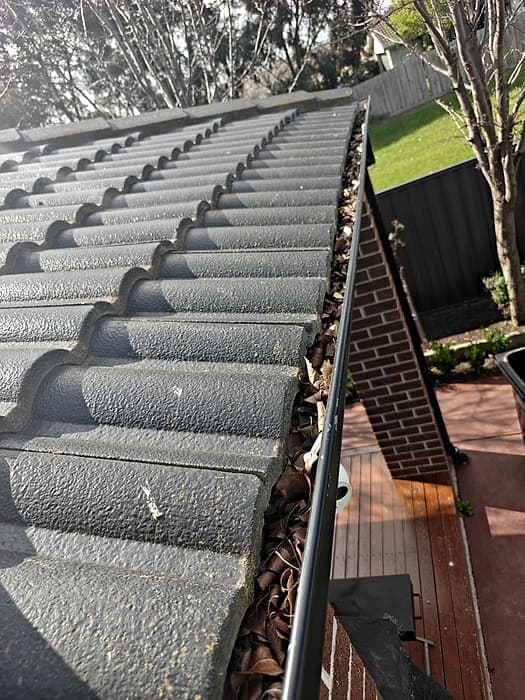
- Long, narrow leaves. Gum leaves are tough and slow to break down. They lie flat along the gutter and layer up like shingles, holding water underneath.
- Bark ribbons. Many gums shed bark in long strips. Those strips drape across the gutter and the roof edge and bind the leaves together.
- Gum nuts and flower caps. Small, hard and round, they roll towards the outlet and wedge in the downpipe.
- Twigs. Thin twigs form a lattice in the outlet that catches everything else.
- Fine material. Pollen, stamens and broken leaf pieces settle into a dark sludge at the bottom.
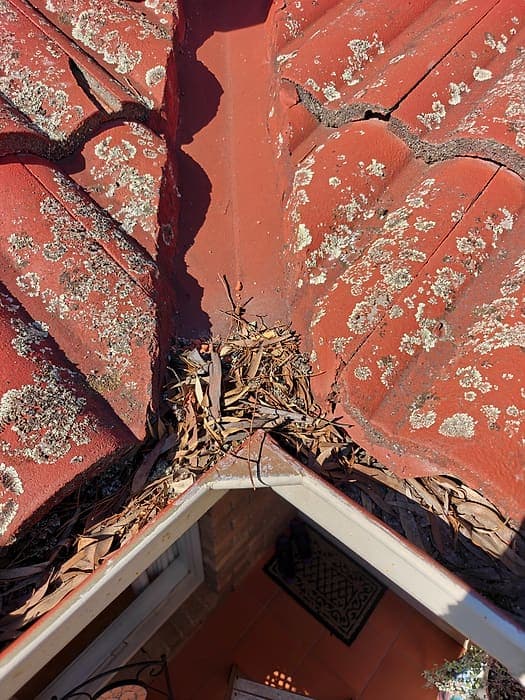
Put together, gum debris tends to form a mat rather than a loose pile. That mat blocks the outlet sooner than the same volume of broad deciduous leaves, which is why gutters under gums can overflow even when they do not look very full from the ground.
Why the outlet blocks first
Water carries the lighter material towards the downpipe every time it rains. Gum nuts and twig fragments reach the outlet first and wedge at the opening or at the first bend, then leaf pieces and bark strips pile up behind them. A gutter can look half-empty while its outlet is completely sealed, so every clean under gums should finish with a water test of each downpipe.
When do eucalypts drop the most leaves in Melbourne?
Eucalypts drop the most leaves in summer and early autumn and the fewest in winter and early spring. That finding comes from a study of litter in mountain ash forest published in the Australian Journal of Botany, which recorded leaf fall at its maximum in summer and early autumn and at its minimum in winter and early spring. Garden gums are a mix of species growing in very different conditions, so treat the pattern as a guide rather than a timetable.
The chart below sets that leaf-fall pattern beside Melbourne's long-term rainfall. Read together, they show a mismatch: the leaves fall hardest when rain days are fewest, then sit in the gutter until the rain days build through autumn and winter.
Gum leaf fall and Melbourne rain by month
| Month | Mean rainfall (mm) | Rain days (1 mm or more) | Eucalypt leaf fall |
|---|---|---|---|
| Jan | 46.8 | 5.6 | High |
| Feb | 48.0 | 5.1 | High |
| Mar | 50.1 | 6.1 | High |
| Apr | 57.3 | 7.9 | Easing |
| May | 55.7 | 9.7 | Easing |
| Jun | 49.5 | 9.4 | Low |
| Jul | 47.5 | 9.7 | Low |
| Aug | 50.0 | 10.4 | Low |
| Sep | 58.0 | 10.4 | Low |
| Oct | 66.0 | 10.2 | Rising |
| Nov | 60.3 | 8.3 | Rising |
| Dec | 59.1 | 7.2 | High |
Sources: rainfall from the Bureau of Meteorology (opens in a new tab), Melbourne Regional Office, station 086071, records 1855 to 2015. Leaf fall pattern from Ashton (1975 (opens in a new tab)), Studies of litter in Eucalyptus regnans forests, Australian Journal of Botany 23(3); "Easing" and "Rising" mark the months between the study's summer and early autumn maximum and its winter and early spring minimum.
What the chart means for your gutters
- December to March: the gutters fill fastest, while rain days are at their lowest. Leaves dry out on the roof, which matters in fire season.
- April and May: the summer drop is in the gutter just as the rain days pick up. This is when overflow starts if the early autumn clean was missed.
- June to September: leaf fall is low, but this is the wettest stretch by rain days, so a blocked outlet shows quickly.
- October and November: leaf fall is building again and October is the wettest month on the long-term record. A late spring clean resets everything before summer.
What cleaning schedule works for gutters under gums?
The schedule that works under gums is a full clean in late spring and early autumn, with lighter checks in mid summer and late winter. That puts the full cleans either side of the summer leaf peak and the checks where storms and wind are most likely to refill the gutters. The key facts table above sets out the four visits.
Why each visit sits where it does
- Late spring, November. The gutters go into summer and the Fire Danger Period empty. The CFA advises completing preparation in early spring, before bushfire season starts, so earlier is better in high fire risk areas.
- Mid summer, January. This is the heaviest leaf fall. A check, and a clean if needed, keeps dry leaves from piling up during the hottest weeks.
- Early autumn, late March to April. This clears the summer and early autumn drop before the rain days build. If you also have deciduous trees, push this clean back to late autumn, once their leaves are down too.
- Late winter, August. Leaf fall is low, but winter wind brings down bark and twigs. Clearing the outlets now gets the roof ready for the spring rain.
Add a check after wind
The CFA's advice is to keep gutters clear of leaves and twigs during the warmer months, especially after windy days. A hot northerly followed by a cool change can bring down a surprising amount of gum debris in an afternoon. After any strong wind between December and April, look at the gutters and downpipe outlets.
Pick the downpipe outlet closest to the biggest gum and check it from the ground after rain. If that one is overflowing or the downpipe is quiet while the gutter is full, the rest of the roof is likely close behind. It is a simple way to time cleans by what your trees actually do.
For the hands-on method, including ladder setup, tools and downpipe testing, see our guide on how to clean gutters safely.
Does gutter guard help under gum trees?
Gutter guard helps under gum trees, but it changes the job rather than removing it. A mesh guard keeps most leaves and gum nuts out of the gutter itself. The catch is that long gum leaves and bark strips lie flat on the mesh, layer up and form a mat that water runs over instead of through.
What to expect with guard under gums
| What happens | Without guard | With mesh guard |
|---|---|---|
| Leaves | Fill the gutter | Collect on top of the mesh |
| Bark ribbons | Drape into the gutter and outlets | Lie across the mesh, binding leaves together |
| Gum nuts | Roll into the outlets | Mostly stay out, some sit on the mesh |
| Fine sludge | Builds in the gutter | Still gets under the mesh, more slowly |
| Cleaning | Scoop out, test downpipes | Clear the mesh, lift sections, check below, test downpipes |
Guard can mean fewer full cleans, and that matters on a roof that is hard to reach. It does not mean no cleans. Plan to clear the top of the mesh at least once or twice a year under gums, more often if the canopy overhangs the roof, and lift a section near a downpipe at least once a year to check underneath.
In a bushfire prone area
A mat of dry gum leaves sitting on top of guard is still fuel on the roof. If you live near bush or a reserve, the late spring clean should include the top of the guard as well as the gutter. Action Garden can fit gutter guard as an add-on to a clean, and we do not recommend a particular brand; ask about the mesh material and whether it suits your bushfire setting.
Why are gum leaves in gutters a bushfire concern?
Gum leaves in gutters are a bushfire concern because dry leaf litter on the roof is fuel exactly where embers land. The CFA says leaf buildup is perfect tinder for a fire, which makes clearing gutters periodically critical. It also says embers landing on or near the house are the most common way houses catch fire.
What the CFA asks of households
- Clear gutters of leaves, twigs and rubbish before bushfire season starts, then regularly through the season.
- Check the gutters again before bad fire days.
- Cut back branches that overhang the house, with no branches within 10 metres of buildings.
- Keep grass trimmed to between 5 cm and 10 cm during the season.
- Move woodpiles away from the house.
- Remove fallen leaves where they gather around the home, such as corners and doorways.
The CFA's advice on fire resistant homes adds a point that matters for gum trees in particular: avoid trees with loose, ribbon or stringy bark that could shower the house with embers during a fire. That is advice about planting choices and tree management near the house, not a reason to panic about every gum in the street.
Gum trees and the wider property
The CFA's guidance is about the whole property, not just the roof. Leaf litter under gums gathers along fences, in corners and against walls, and the bark that falls on the lawn is fuel too. A late spring tidy that covers the gutters, the ground under the trees and the base of the walls does more than any one job on its own.
Should you prune or remove the gum tree?
Pruning branches that overhang the roof is usually the better first step, and removal is a bigger decision with rules attached. Cutting back overhanging branches reduces the leaf load on the roof, follows the CFA's advice on overhanging branches and keeps the tree's shade and habitat. Removing a healthy gum often needs a permit and is worth thinking through.
Check the rules first
Many Melbourne councils protect larger or significant trees through local laws, and planning overlays can protect vegetation on a property. The rules differ from council to council, so the first step is your council's tree pages. You can see whether planning overlays apply to your property on VicPlan, the Victorian Government (opens in a new tab)'s planning map, and ask the council if anything is unclear.
Power lines
Energy Safe Victoria (opens in a new tab) says pruning should be done before trees and shrubs grow to within one metre in any direction of power lines, and that only authorised pruning contractors should work on trees touching or close to power lines. If a gum is near the service line to your house or the street lines, do not prune it yourself; contact your electricity distributor.
Call a professional for any pruning above head height, any branch over the roof, anything near power lines, and any tree showing cracks, splits, dead limbs or lean. Large gums can drop limbs, and working in them takes the right equipment and training. Action Garden arranges tree trimming and tree shaping and pruning by our own team.
What are the signs gutters under gums are overdue?
The signs are overflow in light rain, gum leaves or seedlings visible over the gutter edge, bark strips hanging off the roof line and a downpipe that stays quiet while the gutter is full. Under gums, check for them every season rather than waiting for a storm to show you.
Quick checklist from the ground
- Overflow in ordinary rain, not just in a storm.
- Leaves standing up above the gutter line, or bark ribbons draped over it.
- Seedlings or grass growing in the gutter.
- Dark streaks on the fascia or the wall below.
- A dry downpipe at the bottom during rain.
- Debris piled at the base of a downpipe or in the drain grate.
Making it routine
The simplest way to stay ahead of gum trees is to put the gutters on a fixed programme, so the late spring and early autumn cleans happen on time every year. Our gutter cleaning service clears the gutters and downpipes, flushes the downpipes and includes a photo report, and gutter cleans can sit alongside lawns and gardens in a regular maintenance plan. More reading on roofs, walls and paths is in our gutters and exterior articles.
If the gums are big, the roof is high or you would rather not keep climbing a ladder four times a year, it is worth handing the job to Action Garden. Request a free quote and let us know roughly where the trees sit in relation to the roof.
Your Garden. Our Promise.
From our jobs
Frequently asked
Do gum trees drop leaves all year round?
When do eucalypts shed the most leaves?
Do gum nuts and bark strips block downpipes?
Do I need a council permit to prune or remove a gum tree?
Is gutter guard enough under gum trees?
Are gum leaves in gutters a bushfire risk?
Should gutters under gum trees be checked after a windy day?
Sources and further reading
- Climate statistics for Melbourne Regional Office, 1855 to 2015 (Bureau of Meteorology)
- Studies of litter in Eucalyptus regnans forests, Australian Journal of Botany 23(3), 1975
- Preparing for bushfire season (CFA)
- Fire resistant home improvements (CFA)
- Electrical safety outdoors (Energy Safe Victoria)
- VicPlan, planning property reports and overlays (Victorian Government)
Caring for Melbourne gardens since 2019. Updated 17 November 2026.