


Local rules and safety
Nature strips: what the council expects and what we do
By the Action Garden team · Updated · 11 min read
Checked against: Merri-bek City Council, City of Boroondara, Banyule City Council, City of Whittlesea, Darebin City Council, City of Monash, Wyndham City
TL;DR
- The nature strip is public land; the household next to it normally mows, weeds and picks up litter
- Street trees belong to council; residents cannot prune, plant or remove them
- Planting usually needs a permit, and height limits run from about 30 cm to 90 cm depending on the council
- Keep the footpath fully clear, the surface level with the kerb and path, and low plants near driveways and corners
- Rules differ by council, so read your own council's nature strip page before you dig
| Job | Whose job | Notes |
|---|---|---|
| Mowing, edging, weeding, litter | Resident | Stated by Merri-bek, Wyndham and Whittlesea; Boroondara calls it a shared community expectation |
| Street trees | Council | Residents cannot prune, plant or remove them (Banyule, Boroondara, Wyndham, Darebin) |
| Planting or landscaping | Resident, with a permit | Most councils listed here need a permit or approval first; re-seeding grass usually does not |
| Pipes and cables underneath | Utility companies | They may dig the strip up and generally reinstate soil and grass only |
Who is responsible for the nature strip in Melbourne?
The nature strip is public land, but in most Melbourne councils the household next to it looks after the grass. Merri-bek puts it plainly: "Council does not maintain the nature strips in front of private property." Wyndham and Whittlesea say the same, and Boroondara describes it as "a shared community expectation that residents are responsible for mowing the grass on the nature strip directly outside their property".
Council keeps the parts that are clearly public infrastructure. That means the street tree, the footpath, the kerb and the drainage. Utility companies own the pipes and cables that run underneath.
So the split most households live with looks like this:
- You: mowing, edging along the kerb and footpath, weeding, picking up litter, and looking after any planting you have a permit for.
- Council: planting, pruning and removing street trees, and repairing footpaths and kerbs.
- Utilities: the gas, water, power and communications services below the surface, and reinstating the ground after they dig.
This is general information drawn from council pages, not a ruling on any property. Arterial roads, estates with an owners corporation and some new subdivisions can follow different arrangements, so your council's own page is always the final word.
What does maintaining a nature strip actually involve?
Maintaining a nature strip means keeping it short, tidy, level and safe for people walking past. Merri-bek lists "mowing, weeding, trimming nature strip edges and picking up litter", and Whittlesea adds that the strip must not become unsafe or unsightly.
In practice that comes down to five habits:
- Mow it with the front lawn. In Melbourne's growing season that is weekly to fortnightly; the lawn care calendar shows how the rhythm changes through the year.
- Edge the kerb and footpath. Grass creeping over concrete narrows the path and holds water and dirt.
- Keep clippings off the road. Merri-bek says it is a littering offence to blow or sweep clippings into the road or drain.
- Weed it. A strip full of flowering weeds seeds straight into your lawn and your neighbours'.
- Watch the level. Ruts from car tyres and sunken patches over old trenches turn into trip hazards.
A nature strip cut lower than the lawn behind it browns off first in summer and lets weeds in. Set the mower once and do both, then edge last so the line along the kerb is crisp. Our guide to how often to mow in Melbourne covers the season by season frequency.
Can you plant a nature strip instead of mowing it?
Yes, most Melbourne councils now encourage planted nature strips, but almost all of them want you to apply first. Boroondara, Banyule, Whittlesea, Darebin and Monash each ask for a permit or an approval form before planting or landscaping, while mowing and re-seeding grass generally need no permit.
Councils like planted strips because they soak up rain, cool the street and give habitat to insects and birds. Several also point out that a well-designed planting can be less work than grass. Merri-bek and Banyule both encourage locally native or indigenous plants, and Banyule allows only locally native species within 200 m of a waterway or biodiversity corridor.
The conditions are similar from council to council, even where the numbers differ:
- low plants, with the lowest at the edges and near driveways;
- clear space by the kerb so people can open car doors and step out;
- room for bins on flat ground;
- a footpath that stays completely clear;
- no spiky, prickly or weedy plants;
- no hard or loose materials that can trip someone or be thrown by a mower.
Before you dig: pipes, cables and tree roots
Nature strips carry gas, water, sewer, power and communications lines. Merri-bek's guidelines and Wyndham's information sheet both tell residents to check what is underground first, through the free Before You Dig Australia service. Darebin also asks residents not to plant within 60 cm of a street tree, so council crews can reach it and roots are not damaged.
Keep in mind what happens when a utility needs access. Wyndham says the utility "only needs to backfill with soil and seed with grass", and Merri-bek warns that no plants will be replaced. A simple planting of tubestock and mulch is far easier to redo than an expensive one.
How do the rules compare council by council?
The table below sets out what seven Melbourne councils say on their own nature strip pages. It is a summary of their published wording as checked in November 2026, not a complete list of their rules, and councils update their guidelines. Follow the link for your council and read the current version before you start.
| Council | Who mows | Planting | Height limit | Clearances and other points |
|---|---|---|---|---|
| Merri-bek (opens in a new tab) | Residents; council does not maintain strips in front of private property | Encouraged, in line with the guidelines (opens in a new tab); some planting allowed without a permit | Below 0.5 m, especially within 1.5 m of driveways or intersections | Surface within 40 mm of footpath and kerb level; parking on the strip is illegal |
| Boroondara (opens in a new tab) | A "shared community expectation" that residents mow | Nature Strip Renovation Permit for planting, mulching or landscaping | See the 2025 guidelines | No permit to mow or plant new grass; residents cannot prune or remove the tree |
| Banyule (opens in a new tab) | Not stated on the planting page | Free permit needed before digging up lawn | 70 cm in the middle, 30 cm at the edges and beside driveways | Nothing spilling over the footpath or kerb; space for three bins; 1.5 m clear by the boundary where there is no footpath |
| Whittlesea (opens in a new tab) | Residents: "your responsibility to maintain the nature strip" | Permit for a nature strip garden; re-seeding needs none | Set in its nature strip garden guidelines | No synthetic grass, crushed rock, retaining walls, statues or spiky plants |
| Darebin (opens in a new tab) | Residents keep it "clear, tidy, and safe" | Nature Strip Approval Form | Not stated on the page | No planting within 60 cm of street trees; no irrigation or artificial turf |
| Monash (opens in a new tab) | Not stated on the guidelines page | Nature Strip Planting Permit before landscaping | 50 cm | 1.4 m clear zone for the footpath; soil and mulch within 4 cm of footpath level; no synthetic turf, pavers, rocks or edging |
| Wyndham (opens in a new tab) | Residents; council "does not conduct maintenance on nature strips" | Approved planting under set conditions | 500 mm | 1 m from the kerb free of planting; 1.5 m clear by the boundary with no footpath; no irrigation or synthetic turf |
If your council is not listed, the same questions apply: who mows, whether planting needs a permit, the height limit, and the clearances. The section below shows how to find the answers in a few minutes.
Why do sight lines and footpath clearance matter so much?
Sight lines and footpath clearance are about safety, which is why they appear in nearly every council's guidelines. A driver backing out of a driveway needs to see a child on a scooter, and a person using a wheelchair or pram needs the whole width of the path.
That is why the height limits are lowest exactly where visibility matters most. Banyule drops to 30 cm next to driveways "to keep sight lines clear", and Merri-bek's guidelines keep plants below 0.5 m within 1.5 m of driveways or intersections. Corner blocks deserve extra care, because drivers are looking across the strip in two directions.
Footpaths have their own rules. Merri-bek says "pedestrians need to be able to use the entire width of a footpath", Monash asks for a 1.4 m clear zone, and Banyule says plants and mulch must not spill over the path or kerb.
A side view from the property boundary to the road, from left to right: the property boundary, the footpath kept fully clear, a band of low plants or short grass beside the footpath, a taller planting zone in the middle of the strip, a lower band near the kerb with gaps for car doors, then the kerb and road. The street tree sits in the middle zone with a clear circle around its trunk. Dashed lines below the surface show service pipes and cables. A dotted triangle at a driveway shows the sight line a driver needs, with plants kept low inside it.
Trip hazards: the level matters as much as the plants
Councils measure level changes in millimetres. Merri-bek's guidelines ask that the surface, including mulch, stays within 40 mm of the footpath or kerb level for the first 300 mm, and Monash allows no more than 4 cm above or below the footpath. Mulch heaped high against a path, a sunken trench line, or tyre ruts can all break that rule without anyone noticing.
A quick check: lay a straight piece of timber from the footpath onto the strip. If you can slide a matchbox under it, the strip probably needs topping up or raking back.
What is not allowed on a nature strip?
Hard, loose, spiky or private items are the usual things councils rule out, because they trip people, hide services or get thrown by mowers. The details vary, but the same items come up again and again in the pages checked for this article.
- Synthetic turf: not permitted in Monash, unacceptable in Wyndham, excluded by Whittlesea's guidelines, and Darebin says not to install it.
- Hard surfaces and edging: Monash rules out concrete, bricks, pavers and garden edging; Wyndham lists concrete, asphalt, rocks, railway sleepers, retaining walls and edges.
- Loose stones: Wyndham lists pebbles and loose gravel as unacceptable, and Monash rules out logs, rocks and pebbles.
- Irrigation: Darebin, Monash and Wyndham all say no irrigation systems.
- Spiky or prickly plants: ruled out by Banyule, Whittlesea and Wyndham, and Darebin asks residents to avoid succulents and cacti.
- Rubbish and goods: Whittlesea says hard waste, second hand goods and rubbish cannot be kept on the strip.
- Cars: Merri-bek says parking on a nature strip is illegal, and Wyndham says it is prohibited under the road rules.
Councils can also make you remove what does not comply. Merri-bek's guidelines say residents will be required to remove inappropriate or inadequately maintained landscaping. It is far easier to check first than to undo work later.
How do you check your own council's nature strip rules?
The fastest way is your council's own website, not a forum or a neighbour's memory. Councils revise these guidelines from time to time; Boroondara, for example, has recently updated its Nature Strip Planting Guidelines.
- Search your council's website for "nature strip". Most have a page on maintenance and a separate one on planting.
- Download the current guidelines and note the date on them.
- Find four answers: who mows, whether planting needs a permit, the height limits, and the clearances from the footpath, kerb, driveway and tree.
- Check whether your street is an arterial road. If it is, a state agency may be involved.
- Check what is underground through Before You Dig Australia.
- Apply for the permit and wait for approval before you dig.
- Keep a copy of the permit with your house papers, so a future owner knows the planting was approved.
Quick decision guide
Mow, plant or leave it to council?
Start with one question: are you happy to keep grass? If yes, mow and edge it with the front lawn; no permit is needed in the councils listed here.
If you would rather plant, check your council's guidelines and apply for a permit first. If something on the strip is unsafe, such as a broken footpath, a damaged kerb or a dangerous branch on the street tree, that is a council job: report it rather than fixing it yourself.
Call council for anything to do with the street tree: low or split branches, roots lifting the path, or a tree that looks dead. Never prune it yourself, even a small branch.
Call a plumber or the relevant utility if the strip stays wet or sinks along a line, which can mean a leaking pipe. For mowing and edging on a steep, narrow or busy strip, a team with the right equipment and road awareness is the safer choice.
What does Action Garden do on a nature strip?
On a lawn mowing visit, the nature strip is part of every mow unless you ask us to leave it. We mow and edge it to match the front lawn, trim carefully around the street tree without touching the trunk, and clear clippings off the footpath and out of the gutter so they do not wash into the drain.
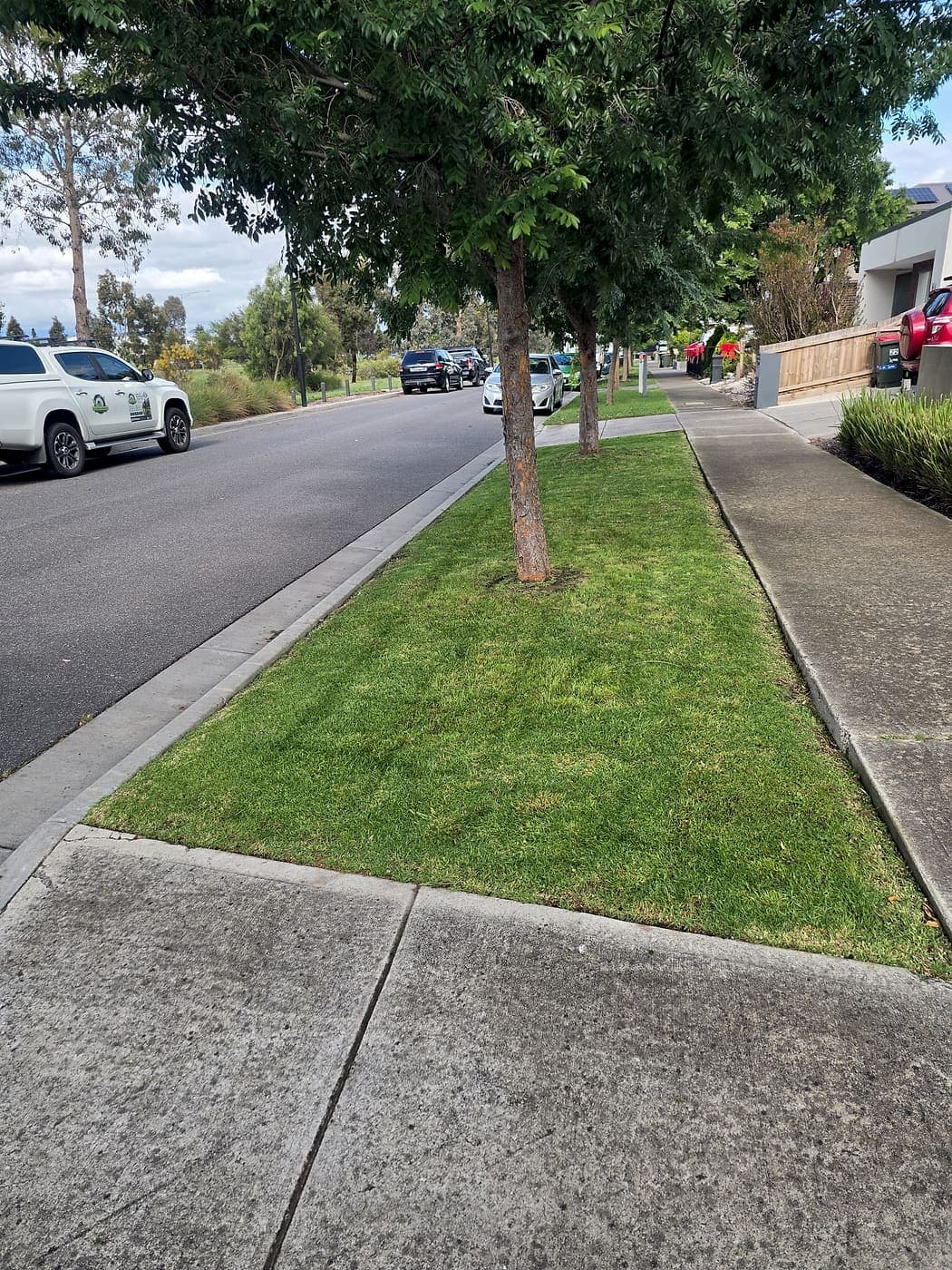
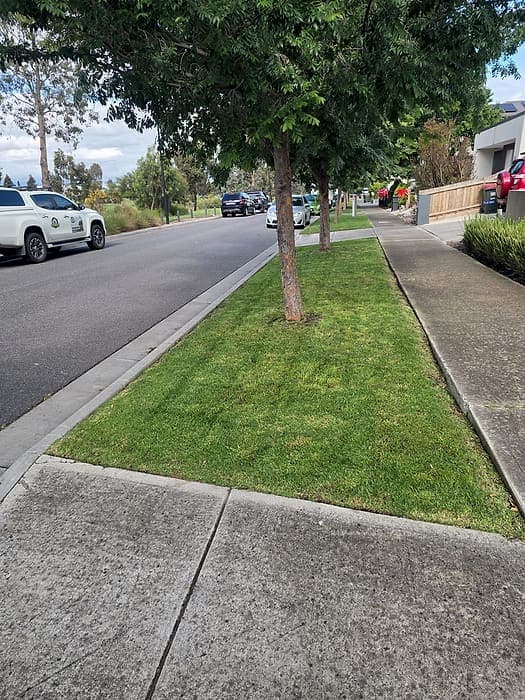
The lawn mowing service sets the cut height to your grass type and the season, and our complete lawn mowing guide explains the reasoning behind it. You can see a real example in this nature strip mown and edged job.
What we do not do is prune or remove street trees, or change a strip in ways your council needs a permit for. Those jobs belong to council or to you as the permit holder. More local rules, from water to fire season, are collected under local rules and safety articles.
Rentals, units and body corporates
Who mows a nature strip outside a rental or a block of units depends on the lease or the owners corporation's arrangements, not on the council. Councils simply expect the strip to be kept tidy.
If you manage a property, write the nature strip into the grounds scope so nobody assumes someone else is doing it. A regular maintenance plan can include it with the lawns.
If the strip outside your place has got away from you, or you simply want the whole frontage to look cared for every visit, that is a good time to hand it over. You can ask for a free quote and we will include the strip with the lawn.
Your Garden. Our Promise.
From our jobs
Frequently asked
Can I put synthetic turf on my nature strip?
Can I prune the street tree on my nature strip myself?
Do I need a permit to plant my nature strip?
How tall can plants on a nature strip grow?
Is it legal to park on the nature strip?
What happens if a utility company digs up my planted nature strip?
Can I blow grass clippings into the gutter after mowing?
What can I do about a neighbour's overgrown nature strip?
Sources and further reading
- Nature strips (Merri-bek City Council)
- Nature Strip Guidelines, PDF (Merri-bek City Council)
- Nature strips (City of Boroondara)
- Grass maintenance (City of Boroondara)
- Nature strip planting (Banyule City Council)
- Nature strips and nature strip gardens (City of Whittlesea)
- Nature strip planting (Darebin City Council)
- Planting on nature strips guidelines (City of Monash)
- Nature strip information sheet, PDF (Wyndham City)
Caring for Melbourne gardens since 2019. Updated 17 November 2026.