


Lawn care · Complete guide
Lawn mowing in Melbourne: the complete guide
By the Action Garden team · Updated · 17 min read
Checked against: Bureau of Meteorology, EPA Victoria, Yarra Valley Water, South East Water, Sustainable Gardening Australia
TL;DR
- Never remove more than a third of the leaf in one mow; bring a long lawn down over several cuts
- Kikuyu 30 to 50 mm (never below 30 mm), buffalo 40 to 60 mm, couch 20 to 40 mm, fescue 50 to 70 mm
- Mow weekly in spring, weekly to fortnightly in summer, fortnightly in autumn, every 3 to 4 weeks in winter
- Mow dry grass with a sharp blade, inside Victoria's noise hours, and raise the cut in heat
- Edge every visit, leave short dry clippings, and catch long, wet or seeding ones
| Topic | Setting | Notes |
|---|---|---|
| Height | One third rule | Never cut more than a third of the leaf in one mow |
| Kikuyu | 30 to 50 mm | Never below 30 mm; 40 to 50 mm in summer and winter |
| Buffalo (soft leaf) | 40 to 60 mm | Top of the range in shade and summer |
| Couch | 20 to 40 mm | Lowest cut of the common grasses, raise it in heat |
| Tall fescue and rye | 50 to 70 mm | Cool-season lawns, never scalp |
What does good lawn mowing in Melbourne involve?
Good mowing is three decisions made well every time: the height of cut, how much leaf comes off in one go, and how often you come back. Get those right for your grass and the season, and the lawn thickens, shades out weeds and handles a Melbourne summer far better. Get them wrong and no amount of fertiliser will make up for it.
The core rule is the one-third rule. Never remove more than a third of the leaf blade in a single mow, because the leaf is what feeds the roots. Take more and the grass has to spend its reserves regrowing leaf instead of roots, which leaves it thin, pale and open to weeds.
A single grass plant drawn at 60 mm tall, with a dashed line at 40 mm. The top third above the line is shaded and labelled "remove". The lower two thirds, labelled "keep", feed the roots drawn below the soil line. A second plant beside it is cut to 15 mm, with a short, shallow root system, to show what scalping does.
Everything else in this guide hangs off that rule. The right height depends on the grass, which is why the lawn mowing service sets the cut to the grass type first. The right frequency is simply how often you need to come back so you never take more than a third, and that changes month by month in Melbourne.
A good mow also looks finished. Crisp edges, clippings dealt with, paths swept clean and the nature strip done are what people actually notice from the street. The sections below take each part in turn: heights, grass types, frequency, timing, equipment, edging and clippings, common problems and when to hand it over.
The basic mowing routine, step by step
- Walk the lawn first and pick up sticks, stones, toys and dog bones that could jam the blade or be thrown.
- Check the grass is dry and the blade is sharp.
- Set the height for your grass and the season, using the table in the next section.
- Mow in straight, slightly overlapping passes, changing direction from last time so the grass stands up and wheels do not rut the same lines.
- Edge along paths, beds, fences and the kerb.
- Mulch or catch the clippings depending on their length and how wet they are.
- Blow or sweep clippings off paths, driveways and the road gutter, back onto the lawn or into the green waste bin.
What height should you mow each type of grass?
Mow each grass in its own range: kikuyu 30 to 50 mm and never below 30 mm, soft-leaf buffalo 40 to 60 mm, couch 20 to 40 mm, and tall fescue or rye blends 50 to 70 mm. Use the bottom of the range in spring, when growth is fast and the weather mild. Lift to the top of the range for summer heat, shade and winter.
| Grass | Spring and autumn | Summer | Winter | Lowest cut |
|---|---|---|---|---|
| Kikuyu | 30 to 40 mm | 40 to 50 mm | 40 to 50 mm | 30 mm |
| Buffalo (soft leaf) | 40 to 50 mm | 50 to 60 mm | 50 to 60 mm | 40 mm |
| Couch | 20 to 30 mm | 30 to 40 mm | 30 to 40 mm | 20 mm |
| Zoysia | 20 to 30 mm | 30 to 40 mm | 30 to 40 mm | 20 mm |
| Tall fescue and rye blends | 50 to 60 mm | 60 to 70 mm | 50 to 70 mm | 50 mm |
Why higher in summer? A longer leaf shades the soil, keeps it cooler and slows evaporation, so the lawn needs less water to stay green. It also shades out summer weeds such as crabgrass that need light on bare soil to germinate.
Why never below the lowest cut? Kikuyu cut under 30 mm, for example, is cut into its brown stems and runners. It goes yellow for weeks, thins out and lets weeds in, and on an uneven Melbourne lawn the mower scalps every high spot down to soil.
How to check the height your mower actually cuts
The numbers on a mower's height lever are positions, not millimetres, and they differ between brands. To find the real cut, mow a strip on a flat part of the lawn, then stand a ruler upright in the strip and read where the leaf tips sit. Write the setting and the height on a piece of tape under the deck lever so you never have to guess again. If the mower is on a slope or the lawn is soft after rain, the wheels sink and the cut drops, so check in those conditions too.
When moving between seasonal heights, change one notch at a time across two or three mows. A sudden drop of 15 or 20 mm in one cut breaks the one-third rule even if the grass was only a little long.
Which grass do you have, warm-season or cool-season?
Most Melbourne home lawns are warm-season grasses, chiefly kikuyu, buffalo and couch, with some zoysia. These grow hard from late spring through summer and slow right down or go dormant in winter. Cool-season lawns, mostly tall fescue and ryegrass blends, do the opposite: they stay green in winter and struggle in a hot, dry summer.
You can usually tell them apart at a glance:
- Kikuyu: bright to mid green, coarse leaves, thick fleshy runners above ground that push into garden beds. Very fast in summer, recovers from wear, browns off in a cold winter.
- Buffalo (soft leaf): broad, flat leaves and chunky runners, a denser feel underfoot. Handles more shade than kikuyu or couch and spreads more slowly.
- Couch: fine, narrow leaves, dense and low, with runners above and below ground. Wants full sun, browns in winter, takes the lowest cut.
- Zoysia: fine to medium leaf, stiff and very dense, slow growing. Less common, but it appears in newer estates.
- Tall fescue and rye: upright, clumping leaves with no runners, darker green in winter. Often sown from seed, and common in shadier gardens and older lawns.
Many Melbourne lawns are a mix. An older lawn might be fescue that kikuyu has invaded from next door, or couch with patches of winter grass. In a mixed lawn, set the height for the grass that makes up most of it, and lean higher rather than lower.
Native grasses are a third option some households choose. Sustainable Gardening Australia (opens in a new tab) notes that some native grasses, such as weeping grass, can be mown regularly as a lawn, while others prefer a higher cut or only occasional mowing. Native lawns are slower to establish and need their own approach to height, so treat them as a separate case.
How often should you mow through the Melbourne year?
Mow about weekly from October to December, weekly to fortnightly in January and February depending on heat and water, fortnightly from March to April, every two to three weeks in May, and every three to four weeks from June to August, only when the grass has actually grown. September is the shoulder month: growth returns unevenly, so mow when the lawn needs it.
That is the warm-season pattern. Cool-season fescue lawns flip the middle of it: they grow strongly in autumn and spring, keep growing slowly through winter and slow in the hottest weeks of summer. Our guide on how often to mow your lawn in Melbourne breaks the frequency down by season and grass type, with the reasons behind each interval.
Melbourne temperature and rainfall by month
| Month | Mean max (°C) | Mean min (°C) | Mean rainfall (mm) |
|---|---|---|---|
| Jan | 26.8 | 16.5 | 53.3 |
| Feb | 25.9 | 16.0 | 26.3 |
| Mar | 24.3 | 14.8 | 36.4 |
| Apr | 20.9 | 12.2 | 63.0 |
| May | 17.6 | 9.8 | 46.5 |
| Jun | 14.9 | 7.8 | 42.1 |
| Jul | 14.5 | 7.6 | 41.0 |
| Aug | 15.6 | 8.1 | 47.0 |
| Sep | 18.1 | 9.6 | 41.0 |
| Oct | 20.6 | 11.0 | 68.0 |
| Nov | 22.2 | 12.7 | 64.4 |
| Dec | 24.7 | 14.4 | 50.2 |
Source: Bureau of Meteorology, climate statistics for Melbourne (Olympic Park), station 086338, records from 2013 to 2026.
The chart explains the Melbourne rhythm. October and November combine warming days with the wettest months of the year at this station, so lawns surge and weekly mowing is needed to keep inside the one-third rule. February is the driest month, so a lawn left without water may slow down while a watered one keeps racing.
Frequency is also set by the height you mow at. A kikuyu lawn kept at 30 mm in spring can lose its third in four or five days, while the same lawn kept at 45 mm has more room before it needs a cut. For the jobs that sit around mowing in each month, such as feeding, aerating and weed control, see the Melbourne lawn care calendar.
When is the best time of day to mow?
Mid-morning to late afternoon on a dry day is the best time, inside Victoria's noise hours. EPA Victoria (opens in a new tab) lists lawn mowers and other grass-cutting devices as prohibited on weekdays before 7 am and after 8 pm, and on weekends and public holidays before 9 am and after 8 pm. Within those hours, pick a time when the dew has gone and the heat has not yet built.
Morning dew makes grass bend and clump, so the cut is ragged and the deck clogs. In summer, mowing in the middle of a hot afternoon stresses a lawn that is already losing water, so aim for the cooler part of the day. A light evening mow is fine as long as it finishes before 8 pm and the lawn is dry.
Watering after a mow follows the permanent water saving rules. South East Water (opens in a new tab)'s wording is that "Watering systems for home and commercial gardens can only be used between 6pm and 10am", and that "You can water gardens at any time using a hand-held hose, watering can or bucket." Yarra Valley Water (opens in a new tab) adds that "Hoses must be leak free with a trigger nozzle for all uses".
The same rules affect the clean-up. Both retailers state that "Water must not be used to clean hard surfaces such as concrete, paths and driveways", so clippings on paths and driveways are blown or swept back onto the lawn, never hosed off.
Which mower and tools suit a Melbourne lawn?
For most Melbourne home lawns, a rotary mower with a sharp blade, a catcher and a mulching option is the right tool, paired with a line trimmer or edger for the borders. Cylinder (reel) mowers suit only fine, low lawns such as couch or zoysia kept around 20 mm. Battery, petrol and electric rotary mowers all cut well; the differences are in noise, runtime and weight.
| Tool | Best for | Watch out for |
|---|---|---|
| Rotary mower | Kikuyu, buffalo, fescue and most mixed lawns; taller cuts; catching or mulching | Blunt blades tear the leaf; scalps high spots if set too low |
| Cylinder (reel) mower | Fine couch and zoysia kept low and even | Struggles with long grass, kikuyu runners and bumpy lawns |
| Line trimmer | Edges along fences, posts, trees and garden beds | Strips bark from young trees; throws stones, so wear eye protection |
| Edger (blade) | Crisp straight edges along paths, driveways and the kerb | Cutting too deep into soil; keep the blade in the joint line |
| Blower or broom | Clearing clippings from hard surfaces | Blowing clippings into the road gutter and drains |
A sharp blade matters more than the mower. A blunt rotary blade bruises and shreds the leaf tips, which turn white or brown within a day or two and give the whole lawn a dull look. Check the blade's edge whenever it hits a stone or root, and keep the deck underside clear of caked grass so the airflow can lift the leaf for a clean cut.
Mulching mowers, catchers and side discharge
A mulching mower cuts each clipping several times before dropping it into the lawn, where the fine pieces break down fast and return nutrients. It works best when you mow often enough that only a little comes off each time, and when the grass is dry. A catcher is better when the lawn has got long, when it is wet, when weeds such as winter grass or bindii are seeding, and in autumn when leaves are mixed in. Side discharge is rarely the right choice on a home lawn because it leaves rows of clippings and throws grass onto beds and paths.
Safety is part of the equipment. Wear closed shoes, long trousers and eye protection, keep children and pets inside, and never lift or tip a running mower to clear a blockage. Disconnect the spark plug lead or remove the battery before reaching under the deck.
How should you edge the lawn and deal with clippings?
Edge every mow along hard surfaces and every second or third mow along soft garden bed edges, keeping the line in the same place each time. Then leave short, dry clippings on the lawn and catch long, wet or seeding ones. Clippings that end up on paths go back onto the lawn or into your council green waste bin, never into the gutter.
Edges are what make a lawn look finished. A blade edger along paths and driveways gives a sharp, vertical line; a line trimmer turned on its side does the same along garden beds and fences. Warm-season grasses send runners sideways fast in summer, and kikuyu in particular will cross a path or climb into a bed within weeks if the edge is skipped.
For garden bed edges, cut a clean vertical edge with a half-moon edger or spade once or twice a year, then keep it with the trimmer. A physical edge, such as steel, timber or a brick mowing strip, saves a lot of work and stops runners getting under mulch.
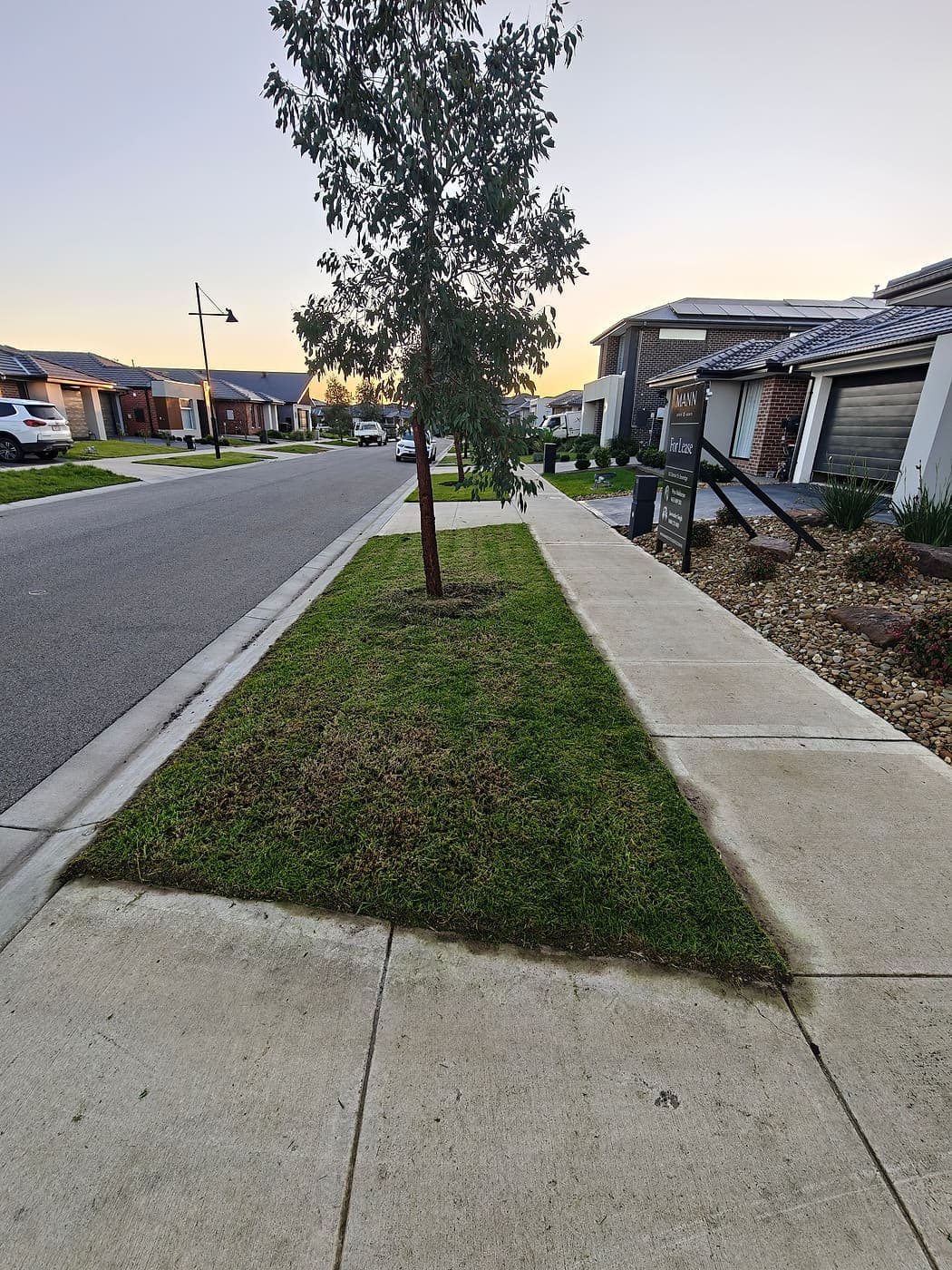
The nature strip is part of the job too. Who is expected to mow it, and to what standard, depends on your council, and the rules differ across Melbourne. Our post on nature strips and what the council expects explains how to find your council's rules.
What to do with clippings
- Leave them: when the lawn is mown regularly and only a little comes off, the grass is dry, and the clippings disappear into the turf within a day or so.
- Catch them: when the lawn has got long, when it is wet, when weeds are setting seed, and when autumn leaves are mixed in.
- Dispose of them: in the council green waste or food and garden organics bin, or a compost heap mixed with dry brown material so it does not turn slimy.
- Never: in the road gutter or a drain, where they wash into stormwater.
What mowing problems are common in Melbourne, and how do you fix them?
The common problems are scalping, wheel ruts, a torn or patchy cut, thin lawns in shade, winter weeds and summer pests. Most of them trace back to cutting too low, mowing wet ground or using a blunt blade, and they are fixed by changing the routine rather than adding products.
| Problem | Likely cause | Fix |
|---|---|---|
| Brown, bald stripes or patches after mowing | Scalping: the cut is below the lowest height, or high spots on an uneven lawn | Raise the height a notch or two; top-dress hollows over time |
| Wheel ruts and muddy lines | Mowing wet clay in winter or after heavy rain | Wait for the surface to drain; change mowing direction each visit |
| White or frayed leaf tips | Blunt or chipped blade | Sharpen or replace the blade; clear the deck |
| Thin, spindly grass under trees | Too much shade for the grass, cut too low | Mow at the top of the range; consider a shade-tolerant grass or a bed |
| Lawn browns quickly in late summer or autumn | Heat stress, or caterpillars such as lawn armyworm | Check for caterpillars at dusk; water deeply within the rules; raise the cut |
| Pale tufts of grass that seed in winter | Winter grass, an annual weed | Catch clippings while it is seeding; thicken the lawn in spring |
Clay soils, common across Melbourne's north and west, are the reason ruts and compaction come up so often. Wet clay squashes under wheels and feet and then sets hard, which starves roots of air. Sandier soils in the south-east drain faster but dry out sooner in summer, so a higher cut matters even more there.
Is it caterpillars or just heat?
A lawn that turns brown in irregular patches over a few days in late summer or autumn may have caterpillars feeding on the leaf. A common home check is to mix a little detergent into a bucket of water, pour it over a square of lawn at the edge of a brown patch around dusk, and watch for caterpillars rising within ten minutes. If nothing appears and the patches match the sunniest, driest parts of the lawn, heat and water stress are the more likely cause. Any product used must be applied exactly as the label directs.
Get help rather than pushing on when the job involves steep slopes or embankments where a mower could roll, grass around pools, retaining walls or drop-offs, long grass that may hide snakes, glass or hidden objects, or chemical treatment for pests and weeds you are unsure about. Snakes can be active in warmer months, especially near bushland, creeks and wetlands, so very long grass is worth treating with care. A lawn that keeps failing despite a good mowing routine may also need a closer look at soil, drainage or shade.
When is it worth hiring a lawn mowing service?
It is worth handing mowing over when the lawn is getting away from you in spring, when you want it kept at the right height all year without thinking about it, or when edges, the nature strip and the clean-up are the parts you never get to. A regular service also makes the seasonal changes for you: frequency, height and when to catch rather than mulch.
Action Garden's lawn mowing covers mowing to the right height for your grass, edge trimming along paths, beds and fences, the nature strip, clippings mulched back in or removed, a seasonal change of frequency and a full tidy-up. Visits can be weekly, fortnightly or one-off, and add-ons include aeration and dethatching, a fertiliser programme and weed control.
What affects the quote is the lawn itself, not a fixed rate:
- the size of the lawn and how overgrown it is;
- edges, the nature strip and access, such as side gates, steps and slopes;
- whether it is a one-off mow or a regular schedule;
- add-ons such as fertilising or weed control.
If the rest of the garden needs regular attention as well, mowing can be combined with gardening services such as weeding, pruning and mulching, or set up as one of the regular maintenance plans. Mowing is one part of lawn health, and our lawn care guides cover the other jobs that keep a lawn thick.
If you would rather spend your weekends on the lawn than behind the mower, ask for a free quote and the team will set the height, frequency and edges to suit your grass.
Your Garden. Our Promise.
From our jobs
Frequently asked
What hours am I allowed to run a lawn mower in Victoria?
How do I mow a lawn that has got far too long?
Is it bad to mow a wet lawn?
How often should mower blades be sharpened?
Do grass clippings cause thatch?
Should I mow during a heatwave?
What does a regular mowing visit from Action Garden include?
Is a cylinder mower better than a rotary mower?
Sources and further reading
- Climate statistics for Melbourne (Olympic Park), Bureau of Meteorology
- Residential noise, EPA Victoria
- Permanent Water Saving Rules, Yarra Valley Water
- Permanent Water Saving Rules, South East Water
- Native lawns, Sustainable Gardening Australia
Caring for Melbourne gardens since 2019. Updated 17 November 2026.
Related reading