


Property care: rentals, sales and strata guide
Fire season property checklist for Melbourne's outer suburbs
By the Action Garden team · Updated · 15 min read
Checked against: CFA, Victorian Government, Bureau of Meteorology, Water Victoria
TL;DR
- Do the big clean-up in late winter and early spring, before your council area's Fire Danger Period starts.
- Keep grass between 5 and 10 cm and aim for about 10 metres of well-mown ground around the house.
- The first metres around the house matter most: gutters, corners, doormats, woodpiles, gas bottles and mulch.
- Check VicPlan to see whether you are in a Bushfire Prone Area or a Bushfire Management Overlay before you clear.
- Once the Fire Danger Period starts, burning off needs a permit and mowers in dry grass have strict conditions.
| When | What to do | Notes |
|---|---|---|
| Late winter (August) | Plan and book the big jobs | Walk the block, list heavy pruning, green waste and gutter work |
| Early spring (September to October) | Main clean-up | CFA says the Fire Danger Period can start as early as October |
| Late spring (November) | Second pass | Grass grows fast after spring rain, so mow and clear again |
| Summer (December to February) | Weekly to monthly upkeep | Mow, clear leaves and gutters, check before hot, windy days |
| Autumn (March to May) | Keep going until restrictions lift | The Fire Danger Period can last until May in some areas |
When should you start preparing a property for fire season in Melbourne?
Start in late winter and finish the big jobs in early spring, before CFA (opens in a new tab) declares the Fire Danger Period for your council area. CFA says that period can start as early as October and run as late as May, depending on rainfall and how quickly grass cures.
The Fire Danger Period is declared council by council, not for the whole state at once. In the 2025 to 2026 season, for example, CFA announced it would begin at 1am on Monday 29 December 2025 for Knox, Yarra Ranges, Maroondah and Manningham, after other areas had already started. Check the CFA website for your own municipality each year rather than relying on last year's date.
Timing matters for two reasons. Once the period starts, burning off garden waste needs a permit, and machinery used in dry grass has to meet strict conditions. And spring growth is fast: grass cut in September can be knee high again by November after good rain.
- August: walk the property, list the heavy jobs and book help early.
- September to October: do the main clean-up, pruning and green waste removal.
- November: second pass after spring growth, and a full gutter clean.
- December to April: steady upkeep, with an extra check before forecast hot, windy days.
Melbourne days of 30 °C or more, October to April
| Month | Mean days of 30 °C or more |
|---|---|
| Oct | 0.8 |
| Nov | 3.1 |
| Dec | 5.8 |
| Jan | 7.8 |
| Feb | 7.0 |
| Mar | 5.0 |
| Apr | 0.5 |
Source: Bureau of Meteorology (opens in a new tab), Melbourne Regional Office (086071), records 1855 to 2015. Hot days climb from November and stay high through March, so the property needs to be ready before December and kept that way into autumn.
Is your property in a Bushfire Prone Area or overlay?
Find out before you clear anything, because the rules about what you may remove depend on it. Make a free property report on VicPlan, the Victorian Government (opens in a new tab)'s planning map, and look for a Bushfire Prone Area designation or a Bushfire Management Overlay (BMO), along with any vegetation or landscape overlays.
Many of Melbourne's outer suburbs carry one or both. The obvious ones sit where houses meet bush: the Dandenong Ranges, the edge of the Yarra Valley, the green wedge country to the north-east and parts of the Mornington Peninsula. Less obvious are the grassland fringes in the north and west, where new estates back onto paddocks, reserves and vacant lots that cure to dry, tall grass by summer.
Property status also shapes what a buyer, tenant or insurer will ask about. If the report shows overlays you do not understand, ask your council's planning department. This guide explains how the exemptions work, but it does not give a ruling for any particular property.
What should the checklist cover close to the house?
Start at the walls and work outwards, because the first few metres around the house are where embers land and collect. CFA's property advice focuses on removing the small, dry fuel that catches first: leaves, twigs, loose bark and anything burnable left against the building.
The house and roof line
- Clear leaves, twigs and rubbish from gutters, valleys and downpipes.
- Cut back branches that overhang the roof.
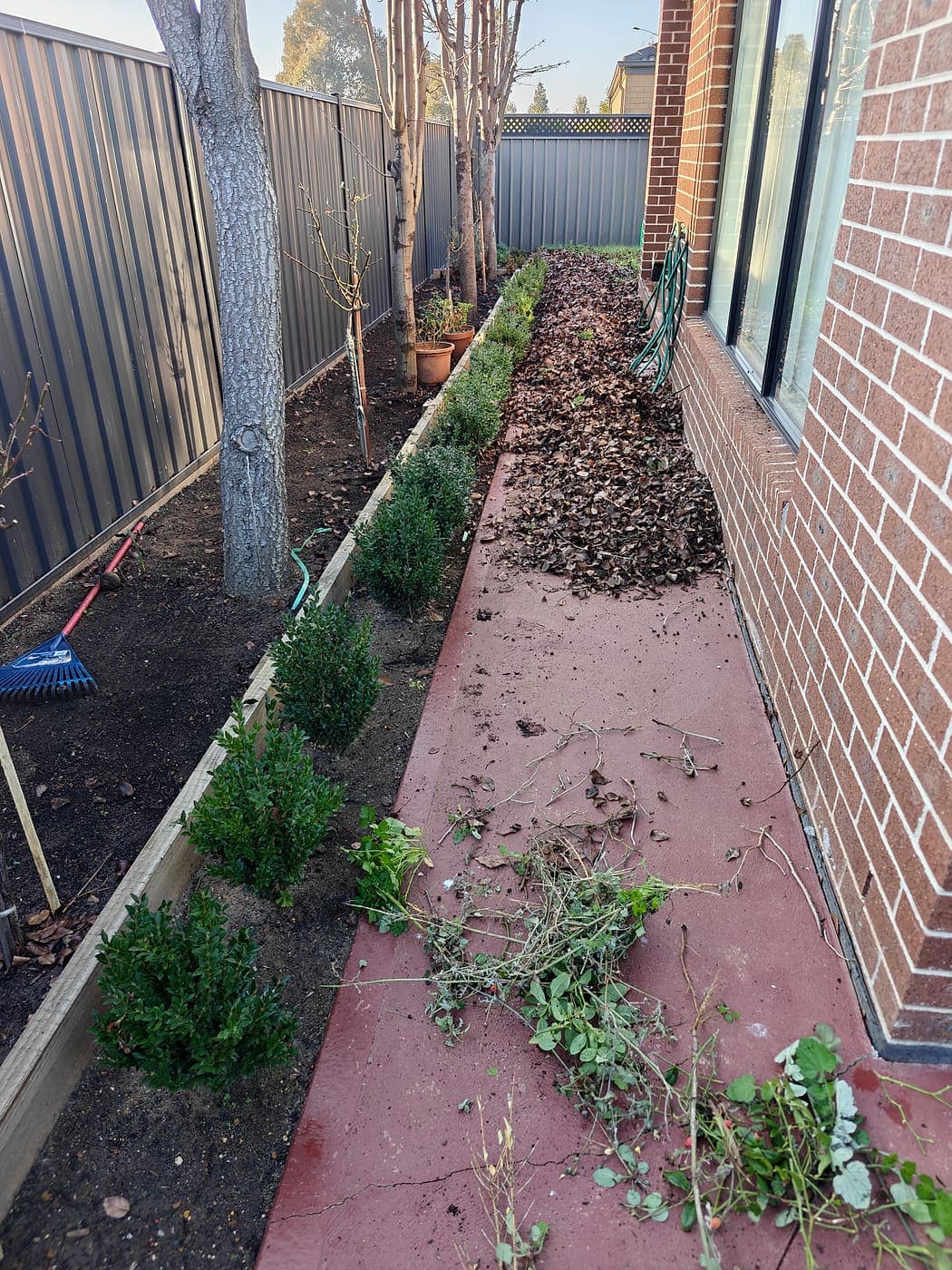
- Rake leaf build-up from corners, doorways, steps and under decks, where embers collect.
- Seal gaps and vents, and close off or cover underfloor areas.
- Clear flammable items from decks and verandahs: boxes, cushions, doormats and stored furniture.
Gutters get their own guide, because the job has its own safety questions. Our guide to gutters and bushfire season covers what CFA recommends for roof lines, leaf guards and downpipes.
Garden beds and stored fuel
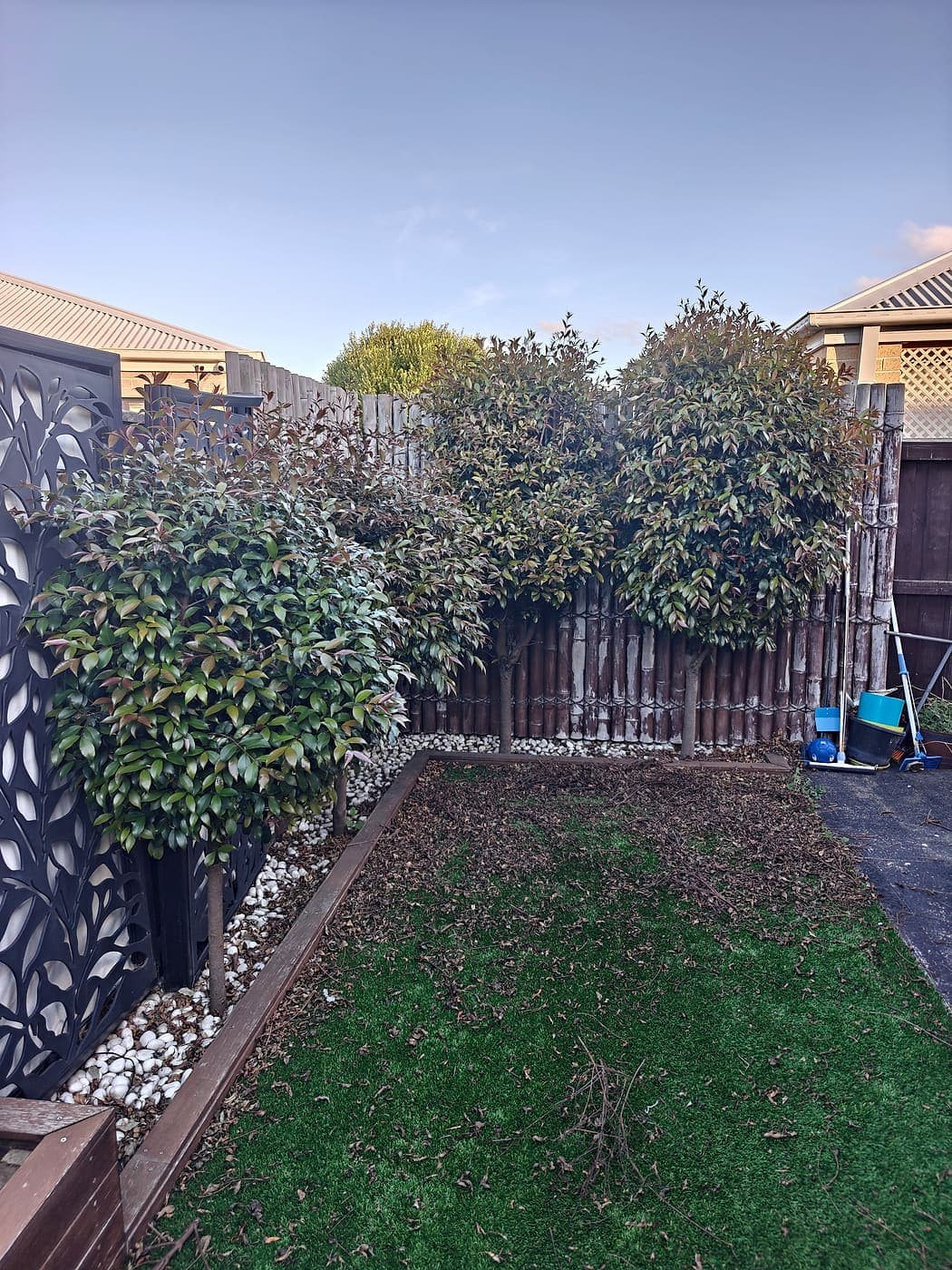
- Swap flammable mulch in the beds right against the house for pebbles or rock, as CFA advises.
- Avoid large shrubs next to or under windows; prune them low or move them further out.
- Move woodpiles away from the house; CFA notes they become ember traps in summer.
- Store fuels and garden chemicals away from the home.
- Check gas bottles are secured, with relief valves facing away from the house.
- Mark every water source: taps, tanks, pools and hoses long enough to reach the house.
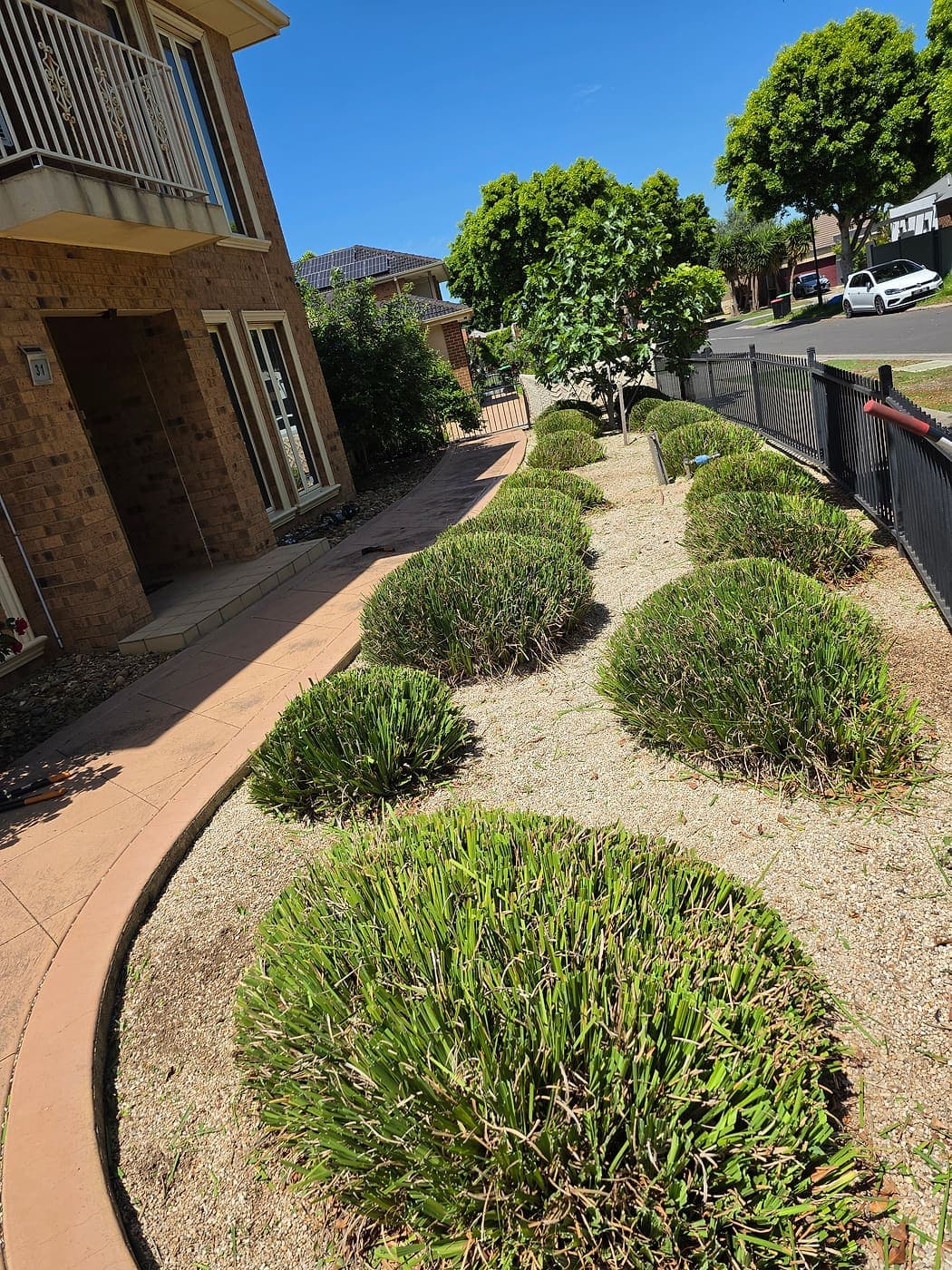
How short should the grass be, and how far out should you clear?
Keep grass between 5 and 10 cm through the season, and aim for about 10 metres of well-mown grass around the house where the block allows. Those are CFA's figures, and they are the backbone of the outer-yard checklist.
- Mow to between 5 and 10 cm, and trim along fences, sheds and driveways where the mower cannot reach.
- Keep about 10 metres of mown ground around the house if possible.
- Keep branches 10 metres clear of buildings where you can.
- Prune branches lower than about 2 metres off the ground, so fire on the ground cannot climb into trees.
- Keep shrubs under trees short and well apart from the branches above.
- Remove dry grass, leaves, twigs and loose bark, and take green waste away from the house.
Lower than 5 cm is not better. Scalped lawn dies back in heat, leaving bare, dusty patches that weeds take over by autumn. A lawn kept at the right height, and watered within the rules, stays green longer and burns far less readily than cured grass.
Mature trees are not automatically the enemy. CFA notes that well-placed trees away from the building can shield it from radiant heat and embers. The aim is separation: a gap between ground fuel, shrubs and tree canopies, and a gap between all of them and the house.
A plan view of a house on a suburban block. A narrow ring hugging the walls is marked "first metres": gutters, corners, doormats, woodpile, gas bottles and stone mulch. A wider band out to 10 metres is shaded as mown grass at 5 to 10 cm, with tree branches cut back so none reach within 10 metres of the roof. A dashed outer line at 30 metres (50 metres in a Bushfire Management Overlay) shows how far the permit exemption reaches for vegetation other than trees. Along the boundary fence, a strip up to 4 metres wide in total, split across both sides, shows the fence line exemption.
What does the 10/30 rule let you clear without a permit?
The 10/30 rule is a planning permit exemption, not an obligation. CFA explains that in a designated Bushfire Prone Area you do not need a permit to clear any vegetation, including trees, within 10 metres of your house, or any vegetation other than trees within 30 metres. In a Bushfire Management Overlay the same idea applies out to 50 metres for vegetation other than trees, known as the 10/50 rule.
| Rule | Where it applies | Trees | Other vegetation |
|---|---|---|---|
| 10/30 | Designated Bushfire Prone Area | Within 10 metres of the house | Within 30 metres of the house |
| 10/50 | Bushfire Management Overlay | Within 10 metres of the house | Within 50 metres of the house |
| Fence line | Bushfire prone areas, including the BMO | Along an existing boundary fence | Combined width of up to 4 metres across both sides |
There are conditions. CFA says the exemptions cover homes built or approved before 10 September 2009 (and certain homes rebuilt after the 2009 fires), and that newer buildings will likely need a permit to clear. CFA also advises checking with your council before removing native vegetation or significant trees, "even if you believe you can clear vegetation without a permit".
Working out the fence line allowance
The fence line exemption covers a combined width of up to 4 metres across both sides of an existing boundary fence, and you need written permission from your neighbour before clearing on their side. CFA gives worked examples:
- If your neighbour has cleared 1 metre on their side, you can clear up to 3 metres on yours.
- If they have cleared 2 metres, you can clear up to 2 metres.
- If they have cleared 4 metres or more, you can clear up to 1 metre.
Anything beyond that would likely need a permit. CFA also notes that fences built after 10 September 2009 will likely need a planning permit for clearing, so check with council first.
What can you do with mowers, fires and green waste during the Fire Danger Period?
You can keep mowing and trimming, but in dry grass the machine and the site have to meet CFA's conditions, and burning off needs a permit. On Total Fire Ban days, CFA asks people to avoid this work where possible.
| Activity | During the Fire Danger Period | On a Total Fire Ban day |
|---|---|---|
| Mower, line trimmer or chainsaw in dry grass | Allowed with conditions (see below) | Avoid where possible; same conditions if essential |
| Mowing green grass | Allowed; CFA suggests carrying the same equipment | Avoid where possible |
| Burning off garden waste | Only with a Fire Danger Period permit, and attended | Banned; existing permits are suspended |
| Incinerator | Only under strict conditions, after checking council local laws | Banned |
| Angle grinding or welding outdoors | Allowed with a spark shield, cleared area and water | Banned |
CFA's conditions for machinery in dry grass
CFA's "Can I or can't I?" guidance says a mower, grass trimmer or chainsaw used in dry, non-green vegetation during the Fire Danger Period must be "free from faults and mechanical defects that could cause an outbreak of fire" and "fitted with an efficient spark arrester".
You also need to clear flammable material for at least 3 metres around the machine, and someone must be present the whole time with a 9 litre knapsack spray pump or a 9 litre water fire extinguisher. Slashers and tractors working within 9 metres of vegetation have their own equipment rules. A blade striking a rock in cured grass is a real ignition source, so mow dry grass early in the day and keep water close.
Getting rid of green waste without burning
Once the Fire Danger Period is declared, the simplest plan is to take green waste off the property. Options include the council green waste bin, a booked council collection where your council offers one, a transfer station, or a garden waste removal service.
Chipping prunings and spreading the mulch well away from the house also works. What does not work is leaving piles of cuttings at the back fence for the summer, where they dry into exactly the fuel the clean-up was meant to remove. Our garden rubbish removal service takes away green waste, and recycles or composts it where possible.
How do you keep the property ready through summer?
Treat fire season as a maintenance programme, not a one-off tidy. CFA suggests trimming grass, clearing gutters and removing dead undergrowth regularly through the season, weekly, fortnightly or monthly depending on the size of the property, with reminders set so the jobs are not left to the last minute.
A workable rhythm for an outer-suburban block:
- Weekly or fortnightly: mow and edge, and blow leaves from paths, corners and decks.
- Monthly: check gutters and valleys, trim along fences and sheds, and remove green waste.
- After every strong wind: look for fallen branches, loose bark and leaf drifts against walls.
- Before forecast hot, windy days: a final mow, leaf clear and gutter check, done in the days before.
Watering helps a lawn stay green and slows how quickly it cures. Under Victoria's permanent water saving rules (opens in a new tab), "sprinklers and watering systems can only run between 6pm and 10am", while a hand-held hose with a trigger nozzle can be used at any time. Water deeply and less often, in the cool of the evening or early morning.
Gutters, mowing and green waste all fit naturally into a regular visit. The complete guide to garden maintenance in Melbourne sets out the full year, so fire season jobs sit alongside feeding, pruning and mulching rather than competing with them.
What changes for rentals, vacant blocks and commercial sites?
The checklist stays the same; who does the work, and how often, changes. A property nobody visits every day can go from tidy to overgrown in a single wet spring, so the schedule matters more than the scope.
- Rentals: routine garden care and the bigger jobs, such as gutters and major pruning, are often split between renter and rental provider, and the lease can change that split. Our guide to preparing the garden for a routine rental inspection covers what an inspection looks at.
- Vacant blocks: long grass on an empty lot is one of the most common reasons councils issue fire prevention notices. See keeping vacant blocks tidy and compliant for a mowing and slashing plan, and our explainer on council fire prevention notices for what a notice means.
- Commercial and strata sites: large grounds need fire season jobs written into the scope, with dates, so they happen before the first hot spell. Our guide to what a good commercial grounds programme includes shows how to set that out.
What should you do in the days before an Extreme or Catastrophic day?
Finish the property work in the days beforehand, not on the day. CFA's advice for the lead-up to Extreme or Catastrophic fire danger is to mow the lawn, clear leaves and debris, clean gutters, move flammable items away from the house, move pot plants a few metres away from the walls, and check gas bottles.
On the day itself, your bushfire plan comes first. If your plan is to leave early, the garden work should already be done; nobody should be on a ladder or running a mower in dry grass on a Catastrophic day. CFA asks people to avoid machinery work on Total Fire Ban days wherever possible.
- Mow and clear leaves two or three days ahead.
- Check gutters and remove anything blown in since the last clean.
- Bring doormats, cushions and outdoor furniture inside or well away from the house.
- Move pot plants and stored items off decks.
- Re-read your household bushfire plan and check the CFA website for warnings.
What are the most common fire season mistakes?
Most problems come from timing and from leaving the clean-up half finished. These are the ones to avoid.
- Starting after the Fire Danger Period is declared. Burning is then off the table and dry-grass machinery rules apply.
- Cleaning up once in spring and stopping. Grass and leaf fall keep coming through summer.
- Leaving green waste in piles. Cuttings at the back fence become fuel by January.
- Bark mulch against the walls. Use stone in the first strip around the house.
- Scalping the lawn. Below 5 cm, grass dies back and leaves bare, weedy ground.
- Clearing without checking. The exemptions have conditions, and council protections can still apply to native vegetation and significant trees.
- Working with machinery in cured grass on hot, windy afternoons. Do it early, with water on hand, or not at all on a Total Fire Ban day.
Some fire season jobs carry real risk. Leave roof and two-storey gutter work to someone with the right access gear if you are not confident on a ladder. Large branches over the roof, dead trees and anything near power lines need trained tree workers; the Action Garden team does that work. Long grass in the outer suburbs can hide snakes in warm weather: back away, keep children and pets clear, and call a licensed snake catcher rather than trying to move one.
Is it worth handing the fire season work over?
If the block is large, you are away over summer, or the property is a rental or vacant, it can be worth putting the jobs on a schedule with a team that will turn up before you think of it. Our gardening services cover the clean-up, pruning, mowing and green waste removal that this checklist describes, and the same jobs can be built into a regular plan through the season. More guides for landlords, sellers and strata managers sit under property care guides.
When you are ready, get a free quote.
Your Garden. Our Promise.
From our jobs
Frequently asked
Does the 10/30 rule mean I have to clear 30 metres around my house?
Do the bushfire clearing exemptions cover a house built after 2009?
What should I do with green waste once burning off needs a permit?
Can I use a line trimmer in dry grass during the Fire Danger Period?
How often should a bushfire-prone block be mowed over summer?
Are grassfires a risk in Melbourne's northern and western growth suburbs?
Should large shrubs be removed from under windows before summer?
Sources and further reading
- How to prepare your property (CFA)
- Removing vegetation, trees and other plants (CFA)
- About the Fire Danger Period (CFA)
- Can I or can't I? (CFA)
- VicPlan property reports (Victorian Government)
- Melbourne Regional Office climate statistics (Bureau of Meteorology)
- Permanent water saving rules (Water Victoria)
Caring for Melbourne gardens since 2019. Updated 18 November 2026.