


Property care: rentals, sales and strata guide
Vacant blocks and open lots: keeping them tidy and compliant
By the Action Garden team · Updated · 11 min read
Checked against: Hume City Council, City of Whittlesea, CFA, EPA Victoria, Agriculture Victoria
TL;DR
- Councils set the height limit, and it varies; Hume asks for under 10 cm and Whittlesea says no more than 20 cm on residential vacant land.
- Fire Prevention Notices are issued under the CFA Act, and ignoring one can bring a fine and a council contractor's bill.
- Plan the first cut in October, before inspections, then keep it short through to the end of summer instead of one big slash.
- Slash long grass in two stages, check the ground first, and take heavy cut material away so it does not become fuel.
- Dumped rubbish and declared weeds are the owner's problem too, so check the block each visit and report anything hazardous.
| Season | How often | Notes |
|---|---|---|
| September to October | First cut, slash if long | Get ahead of spring growth and council inspections |
| November to December | Every 3 to 6 weeks, by growth | Fire Danger Periods begin in many municipalities; keep under the limit |
| January to March | As needed after rain | Dry grass grows slowly, but summer storms bring flushes |
| April to August | One or two tidy-ups | Weeds, dumping and access checks; ground often too wet to slash |
What does keeping a vacant block compliant actually involve?
It means keeping grass and weeds below your council's height limit, keeping the block free of rubbish and flammable material, and controlling declared weeds. Councils check vacant land most closely in the lead-up to fire season, but the duty to keep land safe runs all year.
Hume City Council (opens in a new tab) puts it plainly: "As a property owner, it is your responsibility to keep your property clean through the year." The same idea runs through every Melbourne council's local laws, even though the details differ.
In practice, compliance on a vacant block comes down to four jobs:
| Job | Why it matters | When |
|---|---|---|
| Grass and weeds cut below the limit | Fire risk, council notices, neighbours | Spring and summer, on a cycle |
| Rubbish and dumped waste removed | Fire risk, vermin, attracts more dumping | Every visit |
| Fence lines and boundaries cleared | Grass along fences is where fires and complaints start | Every cut |
| Declared weeds controlled | Legal duty for landowners | Before seed set, usually spring |
The work itself is the same mowing and slashing covered in our complete guide to lawn mowing in Melbourne, applied to rougher ground and longer grass, with fire season deadlines on top.
What height limit applies, and who sets it?
Your council sets it, and it varies across Melbourne. There is no single height for the whole city, so check your own council's fire prevention or local laws page before you book the work.
Two examples from Melbourne's north show the difference:
- Hume City Council asks owners to keep "grass and weeds so they are less than 10cm in height, including around fence lines".
- City of Whittlesea says that on residential vacant land "you must ensure the grass, weeds and scrub do not grow to more than 20cm high", and that urban and commercial vegetation, including nature strips, must be kept shorter than 20 cm all year round.
Other councils use different wording, and some judge the fire risk on inspection rather than a single number. Whatever the figure, aim well under it. Grass that is cut to the limit in October is over it again within weeks in a wet spring.
How do Fire Prevention Notices work?
A Fire Prevention Notice is a formal notice from your council, issued under the CFA (opens in a new tab) Act, that lists the work needed to reduce a fire hazard on your land and the date it must be done by. It usually follows an inspection in late spring, before or as the Fire Danger Period starts.
The usual sequence looks like this:
- Advisory letters. Many councils write to vacant land owners each year before fire season. Hume says it sends advisory letters to vacant land owners every year.
- Inspection. A municipal fire prevention officer inspects the block.
- Notice. If the block is a hazard, the council issues a notice listing the works, such as cutting grass, removing rubbish or clearing fence lines, with a deadline.
- Response. Some councils, including Hume, ask owners to confirm the works through an online form.
- Follow-up. If the work is not done, the council may issue an infringement and send its own contractor, with the cost passed on to the owner.
Hume also notes that if court proceedings are taken, the penalty can be up to 120 penalty units or 12 months' imprisonment. Those are maximums, not the usual outcome, but they show how seriously councils treat an ignored notice. Our fire season property checklist covers the wider preparation for blocks on the urban fringe.
Owners who live interstate or overseas
Councils send notices to the owner's address on their rates record. If that address is out of date, or mail sits unopened at an empty house, the deadline can pass before you know about it.
Keep your rates address current, and give a local contact, such as a property manager or a regular contractor, permission to check the block and tell you about any notice on the fence or in the letterbox. Booking cuts in advance on a set cycle avoids most notices in the first place.
When should a vacant block be cut through the year?
Plan the first cut for September or October, before council inspections begin, and keep the grass short through to the end of summer. One big slash in December is the most common mistake: by then the grass is long, dry and hard to cut, and the block has already been inspected.
Melbourne's growing year drives the timing. Spring rain and warming days bring the fastest growth from September to November. Grass then dries and slows in summer, though a storm can bring a fresh flush. Autumn and winter growth is slow, and clay blocks become too wet to slash without leaving ruts.
A typical cycle for a residential lot looks like this:
- September to October: first cut; slash if the grass has grown long over winter.
- November to December: cut every few weeks, depending on growth, so the block stays well under the limit through inspections.
- January to March: cut as needed after rain, and clear any rubbish that has built up.
- April to August: one or two visits to check for dumping, weeds and fence damage.
A line chart in brand colours, months along the bottom from September to March. A dashed horizontal line marks the council height limit. One line, labelled "cut on a cycle", rises and drops in a sawtooth pattern, always staying below the dashed limit. A second line, labelled "one big slash", climbs steeply through spring, crosses the limit in October and stays above it until a single drop in December. A small marker on the second line in November reads "inspection". The diagram shows why a cycle of cuts keeps a block compliant.
How is an overgrown block brought back under control?
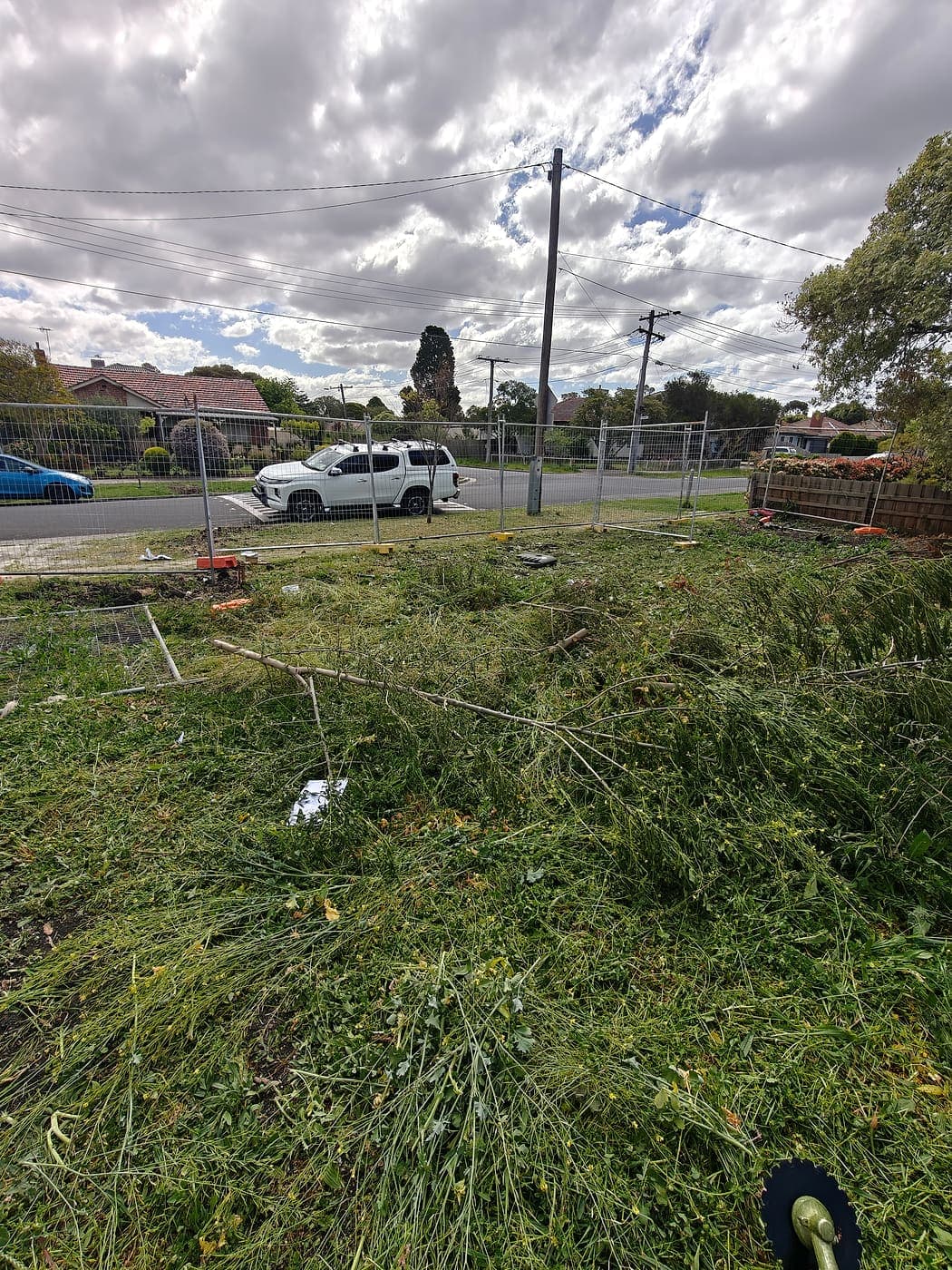
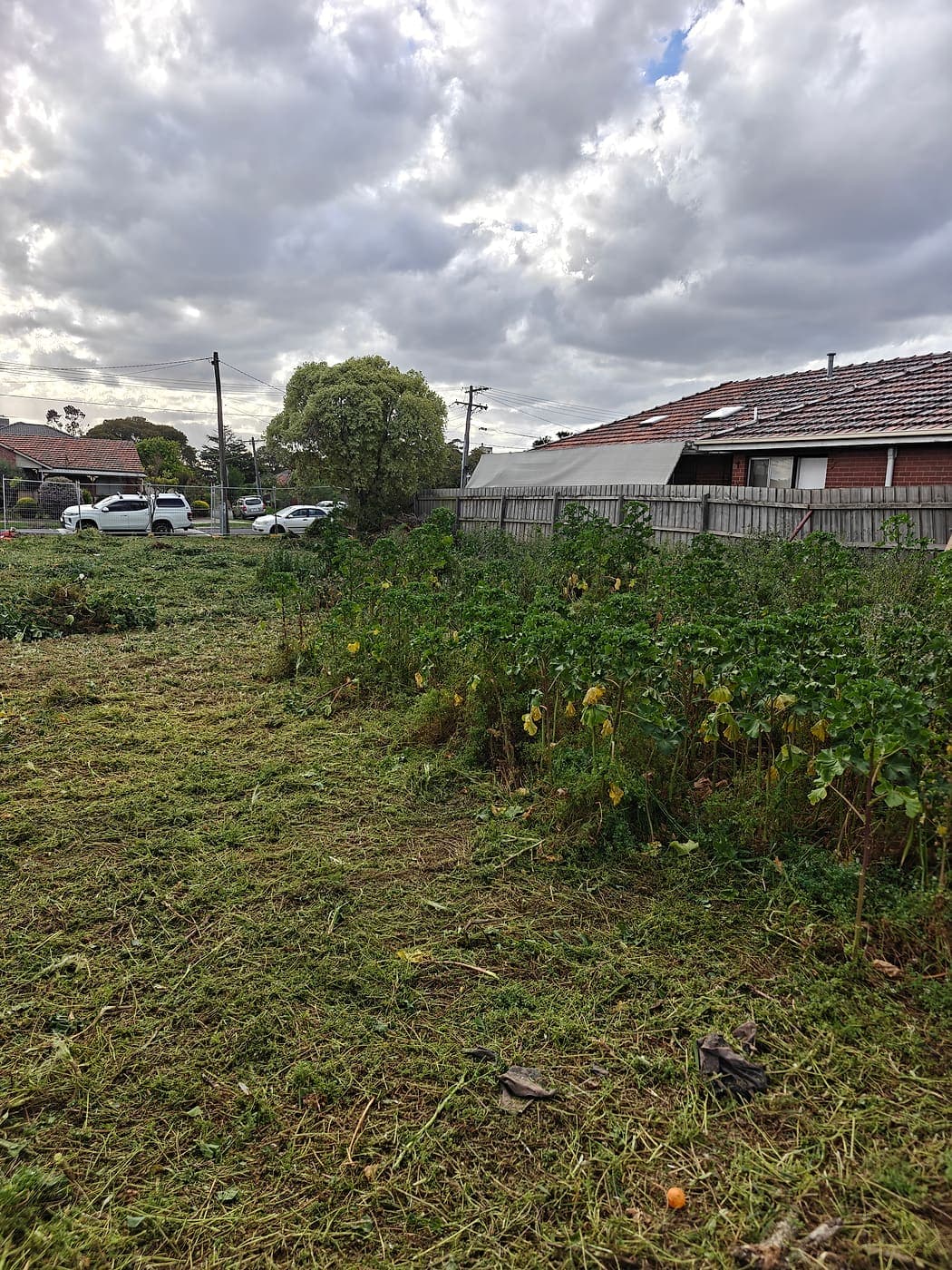
Walk the block first, then cut it in stages, and remove the heavy material. Long grass hides rubbish, holes, stakes and old fencing that can wreck a machine or hurt someone.
- Walk the block. Look for dumped rubbish, sharp objects, star pickets, pits, holes and soft ground. Mark or remove hazards.
- Clear rubbish first. Take out loose rubbish so it is not shredded and scattered by the slasher.
- First cut high. Slash or brush-cut the long growth at a high setting, so the machine is not overloaded and the cut is even.
- Second cut lower. Once the bulk is down, cut again to the target height.
- Fence lines by hand. Use a line trimmer along fences, posts and around obstacles where a slasher cannot reach.
- Deal with the cut material. Rake heavy thatch into rows and remove it, or mow it again to break it down.
- Book the next cut. A block that has just been reset grows back fast in spring.
During the Fire Danger Period, CFA rules apply to mowers, trimmers and slashers used in dry grass. Machines must be in good order and fitted with a spark arrester, the area around the machine cleared, and a knapsack spray or water extinguisher of at least 9 litres on hand. CFA says this work "should be avoided wherever possible" on Total Fire Ban days.
Slashing long grass is heavy machine work on unknown ground. Get help if the grass is above knee height, the block is steep or rough, the ground is soft clay, or you find dumped building waste. Never touch or break fibrous sheeting or pipes that could contain asbestos: keep clear and call a licensed asbestos removalist. If you see a snake, leave the area and let it move on.
What about rubbish, dumping and declared weeds?
Rubbish and declared weeds are part of keeping a block compliant, not optional extras. A tidy, regularly cut block also attracts far less dumping than one that already looks abandoned.
EPA Victoria (opens in a new tab) is clear that dumping waste on private land is an offence, and that landlords can be liable for waste tenants leave behind. EPA deals mainly with large-scale and hazardous dumping and passes other reports to councils. For a small pile on your block, the practical step is to photograph it, report it to your council, and have it removed safely. Our rubbish removal service takes garden waste and general rubbish; anything that might contain asbestos or chemicals is left alone and flagged for a specialist.
Declared weeds carry a separate legal duty. Under Victorian law, landowners must control declared noxious weeds on their land, and Agriculture Victoria (opens in a new tab) publishes the list for each region. On vacant lots in Melbourne's north and west, grassy weeds such as serrated tussock and Chilean needle grass spread fast from open land, so they are worth learning to recognise.
Weeds that slashing spreads
Slashing a weedy block after the weeds have set seed can spread that seed across the block and onto the machine, which then carries it to the next site. Cut before seed heads mature where you can, and clean down machines between sites.
Where declared weeds are already established, slashing alone will not control them. They may need spot spraying, used strictly as the label directs, or removal by hand. Check Agriculture Victoria's guidance for the weed you have before you start.
How do commercial and industrial lots differ?
Commercial and industrial lots follow the same council rules but are usually bigger, rougher and further from anyone who checks them. They also often sit inside a larger site with a car park, verges and fence lines that need the same treatment.
The main differences are scale and access. Large lots may need a tractor slasher rather than a ride-on mower, access through locked gates must be organised, and verges along the road are in public view. Our article on industrial and warehouse grounds covers weeds, verges and drainage on those sites, and the story of a commercial grounds job, start to finish shows a long-neglected site brought back.
The same cycle works for land that is between uses, such as a house that has been demolished, a lot waiting for a building permit, or a block next to a new build in its first year.
When is it worth handing the block to someone else?
It is worth handing over when you do not live nearby, when the block is too big or rough for a domestic mower, or when you have already had a council letter. A regular booked cycle costs less effort than chasing a deadline each November.
Our lawn mowing service covers vacant blocks and open lots, with photos after each visit so owners who live away can see the block without driving out. If you also have a home or rental to look after while you are away, our guide to looking after the garden while you are away covers that side, and more property guides sit under property care.
When you are ready, get a free quote.
Your Garden. Our Promise.
From our jobs
Frequently asked
What height does grass on a vacant block have to be kept at in Melbourne?
What happens if I ignore a Fire Prevention Notice on my land?
Is slashing or mowing better for a vacant block?
Who looks after a vacant block that has a builder on site?
Can I leave the cut grass lying on the block?
Do I need to mow a vacant block in winter?
Are snakes a real risk on overgrown vacant land in Melbourne?
Sources and further reading
- Fire management (Hume City Council)
- Mowing and slashing land (City of Whittlesea)
- Fire Danger Period and Total Fire Ban restrictions, can I or can't I (CFA)
- Dumped waste (EPA Victoria)
- Weeds (Agriculture Victoria)
Caring for Melbourne gardens since 2019. Updated 18 November 2026.