


Property care: rentals, sales and strata guide
New build gardens: the first year of maintenance
By the Action Garden team · Updated · 11 min read
Checked against: Building and Plumbing Commission, formerly the Victorian Building Authority, Yarra Valley Water, Before You Dig Australia, Sustainable Gardening Australia
TL;DR
- Builder's soil is usually compacted clay with little topsoil, so improve the soil before you plant, not after.
- New turf and plants need deep, regular watering until they root, inside Victoria's permanent water saving rules.
- Keep garden beds and mulch off the walls; the building authority warns this gives termites a hidden way in.
- Check underground services through Before You Dig Australia before digging holes for trees, posts or edging.
- Read your estate design guidelines for any front landscaping deadline counted from the Certificate of Occupancy.
| When | Main jobs | Notes |
|---|---|---|
| Move-in month | Walk the yard, find pits, taps, drains and services | Photograph the yard as handed over |
| Months 1 to 3 | Soil preparation, front landscaping, first plantings | Plant in autumn or spring where you can |
| First spring | Weekly mowing, weeding, feeding once soil warms | Weeds arrive fastest on bare new soil |
| First summer | Deep watering of new plants, mulch top-up | Watering systems 6pm to 10am only |
| First autumn | Plant trees and shrubs, fix low spots, top up mulch | The best planting window in Melbourne |
| First winter | Check drainage after rain, loosen or remove stakes | Waterlogging shows on clay now |
What makes a new build garden different?
A new build garden starts with disturbed soil, young plants and no history. Construction strips or buries the topsoil, machinery compacts what is left, and everything planted has to grow roots from scratch, so the first year is about building the foundations rather than keeping up appearances.
On most new blocks around Melbourne you inherit some mix of the following:
- Compacted subsoil. Heavy vehicles and stockpiles press the soil hard, especially on the clay common in the north and west.
- Little or no topsoil. What is spread over the top is often a thin layer that hides harder ground below.
- Builder's rubble. Brick fragments, concrete slurry, plaster offcuts and packaging buried just under the surface.
- New turf and plants. If a landscaping package was included, the lawn and plants are young and shallow rooted.
- No shade or shelter. Bare fences and walls reflect heat, and there are no established trees to break wind.
None of this is unusual, and all of it improves with the right first-year care. The table at the top of this page sets out the year at a glance.
A cut-away of a new backyard beside the house. At the top, a thin strip of green turf over a shallow band of brown topsoil. Below it, a dense grey layer of compacted clay with small fragments of brick and concrete scattered through it. Animated water drops fall on the lawn, soak through the topsoil, then spread sideways along the top of the clay towards the house instead of draining down. On the house side, the concrete slab edge is shown exposed above the soil and mulch, with a small label pointing to the weep holes kept clear.
How do you fix builder's soil before planting?
Loosen it, remove the rubble and add organic matter before anything goes in the ground. It is far easier to improve soil in an empty bed than around plants that are already struggling.
- Dig test holes. A spade's depth in a few spots shows how thick the topsoil is, where the clay starts and how much rubble is buried.
- Clear the rubble. Pick out brick, concrete and plaster pieces; slurry and plaster can make the soil more alkaline in patches.
- Break up compaction. Fork or rip the bed as deep as you reasonably can, ideally when the soil is moist rather than wet or bone dry.
- Add organic matter. Mix in well-rotted compost or soil conditioner to open the structure and feed soil life.
- Consider raised beds on heavy clay. Building up the planting level gives roots a well-drained zone above waterlogged clay.
- Mulch straight after planting. Mulch protects the improved soil from crusting and drying out.
Clay in the north and west, sand in the south-east
Estates in Melbourne's northern and western growth areas mostly sit on heavy clay, often basalt-derived. It holds water and nutrients well but drains slowly, cracks when dry and sets hard after it is worked wet. Organic matter, raised beds and patience are the answer, and some of these clays respond to gypsum.
Estates in the south-east, towards the bay and the Mornington Peninsula, are more often on sandy soil. It drains quickly and is easy to dig, but water and nutrients wash through it. There, organic matter and mulch matter even more, and new plants need water more often in their first summer.
How do you look after new turf and plants in the first year?
Water deeply and regularly until the roots take hold, then gradually water less often so the roots chase moisture downwards. Shallow, frequent watering keeps roots near the surface, where they fail first in a hot spell.
New lawns. Keep new turf moist until it roots into the soil below, then move to deeper, less frequent soaks. Sustainable Gardening Australia (opens in a new tab) says "less frequent, deep watering is the best way to keep a healthy lawn over the long-term". On clay, water slowly or in two rounds so it soaks in rather than running off the new turf.
New shrubs and trees. Water at the base, into a small dish of soil around each plant, so the water goes to the root ball. Through the first summer, check the soil a finger deep every few days in hot weather.
First mows. Mow a new lawn only once it has rooted and needs it, with a sharp blade and never taking more than a third of the leaf. A light first cut encourages the grass to thicken.
How should beds sit against a new house?
Keep garden beds, soil and mulch below the slab edge and clear of weep holes and vents. Victoria's Building and Plumbing Commission (opens in a new tab) advises: "Do not build up garden beds and mulching against walls, as this allows termites an undetectable entry point to the building."
A new house is usually designed so the slab edge or termite management system can be seen and inspected. Covering it with a raised bed, a pile of mulch or soil from a later landscaping job defeats that design.
- Leave a gap between beds and the wall, with gravel or paving rather than mulch right against the house.
- Keep the slab edge visible around the whole house.
- Do not stack timber, soil bags or materials against the walls.
- Use termite-resistant timber for retaining walls and edging, as the commission recommends.
- Fix leaks and drainage problems promptly, because termites are attracted to damp conditions.
What should you check before you dig?
Check where the underground services run before you dig holes for trees, fence posts, clothesline footings or edging. New estates carry electricity, gas, water, sewer, stormwater and telecommunications cables, and some run through front yards and along boundaries.
- Lodge an enquiry with Before You Dig Australia (opens in a new tab) before any digging deeper than a garden bed.
- Look at your house plans and the builder's handover documents for drains, pits and the stormwater line.
- Keep trees away from pipes and the house. Choose species by their mature size, not the size in the pot.
- Leave pits and water meters accessible. Do not bury stormwater pits or plant over the water or gas meter.
Stop and call for help if you hit a pipe, cable, marker tape or concrete you did not expect. Do not dig near gas or electricity lines yourself; contact the asset owner shown in your Before You Dig response. Grading problems that send water towards the house, retaining walls and drainage repairs are jobs for your builder, a plumber or a qualified contractor, not a weekend fix.
Do you have a landscaping deadline on a new estate?
Many do. Estate design guidelines in Melbourne's growth areas commonly require the front garden, and sometimes the nature strip, driveway and fencing, to be finished within a set time after the Certificate of Occupancy is issued. Published guidelines range from about 30 days to six months.
The deadline, the plant list and any rules on front fences or artificial turf are in your contract of sale and the estate's design guidelines. Read them early, because a deadline that falls in mid-summer leaves new plants facing their hardest season straight away.
Planning the front garden around a deadline
If your deadline falls in summer, do the soil work, edging, paths and mulch first, and plant the hardiest required species. Put the more delicate plants in during autumn, when the soil is still warm and the weather is milder.
Keep the handover photos and the approval letters from the estate, if one is required. If you plan to sell or rent the house later, a front garden that met the guidelines and has had a year to grow presents much better than one that was rushed.
What are the common first-year mistakes?
Most first-year problems come from planting before the soil is ready and from watering too lightly. These are the ones that cost the most to fix later.
- Planting straight into compacted clay, which leaves roots circling in a hole that fills with water.
- Light daily sprinkles instead of deep soaks, which keeps roots shallow.
- Building beds up against the house, covering the slab edge and weep holes.
- Choosing trees by pot size, then finding them too big for the block in five years.
- Leaving bare soil, which grows a crop of weeds by the first spring.
- Feeding too much, too early, which pushes soft growth the roots cannot support.
Weeds on a new block
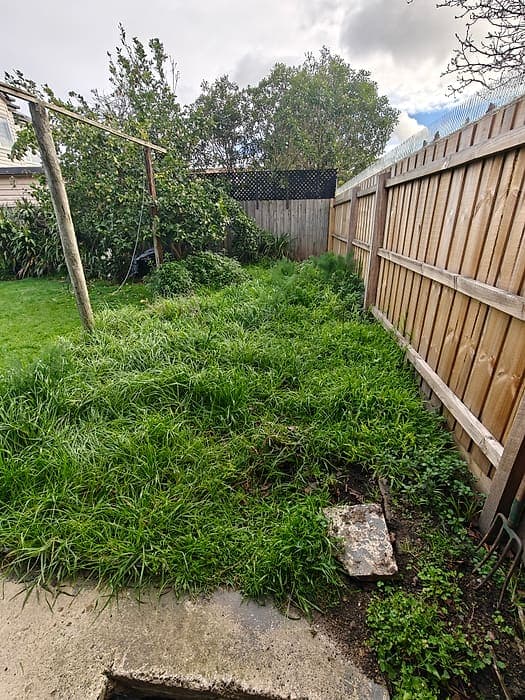
Bare new soil is quickly colonised by weeds from vacant blocks, nature strips and construction fill. The first spring is the peak, when grasses, thistles and broadleaf weeds all germinate at once.
Pull them while they are small and before they set seed, keep beds mulched, and mow the lawn regularly so weeds in the turf cannot flower. Any herbicide must be used strictly according to its label, away from new plants.
When is it worth getting help with a new build garden?
When the soil needs serious work, when an estate deadline is close, or when you would rather spend the first year settling into the house. A regular visit through the first spring and summer keeps the lawn mown, new plants watered and checked, and weeds from taking over.
Action Garden's gardening services cover soil preparation, planting, mulching and regular maintenance on a weekly, fortnightly or one-off basis. Our autumn garden checklist and winter garden checklist set out the season-by-season jobs, and the complete guide to garden maintenance in Melbourne covers the year round. If the new house is an investment, read what renters and rental providers each look after and the end-of-lease garden checklist; if you may sell, see how to get a garden ready for sale. More guides sit under property care, and you can ask for a free quote at any time.
Your Garden. Our Promise.
From our jobs
Frequently asked
How long does a new garden take to establish?
When should the stakes come off newly planted trees?
Why does water pool in my new backyard after rain?
Can I build a garden bed against the wall of a new house?
Is gypsum worth adding to clay on a new estate block?
Who is responsible for the nature strip outside a new house?
When should a new garden get its first feed?
Sources and further reading
- Termites (Building and Plumbing Commission, formerly the Victorian Building Authority)
- Exemptions to the permanent water rules, new warm season grass (Yarra Valley Water)
- Permanent water use rules (Yarra Valley Water)
- Before you dig, for homeowners (Before You Dig Australia)
- Minimising water use on lawns and turf (Sustainable Gardening Australia)
Caring for Melbourne gardens since 2019. Updated 18 November 2026.