


Trees and stumps · Complete guide
Tree removal in Melbourne: the complete guide
By the Action Garden team · Updated · 16 min read
Checked against: City of Boroondara, City of Monash, Merri-bek City Council, CFA, Victoria State Emergency Service, Energy Safe Victoria, WorkSafe Victoria, Victoria Legal Aid, Victorian Law Reform Commission
TL;DR
- Check your council's tree local law and any planning overlay first; some councils require a permit even for dead trees.
- Removal is for trees that are dead, structurally unsafe, causing damage or simply wrong for the spot; many problem trees can be fixed by trimming instead.
- Garden trees are usually dismantled in sections from the top and lowered on ropes, because there is rarely room to fell them in one piece.
- A tree near power lines, or one damaged in a storm, is a job for authorised people and the SES or your distributor, not for DIY.
- Action Garden's own team does tree removal, including a permit check, timber and debris removal and optional stump grinding.
| Situation | First step | Who to contact |
|---|---|---|
| Healthy tree you want gone | Check the local law and overlays | Your council's tree or planning team |
| Dead or dying tree | Check whether dead trees are exempt in your council | Council first; some still require a permit |
| Tree damaged in a storm | Keep clear and make the area safe | VICSES on 132 500 if it hits the house or blocks an exit |
| Tree touching power lines | Do not touch the tree or the line | Your electricity distributor; 000 if lives are at risk |
When does a tree really need to be removed?
A tree needs to come out when it is dead, structurally unsafe beyond repair, causing damage that cannot be managed, or simply the wrong tree for the place. If the problem is a branch, the shade or the gutters, trimming is usually the better answer, and it keeps the tree.
Common reasons for removal in Melbourne gardens:
- Dead or dying trees. Drought, root damage, borers or fungal disease can kill a tree over a few seasons, and dead timber becomes brittle.
- Structural failure. Split forks, a new lean, cracked limbs or decay at the base can make a tree unsafe to keep.
- Damage to the house or services. Roots in pipes, lifted paths and movement in clay soils near footings are frequent complaints.
- Wrong tree, wrong place. A fast-growing species planted too close to the house, or a tree that has outgrown a small block.
- Weed species. Some trees, such as desert ash, sweet pittosporum and some willows, spread into bushland and are often removed on purpose.
- Building and renovation work. New extensions, pools and driveways can need trees cleared, usually through the planning process.
Before deciding, consider the alternatives. A crown reduction, clearance trim or deadwooding can often solve the problem; our tree trimming guide for Melbourne shows what each option achieves. Our guide to the signs a tree may be unsafe explains which faults are urgent.
Side by side
Remove, reduce or keep and monitor
| Remove the tree | Reduce or trim | Keep and monitor | |
|---|---|---|---|
| Suits | Dead trees, failed structure, weed species, unavoidable damage | Healthy trees too big for their spot, or with a single problem limb | Healthy trees with minor issues |
| Permit risk | Highest; most local laws cover removal | Sometimes, depending on how much is cut | None |
| Result | Space and light, but loss of shade and habitat | Tree kept, problem managed | No change; needs regular checks |
| Follow-up | Stump treatment, replanting | Repeat trims every few years | An annual look, and after storms |
Do you need a permit to remove a tree in Melbourne?
Very often, yes. Most Melbourne councils protect trees above a set size through a local law, and planning overlays such as a Vegetation Protection Overlay (VPO), Significant Landscape Overlay (SLO), Environmental Significance Overlay (ESO) or Heritage Overlay can protect trees regardless of size.
The thresholds and exemptions differ widely. Three examples, from each council's website in November 2026:
| Council | Protected trees | Dead trees |
|---|---|---|
| Boroondara | Canopy trees with a trunk circumference of 110 cm or more at 1.4 m above ground, or 150 cm or more at ground level, plus registered significant trees | A permit is still needed to remove a protected canopy tree that is dead or a weed species |
| Monash | Canopy trees of at least 5 m with a 4 m canopy in controlled areas; in a VPO, trees over 10 m with a trunk circumference over 50 cm at 1.2 m | Exempt from both controls; immediate-risk work is exempt only for the part posing the risk |
| Merri-bek | Mature trees of 8 m or more with a trunk diameter over 40 cm at 1.2 m, and registered significant trees | Check with the council; a qualified arborist report may be requested |
Penalties for removing a protected tree without approval can be significant, and several councils actively investigate illegal removals and suspected poisoning. Our step-by-step guide to tree removal permits in Melbourne explains how to check the rules for your address and what an application needs.
What an arborist report for a permit usually covers
When a council asks for a report, it generally wants an independent assessment of the tree, not a quote. The report usually identifies the species, measures the trunk, describes the tree's health and structure, explains the reasons for removal and comments on any risk to people or property.
Councils often specify who can write it. Merri-bek, for example, says the arborist writing a report should hold an AQF Level 5 (Diploma) qualification or higher, and that a plumber or engineer's report is also needed if the tree is said to be damaging pipes or structures.
How is a tree removed safely in a Melbourne garden?
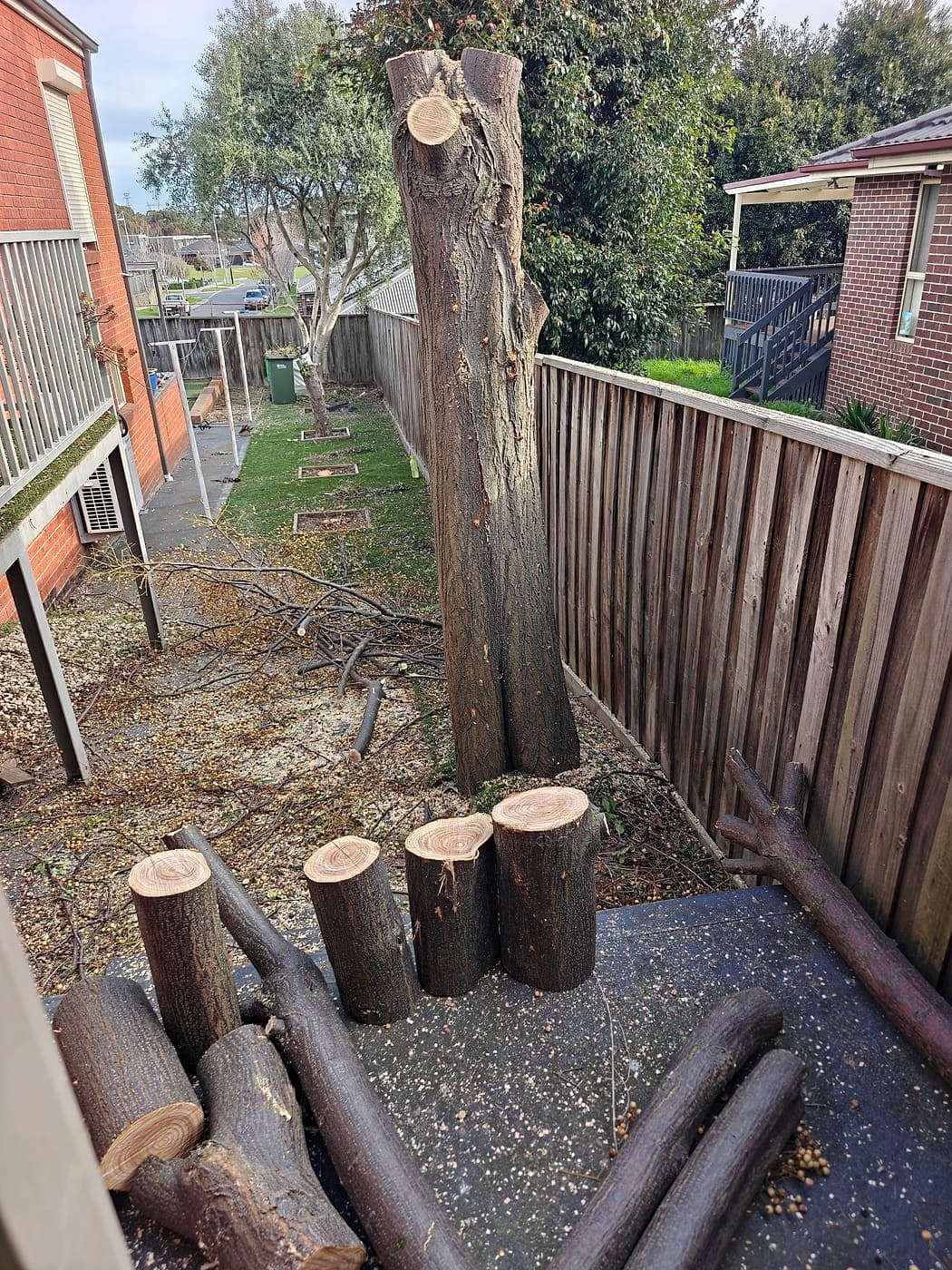
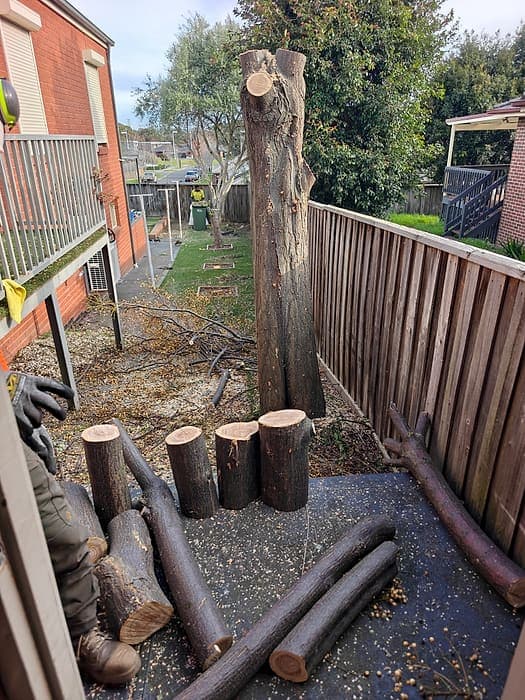
In most suburban gardens a tree is dismantled in sections rather than felled whole, because there is rarely a clear landing zone as long as the tree is tall. Climbers or an elevated platform remove the crown branch by branch, then the trunk is taken down in lengths, with heavy pieces lowered on ropes.
- Site set-up: the work zone is fenced off and kept clear of people, pets and cars.
- Crown removal: smaller branches come off first and are lowered or dropped into a clear space.
- Rigging: larger limbs and trunk sections are tied off and lowered on ropes through a pulley in the tree, controlling where each piece lands.
- Trunk sections: the trunk is shortened from the top in manageable lengths.
- Final cut: once the trunk is short enough to fall safely within the space, it is felled close to the ground.
- Clean-up: branches go through the chipper, logs are removed or stacked, and the area is cleaned.
In very tight spaces, or for large trees over a house, a crane can lift sections out instead of lowering them. That is planned case by case after a site visit; Action Garden does not use cranes and refers those jobs to a specialist with heavy equipment.
An animated side view of a tall tree beside a house and fence. The crown fades out in stages from the top while numbered rope lines show sections being lowered to a marked landing zone. A dashed exclusion zone surrounds the work area. In the last frame only a low stump remains, and an arrow points to the stump grinding step.
WorkSafe Victoria (opens in a new tab)'s guidance on working safely with trees covers preparation and planning, overhead power lines, working at height, chainsaws, falling objects, wood chippers and emergency procedures. Every one of those hazards is present on a residential removal, which is why tree removal is not a DIY job beyond very small trees.
Any tree you cannot cut down in a single piece from the ground into clear, open space needs professionals. So does every tree near power lines, buildings, fences, pools or neighbours' yards, any tree with dead limbs or decay, and every storm-damaged tree. Action Garden's own team does tree removal, after a site visit and a permit check.
What should you do about a dangerous or storm-damaged tree?
Keep everyone well clear first, and call for help according to the risk. If a fallen tree has damaged your home or car, or blocks an exit from the house, VICSES (opens in a new tab) says to call 132 500; if a life is at risk, call 000.
- Power lines involved: assume any fallen line is live. Energy Safe Victoria (opens in a new tab) advises staying at least 8 to 10 metres away, and calling 000 if lives are in danger.
- Tree hung up in another tree: do not try to pull it down. Hung-up trees can release suddenly.
- Split or leaning tree after rain: keep people and pets out of the fall zone and get it assessed promptly.
- Debris only: once it is safe, small branches can be cleared, and large timber is best left to tree crews.
After the emergency, insurance and private contractors usually handle the removal of timber and repairs. Our guide on what to do after a storm damages a tree covers the order of jobs, the insurance photos to take and who does what.
Why healthy-looking trees sometimes fall in storms
Sustainable Gardening Australia explains that roots break free from wet soil more easily than from dry soil, so heavy rain followed by strong winds raises the risk. It also points to root damage from digging, driveways and soil compaction, which can take ten to fifteen years to show.
Large trees anchor mainly on the windward side, so wind from an unusual direction can topple a tree that has stood for decades. Melbourne's heavy clay soils in the north and west hold water for long periods after rain, which is one reason storm damage often follows a wet week.
What if the tree is on the boundary or in a neighbour's yard?
A tree belongs to the owner of the land where its trunk stands, and that owner decides whether it is removed, subject to council rules. You cannot remove a neighbour's tree, but you can usually deal with branches that overhang your side.
Victoria Legal Aid (opens in a new tab) says property owners are responsible for branches that overhang a neighbour's fence, and that you can generally cut overhanging branches and place them on the neighbour's side. It also says to talk to your neighbour first, and that the same rules apply to roots. If you cannot agree, the Dispute Settlement Centre of Victoria offers free mediation, and the Magistrates' Court is the last resort.
- Talk before you cut, and put agreements in writing.
- Remember that council tree rules still apply to overhanging branches on a protected tree.
- For trees on a shared boundary, agree on who pays and who arranges the work before booking anyone.
- For damage claims, get evidence from a qualified arborist, plumber or engineer.
The Victorian Law Reform Commission (opens in a new tab) has reviewed neighbourhood tree disputes and recommended new laws. Check the current position with Victoria Legal Aid or the Dispute Settlement Centre before acting, as this guide does not give legal advice.
What happens to the stump, timber and site afterwards?
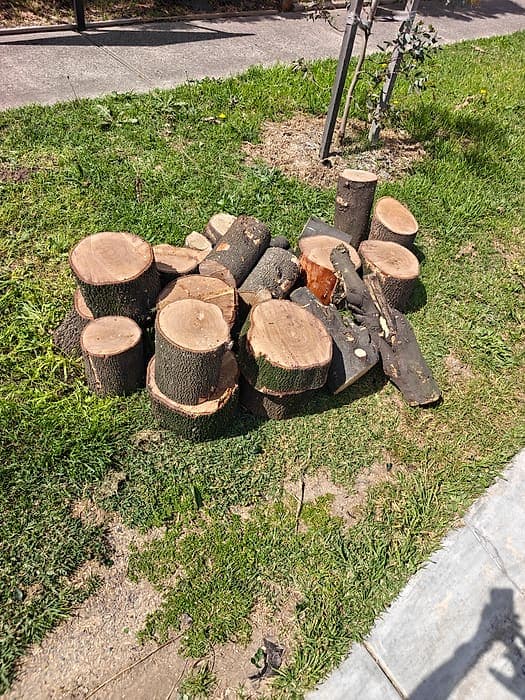
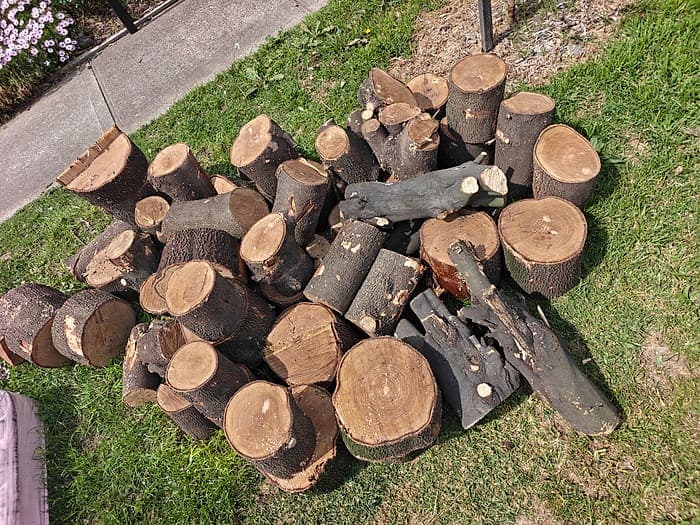
After a removal you choose what stays: the stump can be left, ground out or removed, and the timber can be taken away, left as firewood or chipped as mulch. The right choice depends on what you plan to do with the space next.
| Leftover | Options | Things to know |
|---|---|---|
| Stump | Leave low, grind below ground, or remove with the main roots | Grinding is quicker and disturbs less soil than full removal |
| Logs | Removed, or cut to length and left for firewood | Season the timber before burning; some species burn poorly |
| Chip | Removed, or left for paths and beds | Fresh chip is best on paths or aged before use in beds |
| Surface roots | Ground out with the stump where needed | Large roots can be left to decay in place if they are deep enough |
Some trees send up suckers from their roots after the trunk is removed, including poplars, robinia, desert ash and some ornamental plums. Grinding the stump and removing any shoots as soon as they appear wears the roots out over time.
Our stump grinding and stump removal guide compares the options in detail, including depth, access and what to plant afterwards.
How do access and tight backyards change the job?
Access decides the method more than the tree does. A tree with a clear side path, a wide gate and open lawn beside it is straightforward; a tree in a narrow courtyard behind a house with no side access may need everything carried through the house or lifted over the roof.
- Gate and path width: chippers and stump grinders need a minimum width to pass through.
- Lawn and garden protection: boards or mats protect soft lawn and paving under machine wheels.
- Overhead hazards: roofs, eaves, glasshouses and service lines limit where sections can be lowered.
- Neighbours: a drop zone over a fence needs the neighbour's agreement.
- Parking: the truck and chipper usually need space on the street, close to the property.
Our article on tree work in tight backyards covers how crews protect houses, fences and lawns when space is limited.
How does tree removal work with Action Garden?
Action Garden's own team does tree cutting and removal, arranged as a single job: one site visit, one quote, and the removal, debris and clean-up handled together. Our service includes safe sectional removal, a permit check with your council, removal of timber and debris, and optional stump grinding.
- Your enquiry: send a photo of the tree and your suburb by message or the quote form.
- Site visit: the tree, access and anything underneath are checked, and the scope is agreed.
- Permit check: the council rules for the tree are confirmed before any work is booked.
- Quote: a written quote for the removal, the debris and any stump work.
- Removal day: the tree is dismantled, and the site is cleaned up before the crew leaves.
Action Garden is insured, including for the tree removals the team does.
Action Garden does not offer crane removals; very large jobs that need heavy equipment are referred to a specialist who has it. After a storm, the team helps as soon as possible, depending on the situation. The removal day is agreed with you once the quote is approved, based on when the team is available.
Questions about how quotes, visits and payments work are answered in our help centre.
What affects the quote for tree removal?
Tree removal is quoted per job after a site visit, without set prices on the website. The main things that shape a quote are:
- the height, trunk size and species of the tree;
- access for climbers, the chipper and any machinery;
- what is underneath, such as roofs, fences, pools and power lines;
- whether the tree is dead, decayed or storm-damaged, which changes how it can be climbed;
- whether the timber, chip and stump are removed or left;
- any arborist report or permit the council requires.
What are the most common tree removal mistakes?
The costly mistakes are usually about rules and safety rather than technique. Most can be avoided with a phone call before the first cut.
- Removing a protected tree without checking. Fines and replanting orders can follow.
- Assuming a dead tree is exempt. Some councils still require a permit.
- Cutting a tree that is leaning on another tree, a line or a building. The stored tension releases unpredictably.
- Felling a tree into a space that is too short. Most garden trees are taller than they look.
- Forgetting the stump. A stump left high is a trip hazard and can sucker or harbour fungi.
- Not agreeing with the neighbour first. Boundary trees and drop zones cause the most disputes.
- Choosing the lowest quote without checking insurance. Ask what the crew is covered for before work starts.
Is it time to hand it over?
If a tree is dead, damaged, unsafe or simply too big for where it stands, and you want the permit check, the removal and the clean-up handled together, that is the point to bring us in. We will look at the tree and the access, and do the work ourselves.
You can get a free quote with just your name and mobile.
Your Garden. Our Promise.
From our jobs
Frequently asked
Can a dead tree be removed without a council permit in Melbourne?
How long does it take to get a tree removal permit?
Can I remove a tree that is damaging my house foundations?
Who removes a fallen tree after a storm?
Does the bushfire 10/30 rule apply in Melbourne?
What happens to the timber after a tree is removed?
Is it better to remove a tree in winter or summer?
Can a tree be removed from a neighbour's side without access?
Sources and further reading
- Protected and significant trees (City of Boroondara)
- Tree removal, pruning and lopping guidelines (City of Monash)
- Trees on private property (Merri-bek City Council)
- Bushfire protection exemptions for clearing vegetation (CFA)
- When to call VICSES (Victoria State Emergency Service)
- Trees and vegetation, frequently asked questions (Energy Safe Victoria)
- Working safely with trees (WorkSafe Victoria)
- Fences and trees (Victoria Legal Aid)
- Neighbourhood tree disputes report, executive summary (Victorian Law Reform Commission)
Caring for Melbourne gardens since 2019. Updated 18 November 2026.
Related reading