


Trees and stumps · Complete guide
Tree trimming in Melbourne: the complete guide
By the Action Garden team · Updated · 16 min read
Checked against: Standards Australia, Energy Safe Victoria, WorkSafe Victoria, Merri-bek City Council, City of Monash, Victoria Legal Aid, Sustainable Gardening Australia
TL;DR
- Good trimming removes whole branches back to a junction or the branch collar; lopping and topping weaken trees and regrow worse.
- The main jobs are crown lifting, crown thinning, deadwooding and clearance from the house, gutters and service lines.
- Late winter suits most deciduous trees; many evergreens and natives are best trimmed after flowering, and dead or dangerous wood can come off any time.
- Melbourne councils set different rules, such as Merri-bek's 15 per cent canopy limit on mature trees and Monash's one third exemption, so check yours.
- Ladders, chainsaws and anything near power lines are professional work; Action Garden's own team does tree work after a site visit.
| Season | Tree work that suits it | Notes |
|---|---|---|
| Winter (June to August) | Structural trimming of deciduous trees | Leaves are off, so the branch structure is easy to read |
| Spring (September to November) | Light trims only; deadwood any time | Trees are pushing new growth and many are flowering |
| Summer (December to February) | Clearance trims and post-flowering trims | Check roof and gutter clearance before bushfire season peaks |
| Autumn (March to May) | Deadwooding and storm-season checks | Clear over-roof limbs before the windier months |
What does tree trimming actually involve?
Tree trimming is the selective removal of branches to fix a specific problem: a limb over the roof, a canopy too low over the driveway, deadwood above a play area, or a crown so dense that the garden below is in permanent shade. Done well, the tree looks the same shape afterwards, only lighter, higher or clearer.
The work is defined in Australia by AS 4373, the Australian Standard for pruning amenity trees. It names the accepted pruning types, such as deadwooding, crown lifting, formative pruning and reduction pruning, and the practices to avoid, including lopping, topping, flush cuts and wound painting. Councils across Melbourne refer to it in their tree policies and permit conditions.
| Trim type | What is removed | Typical reason |
|---|---|---|
| Deadwooding | Dead, dying and broken branches | Safety over paths, cars and play areas |
| Crown lifting | The lowest live branches | Head height over paths, driveways and lawn |
| Crown thinning | Selected inner branches across the crown | More light and less wind load |
| Clearance pruning | Branches near the roof, gutters, walls or service lines | Protects the house and reduces gutter litter |
| Crown reduction | Ends of major limbs, cut back to strong side branches | Reduces height or spread without topping |
| Formative pruning | Competing leaders and poorly attached branches on young trees | Builds a strong structure early |
Our tree trimming service covers crown lifting and thinning, clearance from roofs and gutters, deadwood removal and taking away the cuttings. Formative work on young and ornamental trees is a topic of its own, covered in our tree shaping and formative pruning guide. For the full set of articles on trees, stumps and permits, see the trees and stumps guides.
Trimming, pruning, lopping: is there a difference?
In everyday speech, trimming and pruning mean the same thing: cutting branches off a tree with a purpose. In the trade, pruning to the standard means each cut is made at a junction or the branch collar, so the tree can seal it.
Lopping is different. It means cutting branches or the main stem between junctions, leaving stubs. The stubs sprout a mass of fast, weakly attached shoots, and the exposed wood often decays. That is why AS 4373 lists lopping and topping as practices to avoid, and why a tree that has been lopped once tends to need more work, not less.
When is the best time to trim trees in Melbourne?
For most deciduous trees, late winter is the best time for structural trimming, while many evergreens and natives are best trimmed straight after flowering. Deadwood, storm damage and anything that is a hazard can come off at any time of year.
Melbourne's seasons make the timing practical as well as biological. In winter, deciduous trees such as elms, oaks, maples, ornamental pears and plums are bare, so it is easy to see crossing limbs and choose cuts. Cuts made just before spring growth seal quickly as the tree wakes up.
- Deciduous ornamentals: late winter, while dormant, unless a council permit says otherwise.
- Flowering trees: after flowering, so the next season's buds are not removed. Jacarandas and crepe myrtles are common examples in Melbourne gardens.
- Eucalypts and other natives: light trims after flowering or in the cooler months; avoid heavy cuts in summer heat.
- Fruit trees: follow the species, with stone fruit often pruned after harvest and pome fruit in winter.
- Clearance and deadwood: any time, ideally before the windy late winter and spring months and before summer bushfire preparation.
Timing by species is covered in detail in our guide to when to prune ornamental and native trees in Melbourne.
Do you need council permission to trim a tree in Melbourne?
Sometimes, and it depends entirely on your council, the tree and how much you remove. There is no single Melbourne rule: each council has its own local law, and planning overlays such as a Vegetation Protection Overlay (VPO) or Significant Landscape Overlay (SLO) can add more controls.
Three councils show how different the rules are:
| Council | What triggers a permit for pruning | Where it is set out |
|---|---|---|
| Merri-bek | Removing a tree, or pruning more than 15 per cent of the canopy, of a mature tree (8 metres or taller with a trunk over 40 cm in diameter at 1.2 metres) or a registered significant tree | Tree Works Permit under the council's general local law |
| Monash | Lopping or pruning canopy trees in the controlled areas is exempt if no more than one third of the foliage is removed and the tree stays at least 5 metres tall with a 4 metre canopy | Canopy tree controls in the planning scheme |
| Boroondara | Works near or on protected canopy trees (trunk circumference of 110 cm or more at 1.4 metres) and significant trees need checking against the Tree Protection Local Law | Tree Protection Local Law |
These are summaries of each council's own pages, checked in November 2026. Rules change, so always read your council's current page or call them before trimming a large tree. Our guide on tree permits in Melbourne explains how to check local laws and overlays step by step.
How to check the rules for your property in ten minutes
- Search your council's website for "tree local law" or "tree permit" and read the size thresholds.
- Check whether your property sits in an overlay such as a VPO, SLO, ESO or Heritage Overlay, using the planning property report from the Victorian Government's planning website.
- Look for any condition on an old planning permit for the property that protects specific trees.
- If the tree is on a significant tree register, assume every cut needs approval.
- When in doubt, ring the council's arborist or planning team and describe the work.
Keep before and after photos of any trim. Merri-bek, for example, recommends keeping them in case the council asks.
How is a branch cut correctly?
A correct cut removes the branch just outside the branch collar, the slightly swollen ring where the branch joins the trunk or a larger limb, without leaving a stub and without cutting into the collar. The collar holds the tissue that seals the wound, so protecting it is the single most important part of trimming.
Heavier limbs are cut in three steps so the bark does not tear down the trunk:
- Undercut: about 30 cm out from the trunk, cut upwards a third of the way through the branch.
- Top cut: a little further out, cut down through the branch so it drops cleanly, breaking at the undercut.
- Final cut: remove the remaining short stub just outside the collar, angled to follow the collar line.
Small branches only need the final cut, made with sharp bypass secateurs or a pruning saw. Blunt tools crush tissue and leave ragged wounds that take longer to close.
An animated side view of a limb joining a trunk. The swollen branch collar and the branch bark ridge are highlighted. Three numbered cuts draw in turn: an undercut from below, a top cut further out that drops the branch, and a final angled cut just outside the collar. A red cross marks a flush cut into the trunk and a long stub, the two cuts to avoid.
Side by side
Lopping or proper trimming
| Lopping or topping | Trimming to the standard | |
|---|---|---|
| Where cuts are made | Between junctions, leaving stubs | At a junction or the branch collar |
| How the tree responds | Dense, fast, weakly attached shoots | Steady growth from strong side branches |
| Decay risk | High, as stubs die back | Low, as wounds seal at the collar |
| Look after a year | Bushy, top-heavy and unnatural | Natural shape, lighter crown |
| Work needed later | More frequent, to manage regrowth | Less, and more predictable |
A tree that has been lopped can often be brought back over several seasons by selecting the strongest regrowth shoots as new branches and removing the rest in stages.
Which trimming jobs suit which Melbourne trees?
The right trim depends on the species, its age and where it stands. A few tree groups make up most of the trimming work in Melbourne gardens.
| Tree group | Common trimming need | Watch for |
|---|---|---|
| Eucalypts (gums) | Deadwooding, clearance from roofs and gutters | Summer limb drop, bark and leaf litter in gutters, council or overlay protection |
| Ornamental pears, plums and cherries | Thinning crossing branches, lifting over paths | Water shoots after hard cuts; prune plums in dry weather |
| Elms, oaks and planes | Crown lifting and deadwooding on large trees | Size: these quickly reach permit thresholds |
| Lilly pillies and other evergreen screens | Clearance from walls, height control | Treated more like a tall hedge once planted close |
| Jacaranda and crepe myrtle | Light shaping after flowering | Topping ruins the natural form of both |
| Liquidambar | Crown lifting, clearance | Surface roots and heavy autumn leaf fall in gutters |
Gum trees deserve a special mention. Large eucalypts can shed apparently healthy limbs on hot, still days, which is why branches over houses, cars and play areas are worth checking each year. Our article on why gum trees drop limbs in summer explains what is known about it and what to watch for.
Trees that overhang the roof fill gutters with leaves, bark and seed pods. Trimming back the branches over the roof line, together with regular gutter cleaning, is one of the most practical things you can do for a house under big trees.
How do trees, roofs and power lines fit together?
Branches that touch a roof scrape tiles and sheeting, drop litter straight into the gutters and give possums an easy path into the roof space. The usual goal is a clear gap between the canopy and the roof line, achieved by removing whole branches back to a junction rather than cutting a straight line through the canopy.
Power lines are a different matter, and the rules come from Energy Safe Victoria (opens in a new tab). For a tree on your property, the occupier is responsible for keeping it clear of the service line that runs to the house, and Energy Safe Victoria recommends clearing trees before they grow to within one metre of that line in any direction. Trees near other lines crossing your boundary, or near the lines in the street, are generally the electricity distributor's responsibility.
- Never trim near a line yourself, and never use a ladder or pole tool near one.
- Only trained, authorised people may work within the regulated distances from power lines under Victoria's electricity safety rules.
- Contact your electricity distributor first if a branch is touching or close to a line.
- If a line is down, stay at least 8 to 10 metres away and call 000 if lives are at risk.
Call a professional for any branch you cannot reach from the ground with a pole saw, any limb thicker than your arm above head height, any chainsaw work, and anything within reach of a power line. WorkSafe Victoria (opens in a new tab) notes that workers in the tree industry are killed or seriously injured each year, with power lines, working at height, chainsaws, falling objects and wood chippers all listed as hazards. Action Garden's own team does tree work and quotes per job after a site visit.
Can you trim a tree yourself, and where do you stop?
You can safely trim small trees yourself when every cut is reachable from the ground, the branches are lighter than your forearm, and there is nothing to damage underneath. Beyond that point, the risk rises quickly.
Jobs most people can do
- Removing small dead twigs and suckers from the base of the trunk.
- Lifting the lowest thin branches of a young tree over a path.
- Cutting off water shoots on ornamental plums and pears.
- Trimming a small fruit tree that is kept to head height.
Keep each cut at a junction or just outside the collar, exactly as on a large tree.
Jobs to hand over
- Any cut that needs a ladder. Ladder falls with a saw in hand are a common cause of serious injury.
- Limbs over the house, fences, cars, pools or neighbours' yards, where a falling branch causes damage.
- Trees that lean, have cracks, fungi at the base or large dead limbs. Our guide to the signs a tree may be unsafe lists what to look for.
- Protected trees, where a wrong cut can lead to a council fine.
Sustainable Gardening Australia (opens in a new tab) notes that dead or dying limbs with little foliage are the branches most likely to fall in storms, and that root damage from digging or soil compaction can take years to show. Both are reasons to have big trees looked at before a problem shows up, not after.
What happens on a professional tree trimming job?
A professional trim starts with a site visit to agree the goal, check the rules and plan how the cuttings come down safely. On the day, the crew sets up an exclusion zone, makes the cuts in a planned order and cleans up the site.
- Site visit and scope: which branches, how much, and why. Photos are taken for any permit questions.
- Rules check: council local law, overlays and any power line clearance issues are confirmed before work is booked.
- Set-up: the drop zone under the tree is cleared and fenced off, and fragile items are moved or protected.
- Climbing or elevated work: larger trees are trimmed from ropes or a platform, with heavier limbs lowered on ropes rather than dropped.
- Clean-up: cuttings are chipped or removed, and paths, lawns and gutters below are cleared.
Action Garden's own team does tree trimming: the visit, the quote, the work and the clean-up are arranged as one job, with the cuttings chipped and taken away. If a tree turns out to be beyond trimming, the next step is covered in our tree removal guide for Melbourne.
Shared trees in strata and body corporate properties
Trees on common property belong to the owners corporation, not to the owner whose unit they shade. Trimming them needs the committee's approval and, usually, a quote that every lot owner can see.
The council rules still apply, so the same permit checks are needed. Our article on trees on common property covers how to plan tree work with an owners corporation and a strata manager.
What affects the quote for tree trimming?
Tree trimming is quoted per job after a site visit, without set prices on the website. The things that shape a quote are:
- the size and species of the tree, and how many trees are involved;
- the type of trim, such as deadwooding, lifting, thinning or clearance;
- access for climbers, platforms and the chipper;
- what sits under the tree, such as roofs, glasshouses, pools or power lines;
- whether cuttings are taken away or the chip is left for your beds;
- any permit or arborist report the council asks for.
What are the most common tree trimming mistakes?
Most damage to garden trees comes from a handful of avoidable mistakes. Avoid these and a tree stays safer and needs less work over its life.
- Topping the tree to make it shorter. It regrows taller, denser and weaker within a few seasons.
- Flush cuts against the trunk. Cutting into the collar removes the tissue that seals the wound and invites decay.
- Leaving long stubs. Stubs die back and rot into the trunk.
- Lion-tailing. Stripping all the inner branches and leaving tufts at the ends leaves limbs thin, springy and prone to breaking.
- Removing too much at once. Big cuts in one season stress the tree and trigger masses of water shoots.
- Trimming without checking the rules. Many protected trees carry fines for unapproved work.
- Ignoring what is underneath. A branch that looks light can still break a roof tile, a fence paling or a window.
Is it time to hand it over?
If branches are over the roof, a gum has started dropping limbs, or the tree is simply too big to reach from the ground, that is a good time to bring in help. We will look at the tree, check the rules that apply, and do the work ourselves, with the clean-up included.
You can request a free quote with just your name and mobile.
Your Garden. Our Promise.
From our jobs
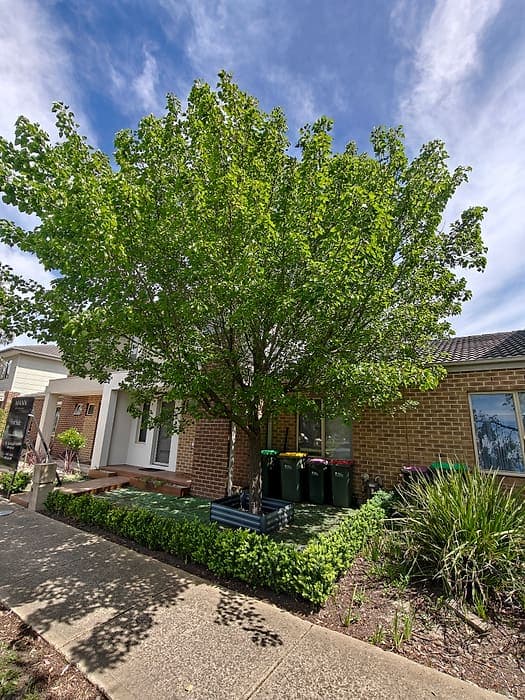
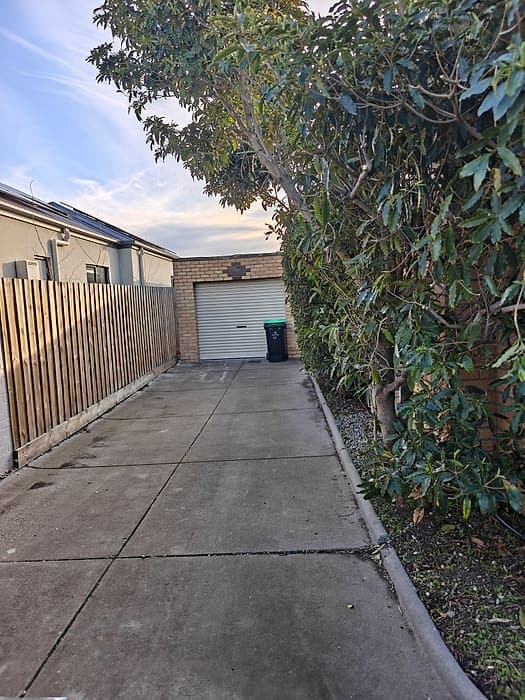
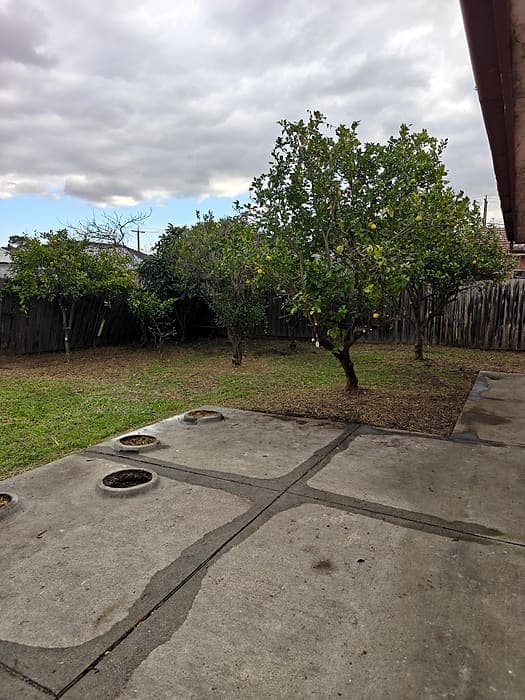
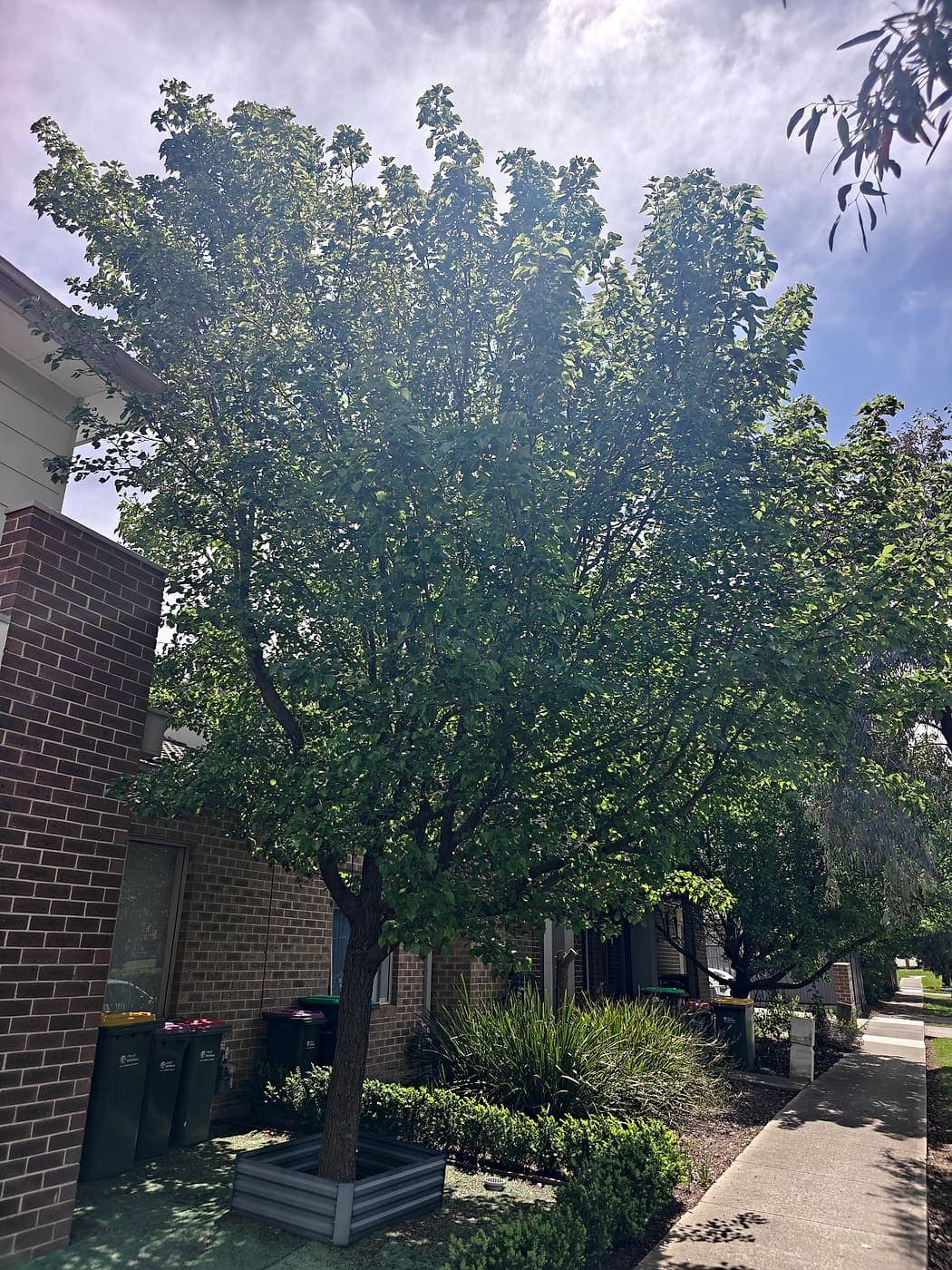
Frequently asked
How much of a tree can be trimmed in one go without harming it?
Can I trim branches that overhang my roof from a neighbour's tree?
Who trims a tree that is touching the power line to my house?
Is it safe to trim a gum tree in summer?
Should trimming cuts be sealed with paint or wound dressing?
How often should a mature garden tree be trimmed?
What is the difference between crown lifting and crown thinning?
Do tree trimmers take the branches away?
Sources and further reading
- AS 4373-2007 Pruning of amenity trees (Standards Australia)
- Trees and vegetation, frequently asked questions (Energy Safe Victoria)
- Managing trees near power lines (Energy Safe Victoria)
- Working safely with trees (WorkSafe Victoria)
- Trees on private property (Merri-bek City Council)
- Tree removal, pruning and lopping guidelines (City of Monash)
- Fences and trees (Victoria Legal Aid)
- Why living trees suddenly fall down (Sustainable Gardening Australia)
Caring for Melbourne gardens since 2019. Updated 18 November 2026.
Related reading