


Strata and commercial
Trees on common property: planning work with owners corporations
By the Action Garden team · Updated · 12 min read
Checked against: Consumer Affairs Victoria, vic.gov.au, Energy Safe Victoria, EPA Victoria
TL;DR
- Trees growing on common property are the owners corporation's to maintain, and lot owners must not prune them without express authority.
- A short tree list for the site, with each tree's location, condition and last work, turns reactive call-outs into planned work.
- Council rules apply to common property trees exactly as they do to a house block, so permits are checked before removal or heavy pruning.
- Removing trees in a way that changes how the complex looks can need a special resolution, while urgent safety work can be approved faster.
- Residents need notice of tree work, cars moved and areas kept clear, and work near power lines is left to authorised specialists.
| Tree work | Who usually decides | Notes |
|---|---|---|
| Routine pruning and clearance | Committee or manager, under the usual approval process | Lifting branches off roofs, paths and car parks, deadwood removal, clearance from gutters and walls. |
| Inspection of large trees | Committee arranges, often through the manager | A regular look by a qualified tree specialist, plus a check after storms. Findings go on the tree list. |
| Removal of a healthy tree | Owners corporation decision, council permit check first | Can change the look of the common property, so it may need a special resolution. Some trees need a planning permit or local law permit. |
| Urgent hazard (split limb, fallen tree) | Committee or ordinary resolution | Consumer Affairs Victoria says work needed for immediate safety can be approved by ordinary resolution or by the committee. |
| Tree inside a lot (private courtyard) | Lot owner | The plan of subdivision decides. The owners corporation rules may still set standards for trees visible from common areas. |
Who is responsible for trees on common property?
The owners corporation is responsible for trees growing on common property, in the same way it is responsible for the lawns, paths and fences around them. It repairs and maintains the common property, and Consumer Affairs Victoria (opens in a new tab) lists gardens, paths, driveways and fences among the things common property may include.
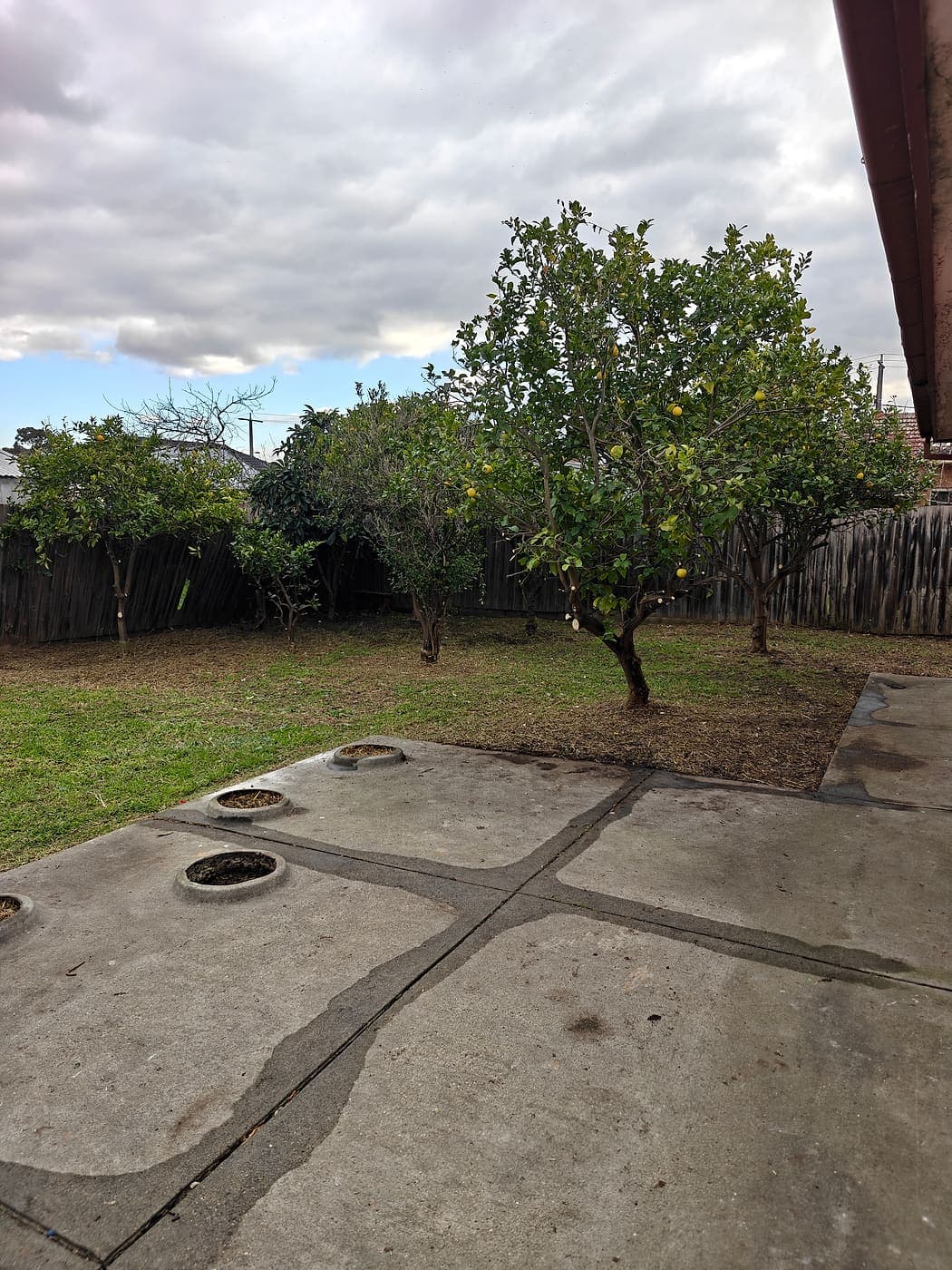
The tree's position on the plan of subdivision decides who owns it, not who enjoys it most. A gum on the shared driveway verge is common property. A lemon tree inside a ground floor unit's courtyard is usually part of that lot, and its care sits with the lot owner. Our article on what an owners corporation looks after in common gardens explains how to read those boundaries.
Two practical rules follow from that ownership:
- Lot owners do not prune common property trees on their own initiative. Consumer Affairs Victoria says a lot owner must not repair, alter or maintain common property unless the owners corporation has expressly authorised it.
- The owners corporation carries the decisions and the cost. That includes inspection, pruning, removal, stump grinding, replanting and any council permit work.
This article is general information, not legal advice. For your own owners corporation, the registered rules, the plan of subdivision and your manager are the place to start.
What tree work does a typical complex need?
Most owners corporations need the same handful of tree jobs, repeated over the years: clearance pruning, deadwood removal, inspection of large trees, occasional removal, and replanting. Planning them as a list, rather than waiting for complaints, is what keeps the work and the disruption predictable.
| Job | What it involves | Why complexes need it |
|---|---|---|
| Clearance pruning | Lifting or shortening branches over roofs, gutters, paths, car spaces and windows | Leaves in gutters, scraped cars, branches brushing walls and balconies |
| Deadwood removal | Taking out dead and broken branches from the crown | Dead limbs fall without warning, often onto shared paths and car parks |
| Crown thinning or lifting | Selective removal to let in light and air, or to raise the canopy | Shaded lawns failing, dark paths at night, sightlines at driveway exits |
| Inspection | A qualified tree specialist looking at structure, roots and health | Large trees near buildings, and trees that have dropped limbs before |
| Removal and stump grinding | Felling in sections, removing timber, grinding the stump below ground | Dead, failing or badly placed trees, after a council permit check |
| Replanting | Choosing and planting a replacement suited to the space | Keeping canopy and screening, and sometimes a permit condition |
Our tree trimming service covers the pruning side of that list, and the complete guide to tree trimming in Melbourne explains each type of cut in more detail.
Who decides, and how is tree work approved?
Routine tree work is approved like any other maintenance, through the committee or the manager under the owners corporation's usual process. Bigger decisions, such as removing healthy trees that shape how the complex looks, can need the owners themselves.
Consumer Affairs Victoria's guidance points to three broad kinds of decision:
- Routine maintenance, such as clearance pruning and deadwood removal, is part of maintaining the common property. A committee, or a manager acting under delegated powers, usually approves it against a quote.
- Significant alterations to the use or appearance of common property are allowed if they are in the maintenance plan or approved by special resolution of the owners corporation. Removing a screen of trees along a boundary, or replacing an avenue of trees with something different, can fall here.
- Urgent safety work, where there are reasonable grounds to believe immediate work is necessary, can be approved by ordinary resolution or by the committee.
A manager's powers come from the owners corporation, usually through an instrument of delegation, and the owners corporation keeps its own powers. If you are not sure whether a tree job sits inside the manager's authority, ask before the work is booked rather than after.
Quick decision guide
Who needs to approve this tree job?
- Is a branch split, hanging or already down on a path, car or roof? Treat it as urgent safety work: make the area safe, then the committee or an ordinary resolution can approve the work.
- Is the tree inside a lot on the plan of subdivision? It is the lot owner's to manage, subject to the owners corporation rules and council rules.
- Is it routine pruning, deadwood or clearance on common property? The committee or manager approves it under the usual process, against a written quote.
- Will the work remove healthy trees or noticeably change how the common property looks? Check whether it is in the maintenance plan; if not, it may need a special resolution.
- Could the tree be protected by the council? Check permits before anyone approves removal or heavy pruning.
Do council tree rules apply to common property?
Yes. A tree on common property is a tree on private land, and the council's rules apply to it exactly as they would to a house block. The owners corporation is the landowner for the purposes of any permit.
Melbourne has no single tree rule. Depending on the council, a tree can be protected by a local law based on trunk size or species, by a significant tree register, or by a planning overlay. Clause 52.37, on canopy trees, now sits in every Victorian planning scheme and can require a planning permit to remove or lop larger trees near the front or rear boundary in residential zones. The vic.gov.au (opens in a new tab) trees page puts it simply: check with your council to see whether a tree is protected, and if it is covered by an environmental overlay you will need a permit even to prune.
Our guide on whether you need a permit to remove a tree in Melbourne walks through the checks council by council. For an owners corporation, three points are worth adding:
- Allow time. A permit application, plus the meeting cycle needed to approve the work, can stretch a removal over months. Start early for a declining tree.
- Decide who lodges it. The manager often lodges the application on the owners corporation's behalf, with an arborist report if the council asks for one.
- Expect conditions. Councils can require a replacement tree. Build replanting into the plan from the start, so the decision put to owners covers both.
What an arborist report gives the committee
An arborist report is a written assessment of a tree by a qualified arborist. For an owners corporation it does three jobs. It gives the council what it needs to assess a permit, where the council asks for one. It gives the committee an independent reason for a decision that some owners may not like, such as removing a large, much-loved tree. And it sets out options, such as a crown reduction instead of removal, with the reasons for each.
A report is not needed for every job. Routine clearance pruning and deadwood removal do not usually call for one. It is worth the effort when a large tree is near a building, when the tree is likely to be protected, or when owners disagree about what should happen. Our guide to whether you need an arborist or a gardener explains where each fits.
How should tree work be planned across the year?
Plan tree work around an inspection routine, the trees' own seasons and the owners corporation's meeting cycle. That way urgent call-outs become rare, and the committee approves most work once a year instead of job by job.
A simple yearly rhythm for a Melbourne complex:
- Late winter: inspect large trees while deciduous ones are bare and their structure is easy to see. Prune deciduous ornamentals before spring growth.
- Spring: clearance pruning off roofs, gutters and paths as growth starts. Plan replanting for autumn.
- Summer: watch eucalypts and other natives for dropped limbs in heat. Keep grass short and litter clear under trees near buildings.
- Autumn: leaf fall season. Clear gutters on buildings under trees, and plant replacement trees once the soil cools and the rain returns.
- Before the AGM: bring the tree list, the inspection findings and the quotes for the year's tree work to the committee in one bundle.
Timing differs by species. Our guide on when to prune ornamental and native trees in Melbourne has the details, and the body corporate grounds schedule shows where tree work sits beside routine mowing, weeding and hedge trims.
A loop of four steps around a small site plan with numbered tree icons. Step one, a magnifying glass: inspect and update the tree list. Step two, a clipboard: quote and check permits. Step three, a raised hand: approve through the committee, or by special resolution for big changes. Step four, a pruning saw: carry out the work and report with photos. An arrow from step four returns to step one, and a short side arrow labelled storm jumps straight from the site plan to step four for urgent hazards.
Tree work and the maintenance plan
Consumer Affairs Victoria says tier one and tier two owners corporations must have a maintenance plan, while smaller ones may choose to prepare one. The plan covers major capital items due for repair or replacement over the next 10 years, with their condition and expected life.
Routine pruning is normally an operating expense, not a maintenance plan item. Large, predictable tree work can belong in the plan, though: the staged removal of an ageing row of trees, a major crown reduction, or works to stop roots lifting a shared driveway. Listing them gives the owners corporation time to fund them, and Consumer Affairs Victoria notes that significant alterations listed in the maintenance plan do not need a separate special resolution.
How do you keep residents safe and informed during tree work?
Tell residents what is happening, when, and what they need to do, well before the crew arrives. Tree work moves heavy timber over shared driveways, paths and car spaces, so the plan has to clear people and vehicles out of the drop zone.
A notice to residents should cover:
- The date, the start time and the expected finish.
- Which areas will be closed, such as a section of driveway, a path or visitor parking.
- Which cars must be moved, and by when.
- Any entry to a lot or private courtyard that is needed to reach a tree. Consumer Affairs Victoria explains that entry to a lot for authorised repairs and maintenance generally needs written notice in advance, unless it is an emergency or the occupier agrees.
- A contact on the day for questions.
On the day, a professional crew sets up an exclusion zone around the work with cones or barriers, keeps someone watching the zone while timber is cut, and keeps blowers and debris away from open windows and parked cars. Chainsaws, chippers and stump grinders are loud, so start times should respect EPA Victoria (opens in a new tab)'s residential noise hours and the times agreed with the committee. On mixed-use or commercial sites, our article on working around trading hours covers how to time noisy work.
Any tree work above ladder height, any branch over a roof, power line, car or path, any tree that is cracked, leaning or hollow, and any tree removal should go to a tree specialist with the right equipment and insurance, never to a resident with a chainsaw. Energy Safe Victoria (opens in a new tab) recommends private tree contractors keep a 3 metre exclusion zone from powerlines, and work closer than that is for authorised line clearance workers only. Action Garden's own team does tree work.
What about trees near power lines, buildings and neighbours?
Trees near power lines, buildings and boundaries need the most planning, because the risks and the rules both increase. Each has its own question to answer before any work is quoted.
Power lines. Electricity distribution companies are responsible for keeping trees clear of most powerlines, while property owners are generally responsible for vegetation around their own private electric lines, such as a private pole feeding a building at the back of the site. Larger complexes can have private lines, so check which kind you have. Energy Safe Victoria says anyone working near powerlines must notify the local distributor first.
Buildings and gutters. Branches over roofs drop leaves into gutters and box gutters, and rub on tiles and fascias in the wind. Clearance pruning on a regular cycle is usually gentler on the tree, and easier on residents, than a heavy cut every few years.
Roots. Roots lifting paths and driveways are a common trip hazard on shared property. Cutting large roots can destabilise a tree, so root work is assessed by a tree specialist before anyone digs.
Neighbours. If a common property tree overhangs the property next door, the neighbour has a right to cut back overhanging branches to the boundary at their own cost, and vic.gov.au notes they are liable for any damage they cause to the tree. Talking early avoids most disputes. Where talks stall, mediation through the Dispute Settlement Centre of Victoria is the suggested next step.
Storms and fallen trees on a shared site
After a storm, safety comes first: keep residents away from fallen branches and anything touching a power line, and call the distributor, or 000 if life is at risk. Take photos before anything is moved, for the record and any insurance claim. A committee can approve the urgent clean-up as safety work, and the manager should log what happened, what was done and who did it. Once the site is safe, have damaged trees looked at by a qualified tree specialist before deciding whether they can stay.
What should a tree work quote for an owners corporation include?
A good quote names every tree by its number on the site plan, says exactly what will be done to each, and states how the site will be protected and cleaned up. That lets the committee compare quotes properly and check the result afterwards.
A checklist for the committee or manager:
- Each tree identified, by number, species and location.
- The work described in plain terms, such as "remove deadwood over the driveway" or "lift the canopy clear of the visitor car spaces", not just "trim tree".
- Permit status, stating whether a council check has been done and who will lodge any application.
- Method and access, such as climbing, an elevated work platform or a crane, and what needs to be closed or moved.
- Waste, including whether timber and green waste leave the site, are chipped for mulch on site, or are left for a stated reason.
- Stumps, stating whether stumps are ground out and how deep.
- Insurance, with a current certificate of public liability cover.
- Reporting, with before and after photos for the owners corporation's records.
The lowest quote is not the only test. A quote that leaves out permit checks, waste or stump grinding is not the same job.
When is it worth handing tree work to one coordinator?
It is worth it when the committee wants tree work planned alongside the rest of the grounds, with one contact, one tree list and one report, rather than calling a different tree crew each time something goes wrong. A single coordinator who already knows the site notices the cracked limb or the branch on the gutter at the next routine visit.
Action Garden looks after common property grounds for owners corporations and strata managers in Melbourne's north, west and inner suburbs, and delivers tree work by our own team: clearance pruning, deadwood removal, removals and stump grinding, quoted per job after a site visit. Our tree trimming service explains how that works, and more articles for committees and managers are in strata and commercial articles.
When the committee is ready to plan the year's tree work, ask for a free quote and we will walk the site first.
Your Garden. Our Promise.
From our jobs
Frequently asked
Can a lot owner prune a common property tree that shades their balcony?
Does an owners corporation need an arborist report before removing a tree?
How often should the trees on a strata site be checked?
Does replacing a removed common property tree need a vote of the owners?
Can the committee approve emergency tree work without a general meeting?
Who looks after a common property tree that overhangs the house next door?
Should large tree work go into an owners corporation maintenance plan?
Sources and further reading
- Maintaining and improving common property (Consumer Affairs Victoria)
- Owners corporation maintenance plan (Consumer Affairs Victoria)
- Owners corporation definitions (Consumer Affairs Victoria)
- Working with your owners corporation manager (Consumer Affairs Victoria)
- Trees in Victoria (vic.gov.au)
- Keeping tree industry workers safe around powerlines (Energy Safe Victoria)
- Residential noise (EPA Victoria)
Caring for Melbourne gardens since 2019. Updated 18 November 2026.