


Strata and commercial
Body corporate grounds: what a good maintenance schedule looks like
By the Action Garden team · Updated · 11 min read
Checked against: Consumer Affairs Victoria, Bureau of Meteorology, EPA Victoria, South East Water
TL;DR
- Same scope every visit, written down, so the committee knows exactly what each visit covers.
- Frequency follows Melbourne's seasons, with more visits in spring growth and fewer in winter.
- Seasonal extras such as hedge trims, mulch, gutters and pressure cleaning are listed and quoted ahead of time.
- A photo report after every visit gives the manager a record for questions and the AGM.
- Under Victorian law the owners corporation maintains common property, and tier one and two must have a maintenance plan.
| Season | Typical visit frequency | Focus |
|---|---|---|
| Spring (Sep to Nov) | Fortnightly, weekly for lawns in peak growth if the committee wants | Fastest growth. Weed beds early, mulch, first hedge trim late in the season, check irrigation timers. |
| Summer (Dec to Feb) | Fortnightly | Mow higher, watch for heat stress, clear gutters and dry litter, keep grass short near buildings. |
| Autumn (Mar to May) | Fortnightly | Leaf fall. Blow paths and car parks each visit, gutter clean, second hedge trim, feed lawns. |
| Winter (Jun to Aug) | Monthly or three-weekly | Slow growth. Pruning of deciduous trees and roses, moss on shaded paths, drainage checks. |
What does a good body corporate grounds schedule include?
A good schedule has five parts: a fixed scope for every visit, a visit frequency that changes with the seasons, a list of seasonal extras, a short report after each visit, and one named point of contact. If any of those is missing, the committee ends up paying for work it cannot see or check.
Most complaints about strata gardening come from the same few gaps. The scope was never written down, extras crept in without a quote, nobody could show what happened on a given visit, or a different crew turned up each time. A written schedule fixes all four.
This article sets out what each part should contain, with a season-by-season view for Melbourne and the parts of Victorian owners corporation law that shape it. It is general information, not legal advice. For anything about your own owners corporation's obligations, ask your manager or check with Consumer Affairs Victoria (opens in a new tab).
Who is responsible for common property gardens in Victoria?
The owners corporation is responsible for repairing and maintaining the common property, and in most complexes that includes the shared gardens, lawns, paths, driveways and fences. Consumer Affairs Victoria defines common property as the parts of the land and buildings that are not lots on the plan of subdivision, and says it "may include gardens, passages, walls, pathways, driveways, stairs, lifts, foyers and fences".
Two practical points follow from that:
- The owners corporation engages the contractor. Usually the manager arranges it on the committee's instructions, under whatever approval process the owners corporation uses.
- Lot owners should not do it themselves. Consumer Affairs Victoria says lot owners must not carry out repairs, alterations or maintenance on common property unless they are expressly authorised by the owners corporation.
Gardens inside a lot, such as a private courtyard or a townhouse front yard, are often the lot owner's responsibility instead. The plan of subdivision shows the boundaries, and the owners corporation rules may say more. Getting this right before the schedule is written avoids paying for gardens that belong to someone else, or leaving common areas out.
Tiers and the maintenance plan
Victoria sorts owners corporations into five tiers by the number of occupiable lots. Consumer Affairs Victoria lists tier one as more than 100 lots, tier two as 51 to 100, tier three as 10 to 50, tier four as 3 to 9, and tier five as two-lot subdivisions or services-only owners corporations.
Tier one and tier two owners corporations must have a maintenance plan. Tiers three to five "may choose to prepare and approve a maintenance plan, but it is not compulsory." The plan covers major capital items due for repair or replacement over the next 10 years, with their present condition, when they will need work and their expected life.
An owners corporation with a maintenance plan must also have a maintenance fund to cover the works in it, and it must report on carrying out the plan at each annual general meeting.
What should every routine visit cover?
Every routine visit should cover the same written list, in the same order, so the committee knows what each visit pays for and residents know what to expect. Anything outside that list is an extra, quoted separately.
A typical fixed scope for a residential complex:
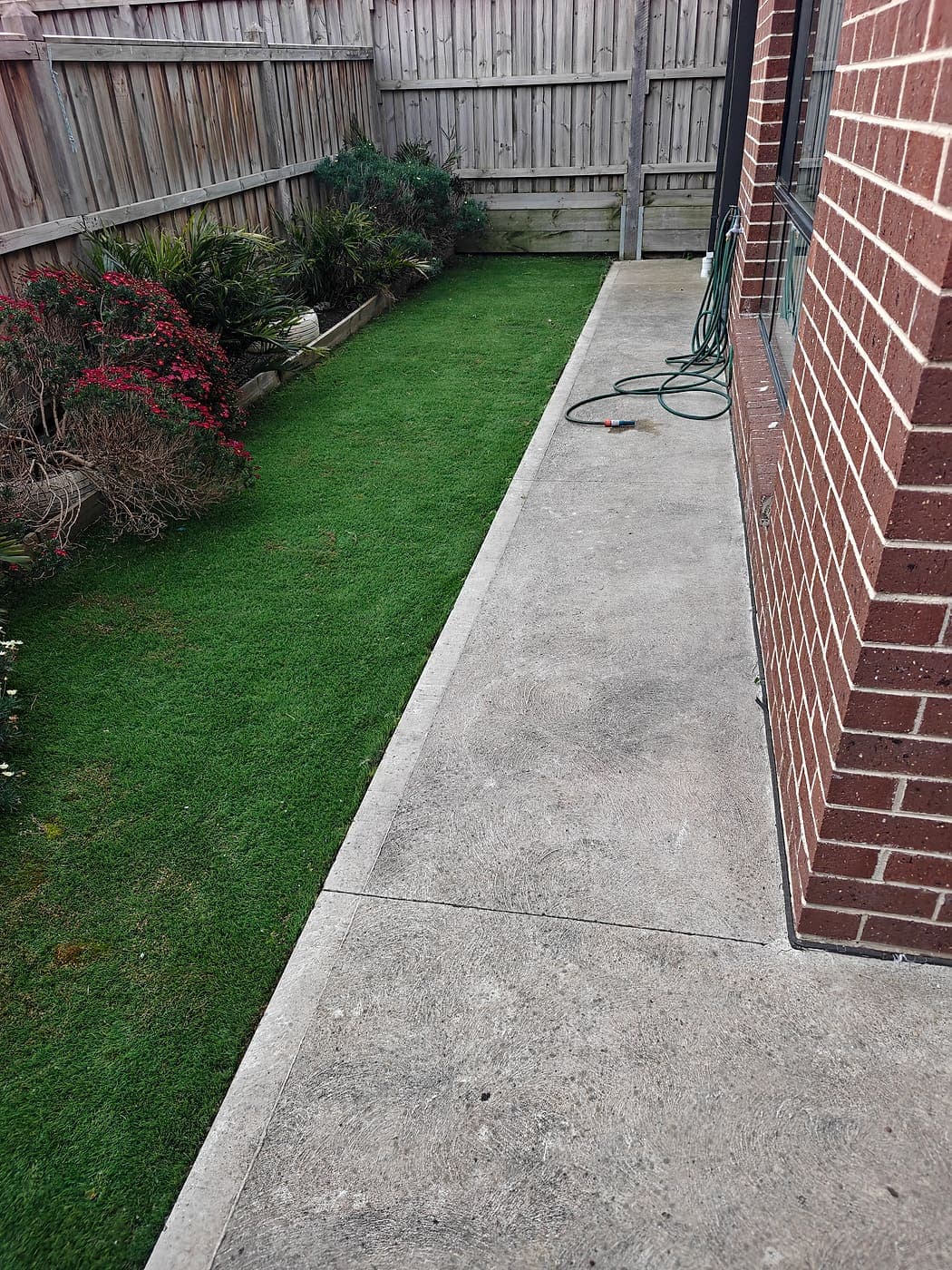
- Mow all common lawns at the height set for the grass type, and catch or mulch clippings as agreed.
- Edge lawns along paths, driveways and garden beds.
- Weed garden beds and paved areas, by hand or as agreed in the scope.
- Blow paths, driveways, entries and car park areas clear of clippings and leaves.
- Pick up litter from gardens, lawns and the nature strip.
- Tidy the bin store surrounds (not emptying the bins).
- Remove all green waste from site, or place it in the owners corporation's green bins if that is agreed.
- Walk the site and note anything that needs attention: broken irrigation, dead plants, trip hazards, damaged fences, dumped rubbish.
Commercial or mixed-use sites often add car park islands, frontage beds and a more frequent litter round. Our regular maintenance plans page shows how a commercial and strata plan is set up.
Attach a simple site plan to the schedule with each area numbered: front lawn, entry beds, side path, car park islands, rear courtyard. The report can then refer to areas by number, and nobody argues later about whether the strip behind block C was ever included.
How often should visits happen in each Melbourne season?
Visit frequency should follow growth, and in Melbourne growth follows the seasons. Fortnightly visits from spring through autumn and monthly or three-weekly visits in winter suit most residential complexes, with weekly mowing in peak spring growth for sites where presentation matters most.
The key facts table at the top of this article sets that out season by season. The Bureau of Meteorology (opens in a new tab)'s long-term averages for Melbourne (Olympic Park) show why the pattern works:
| Season | Mean maximum by month (°C) | Mean rainfall by month (mm) | Mean rain days (1 mm or more) by month |
|---|---|---|---|
| Spring (Sep, Oct, Nov) | 18.1, 20.6, 22.2 | 41.0, 68.0, 64.4 | 7.9, 9.1, 8.0 |
| Summer (Dec, Jan, Feb) | 24.7, 26.8, 25.9 | 50.2, 53.3, 26.3 | 6.3, 5.4, 3.6 |
| Autumn (Mar, Apr, May) | 24.3, 20.9, 17.6 | 36.4, 63.0, 46.5 | 5.2, 7.5, 8.5 |
| Winter (Jun, Jul, Aug) | 14.9, 14.5, 15.6 | 42.1, 41.0, 47.0 | 8.6, 9.0, 9.3 |
Source: Bureau of Meteorology, Melbourne (Olympic Park) station 086338, records from 2013. October and November are among the wettest months on these averages while temperatures climb, which is when lawns and weeds grow fastest. Winter is cool with frequent light rain, so growth slows but grass can stay wet for days.
A circular calendar divided into four seasons. Around the outer ring, small icons mark the visit rhythm: two marks per month from September to May, one mark per month from June to August. Inside the ring, the seasonal extras appear in their months: mulch in spring, hedge trims in late spring and autumn, gutter cleans in autumn, pruning in winter.
Which seasonal extras should be planned and quoted ahead?
Seasonal extras are the jobs that do not happen every visit but come around every year: hedge trims, mulching, gutter cleaning on common buildings, pressure cleaning, pruning and lawn renovation. List them in the schedule with their usual timing, quote them in advance and book them once approved.
| Extra | Usual timing in Melbourne | Notes |
|---|---|---|
| Hedge trims | Late spring and early autumn | Our guide on when to trim hedges in Melbourne covers each species |
| Mulching beds | Spring, before the heat | Our guide on mulching garden beds covers depth and gaps around stems |
| Gutter cleaning on common buildings | Late autumn, plus late spring near trees | Sites near eucalypts may need more, see gutters near gum trees |
| Pressure cleaning entries and paths | When stained, within the water rules | Usually once a season at most under the staining exception |
| Pruning roses and deciduous trees | Winter | Tree work beyond ladder height is quoted as tree work |
| Lawn renovation (aerate, top dress, feed) | Spring | Needs residents to keep off for a short time |
| Irrigation check | Early spring | Timers must run only between 6pm and 10am |
Quoting extras once a year as a package lets the committee approve them at one meeting and spread them across the budget. It also stops the slow creep of unquoted "while we were there" jobs.
Water rules and irrigation on common property
Victoria's permanent water saving rules apply to owners corporations too. South East Water (opens in a new tab)'s summary says watering systems "can only be used between 6pm and 10am", and gardens can be watered at any time with a hand-held hose, watering can or bucket.
Hard surfaces such as paths and driveways must not be cleaned with water except in listed cases, including where "staining to the surface has developed and then only once a season", and then with a high-pressure water cleaning device. Check the irrigation controllers each spring and make sure every zone runs inside the permitted hours.
What should the visit report show the committee?
The report should show what was done, when, and what needs a decision, in the same short format every time. A few photos and five lines of text, sent to the manager after each visit, give the committee a record it can rely on.
A useful report includes:
- Date and time on site, so attendance can be checked against the schedule.
- Scope completed, ticked against the numbered areas.
- Photos of the main areas, and before and after shots where an extra was done.
- Issues found, such as a leaking sprinkler, a dead shrub, a cracked path, a hanging branch or dumped rubbish.
- Extras recommended, each with a quote reference for approval.
Owners corporations that have a maintenance plan must report on its implementation at each AGM, and Consumer Affairs Victoria recommends maintenance be on the agenda of every annual general meeting. A year of consistent grounds reports makes that agenda item easy to prepare, and it answers residents' questions before they are asked.
How do access, safety and residents fit into the schedule?
Access, safety and resident contact should be written into the schedule, not sorted out on the day. Shared driveways, car parks and paths are in use while the work happens, so the contractor needs a plan for keys, timing and keeping people clear.
- Keys and codes: held securely, with a record of who has them and returned at the end of the contract.
- Working hours: inside EPA Victoria (opens in a new tab)'s residential noise hours for mowers and similar equipment, and at times agreed with the committee.
- Safety: cones or signs on shared driveways while machinery is running, debris kept off paths, and blowers pointed away from open windows and parked cars.
- Entry to lots: Consumer Affairs Victoria says entry to a lot for authorised repairs and maintenance generally needs at least 7 days' written notice, unless it is an emergency or the occupier agrees to less.
- Insurance: the committee or manager should hold current certificates for the contractor's public liability cover.
Some grounds jobs should never be done by residents or a general crew without the right equipment: gutters on buildings above single storey, tree work near power lines or above ladder height, removal of large trees (which may need a council permit), and anything that might contain asbestos, such as old fibro fences or shed walls. These should be scoped and quoted separately with the right specialist. Action Garden's own team does tree work.
What goes wrong with strata grounds contracts, and how do you avoid it?
Most problems come from a vague scope, no record of visits, unapproved extras and a changing crew. Each has a simple fix that belongs in the schedule from day one.
| Problem | Fix |
|---|---|
| Residents say "they never do the side path" | A numbered site map and a scope that names every area |
| Nobody knows if the visit happened | A dated photo report after every visit |
| Surprise invoices for extras | Every extra quoted and approved in writing first |
| Hedges trimmed at the wrong time or not at all | Seasonal extras listed with their months |
| Different crew, different standard every time | The same team where possible and one contact for the committee |
| Residents gardening common beds themselves | A clear rule, from the committee, on who may work on common property |
| Irrigation running at midday | A spring check of controllers against the water rules |
Review the schedule once a year, ideally before the AGM. Growth, plantings and resident expectations change, and a schedule that suited a new complex may not suit it five years on. Our guide to garden maintenance in Melbourne covers the plant care that sits behind a good schedule.
When is it worth handing the grounds to one contractor?
It is worth it when the committee wants one schedule, one contact and one invoice for every common area, rather than separate trades for lawns, hedges, gutters and pressure cleaning. One contractor working to a written scope is easier to manage and easier to hold to a standard.
Action Garden looks after common property for owners corporations, strata managers and commercial sites in Melbourne's north, west and inner suburbs: fixed-schedule visits, a single point of contact for the committee, reports and photos for AGMs, and quotes for extras before any work. Our gardening services cover the core work, who we work with explains how we work with committees and managers, and the commercial grounds case study shows a scheduled site in practice. More articles for committees and managers are in strata and commercial articles.
When you are ready to set up or review a schedule, ask for a free quote and we will walk the site first.
Your Garden. Our Promise.
From our jobs
Frequently asked
How often should a body corporate's gardens be maintained in Melbourne?
Who is responsible for the gardens in a Victorian owners corporation?
Does the grounds schedule belong in the owners corporation maintenance plan?
Can a lot owner do gardening on common property themselves?
What should a grounds maintenance visit report include?
How should extra grounds work outside the schedule be approved?
What time of day should mowing and blowing happen at a strata complex?
Sources and further reading
- Owners corporation maintenance plan (Consumer Affairs Victoria)
- Owners corporation definitions (Consumer Affairs Victoria)
- Tiers of owners corporations (Consumer Affairs Victoria)
- Maintaining and improving common property (Consumer Affairs Victoria)
- Climate statistics, Melbourne (Olympic Park) (Bureau of Meteorology)
- Residential noise (EPA Victoria)
- Current water use rules (South East Water)
Caring for Melbourne gardens since 2019. Updated 17 November 2026.