


Trees and stumps guide
Replanting or turfing after stump grinding
By the Action Garden team · Updated · 12 min read
Checked against: Sustainable Gardening Australia, Agriculture Victoria, Water Victoria, Yarra Valley Water, information for homeowners, Energy Safe Victoria, City of Boroondara
TL;DR
- Remove most of the grindings from the hole; a thick layer of fresh wood chip under turf or plants draws nitrogen and settles unevenly.
- Backfill with good topsoil, firm it, water it and top it up as it sinks, then lay turf or plant once the level holds.
- For lawn, grinding about 150 to 200 mm below ground with topsoil on top is usually enough; plants and trees need more room.
- Put a new tree at least a short distance away from the old stump, in undisturbed soil, unless the stump and main roots have been fully removed.
- If the old tree died of root rot, mention it before replanting; Agriculture Victoria says the fungus spreads from infected stumps and roots.
| Item | Guide figure | Notes |
|---|---|---|
| Grinding depth for lawn | About 150 to 200 mm below ground | With good topsoil on top; deeper for beds and trees |
| Grinding depth on our service | 150 to 300 mm below grade | Surface roots followed where needed |
| Settling time before turf | Usually a few weeks | Top up after each heavy watering or rain |
| Watering new turf | Systems 6pm to 10am; hand-held trigger nozzle any time | New warm-season grass can get a retailer exemption for up to 28 days |
What do you need to do after a stump is ground?
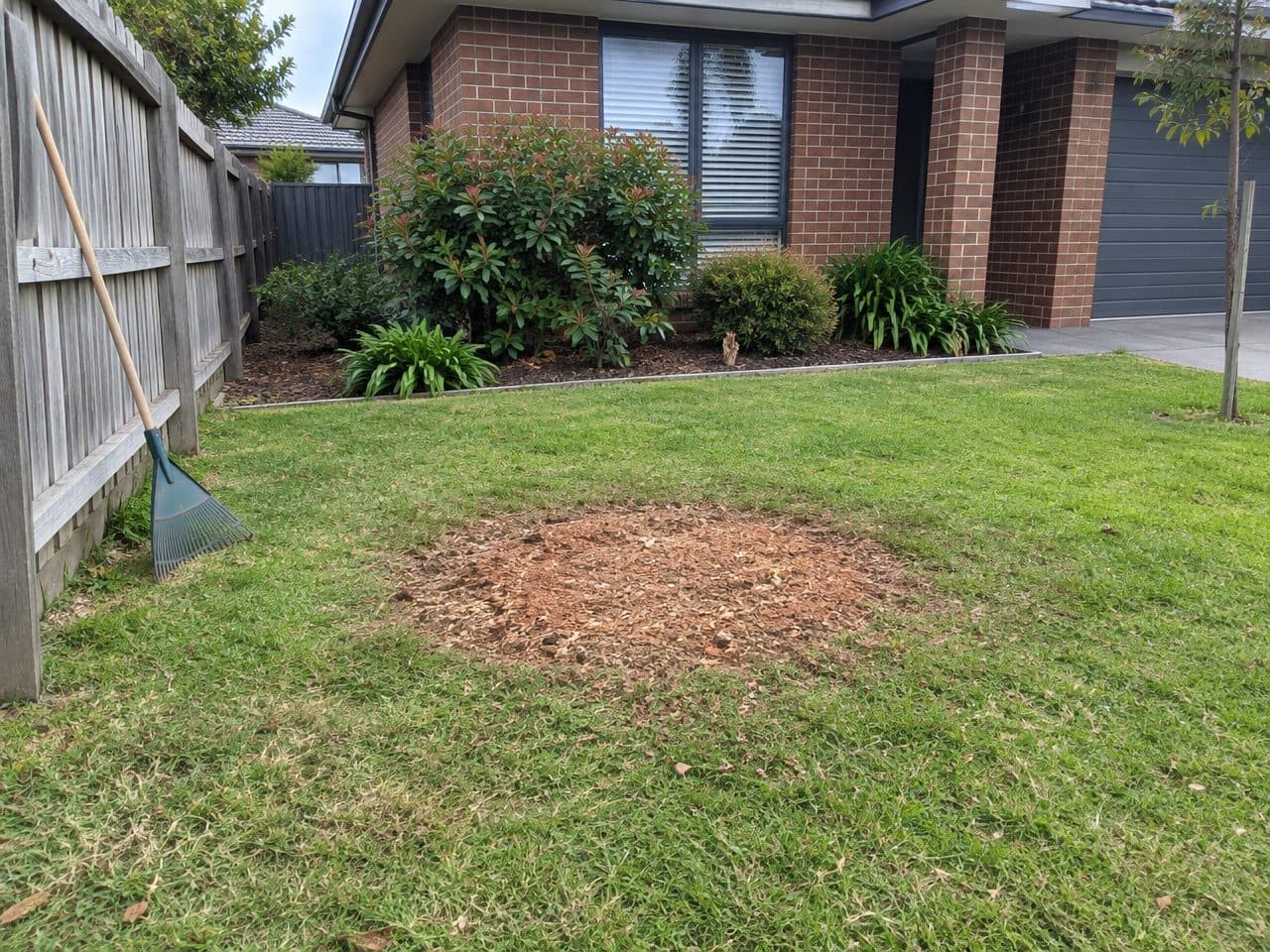
Clear out most of the grindings, backfill with good soil, and let it settle before you plant or lay turf. A ground stump leaves a shallow hole full of wood chip and soil, with the deeper roots still in the ground, and what you put on top depends on how well that hole is prepared.
Most stumps are ground 150 to 300 mm below ground level. Action Garden's stump grinding service works to that range, follows surface roots where needed, and can leave the grindings or remove them and backfill with soil on request. Our stump grinding guide compares grinding with full stump removal if you have not yet decided.
What you plan for the space sets how deep the grinding needs to go:
| Plan for the space | Usual grinding depth | Preparation |
|---|---|---|
| Lawn | About 150 to 200 mm below ground | Remove chip, backfill with topsoil, settle, then turf |
| Garden bed with shrubs and perennials | Deeper, towards 300 mm | Remove chip, backfill with soil and compost |
| A new tree in the same spot | As deep as possible, or full removal | Usually better to plant to one side |
| Mulched area or path | Shallow grinding is fine | Grindings can stay as the surface layer |
Tell the operator before the grinding what you want to do with the space. It is much easier to grind deeper on the day than to come back later.
Why should you remove the stump grindings?
Because a thick layer of fresh wood chip under turf or plants causes two problems: it draws nitrogen from the soil as it breaks down, and it slumps unevenly as it rots. Sustainable Gardening Australia (opens in a new tab) notes that wood chips break down slowly and use nitrogen from the soil as they do so.
A small amount of chip mixed through the soil is fine. What causes yellow turf and slow plants is a deep pocket of almost pure wood chip, sitting where roots need soil.
The grindings are still useful elsewhere:
- On paths and play areas as a coarse surface.
- Around established shrubs as a mulch layer on top of the soil, not dug in.
- In the compost in small amounts, mixed with green material.
- Under the bin area or in utility spaces where nothing will grow anyway.
How do you backfill the hole properly?
Fill it with good topsoil in layers, firm each layer lightly, and finish a little above the surrounding ground to allow for settling. Then water it well and top it up again as it sinks.
- Clear the hole. Rake and shovel out most of the grindings until you reach soil with only a scatter of chip.
- Loosen the sides. Fork the edges of the hole so new soil knits into the old instead of forming a sharp boundary.
- Add soil in layers. Add 100 mm or so at a time, firming each layer with the back of a rake or a light tread.
- Overfill slightly. Finish with a gentle mound above the surrounding ground.
- Water it in. A deep soak settles the soil faster than waiting for rain.
- Top up. Add more soil each time the level drops, until it holds.
On the heavy clay common across Melbourne's north and west, a loamy topsoil over the hole drains better than refilling with the clay you dug out. On the sandy soils of the south-east, add compost to the fill so it holds water.
An animated cross-section of a lawn after stump grinding. The first frame shows the old stump outline, then the grinder's cut removes it to a marked depth of 150 to 300 mm below the surface, leaving a bowl of light wood chip with dark root stubs reaching out below. Next, most of the chip is lifted away, layers of brown topsoil fill the bowl with a small mound on top, and an arrow shows the mound settling level. Finally a strip of new turf rolls across. In the reduced-motion frame the finished cross-section shows with the layers labelled.
When can you lay turf over the old stump area?
Once the backfilled soil stops sinking, which usually takes a few weeks of watering or rain. Turf laid too early ends up in a dip that collects water and scalps when it is mowed.
For the best result:
- Match the level. The soil surface should sit just below the surrounding lawn by the thickness of the turf, so the new turf finishes flush.
- Match the grass. Couch, buffalo and kikuyu are the common warm-season lawns in Melbourne; ask for the same type as the rest of the lawn so the patch does not stand out.
- Pick the season. Warm-season turf establishes best from late spring through summer, when it is actively growing.
- Water it in. Keep the new turf moist until the roots take hold in the soil below.
Victoria's permanent water saving rules (opens in a new tab) allow watering systems such as sprinklers only between 6pm and 10am, while a hand-held hose with a trigger nozzle can be used at any time. Yarra Valley Water (opens in a new tab) says that when you install or sow new warm-season grass you can apply for an exemption to water outside those hours for up to 28 days; check with your own retailer before you lay the turf. Our guide to new turf care covers the first weeks in detail.
Patching a small spot or turfing the whole lawn
A ground stump in the middle of an old lawn usually needs only a patch of turf, cut in a neat rectangle so the edges are easy to blend. If the lawn around it is thin or weedy from years of shade, it can make more sense to renovate a wider area at the same time.
A lawn that was shaded by a large tree often thins out for the first season after removal, then fills in as the grass gets full sun. Couch and kikuyu spread quickly into a bare patch; buffalo spreads more slowly and is often patched with turf instead.
Can you plant a new tree where the old one was?
You can plant nearby, but it is usually better not to plant in the exact same spot. The soil there is full of grindings and old roots that take years to break down, and it keeps settling as they do.
Planting a short distance away in undisturbed soil gives the new tree a cleaner start. If you do want a tree in the same position, ask for the stump and main roots to be fully removed, not ground, and for the hole to be refilled with good soil. Our stump grinding guide explains when full removal is the better choice.
Before choosing the new tree, think about what went wrong with the old one:
- Size. Was it simply too big for the block? Choose a tree whose mature height and spread fit the space.
- Roots near services. Did roots get into pipes or lift paths? Keep the new tree well away from them. Our article on tree roots, pipes and paths explains what to watch for.
- Power lines. Energy Safe Victoria (opens in a new tab) says owners must keep trees on their property clear of the service line to the house, so avoid planting tall species under it.
- Council rules. Some councils ask for a replacement tree as a condition of a removal permit; check the permit conditions before choosing.
Our article on trees for small Melbourne gardens suggests species that suit suburban blocks. Once it is in, our guides on how to prune a small tree and when to prune trees in Melbourne cover its first years.
What if the old tree died from root rot?
Mention it before any replanting, because some root rot fungi spread from infected stumps and roots to new plants. Grinding removes the stump above ground but leaves roots below, which can still carry the fungus.
Agriculture Victoria (opens in a new tab) notes that Armillaria root rot in Australia is most commonly caused by a native fungus, and that it usually spreads from a woody food base such as an infected tree or stump, or a small piece of infected root. It lists removing infected trees and roots among the control methods and says control is difficult.
Signs that the old tree may have had a root rot:
- it declined or died over a season or two without an obvious cause;
- clusters of honey-coloured mushrooms appeared around the base in autumn;
- white, fan-shaped sheets of fungus were found under the bark at the base;
- nearby woody plants are now declining too.
If that sounds familiar, consider full removal of the stump and main roots, plant lawn or non-woody plants in that area, and put any new tree well away. A consulting arborist or plant pathology service can confirm the cause.
Suckers after grinding
Some trees send up shoots from their roots after the stump is ground, including poplars, robinia, desert ash and some ornamental plums. These suckers can appear through the new lawn or bed for a season or two.
Cut or pull each sucker as soon as it appears, as close to the root as you can. Every shoot removed uses up stored energy in the roots, and regular mowing over a lawn usually wears them out. If you use a product, follow the label exactly.
Are there hidden risks when you dig after grinding?
Yes. Old trees often grow around the services you cannot see, and digging out leftover roots with a mattock can hit a pipe or cable. Check before you dig deeper than the grindings.
- Before You Dig Australia. A free enquiry returns plans from member asset owners. Private lines on your own property are not usually shown.
- Clues on site. Where gas and water enter the property, plus pits, inspection openings, garden taps and lights show where lines are likely to run.
- Irrigation. Old drip lines and sprinkler pipes are easy to cut when digging out roots.
- Protected trees nearby. Boroondara notes that works near a protected tree may need a permit, and digging in its root zone can damage it.
Call a plumber if roots from the old tree are in a drain or pipe, and your electricity distributor or an electrician if a cable is damaged. Ask a builder or engineer if a large tree was removed near the house on reactive clay and you notice new cracks or sticking doors. Large surface roots, regrinding, and stumps close to services are best left to an experienced stump grinding operator.
Our guide to tree removal permits in Melbourne explains how to check the rules if a neighbouring tree is protected.
What are the most common mistakes after stump grinding?
The common mistakes are about the soil, not the plants. Most of them show up in the first summer as yellow turf, a sunken patch or a struggling new tree.
- Leaving the grindings in the hole. Turf and plants starve for nitrogen and the surface sinks.
- Laying turf straight away. The soil settles and the turf ends up in a dip.
- Refilling with heavy clay. Water pools and roots struggle to grow down.
- Planting a tree in the old hole. The new tree sits in decaying wood and loose fill.
- Ignoring suckers. Shoots from the old roots become a new problem tree.
- Watering outside the rules. Systems may only run from 6pm to 10am unless you hold an exemption.
- Choosing the same tree again. If the last one outgrew the space, a smaller species saves another removal.
Is it time to hand it over?
If you would rather have the stump ground, the grindings removed and the hole backfilled ready for turf or planting, Action Garden can arrange it through its stump grinding service, done by the Action Garden team. Laying turf or planting over the spot is not part of the service, so that last step is yours. More guides on trees and stumps are on the trees and stumps topic page.
You can get a free quote with just your name and mobile.
Your Garden. Our Promise.
Frequently asked
How long should I wait after stump grinding before laying turf?
Can I plant a new tree in the exact spot where the old one was?
Why is the new turf over an old stump turning yellow?
Should I feed the soil where stump grindings were mixed in?
Why are mushrooms coming up where the stump was ground?
How do I stop the ground sinking where a stump used to be?
How far from the old stump should a replacement tree go?
Sources and further reading
- Choosing mulch for your garden (Sustainable Gardening Australia)
- Armillaria root rot (Agriculture Victoria)
- Permanent water saving rules (Water Victoria)
- Permanent water rule exemptions (Yarra Valley Water)
- Before You Dig Australia, information for homeowners
- Trees and vegetation, frequently asked questions (Energy Safe Victoria)
- Protected and significant trees (City of Boroondara)
Caring for Melbourne gardens since 2019. Updated 18 November 2026.