


Hedges and trees
Tree roots, pipes and paths: what to watch for
By the Action Garden team · Updated · 11 min read
Checked against: Merri-bek City Council, Hobsons Bay City Council, Yarra Valley Water, Building and Plumbing Commission, Victorian Government, City of Monash, Before You Dig Australia
TL;DR
- Roots follow moisture, so they get into pipes that already leak, mostly old earthenware clay pipes with failed joints.
- Clearing roots from a pipe fixes the blockage but not the leak, so roots come back until the pipe is relined or replaced.
- In Victoria, the property owner looks after the sewer and stormwater pipes on their land up to the connection point; drain work is for a licensed or registered plumber.
- Paths and paving lift where shallow roots thicken under them; street footpaths are the council's to inspect and repair.
- Removing a tree does not instantly stop root trouble; grinding the stump and following surface roots ends the regrowth that keeps pushing.
| Item | Figure or rule | Source |
|---|---|---|
| Who owns the private pipes | The property owner, from the house to the connection point near the boundary | Merri-bek City Council tree roots leaflet |
| Who can work on drains | A licensed or registered plumber | Building and Plumbing Commission |
| Usual stump grinding depth | 150 to 300 mm below ground | Action Garden stump grinding service |
| Access the stump grinder needs | About 800 mm | Action Garden stump grinding service |
| Neighbour's roots crossing the boundary | Right of abatement, at your own cost, permit checks first | Victorian Government, Trees in Victoria |
How do tree roots actually get into pipes?
Roots get into pipes through gaps that are already there. A cracked pipe or a failed joint leaks water and nutrients into the soil, roots grow towards that moisture, find the opening and keep growing inside the pipe, where water and food are plentiful.
Hobsons Bay City Council (opens in a new tab) describes tree roots as opportunistic: they spread wherever moisture, nutrients and oxygen let them. It notes that a leaking pipe creates a moisture gradient that draws roots towards it, and that it is rare for a root to crack into a properly installed, well-maintained pipe.
Merri-bek City Council (opens in a new tab) says the same in its leaflet on root damage. Failures usually start with poor installation, poor maintenance, faulty joints, cracks or ground movement, and the roots then exploit the leak. It calls damage to intact pipes "extremely unlikely".
An animated cross-section of a backyard. A tree stands on the left, and an old clay sewer pipe runs under the lawn to the right, made of short sections joined end to end. One joint has a small gap, and a blue haze of moisture spreads from it into the soil. Thin feeder roots from the tree grow slowly towards the damp patch, find the gap and slip inside. In the last frame, the roots have branched into a dense mat filling the pipe, and wastewater backs up behind it.
Inside the pipe, the roots do not need to push hard. They branch into a fine, hair-like mat that catches paper and grease, and the blockage grows each season until the line slows or stops.
Which pipes are most at risk in Melbourne homes?
Old earthenware clay pipes are the most at risk. They come in short sections, so there are many joints, and the old seals between them fail with age and ground movement.
Merri-bek says root entry typically happens in old-style earthenware clay pipes, and Hobsons Bay names old terracotta pipes as the most common source of leaks. Hobsons Bay also flags the joins where newer PVC meets old terracotta, a common sight where only part of a line has been replaced.
| Pipe type | Typical setting | Root risk |
|---|---|---|
| Earthenware or terracotta, many short sections | Older homes, often pre-war and post-war suburbs | Highest: many joints, seals fail with age |
| Mixed line, PVC joined to old clay | Homes with partial repairs or extensions | High at the join between materials |
| PVC with sealed joints | Newer homes and replaced lines | Low, unless damaged, poorly backfilled or moved by soil |
| Relined clay pipe | Older lines repaired from the inside | Low once the lining seals the old joints |
Soil plays a part too. Much of Melbourne's north and west sits on heavy clay that shrinks in dry summers and swells in wet winters, and that movement can open old joints. The sandier soils of the south-east drain fast, so roots there range widely in search of moisture.
Sewer pipes, stormwater pipes and the gully trap
Most Melbourne homes have two separate pipe systems. Sewer pipes carry wastewater from the toilet, kitchen, bathroom and laundry to the water corporation's sewer, while stormwater pipes carry roof and surface water from the downpipes to the street kerb or a council drain.
Both can take in roots. The sewer usually shows trouble first at the overflow relief gully, the grated pipe outside near the laundry or kitchen, which is designed to overflow outside before sewage backs up into the house. Blocked stormwater pipes show up as downpipes that overflow at the base, or water pooling around them after rain.
What are the signs that roots are in your pipes?
The early signs are slow drains and odd noises, before anything overflows. Because roots grow in from one point, the problem usually affects every fixture downstream of that point, not just one sink.
Watch for these signs:
- Slow drains everywhere. Toilets, showers and sinks all drain slowly, especially after heavy use.
- Gurgling. Bubbling from the toilet or floor waste when another fixture drains.
- An overflowing gully. Water or sewage rising out of the overflow relief gully outside.
- Blockages that come back. The line is cleared, then blocks again within months.
- A green stripe in the lawn. A lush line or patch of grass along the route of a pipe can mean it is leaking nutrient-rich water.
- Damp or sinking ground. Soft spots, small holes or settling soil over a pipe line.
- Downpipes overflowing at the base. A sign the stormwater line beyond is choked.
Who is responsible for the pipes and the tree?
In Victoria, the property owner looks after the private sewer and stormwater pipes on their land, up to the point where they connect to the water corporation's sewer or the council or street drainage. Who looks after the tree depends on where the tree stands.
Merri-bek's leaflet puts the pipe side plainly: it is the landowner's responsibility to maintain, repair or replace their stormwater and sewer pipes, from the property to the legal point of discharge for stormwater or the connection point for sewer. The sewer connection point is usually near the property boundary. Hobsons Bay says the same: a property owner is responsible for the services to their property.
| Situation | Who to contact first | Notes |
|---|---|---|
| Blocked drain on your property | A licensed or registered plumber | The Building and Plumbing Commission (opens in a new tab)'s consumer pages explain how to check a plumber's licence or registration |
| Blockage in the sewer main in the street | Your water corporation | Merri-bek lists Yarra Valley Water (opens in a new tab) for its area; check the corporation for your address |
| Council street tree roots near your pipes | Your council | Ask about root inspection and pruning before any excavation |
| Neighbour's tree roots crossing the boundary | Your neighbour, then the official dispute pathway | See the neighbour section below |
| Your own tree or stump | You, with a plumber for the pipe and a tree crew for the tree | Order of work matters, see below |
Councils handle their own trees case by case. Merri-bek says it will not remove trees because roots are in private pipes, but if excavation is needed to repair or replace pipes, its arborists can inspect and prune roots while the pipe is exposed. Hobsons Bay says it will look at all viable options to retain a tree before considering removal, and may ask for a structural engineer's report. Our article on council street trees covers what you can and cannot do to a tree on the nature strip.
Neighbours, roots and the right of abatement
The Victorian Government (opens in a new tab)'s Trees in Victoria page says you can cut back branches, leaves or roots that cross your boundary, at your own cost. This is called the right of abatement. Before cutting, it advises talking to your neighbour, checking with council whether the tree is protected, and getting independent legal advice if you are unsure.
The same page notes you are liable for damage you cause to the neighbour's tree, and that damage from roots, such as cracked pipes, foundations or paths, is usually a matter for property law. Victoria Legal Aid and the Dispute Settlement Centre of Victoria are the places to start if you cannot agree. We do not give legal rulings; if a dispute is building, get advice before anyone cuts.
How do tree roots lift paths, driveways and paving?
Roots lift paving by thickening under it. Shallow roots near the surface grow a little wider every year, and a slab, paver or edging sitting on top of them is slowly pushed up, tilted or cracked.
Most of a tree's feeding roots sit in the upper layers of soil, where water and oxygen are, and they often spread well past the edge of the canopy. Under a path, the soil stays moist because the paving stops evaporation, which makes the space under a slab an inviting place for roots.
Street footpaths show it clearly. The City of Monash (opens in a new tab) says most of its footpath complaints are due to joint displacements caused predominantly by tree roots, and it grinds, ramps or replaces lifted sections depending on how far they have moved. If a footpath outside your home is lifting, report it to your council rather than cutting roots yourself.
On your own property, the common trouble spots are:
- Concrete paths and driveways beside a tree, where one slab rises and leaves a trip edge.
- Brick and concrete pavers on sand, which lift and spread in a dome over a root.
- Garden edging and retaining sleepers, pushed out of line.
- Fences, where a thickening root at the base can lean posts and plinths.
Trip edges are a real hazard for visitors, tenants and older family members. A lifted slab can be ground or relaid, but if the root is still growing, the problem returns, so the paving fix and the tree decision belong together.
Can tree roots damage a house's foundations?
They can contribute, but roots alone are seldom the whole story. On reactive clay, a large, thirsty tree near a house can dry the soil under part of the footing in summer, and uneven drying and wetting can move the footing.
Hobsons Bay notes that trees can damage structures directly through pressure, or indirectly by changing soil moisture next to them, and that damage is seldom associated with root growth alone. Leaking pipes, poor drainage and garden watering against the walls often play a part too.
If you see new cracks in walls, sticking doors or gaps opening at cornices near a big tree, get a building professional or structural engineer to assess the cause before acting on the tree. Removing a large tree on dry clay can also change soil moisture suddenly, so it is a decision for an expert, not a weekend job.
What should you do about a tree or stump near pipes?
Work in the right order: find the pipe, fix the pipe, then deal with the tree. Cutting down a tree first leaves the leak in place, and digging out roots first can damage the pipe you are trying to save.
- Call a plumber. Have the line cleared and inspected with a camera, so you know where roots enter and what the pipe is made of.
- Locate the pipe. Ask the plumber to mark its route and depth. Before You Dig Australia (opens in a new tab) plans come from registered asset owners and are indicative only, so they will not reliably show your own private drains.
- Decide on the pipe repair. Relining or replacing with PVC, which Merri-bek recommends for lines that keep blocking.
- Decide on the tree. A healthy tree near a repaired PVC line can often stay. A tree that keeps breaking paving, or a stump that keeps sending up shoots, may be worth removing.
- Check permits. Some trees are protected by council local laws or planning overlays; our guide to tree removal permits in Melbourne explains how to check.
- Remove the stump properly. Grind it below ground and follow the surface roots, so nothing regrows towards the repaired line.
Why a cut-down tree can still cause trouble
Some species keep living after the trunk is cut, sending up suckers and shoots from the stump and roots, and those living roots keep growing. Others die back, and their roots slowly rot in the soil, which can leave soft spots where the ground later settles.
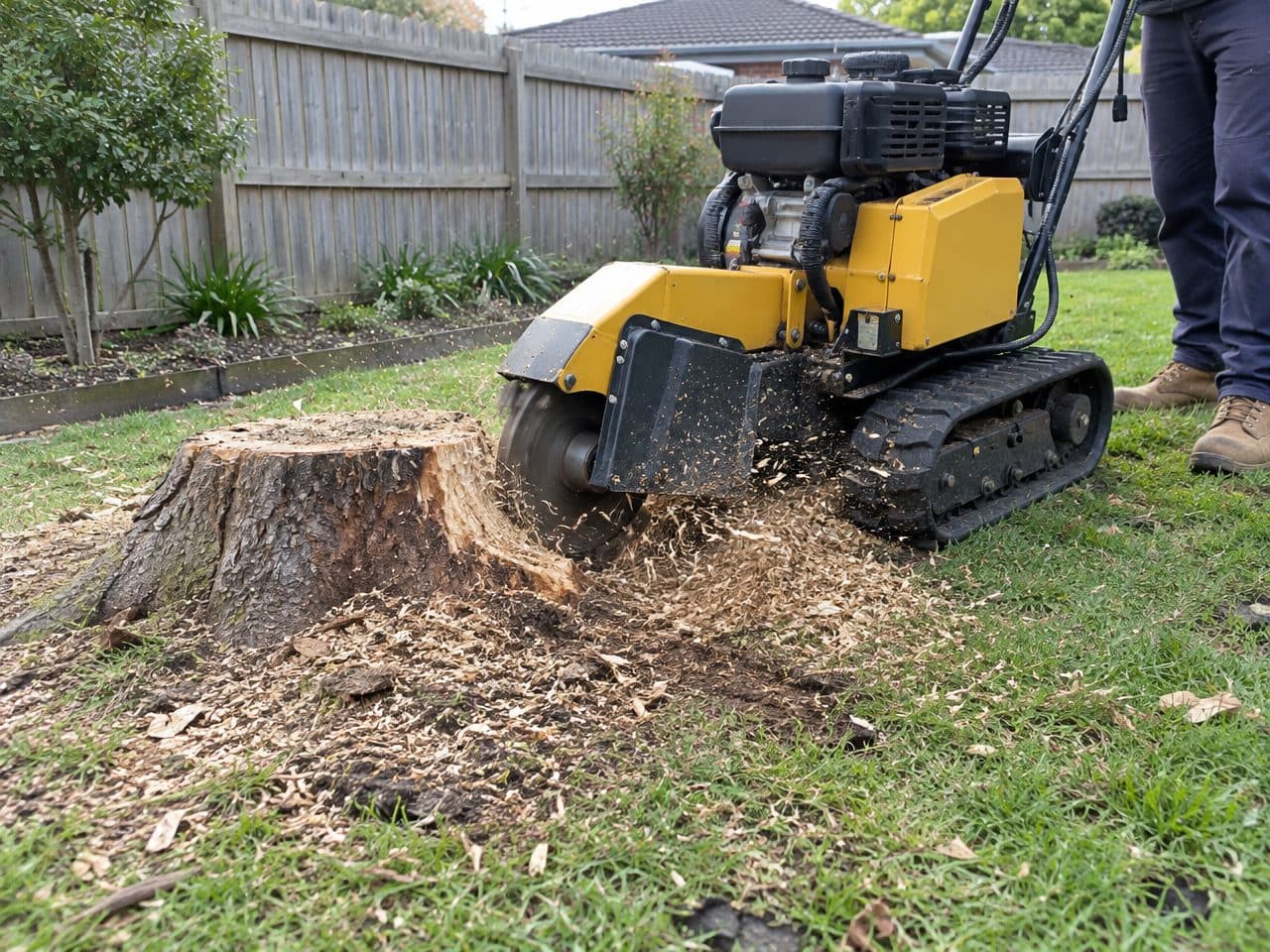
Grinding the stump below ground and following the main surface roots ends most regrowth. Our stump grinding guide explains how grinding compares with digging a stump out, and what is left in the ground afterwards.
If you are deciding what to do with a tree that has outgrown its spot, pruning is often an option before removal. Our article on lopping versus proper pruning explains why a hard lop is not the answer: the fast regrowth it triggers needs even more water, and the roots keep working.
How do you plant near pipes and paths without repeating the problem?
Choose small, less vigorous plants for spots near pipes and paths, and keep large, thirsty trees well away. Water utility planting lists commonly flag figs, willows, poplars, most eucalypts and many bottlebrushes as high-risk near sewer lines.
Yarra Valley Water warns that a tree planted too close to the sewer could become a very costly and messy problem, and keeps a fact sheet listing species not to plant near sewer pipes. It also says sheds, pools and similar structures cannot be placed over sewer mains or other Yarra Valley Water pipes, so get a property asset plan before building or planting over a line.
Practical rules for the garden:
- Plant clear of the pipe route, using a plumber's mark-up or the property's drainage plan.
- Use shrubs, groundcovers and climbers over and beside pipes instead of trees.
- Keep trees back from paths and driveways by at least their expected canopy spread, or more for vigorous species.
- Think about narrow side passages, where sewer lines and inspection openings often run. Our article on screening plants for narrow side passages covers slim, well-behaved plants for those spots.
- Watch climbers on fences, which can root into gaps and loosen palings; see removing ivy and creepers from fences.
After a stump is ground, the spot needs some care before planting. Our guide to replanting or turfing after stump grinding covers clearing the grindings, settling the soil and where a replacement tree should go.
When should you call a professional?
Call a plumber for anything inside a drain, and a tree crew for anything bigger than a shrub. Root problems sit at the meeting point of plumbing, trees and underground services, and the wrong cut or dig in the wrong place can turn a blockage into a burst pipe or a damaged cable.
- Any drain work. The Building and Plumbing Commission says plumbing work must be done by a licensed or registered plumber. Do not dig up or cut into sewer pipes yourself.
- Sewage overflowing. Raw sewage is a health risk; keep children and pets away and call a plumber, or your water corporation if the blockage is in their main.
- Digging near services. Gas, power, water and communications lines can run through gardens. Lodge a Before You Dig Australia enquiry a day or two before digging, and have private lines located.
- Large roots near a tree you are keeping. Cutting a major root can destabilise a tree. Have a tree professional look first.
- Cracks in the house. Get a building professional or structural engineer to find the cause before removing a tree.
How does Action Garden help with roots, stumps and paths?
We do not do plumbing, so the drain itself is always a job for your plumber. Where the tree or stump is the cause, our stump grinding service grinds stumps 150 to 300 mm below ground level, follows surface roots where needed, and removes the grindings or leaves them as mulch, with the hole backfilled on request.
Tree work is done by the Action Garden team and quoted after a site visit, so the plan suits the tree, the pipes and what is around it. The grinder needs about 800 mm of access, and most residential stumps take under an hour on site.
If a stump is pushing up your path or keeps sprouting near a repaired drain, it is worth handing over. You can get a free quote, and browse more articles in our hedges and trees section.
Your Garden. Our Promise.
Frequently asked
Can tree roots break a pipe that has no cracks or leaks?
Why do roots keep coming back after a plumber clears my drain?
Which trees are most likely to get into sewer pipes?
Do roots from a council street tree make the council pay for my pipes?
Will grinding a stump stop roots growing into my drain?
Is it safe to grind a stump that sits right over a drain?
Can I cut my neighbour's tree roots that are lifting my path?
Sources and further reading
- Tree roots, stormwater and sewer pipe damage (Merri-bek City Council)
- Trees and infrastructure (Hobsons Bay City Council)
- Building outside your home (Yarra Valley Water)
- Engaging a plumber (Building and Plumbing Commission)
- Trees in Victoria (Victorian Government)
- Footpaths (City of Monash)
- Before you dig, for homeowners (Before You Dig Australia)
Caring for Melbourne gardens since 2019. Updated 18 November 2026.