


Hedges and trees
Screening plants for narrow side passages
By the Action Garden team · Updated · 11 min read
Checked against: Powercor, Energy Safe Victoria, Yarra Ranges Council, VicFlora, Royal Botanic Gardens Victoria, Victoria Legal Aid, Victorian Government
TL;DR
- In a side passage, mature width matters more than height; pick plants that stay slim or can be trained flat.
- Climbers on wires and espaliered shrubs give the most screening for the least floor space.
- Most side passages are shaded for much of the day, so check the light before choosing a plant.
- Keep a clear walkway and keep the electricity meter, gas meter, drains and inspection openings reachable.
- Avoid sweet pittosporum, privet, cotoneaster, cherry laurel and running bamboo, and keep thirsty, vigorous roots away from pipes.
| Item | Figure or rule | Source |
|---|---|---|
| Access to electricity equipment | Keep gates and routes to equipment accessible | Powercor, accessing electricity assets on private property |
| Plants near the service line to your house | Trim before growth comes within 1 m of the line | Energy Safe Victoria trees and vegetation FAQs |
| Screening plants listed as woody weeds | Sweet pittosporum, cherry laurel, holly, cotoneaster, mirror bush, privet | Yarra Ranges Council weeds page |
| Neighbour's branches over the fence | You may cut back to the boundary; cuttings stay the neighbour's | Victorian Government, Trees in Victoria |
What makes a good screening plant for a narrow side passage?
A good side-passage screen stays slim, copes with shade, and does not need much soil. In a passage that is often only a metre or so between the house and the fence, the plant's mature width matters far more than how tall or how fast it grows.
Most screening plants are sold on height and speed. In a side passage, those are the wrong questions, because a fast hedge that ends up a metre wide will swallow the walkway within a few seasons.
Look for these traits instead:
- Upright or columnar habit. Plants that grow up, not out, or that can be trained flat.
- Shade tolerance. Side passages often get only a slice of sun each day, especially on the south side or between two-storey homes.
- Tolerance of clipping. A screen kept slim needs light, regular trims, so it must recover well from them.
- Modest roots. Side passages often carry sewer lines, stormwater pipes and inspection openings.
- Not a weed. Several popular screening plants spread into bushland around Melbourne.
An animated cross-section looking along a narrow side passage, with the house wall on the left and a paling fence on the right. In the first frame, a young hedge stands neatly against the fence with plenty of walkway beside it. As years tick by, the hedge swells sideways until it fills half the passage and a wheelie bin can no longer pass. A second drawing shows the same passage with star jasmine trained on horizontal wires along the fence: the green layer stays only a hand or two deep, the walkway stays clear, and the electricity meter box on the house wall remains open.
How much space do you really have?
Measure before you buy. Take the distance from the house wall to the fence, then subtract the walkway you need, and what is left is the most your screen can ever be at full width.
Work through the passage with a tape measure and a notepad:
- Measure the full width at its narrowest point, often beside the electricity meter box, hot water unit or air conditioner.
- Mark the walkway. You need room to wheel bins through, carry a ladder, and let tradespeople and electricity meter readers pass.
- Mark the fixtures that must stay reachable: the electricity meter, the gas meter, taps, the hot water unit, the air conditioner, downpipes, drains and sewer inspection openings.
- Note the light. Check the passage at mid-morning and mid-afternoon in winter, when the sun is lowest.
- Check the ground. Is it soil, compacted builder's fill, gravel or concrete?
Powercor (opens in a new tab), one of the distributors serving Melbourne, asks owners to ensure gates and routes to its equipment remain accessible, and its contract terms require safe and unhindered access for its authorised representatives at reasonable times. Plan the screen around the electricity meter box, not over it.
Which plants grow up rather than out?
Columnar shrubs, clumping bamboo and climbers on wires give the most screening for the least width. Each suits a different mix of light, soil and upkeep.
Plant profiles
Plant profiles: slim screens for Melbourne side passages
Columnar lilly pilly (narrow Syzygium selections). Glossy evergreen leaves, quick growth and a naturally upright shape. Takes regular clipping and part shade. Some Syzygium types are prone to psyllid, which blisters new leaves, so ask the nursery about resistance.
Columnar pittosporum (narrow Pittosporum tenuifolium forms). Fine, light leaves on dark stems, naturally upright, good in part sun. Dislikes wet feet, so improve drainage on heavy clay. Not the same as sweet pittosporum, which is a weed.
Illawarra plum (Podocarpus elatus). An Australian native with narrow, dark green leaves. Clips well into a tall, slim screen and copes with more shade than most. Slower to start than lilly pilly.
Slender weaver bamboo (Bambusa textilis var. gracilis). A clumping bamboo with tall, thin canes and light foliage that moves in the wind. Narrow footprint, quick to screen. Only ever plant clumping types.
Star jasmine (Trachelospermum jasminoides). An evergreen twining climber with scented white flowers in late spring. Grows flat on wires or a slim trellis, in sun or part shade. Twines rather than gluing itself to surfaces, so it comes away from a frame cleanly.
Native sarsaparilla (Hardenbergia violacea). A Victorian native climber with purple pea flowers in late winter and spring. Twines on wires, takes dry spells once settled and suits a sunnier passage. Lighter cover than star jasmine.
Camellia sasanqua, espaliered. Trained flat on horizontal wires, it gives a neat, dense evergreen panel with autumn and winter flowers. Copes with part shade and prefers slightly acid, free-draining soil.
Upright bottlebrush (narrow Callistemon cultivars). Native, bird-attracting flowers and a slim habit in the narrower cultivars. Needs good sun. Keep it away from sewer lines, as many bottlebrushes are on water utility lists of root-risk plants.
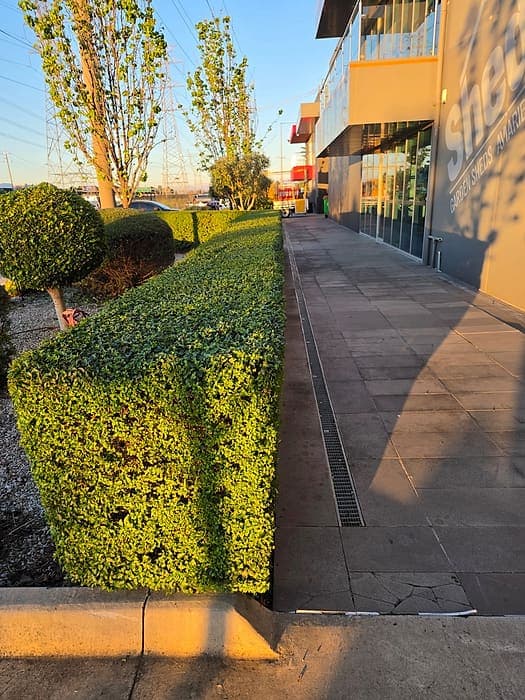
Box, westringia and correa can work as a low, clipped edge at the foot of a climber or along a sunny passage, but they rarely screen above fence height on their own. Our guide to hedge trimming in Melbourne covers how each type of hedge is cut and when.
Should you use climbers, espalier or a hedge?
Use climbers or espalier when the passage is under about a metre wide, and keep a clipped hedge for passages with room to spare. The narrower the space, the more the screen needs to grow flat.
| Option | Width it takes | Speed to screen | Upkeep | Best for |
|---|---|---|---|---|
| Climber on wires or trellis | Very little, a hand or two deep | Medium, one to three seasons | Tie in and trim twice a year | The narrowest passages, concrete with a planter |
| Espaliered shrub | Little, trained flat | Slow, needs training | Regular pruning to keep it flat | Neat formal look, part shade |
| Columnar shrubs, clipped | Moderate | Medium to fast | Two to four trims a year | Passages with room for a slim hedge |
| Clumping bamboo | Moderate, widens slowly | Fast | Thin old canes yearly | Quick height, sunny or bright passages |
| Standard hedge | Large at maturity | Varies | Frequent trims, both faces | Wide passages only |
A standard hedge also needs trimming on both faces, and in a side passage the far face is often against the fence. If you cannot reach it, the back of the hedge grows unchecked and pushes on the palings. If you are still deciding between planting and building, weigh up how much upkeep each needs before committing.
How to set up wires for climbers and espalier
Run horizontal wires about 30 to 40 cm apart up the height you want to screen, held on eye bolts or a freestanding frame a little in front of the fence or wall, so air can move behind the plant. Tie new growth to the wires loosely with soft ties, and check ties each season so they do not cut into stems.
A freestanding frame, or posts set just inside your boundary, avoids loading a shared fence. Victoria Legal Aid (opens in a new tab)'s fences and trees page is a good starting point on shared fences, and it is always worth talking to your neighbour before fixing anything to a dividing fence.
Which screening plants should you avoid in a side passage?
Avoid weedy screens, wide-growing hedges, running bamboo and vigorous, thirsty trees. In a narrow space, each of them turns into a maintenance problem or a risk to pipes and fences.
Yarra Ranges Council (opens in a new tab) lists sweet pittosporum, cherry laurel, holly, cotoneaster, mirror bush and privet among its woody weeds, and English ivy among its environmental weeds. VicFlora, published by Royal Botanic Gardens Victoria, describes sweet pittosporum (Pittosporum undulatum) as a widespread environmental weed in southern Victoria's wet forests and coastal scrub, spread largely by birds from garden plantings.
| Plant | Why to avoid it in a side passage |
|---|---|
| Sweet pittosporum, privet, cotoneaster, cherry laurel, holly, mirror bush | Listed as weeds in Melbourne council areas; birds spread the seed |
| Running bamboo | Spreads by underground runners under fences, paths and into neighbours' yards |
| Leighton green and other big conifers | Grow very wide at the base and need constant trimming to stay in bounds |
| Figs and other vigorous, thirsty trees | Strong roots that seek out leaking pipes, which often run along side passages |
| English ivy | A weed that roots into fences and brickwork and is hard to remove |
If ivy or another creeper is already on the fence, our guide to removing ivy and creepers from fences explains how to get it off without damaging the palings.
Why pipes matter in a side passage
Sewer lines and stormwater pipes often run along the side of the house, and the overflow relief gully and inspection openings are commonly in the side passage. Older clay pipes there can leak at the joints, and roots from vigorous plants follow that moisture inside.
Keep trees and large, thirsty shrubs away from the pipe route, and keep inspection openings uncovered. Our article on tree roots, pipes and paths explains how roots get into pipes and what to watch for.
How do you plant a screen in a narrow passage?
Prepare the strip well, plant at the right spacing for the final width, and give it a sound watering routine for the first summer. Side-passage soil is often poor fill, so the preparation matters more than the plant.
- Prepare the soil. Break up compacted fill and mix in compost, or build a narrow raised bed or trough if the ground is concrete or rubble.
- Keep soil off the house. Keep beds, soil and mulch below weep holes and away from the slab edge, which also keeps the edge visible for termite inspections.
- Set up supports first. Put wires or a frame in before planting climbers or espalier, so roots are not disturbed later.
- Plant for the final width. Set plants close enough to knit together but no closer than the label suggests, and plant a little in front of the fence, not hard against it.
- Mulch and water. A coarse mulch, kept back from stems, helps the soil hold water in summer.
- Water within the rules. Under Victoria's permanent water saving rules, watering systems may run only between 6pm and 10am, and a hand-held hose with a trigger nozzle can be used at any time.
Autumn is usually the best time to plant in Melbourne, when the soil is still warm and the rain is returning. Spring planting works too, with more careful watering through the first summer.
How do you keep a side-passage screen slim?
Trim lightly and often, and always cut the face back to the line you want before it bulges. A screen kept slim from the start never needs a hard cut-back later.
- Clipped shrubs: two to four light trims a year, timed with spring and late-summer growth.
- Climbers: tie in new growth and trim in spring after flowering and again in autumn.
- Espalier: shorten forward-growing shoots back to the wires several times a season.
- Bamboo: cut out old or leaning canes at the base each year and remove any spreading shoots.
- Taper the face slightly, a little narrower at the top, so light reaches the lower leaves and the base stays full.
Columnar shrubs can also be clipped into neat cones or columns, which suits a formal entrance. Our guide to shaping topiary balls and cones shows how, and the right tool makes the job easier: see hedge trimmers, shears and secateurs compared.
Bringing an overgrown side-passage screen back
A screen that has already swallowed the walkway can often be cut back in stages: take one face back hard in a season, let it reshoot, then do the other. Many lilly pillies and pittosporums recover from this; conifers such as Leighton green do not regrow from bare wood, so cutting them back past the green leaves leaves them bare.
Sometimes the honest answer is to remove the overgrown plants and start again with a slimmer choice. Our article on lopping versus proper pruning explains why simply hacking a tall screen down creates more problems than it solves, and if larger plants need to come out of a tight space, see tree work in tight backyards.
When should you call a professional?
Call a professional when the screen is too tall to trim from the ground, sits near a power line, or needs heavy plants removed from a tight space. Ladders in a narrow passage are awkward, with little room to set them up safely.
- Near the service line. Energy Safe Victoria (opens in a new tab) says that if a tree on your property is near the service line to your house, you are responsible for keeping it clear, and growth should be trimmed before it comes within one metre of the line. Ask your distributor for safe pruning advice, and never trim near a line yourself.
- Working at height. Anything that needs a ladder in a narrow passage, or reaching over a fence, is safer done by a crew with the right access gear.
- Neighbour's plants. You may cut back branches that cross your boundary, but the cuttings remain the neighbour's property. Check whether the plant is protected first.
- Removing large screens. Big shrubs and bamboo clumps have heavy root balls that may sit near pipes and fences.
How does Action Garden help with screens in side passages?
Our hedge trimming and pruning service covers precise trimming, selective pruning, formal or natural shaping and a full clean-up, one-off or on a seasonal schedule. In a side passage, that means cutting the screen back to a slim, tapered face and clearing every clipping from the walkway.
If a side-passage screen has crept over the path, or you are planning a new one and want it kept in shape from the start, it is worth handing over. You can get a free quote, and browse more articles in our hedges and trees section.
Your Garden. Our Promise.
From our jobs
Frequently asked
What is the narrowest screening option for a side passage with no garden bed?
Will a lilly pilly hedge fit in a one-metre side passage?
Is clumping bamboo safe to plant beside a house or boundary fence?
Which screening plants cope with a dark side passage on the south side?
Can I attach a trellis or wires to a shared boundary fence?
How often does a narrow side-passage screen need trimming?
Are planter boxes a good idea along a concrete side passage?
Sources and further reading
- Accessing electricity assets on private property (Powercor)
- Trees and vegetation FAQs (Energy Safe Victoria)
- Controlling weeds (Yarra Ranges Council)
- Pittosporum undulatum (VicFlora, Royal Botanic Gardens Victoria)
- Fences and trees (Victoria Legal Aid)
- Trees in Victoria (Victorian Government)
Caring for Melbourne gardens since 2019. Updated 18 November 2026.