


Hedges and trees
Tree work in tight backyards: access, protection and clean-up
By the Action Garden team · Updated · 11 min read
Checked against: Energy Safe Victoria, WorkSafe Victoria, vic.gov.au
TL;DR
- In a small yard a tree comes down in sections, cut and lowered under control, because there is no room to fell it in one piece.
- The narrowest point on the way out, usually a side gate or path, decides how timber is moved and which machines can reach the tree.
- Power lines, the service line to the house, fences, sheds and pools all shape the plan, and anything near a line is a job for the distributor or trained crews.
- Lawns, paths and garden beds are protected along the carry route, and you can help by clearing furniture, pots and cars before the crew arrives.
- Tree work in Victoria often needs a council permit check and your neighbour's consent before anyone goes onto their land.
| Item | Figure | Source |
|---|---|---|
| Access our stump grinder needs | About 800 mm | Action Garden stump grinding service page |
| No Go Zone for private tree contractors near power lines | 3 m | Energy Safe Victoria recommendation |
| Keep plants off the service line to your house | Clear before growth comes within 1 m | Energy Safe Victoria trees and vegetation FAQs |
| Distance to stay from a fallen power line | At least 8 to 10 m | Energy Safe Victoria trees and vegetation FAQs |
How is a tree removed from a tight backyard?
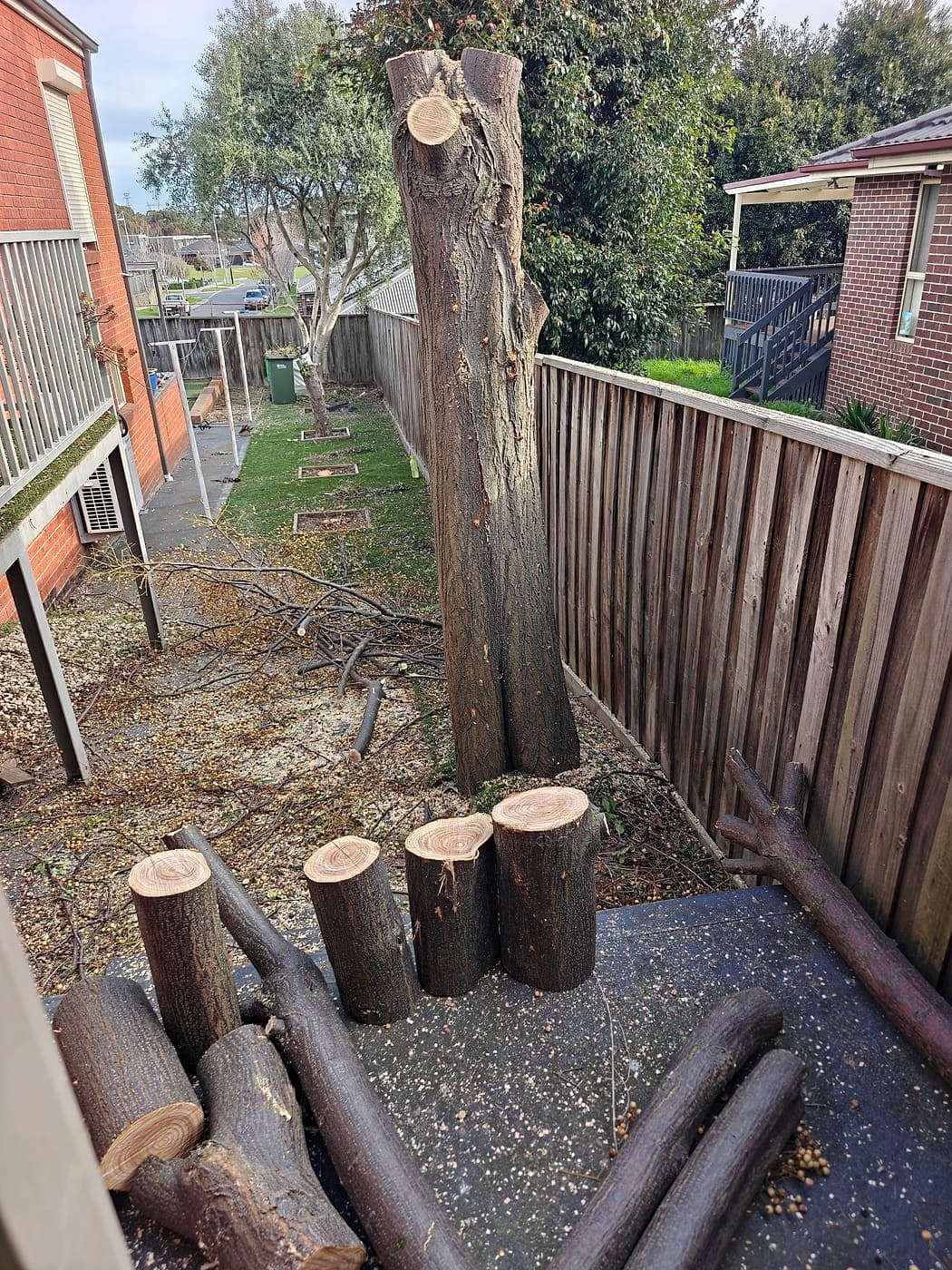
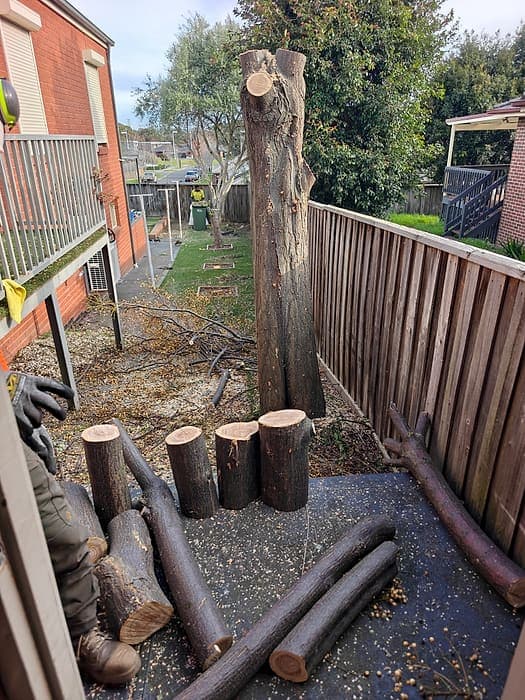
A tree in a tight backyard is removed in sections. Instead of felling it in one piece, the crew cuts it from the top down, lowers each piece under control into a small cleared area, and moves the timber out through whatever access the site has.
Many Melbourne blocks make this the normal case, not the exception. Subdivided lots, townhouses with narrow side paths, and older homes built close to the boundary often leave no room for a tree to fall, so the job is planned around what is in the way.
| Site | What usually happens | What slows it down |
|---|---|---|
| Open yard with wide side access | Larger sections, machinery close to the tree | Very little |
| Narrow side path, no rear access | Sections cut to carry, chipped out the front | The length and width of the carry route |
| Tree beside the house or a shed | Limbs lowered on ropes, away from the roof | Rigging each limb before it is cut |
| Tree near a power line or service line | Distributor or trained crews, No Go Zone rules | Coordination with the distributor |
| Fully enclosed yard, no side gate | Agreed route through a neighbour's yard, or lifting | Permissions and specialist equipment |
An animated cut-away of a small backyard seen from the side: a house on the left, a paling fence on the right, and a tall tree between them. A climber in the canopy cuts the top section, which is lowered on a rope to a small dashed drop zone on the lawn. Next, a limb over the house roof is tied off before it is cut and swung clear of the roof as it is lowered. Finally, the trunk is taken down in short rounds, and arrows show each piece carried along a protected side path to a chipper at the front of the house.
What decides how the tree comes down?
The tree itself and everything around it decide the method. Height, lean, condition and the weight of each limb are matched against the space below, the structures nearby and the route out.
- The tree: species, height, spread, lean, and whether there is decay, splits or dead wood that changes how limbs can be handled.
- The drop zone: how much open ground there is to land pieces safely, and what is in it.
- Structures: roofs, gutters, fences, sheds, pergolas, pools, glasshouses and water tanks under or near the canopy.
- Lines and services: power lines, the service line to the house, phone and data cables, and anything underground near the stump.
- The way out: the width of the side gate or path, steps, slopes, and where a chipper or truck can park.
Signs of decay or a sudden lean can change both the method and the urgency. Our guide to the signs a tree may be unsafe, and who to call explains what to look for before you ask for a quote.
Why a tree cannot simply be dropped in a small yard
Felling a whole tree needs clear ground at least as long as the tree is tall in the direction it falls, plus a safety margin around it. In a suburban yard that ground is usually taken up by the house, the fence or the neighbour's garden.
Cutting in sections reduces the falling distance to a few metres and the weight of each piece to something that can be controlled. It takes longer, but it is what keeps roofs, fences and people safe.
How do access and the side gate change the job?
The narrowest point between the tree and the street changes the job more than anything else. Every branch, round of trunk and bucket of chip has to pass through it, so its width decides the size of each piece and which machines can reach the tree.
Stump grinding is available with our tree cutting and removal service, and the grinder needs about 800 mm of access, so a gate or path narrower than that changes how the stump is reached. For the rest of the job:
- Branches are usually cut to a size two people can carry through the gate without scraping walls and fences.
- Trunk rounds are cut short enough to roll or wheel out on a trolley.
- The chipper usually sits at the front of the property, so cuttings are carried out to it.
- The truck or trailer parks at the kerb or in the driveway. If a council parking permit is needed, the team works it out with you before the job.
When there is no side access
Some yards have no side gate at all, especially where houses are built boundary to boundary. Then the options are an agreed route through a neighbour's yard, taking a fence panel off for the day, carrying pieces through a garage, or lifting timber out over the house with specialist equipment.
The Victorian Government's Trees in Victoria guidance says you need your neighbour's consent before entering their land. If a shared dividing fence is taken down for access, agree it with your neighbour first: the government's fencing guidance says a neighbour who deliberately or negligently damages a dividing fence is responsible for repairing it.
Action Garden looks for the best access first. Where there is none, the tree is cut into small pieces that can be carried out by hand. The team does not use cranes, and a job too big for that approach is referred to a specialist with heavy equipment.
How are the house, fences and garden protected?
They are protected by planning where every piece lands and every footstep goes, then covering what cannot be moved. Most damage on tight jobs comes from pieces swinging into structures or from heavy traffic across soft ground, and both can be prevented.
- Rigging over structures. Limbs above a roof, gutter, pergola or fence are tied off before they are cut, then lowered and swung clear instead of falling.
- A defined drop zone. A small area is cleared and kept free of people and pets, and pieces land only there.
- Protection on the carry route. Lawn, paving and garden edges along the route are covered where the crew walks and wheels timber.
- Plants kept out of harm's way. Pots and small plants are moved, and nearby shrubs are tied back or covered.
- Pool fences and gates kept closed. A pool barrier must never be left open while work is under way; if a panel has to come out for access, plan for it to go back before the crew leaves.
Pets and children stay inside for the whole job. WorkSafe Victoria (opens in a new tab)'s guidance on working safely with trees lists falling objects, chainsaws and wood chippers among the main hazards, and a small yard puts all three close together.
What about power lines and the neighbours?
Power lines and neighbours are the two things most likely to change a tight-yard job, so raise both in your quote request. A tree near a line has rules of its own, and a tree over the boundary affects the people next door.
Power lines and service lines
Energy Safe Victoria (opens in a new tab) says that if a tree on your property is near the service line that connects to your house, you are responsible for clearing it, and advises clearing trees and shrubs before they grow within 1 metre of the line. Trees near power lines outside your boundary are cleared by the electricity distribution business.
For tree workers, Energy Safe recommends that private tree contractors keep the 3 metre No Go Zone from power lines, and talk to the local distributor before starting work near its lines. That can add steps to the plan, but it is not optional.
- A tree or branch touching a power line: keep away and call your electricity distributor. Energy Safe Victoria advises staying at least 8 to 10 metres from fallen lines and calling 000 if lives are at risk.
- A tree that has fallen on the house: keep everyone out of the damaged area and call VICSES on 132 500 for storm damage.
- A tree leaning or cracking after a storm: do not climb it or cut it yourself; have it assessed.
- Chainsaws and height: cutting in sections above head height is work for trained crews with the right equipment.
Neighbours
Overhanging branches and roots can be cut back to the boundary, according to the Trees in Victoria guidance, but you may need a council permit if the tree is protected, and you are liable for damage you cause. Cut branches belong to the tree's owner unless you agree otherwise.
On a tight job, tell your neighbours the date, where the crew will be working, and whether anything needs to pass over or through their yard. It saves arguments and often makes the job simpler.
Do you need a permit, and who checks it?
You may need one, and it is checked with your council before the work is confirmed. Many Melbourne councils protect trees above a set trunk size or of certain species, and planning overlays protect vegetation in some areas, so the same tree can need a permit in one suburb and not the next.
Our tree cutting and removal service includes a permit check with your council. For how the rules work across Melbourne and how to check your own address, see do I need a permit to remove a tree in Melbourne.
What changes the quote on a tight-access job
Without numbers, the main factors are the size and condition of the tree, how many sections it must be cut into, how far each piece has to be carried and through what, the protection and rigging needed over structures, and whether the stump is ground.
Power lines, a neighbour's yard, street parking for the chipper and permit conditions can add time. A clear photo of the side access and the tree from two angles helps the quote reflect what is really there.
What does the clean-up include?
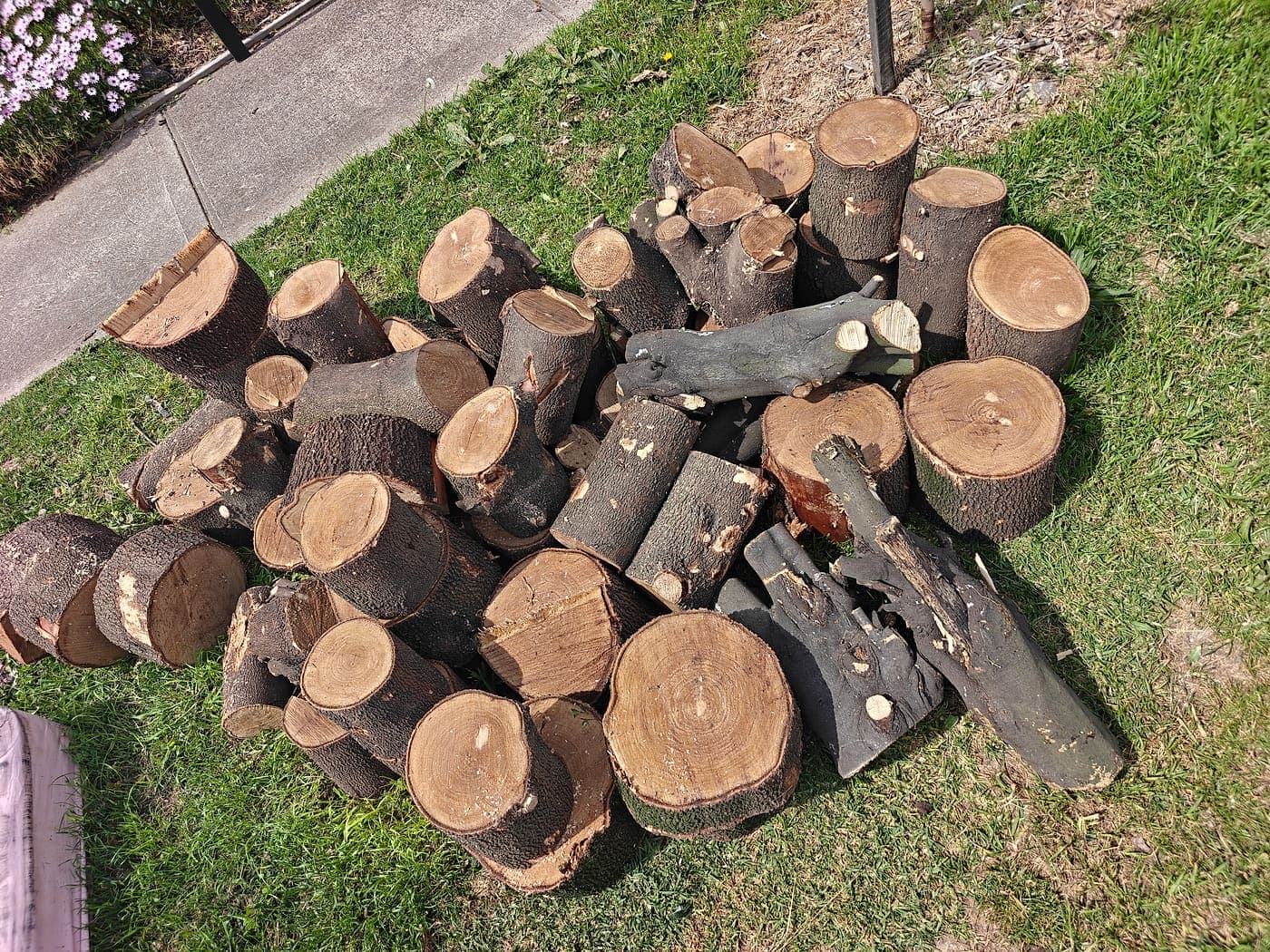
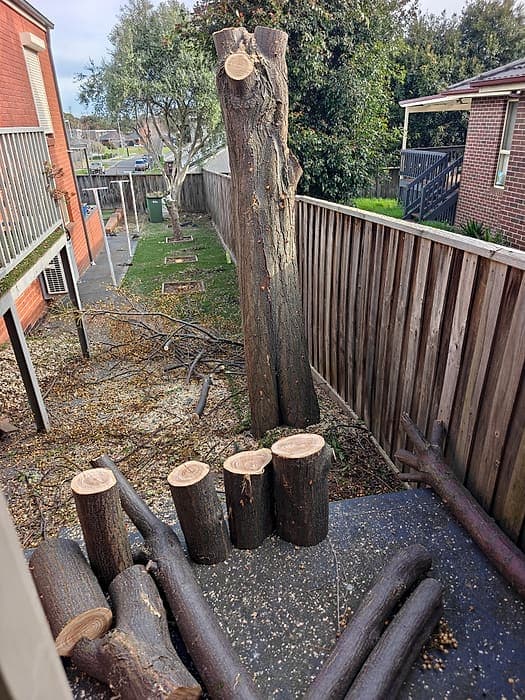
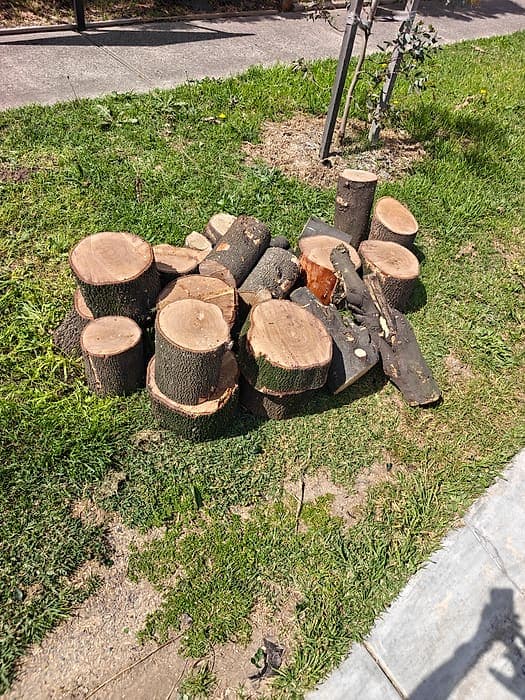
The clean-up includes chipping and removing the cuttings, removing or stacking the timber, and leaving the lawn, paths and beds raked and blown clear. Stump grinding can be added so the spot can be planted, paved or turfed.
- Cuttings are chipped and taken away.
- Timber is removed, or left as firewood if you ask when you request the quote.
- Stump ground below ground level, with the grindings removed or left as mulch, if stump grinding is included.
- Sawdust and leaves are raked and blown off lawns, paths and the side passage.
- A final walk of the carry route and drop zone to check nothing has been missed.
The lawn along the carry route may look flattened for a week or two. Water it if the weather is dry and it recovers with normal mowing.
Every tree job is finished with photos as evidence of the work, and if you want a digital PDF report, the team can prepare a before and after report.
How does this fit with your other garden work?
A tree removal often opens up a space that needs follow-up: a gap in the boundary, more sun on a lawn, or a hedge that was growing in the tree's shade. Plan the next step before the tree comes down.
If you are replacing a tree with screening, our article on hedge or fence: privacy, upkeep and looks compared weighs up the options, and when to trim hedges in Melbourne, species by species helps with timing once the new planting is in. For long boundary hedges that sit beside trees, a big hedge job, start to finish shows how a large job is planned and cleared.
For the full picture on removals, read our complete guide to tree removal in Melbourne, browse more in our hedges and trees articles, or find answers about bookings and visits in the support centre.
If the tree in your yard is boxed in by the house, the fence and the neighbours, it is worth handing over to a crew that plans for exactly that. You can get a free quote and we will arrange a visit to look at the tree and the access.
Your Garden. Our Promise.
From our jobs
Frequently asked
Can a large tree be removed if the backyard has no side gate at all?
Will tree removal in a small backyard ruin my lawn?
Should I tell my neighbours before tree work in a tight yard?
What happens if a stump is behind a gate narrower than the grinder?
Why does tree removal take longer in a tight backyard than an open one?
Is a crane always needed for a big tree surrounded by houses?
How should I prepare a small backyard for tree removal?
Sources and further reading
- Trees and vegetation FAQs (Energy Safe Victoria)
- Keeping tree industry workers safe around powerlines (Energy Safe Victoria)
- Working safely with trees (WorkSafe Victoria)
- Trees in Victoria (vic.gov.au)
- Fencing in Victoria (vic.gov.au)
Caring for Melbourne gardens since 2019. Updated 18 November 2026.