


Hedges and trees
Hedge or fence: privacy, upkeep and looks compared
By the Action Garden team · Updated · 11 min read
Checked against: Victorian Government, Victorian Legislation, Darebin City Council, Agriculture Victoria, CFA, Royal Horticultural Society
TL;DR
- A fence is instant privacy and low routine upkeep; a hedge is slower to establish and needs regular trimming, water and the odd pest check.
- Most side and rear boundary fences in Victoria can be up to 2 metres high without a building permit; front fences have lower limits that vary by council.
- Under the Fences Act 1968, a hedge or similar vegetative barrier can count as a fence, so dividing hedges can come under the same cost sharing and notice rules.
- A hedge filters wind instead of blocking it, which gives a calmer area behind it than a solid fence, and it adds shade, habitat and colour.
- The common best answer is both: a fence on the boundary for day one privacy and security, and a hedge inside it for height, softness and shelter.
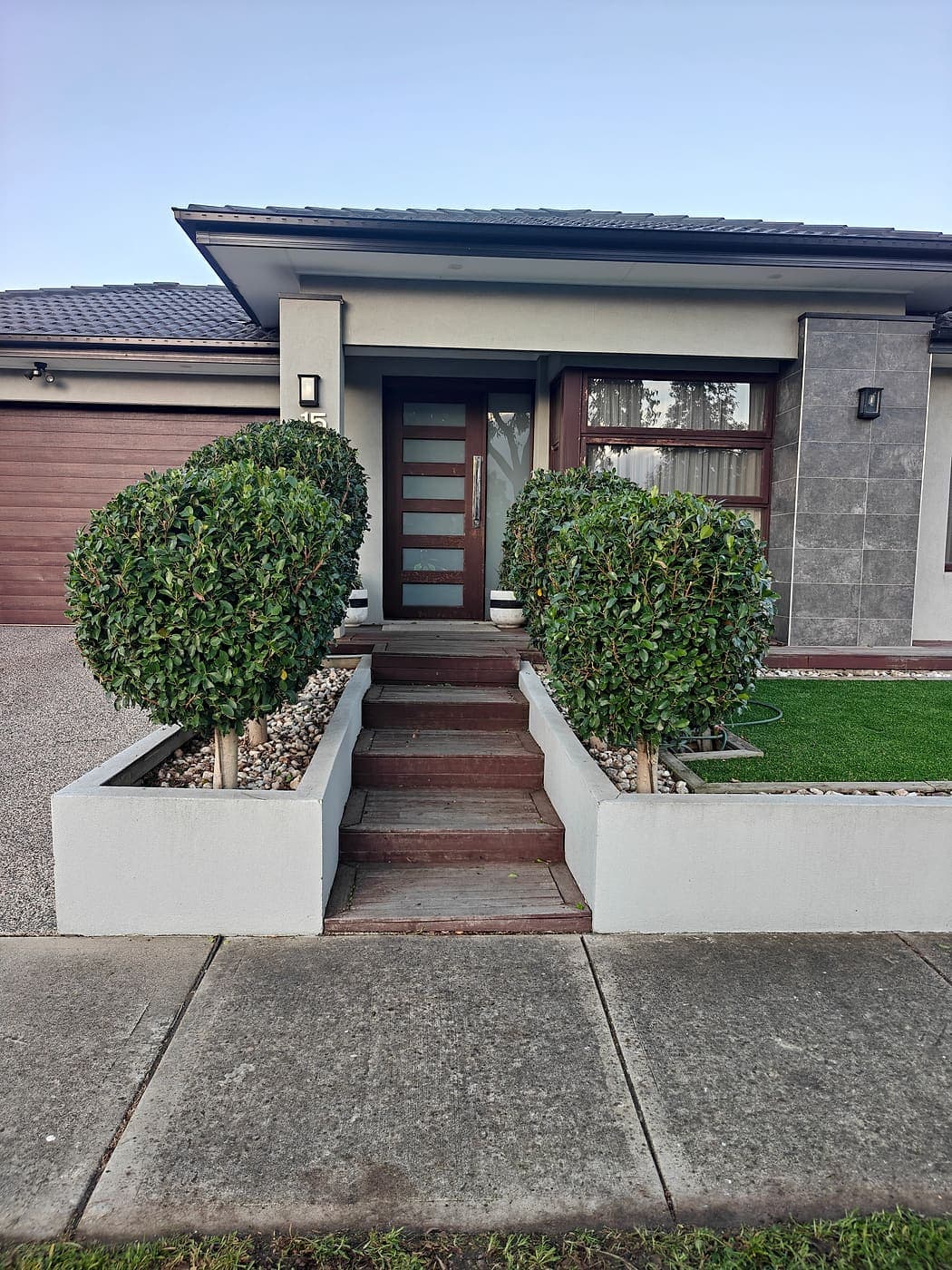
Is a hedge or a fence better for privacy?
A fence is better for privacy right now; a hedge is often better for privacy in five years. A fence screens fully from the day it is built, but it stops at the height the rules allow. A healthy hedge takes a few growing seasons to close up, then can be grown and kept above fence height, which is what most people actually want when a two storey house goes up next door.
The real question is what kind of privacy you need. If you need to stop a dog getting out, keep a pool area secure or block a view this summer, only a built structure does that. If you want to soften a long boundary, hide a neighbour's upper windows or make the garden feel enclosed, a hedge does it better and keeps getting better.
This post compares the two honestly, on privacy, upkeep, rules, wind and looks. For how to keep an existing hedge in shape, our complete guide to hedge trimming in Melbourne covers species, timing and technique.
How do a hedge and a fence compare side by side?
They suit different jobs. A fence wins on speed, security and low routine care; a hedge wins on height, softness, shelter and life in the garden. The table sums it up before the detail.
Side by side
Hedge and fence compared
| Hedge | Fence | |
|---|---|---|
| Privacy on day one | Partial; gaps for the first few seasons | Full, as soon as it is built |
| Height over time | Can be kept above boundary fence height | Fixed; over 2 metres usually needs a building permit |
| Security | Slows people down; not a barrier for pets or pools | A real barrier; required for pool enclosures |
| Routine upkeep | Trims two or three times a year, water, pest checks | Occasional checks, stain or paint for timber |
| Wind | Filters wind, giving a calmer area behind it | Blocks wind at the line; gusts can swirl behind it |
| Heat | Shades and cools the ground and air near it | Sheet metal and dark colours heat up in sun |
| Wildlife | Shelter and food for small birds and insects | Little or none |
| Space taken | A planted strip, often a metre or more | A few centimetres |
| Look | Soft, green, changes with the seasons | Clean line; looks the same all year |
| Under the Fences Act | Can count as a fence | Is a fence |
Space is the trade-off people forget. Even a narrow formal hedge needs a planted strip and room to trim both faces, which matters on small blocks and in side passages. For tight spaces, a narrow screening plant on a trellis or wire often does the job better.
How long does a hedge take to give real privacy?
Longer than most people hope: expect a few growing seasons before a new hedge reads as one solid screen at eye height. The wait depends on the species, the size of the plants you start with, how closely they are spaced, and how well they are watered through their first two summers.
Three things speed it up. Buy the largest healthy plants the budget allows, space them a little closer than you would for single shrubs, and trim lightly from the start so each plant thickens instead of shooting straight up. Our guide on Melbourne hedge plants, including fast privacy hedges compares the usual choices.
What slows it down is just as predictable. Heavy clay that stays wet in winter in the north and west, dry sand in the south-east, a hot west-facing fence line and skipped summer watering all hold a young hedge back by a season or more.
Why a young hedge needs trimming before it reaches full height
It feels backwards to cut a hedge you want to grow taller. But a hedge plant left alone puts its energy into a few strong upright leaders and stays thin low down. Light trims to the sides and tips in the first years make it branch, so the hedge fills from the ground up.
Once a hedge has grown tall and bare at the base, it is slow and sometimes impossible to fix. Our guide on why a hedge goes brown or bare at the bottom explains the causes and what can be done.
What upkeep does each need over the years?
A hedge needs regular, small amounts of work; a fence needs very little until something fails. Over ten years the hedge takes more total hours, while a fence's work comes in lumps, such as a storm-damaged section or rotted posts.
A typical Melbourne hedge programme looks like this:
- Trimming: formal evergreen hedges are usually cut one to three times in the growing season, according to the Royal Horticultural Society (opens in a new tab). In Melbourne that often means late spring and late summer, with a light tidy between on fast growers. Timing shifts by species, with flowering hedges cut straight after they flower.
- Water: deep watering in the first two summers, then in long dry spells. Remember the permanent water saving rules if you use an automatic system.
- Health: a look inside the hedge for scale, psyllid, mildew and dieback a few times a year. Box and photinia hedges have their own common diseases, covered in our guide to box blight and photinia leaf spot.
- Clean-up: clippings raked out, bagged or mulched, and the base kept clear of weeds and leaf build-up.
A fence's list is shorter: check posts and rails after big winds, refix loose palings, keep soil and mulch off the timber, and stain or paint timber if you want to hold the colour. Metal sheet fences mostly need the base kept clear so it does not sit in wet soil.
What do Victoria's rules say about hedges and fences?
Victoria treats a boundary hedge much like a fence for cost sharing, but building permits apply only to built fences. The rules below are the general position; your council and the official pages have the final word.
The Fences Act 1968. The Act defines a fence to include a hedge or similar vegetative barrier that encloses or bounds land. The Victorian Government (opens in a new tab)'s fencing page explains that the cost of a sufficient dividing fence is generally shared equally between neighbours, that a Fencing Notice sets out a proposal for fencing work, and that a neighbour has 30 days to respond to it.
Building permits for fences. Councils across Victoria explain the same general rule: most side and rear boundary fences can be built up to 2 metres high without a building permit. Darebin City Council (opens in a new tab), for example, says front fences within 3 metres of the street need a permit above 1.5 metres for timber or metal and above 1.2 metres for masonry, with lower limits again near corners. A boundary fence that forms part of a pool or spa barrier needs a permit regardless of height.
Hedges and height. Planting is not building work, so a hedge does not need a building permit. But planning overlays, bushfire controls, easements and title covenants can all apply, so check before planting a long screen on a block with an overlay.
Disputes. If you and a neighbour disagree about a dividing fence or hedge, the Dispute Settlement Centre of Victoria offers free advice and mediation. We do not give legal rulings on boundaries, and the official pages linked in the sources below are the place to start.
Which is better for wind, heat and wildlife?
A hedge, clearly. It filters wind instead of stopping it dead, it shades and cools the ground beside it, and it gives small birds and insects somewhere to live and feed.
Wind. Agriculture Victoria (opens in a new tab)'s shelterbelt guidance explains that a very dense windbreak pulls wind down on the sheltered side and creates turbulence, while a less dense barrier gives less turbulence. A solid fence is the extreme case: still air right behind it, then gusts that roll over the top and swirl across the garden. A hedge lets some air through, so the slowed wind stays calmer over more of the yard.
Two side-on panels show the same backyard. In the left panel, wind arrows hit a solid 2 metre fence, rise steeply over the top and curl back down in a tight loop just behind it, with swirl marks over the lawn. In the right panel, a hedge of similar height lets thinner arrows pass through its foliage while the rest rise gently over it; behind the hedge the arrows are shorter and evenly spaced for a longer distance across the lawn, showing slower, steadier air. A label under each panel reads "Blocked: turbulence close behind" and "Filtered: calmer air further back".
Heat. Leaves shade the soil and release moisture, so the air and ground beside a hedge stay cooler on a hot afternoon. Sheet metal fences in dark colours absorb sun and radiate heat into beds planted beside them, which is hard on anything growing along a north or west fence.
Wildlife. A dense hedge with some prickly or twiggy inner growth gives small birds cover from larger birds and cats. Always check for active nests before trimming, and leave a nesting section alone until the young have flown.
What changes in a bushfire-prone area?
The layout around the house matters more than the choice of hedge or fence. CFA (opens in a new tab) guidance says the location and arrangement of plants affects how a fire spreads more than the flammability of any single plant, and that all plants burn in the right conditions.
In practice, for properties on the bushland fringe:
- Keep hedges and dense shrubs away from the walls, windows and doors of the house; use paving, gravel or lawn in that space.
- Do not run a continuous hedge from bushland or a fence line right up to the house.
- Rake out the dead leaves and twigs that collect inside and under hedges, especially through summer.
- Close to the house, a non-combustible fence is the safer choice over timber.
If your property is in a bushfire overlay, check what applies with your council and use the CFA's landscaping resources before you plant.
Can you have a hedge and a fence together?
Yes, and for many Melbourne blocks it is the best of both. The fence goes on the boundary and does the legal and security job; the hedge goes inside it and does the height, softness and shelter job.
To make the combination work:
- Leave a gap. Plant far enough in from the fence that you can stand behind the hedge with a trimmer and the fence stays reachable for repairs.
- Choose the hedge for its final width. A plant that wants to be two metres wide will push into the fence or the lawn whatever you do.
- Keep the base tapered. Trim so the base is wider than the top, which the RHS calls the batter, so light reaches the lower leaves even with a fence casting shade behind.
- Plan the access. A gate or gap at each end of a long hedge makes trimming the back face and clearing behind it far easier.
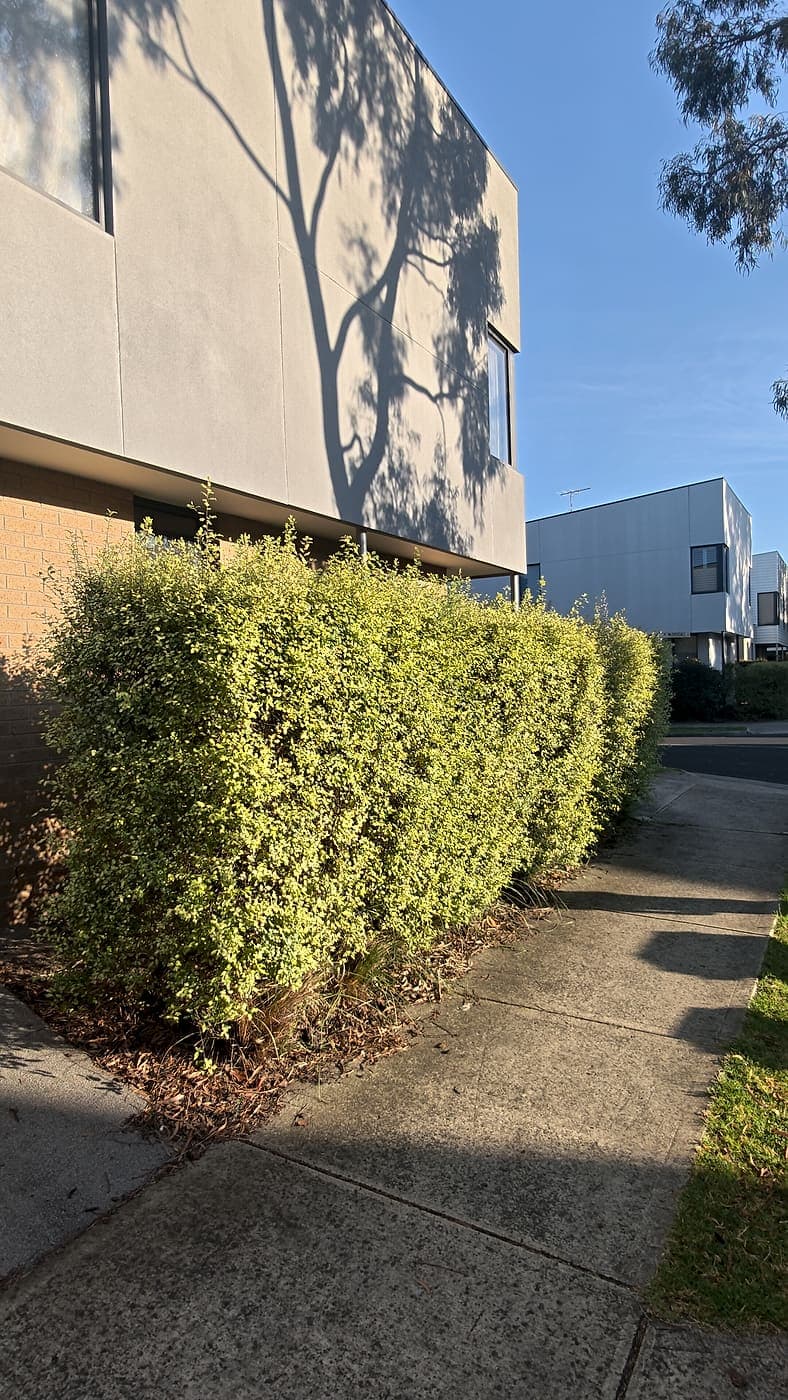
What about a hedge on top of a retaining wall or a raised bed?
A hedge planted along the top of a retaining wall adds height without a taller fence, which is useful where the ground rises toward the boundary. The catches are drainage and roots: the wall needs to cope with wet soil behind it, and vigorous roots can push older walls. Use a moderate grower, and keep the hedge trimmed so its weight and wind load stay reasonable.
Which should you choose for your property?
Choose by what the space has to do. Work through the questions below in order; the first clear answer usually settles it.
Quick decision guide
Hedge, fence or both?
- Do you need a barrier for a pool, pets or small children? You need a compliant fence. A hedge can sit inside it for looks.
- Do you need full privacy within weeks, for example before a sale or a new build next door? Build or extend a fence first, then plant a hedge if you want more height later.
- Is the strip narrower than about a metre? A fence, or a narrow screening plant on a trellis. A true hedge will struggle.
- Do you want screening above 2 metres? A hedge inside the fence line, kept trimmed to the height you want.
- Is wind or summer heat the main problem? A hedge, alone or inside the fence.
- Will nobody trim it two or three times a year? A fence, with low-care plants in front of it.
- None of the above? Both: a fence for the boundary and a hedge for the garden.
What affects the quote for keeping a hedge in shape
Without giving numbers, the things that change the work on a hedge are its length and height, whether both faces and the top are cut, how far it has grown since the last trim, the species (fine-leaved box is slow, large-leaved hedges may need secateurs), access for tools and ladders, and how much green waste comes off. A long, tall hedge trimmed on a regular programme is usually far less work per visit than the same hedge left for two years.
What do people regret about their choice?
The regrets are predictable, and most are about upkeep and space. With a hedge, people regret a species that grows faster or wider than they can manage, a hedge planted hard against the fence, and letting it get too tall before the first serious trim. Our post on pruning mistakes that ruin hedges and shrubs covers the cuts that cause lasting damage.
With a fence, people regret building a long, bare, hot wall with nothing in front of it, and colour choices that dominate a small yard. Many end up planting in front of it anyway.
With trees used as screens, the regret is usually size. A tree that is lovely at three metres can be a problem at twelve. Our post on trees for small Melbourne gardens covers species that stay in scale, and the one on why gum trees drop limbs in summer explains why big eucalypts are a poor choice beside a boundary you sit under.
When is it worth getting help with a hedge?
When the hedge is longer or taller than you can trim safely from the ground, when it has got away and needs reshaping, or when you simply want it done on a regular programme. Action Garden's hedge trimming and pruning service covers one-off trims, regular schedules, shaping and the full clean-up, and you can browse more hedge and tree articles first.
If you are weighing up a new hedge inside an existing fence, or a tired hedge that might be better replaced, we can look at it with you and give you a free quote. Get your quote whenever it suits.
Your Garden. Our Promise.
From our jobs
Frequently asked
Does a hedge or a fence give more privacy in the first year?
Can a hedge legally be the dividing fence between two Victorian properties?
Do I need a building permit to plant a tall hedge on my boundary?
Is a hedge or a solid fence better for blocking wind in a Melbourne backyard?
Which needs more ongoing work, a hedge or a timber paling fence?
Can I plant a hedge right up against a new steel sheet or paling fence?
Do hedges or fences suit bushfire-prone parts of outer Melbourne better?
Sources and further reading
- Fencing in Victoria (Victorian Government)
- Fences Act 1968 (Victorian Legislation)
- Fencing and building permits (Darebin City Council)
- Shelterbelt design (Agriculture Victoria)
- Landscaping for bushfire (CFA)
- Pruning hedges (Royal Horticultural Society)
Caring for Melbourne gardens since 2019. Updated 18 November 2026.