


Trees and stumps · Complete guide
Stump grinding vs stump removal: the complete guide
By the Action Garden team · Updated · 15 min read
Checked against: Agriculture Victoria, Before You Dig Australia, Victoria Legal Aid, City of Boroondara, Merri-bek City Council, WorkSafe Victoria
TL;DR
- Grinding takes the stump below ground level so you can turf, plant or pave over it; the deeper roots decay slowly underground.
- Full removal digs or pulls out the stump and main roots, which disturbs more of the garden but clears the ground for footings and pools.
- Check for underground pipes and cables before any grinding or digging; a Before You Dig Australia enquiry is free.
- Leaving a stump invites suckers, trip hazards and fungi; Agriculture Victoria notes root rot fungus usually spreads from infected stumps and roots.
- Action Garden grinds stumps 150 to 300 mm below grade, follows surface roots where needed and removes the grindings or leaves them as mulch.
| Option | Depth reached | Best for |
|---|---|---|
| Stump grinding | Usually 150 to 300 mm below ground | Lawns, garden beds, paving and most backyards |
| Full stump removal | Stump and main root plate out | New footings, pools, slabs and root rot |
| Leave and let decay | Stump stays at or above ground | Bush gardens and habitat, where safe |
| Cut low and treat | Stump cut close to the ground | Stopping regrowth when grinding access is impossible |
What is the difference between stump grinding and stump removal?
Stump grinding chips the stump away to below ground level and leaves the deeper root system in the soil to decay. Stump removal takes out the stump and its main roots as a whole, by digging, pulling or excavating. Both clear the surface, but only removal clears the ground underneath.
For most Melbourne backyards, grinding is the practical choice: it is quick, needs only a narrow machine, and leaves a spot you can turf, plant or mulch within days. Full removal is worth the extra disruption when something structural is going in, or when the stump is infected with a root rot fungus.
Side by side
Stump grinding or full stump removal
| Stump grinding | Full stump removal | |
|---|---|---|
| What comes out | The stump, down to below ground level | The stump and the main root plate |
| Depth | Usually 150 to 300 mm below ground | The full root plate, often much deeper |
| Ground disturbance | A shallow bowl around the stump | A large hole that must be backfilled and compacted |
| Access needed | A narrow grinder through a gate or path | Often an excavator or heavy digging |
| Roots left behind | Yes, and they decay slowly | Far fewer |
| Best for | Lawns, beds, paving and general tidy-ups | New footings, slabs, pools and root rot fungi |
Our stump grinding service takes stumps 150 to 300 mm below grade, follows surface roots where needed, removes the grindings or leaves them as mulch, and backfills the hole with soil on request. If the tree is still standing, start with the tree removal guide for Melbourne, and for everything else on trees and stumps, the trees and stumps guides.
How does stump grinding work?
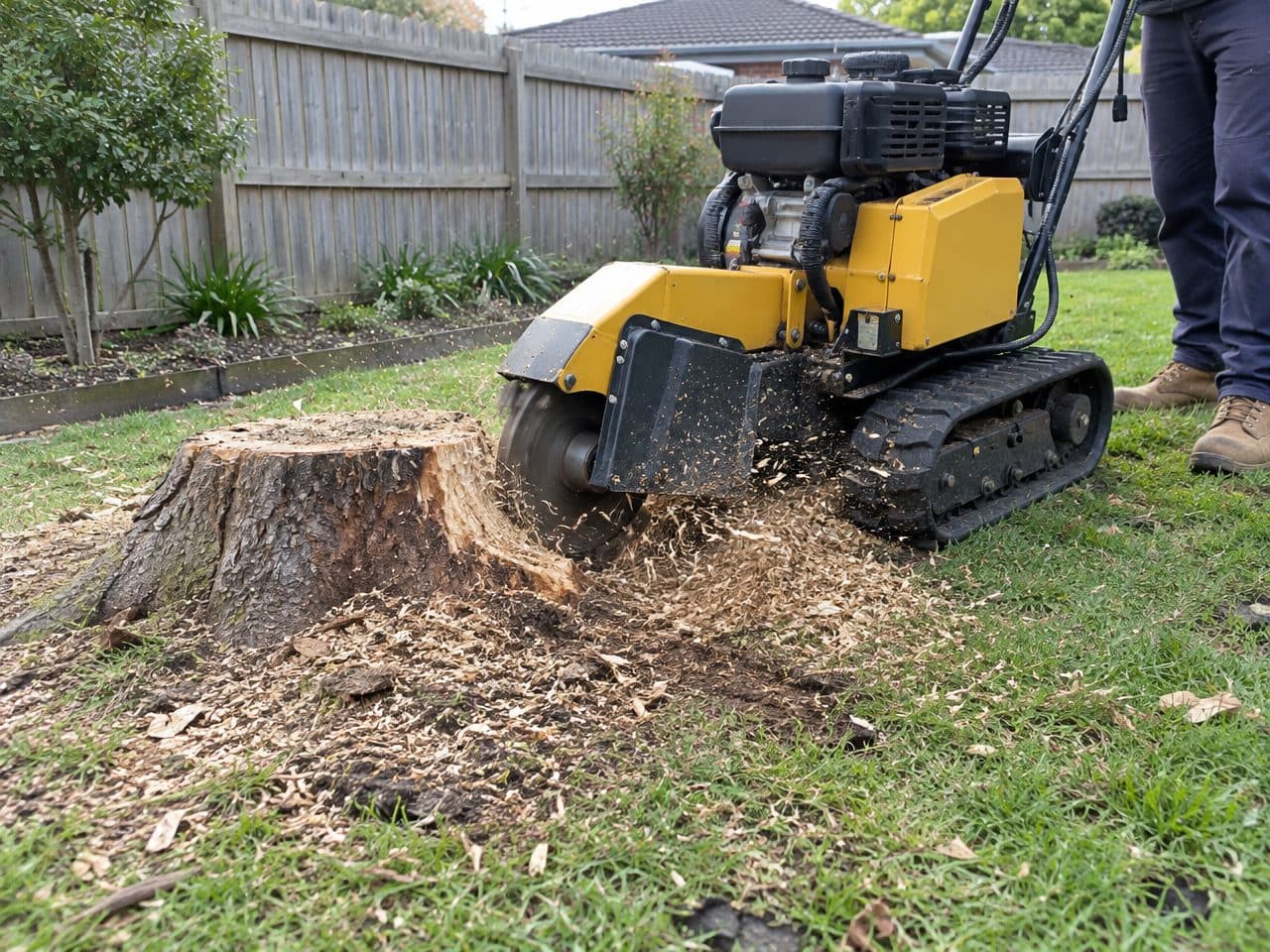
A stump grinder has a heavy rotating wheel fitted with hardened teeth. The operator sweeps the wheel across the top of the stump in passes, lowering it a little each time, until the timber has been chipped away to the depth the job needs.
- Clear the area: rocks, edging, wire and loose items are moved away from the stump.
- Cut the stump low: a tall stump is first trimmed close to the ground with a saw.
- Grind in passes: the wheel moves side to side across the stump, working down in shallow layers.
- Follow surface roots: large roots running near the surface are ground out along their length where they would get in the way.
- Finish and tidy: grindings are removed or spread, and the hole is backfilled if requested.
Most residential stumps take under an hour on site, according to our service page, although large stumps, hard timbers and big surface roots take longer.
An animated cross-section of a stump in the soil with its root plate spreading below. The grinding wheel sweeps across the top in passes and the stump lowers in layers until a dashed line marks 150 to 300 mm below ground. The ground-out bowl fills with soil and new turf, while the deeper roots, shown in a faded colour, remain below and gradually break down.
Grinder sizes and why access matters
Stump grinders range from compact walk-behind machines that fit through a garden gate to large tracked or towed units for big trees. Smaller machines go almost anywhere but take longer on large stumps; larger ones are fast but need wide, firm access.
Our service page notes that the machine needs about 800 mm of access, so the narrowest gate, side path or gap between a house and fence is the first thing to measure. Steps, steep slopes and soft, wet lawn can also limit which machine can reach the stump.
Grinding a row of stumps from an old hedge or screen
Old conifer hedges, lilly pilly screens and rows of overgrown shrubs often leave a line of closely spaced stumps along a fence. These are ground one after another in a single visit, with the machine working along the row and the roots between stumps ground out where a new bed or fence post will go.
Plan the next use before the visit. A new hedge planted in the same line needs the old roots cleared to a good depth along the whole trench, while a lawn edge or a paved path needs only a shallow, even finish. Fence posts close to the row are protected, and any posts already loosened by the old roots are worth noting for repair.
When is full stump removal the better choice?
Full removal is better when the ground below the stump has to carry weight or be dug deeply, or when the stump and roots carry disease. In those cases, leaving a mass of decaying roots in the soil causes problems later.
- New footings, slabs and extensions: decaying roots leave voids that can settle under concrete.
- Pools and deep excavations: the root plate is in the way of the dig anyway.
- Root rot fungi: infected stumps and roots can spread the fungus to nearby plants.
- Replanting in exactly the same spot: a new tree planted in the same position needs clean soil, not a mass of old roots.
- Very large surface roots across lawn or paths: sometimes these are better dug out than ground.
Agriculture Victoria (opens in a new tab) notes that Armillaria root rot is most commonly caused in Australia by a native fungus, and that it usually spreads from a woody food base such as an infected tree or stump, or a small piece of infected root. It lists removing infected trees and roots among the control methods and says control is difficult. If a tree died with honey-coloured mushrooms around its base or white fungal sheets under the bark, mention it before any stump work is planned.
What happens if you just leave the stump?
A stump left in the ground is not dangerous by itself, but it causes a series of small problems. It is a trip hazard and a mowing obstacle, many species sprout from it, and the decaying wood can host fungi and insects for years.
| Left stump issue | What you see | How grinding helps |
|---|---|---|
| Suckers and regrowth | Shoots from the stump and roots | Removes the stump and most of the regrowth points |
| Trip and mowing hazard | Stumps hidden in long grass or under mulch | Clears the surface so lawn or beds can cover it |
| Fungi | Mushrooms and decay around the stump | Removes most of the wood that feeds them |
| Wasted space | A dead spot in the lawn or bed | Frees the area for turf, plants or paving |
| Slow decay | A large stump can take many years to rot | Speeds up the process by leaving smaller, buried pieces |
There are times when leaving it makes sense. In a bush garden, a low stump can become a habitat log, a base for a pot or a seat. If it is away from paths and the species does not sucker, letting nature do the work is a reasonable choice.
Chemical stump treatments and natural decay
Stump-killing herbicides can stop regrowth when applied to a freshly cut stump, but they do not remove the wood, and the stump can take years to rot. Any product must be used strictly as the label directs, including keeping it away from drains, waterways and the roots of nearby plants you want to keep.
Drilling holes and adding products to speed up decay is widely suggested, but it is slow and uneven. In most gardens where the space is needed within the season, grinding is the faster and more predictable option.
What about pipes, cables and roots under the stump?
Check before grinding or digging, because roots often wrap around the very services you cannot see. Water, sewer and stormwater pipes, irrigation lines, gas services and underground power or data cables can all run near an old tree.
- Lodge a Before You Dig Australia enquiry. It is free and returns plans from the asset owners that are members, although not every asset owner is a member and private lines on your own property are not usually shown.
- Look for clues on site: where the water and gas supply enters the property, pits, inspection openings, garden taps and light poles show where lines are likely to run.
- Tell the operator about any irrigation, garden lighting or pipes you know about.
- Watch roots near pipes: a tree removed because its roots blocked a drain may have roots still inside the pipe, so a plumber may need to clear them.
Victoria Legal Aid (opens in a new tab) notes that the same neighbour rules apply to roots as to branches, and that plumbers or engineers are often needed to identify the cause of damage. Our article on tree roots, pipes and paths explains what to watch for around older trees.
Stump grinders are powerful machines that throw chips and stones at speed, and digging out a large stump by hand risks back injury and damage to buried services. Leave grinding to experienced operators, and call a plumber or your electricity distributor if a pipe or cable is damaged. WorkSafe Victoria (opens in a new tab) lists falling objects, chainsaws and wood chippers among the hazards of tree work. Action Garden's stump grinding is arranged as part of its tree work with its own team.
Do you need a permit for stump work?
Usually not for the stump of a tree that has already been lawfully removed. The permit question normally attaches to removing the tree itself, so the stump comes with it.
The exception is work near other protected trees. Boroondara, for example, says you need to check whether you need a permit to work near a protected canopy tree, and its significant tree rules cover works within a tree's protection zone. Grinding a stump and its roots beside a protected tree can damage that tree's roots, so check first.
If the tree is still standing, the rules for removing it, and how to check them for your address, are set out in our guide on tree removal permits in Melbourne.
What do you do with the hole after grinding?
Clear out most of the grindings, backfill with good soil, firm it and top it up as it settles. Within a few weeks the spot is ready for turf, plants or paving, depending on how deep the stump was ground.
- Remove most of the chips. A small amount mixed into the soil is fine, but a thick layer of fresh wood under turf or plants leads to poor growth.
- Backfill with topsoil. Use a quality garden soil or turf underlay, slightly mounded to allow for settling.
- Water and firm. Water the filled hole to settle the soil, then top it up again.
- Wait, then finish. Lay turf, plant or mulch once the level has stopped dropping.
Grindings are useful elsewhere in the garden. They work well as mulch on paths or as a surface layer around shrubs, where they break down slowly without robbing the soil of nitrogen.
Planting a new tree in the same spot needs more care, because the old roots and grindings take years to break down. Our guide on replanting or turfing after stump grinding covers the timing, the soil and when to plant a little to one side instead.
How does stump grinding work with Action Garden?
Action Garden offers stump grinding on its own or as the last step of a tree cutting and removal job, done by its own team. Our service includes grinding stumps 150 to 300 mm below grade, following surface roots where needed, removing the grindings or leaving them as mulch, and backfilling with soil on request.
- Send a photo: a picture of the stump with something for scale, plus the width of the narrowest access point.
- Site check: access, nearby services and what you plan for the spot are confirmed.
- Quote: a written quote for grinding, roots, grindings and backfill.
- Grinding day: surroundings are protected, the stump is ground and the area is cleaned up.
The team talks through what you need, and grinds the stump where the grinder can reach it. Action Garden does not dig out stumps, so a very large stump may need a different contractor. When you send photos, include the stump, the path the grinder would take and anything close by, such as a fence, a path or a garden bed, so the team can tell you early whether grinding will suit the job.
For how quotes, scheduling and payments work, visit our help centre. If you are weighing up who should handle a tree in the first place, our guide on choosing an arborist or a gardener for tree work explains the difference.
What affects the quote for stump grinding?
Stump grinding is quoted per job, without set prices on the website. The main things that shape a quote are:
- the diameter of the stump and how many stumps there are;
- the depth needed and whether surface roots must be followed;
- the hardness of the timber;
- access, including gate width, steps and slopes;
- whether the grindings are removed and the hole backfilled.
What are the most common stump mistakes?
The usual problems come from grinding too shallow, skipping the services check or filling the hole with the wrong material. They are easy to avoid with a little planning.
- Grinding too shallow for the plan. Paving and garden beds may need more depth than a lawn.
- Skipping the services check. A ground-through irrigation line or drain turns a quick job into a plumbing repair.
- Turfing straight over the grindings. Fresh chip under turf sinks and starves the grass.
- Ignoring suckers. Shoots left to grow rebuild the root system's energy.
- Leaving infected stumps. Stumps with root rot fungi can spread it to nearby plants.
- Burning stumps. It is slow, unsafe and restricted in many areas, especially in the fire danger period.
Is it time to hand it over?
If an old stump is in the way of a new lawn, a garden bed or a sale campaign, or a recent removal has left one behind, grinding it out is usually a single short visit. We will check the access and the services, then grind it below ground so the space is yours again.
You can request a free quote with just your name and mobile.
Your Garden. Our Promise.
Frequently asked
How deep should a stump be ground for new turf?
Do the roots keep growing after a stump is ground?
Can stump grindings be used as mulch in garden beds?
Is stump grinding noisy and messy?
Can a stump be removed without a machine?
Will a ground-out stump leave a hole in the lawn?
Do I need council approval to grind a stump?
Is it worth removing old stumps before selling a house?
Sources and further reading
- Armillaria root rot (Agriculture Victoria)
- Before you dig, for homeowners (Before You Dig Australia)
- Fences and trees (Victoria Legal Aid)
- Protected and significant trees (City of Boroondara)
- Trees on private property (Merri-bek City Council)
- Working safely with trees (WorkSafe Victoria)
Caring for Melbourne gardens since 2019. Updated 18 November 2026.
Related reading