


Gutters and roof line guide
Rusty, sagging or leaking gutters: cleaning or a plumber?
By the Action Garden team · Updated · 14 min read
Checked against: Building and Plumbing Commission, Australian Building Codes Board, Rental Dispute Resolution Victoria, Asbestos in Victoria, Lysaght
TL;DR
- A clean comes first, because sludge causes many leaks and sags and hides the real condition of the metal.
- Surface staining and light rust can be watched; holes, flaking metal and rust along the bottom of the gutter mean replacement.
- A sag that stays once the gutter is empty usually means a dropped bracket, a rotten fascia or a run with the wrong fall.
- Repairing, refitting or replacing gutters and downpipes is roofing (stormwater) plumbing work in Victoria; check the plumber on the Building and Plumbing Commission register.
- In a rental, rusty, sagging or leaking gutters are the rental provider's to fix; renters report them.
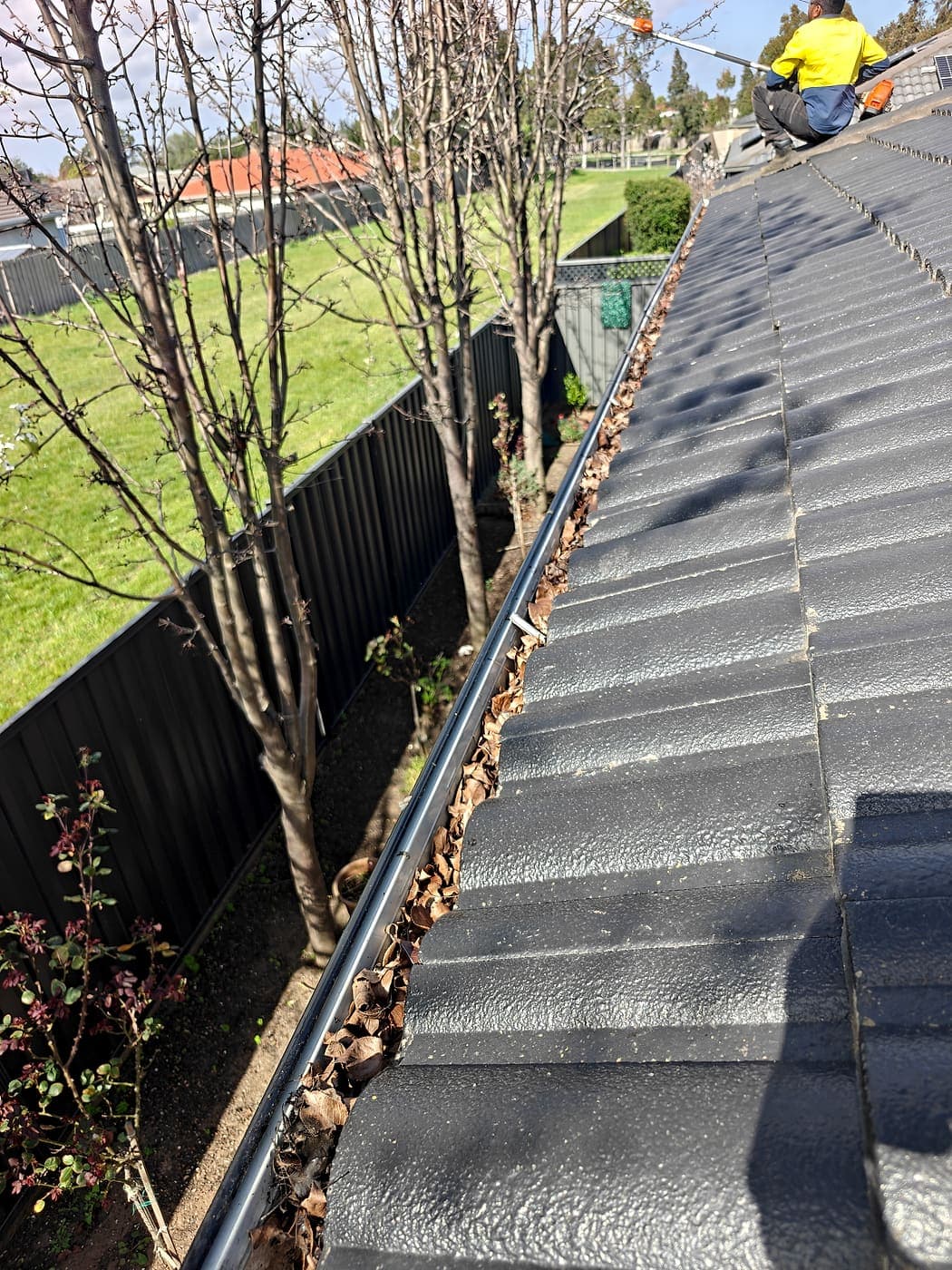
| Problem | Cleaning can fix it when | Plumber needed when |
|---|---|---|
| Overflow along the run | Leaves and sludge fill the gutter | It still overflows once clean |
| Drips at a joint or corner | Debris is holding water at the joint | The joint drips in light rain once clean |
| Sagging section | The weight of wet debris pulled it down, and it lifts once empty | It stays low once empty, or brackets are loose |
| Rust staining | Stains are surface marks under old debris | There are holes, flaking metal or daylight through the base |
Can gutter cleaning fix rusty, sagging or leaking gutters?
Sometimes, and it is always the right first step. A gutter packed with wet leaves holds water against the metal, overflows at the low spots and weighs enough to bow between brackets. Clearing it removes the cause of many leaks and sags, and it shows you the real condition of the gutter underneath.
What a clean cannot do is put metal back. If the gutter still leaks, still sags or shows holes once it is empty and flushed, it needs repair or replacement. That is where the line between cleaning and plumbing sits:
| You see | After a clean | Next step |
|---|---|---|
| Overflow along a run | Water now runs to the downpipe | Nothing more; keep it on a cleaning schedule |
| Overflow along a run | Water still spills over the front | Check the fall and the outlet with a plumber |
| A section bowing down | It lifts back once empty | Clean more often; check the brackets |
| A section bowing down | It stays low once empty | Plumber to refit brackets or the run |
| Brown staining | Stains wipe or brush off, metal is sound | Monitor at each clean |
| Brown staining | Holes, flaking or thin metal | Plumber to replace the affected length |
| Drips at a joint | Dry once the debris is gone | Nothing more |
| Drips at a joint | Still drips in light rain | Plumber to reseal or replace the joint |
The reason the clean comes first is practical. Lysaght (opens in a new tab)'s roofing maintenance manual tells inspectors to look for staining at possible ponding locations, metallic staining, surface rust and build-up of leaves and debris along gutter runs. Most of those are invisible under a gutter full of leaf litter.
Why do gutters rust?
Gutters rust where they stay wet. Steel gutters are protected by a metallic coating, and that coating wears fastest where water and wet debris sit against it for weeks. A gutter that drains and dries after rain lasts far longer than one that holds a strip of sludge along its base all year.
The common causes are:
- Ponding debris. Leaves and roof grit hold water in the bottom of the gutter long after rain stops. This is the most common pattern: rust concentrated in a line along the base, worst near the outlets and at low points.
- Low spots. A section with no fall or a sag holds a puddle after every storm, so it corrodes faster than the rest of the run.
- Metal debris. Lysaght's installation advice is to remove metal swarf and other debris from the roof and gutters after work. Filings left behind after a solar panel, antenna or roof installation rust quickly and stain or pit the coating around them.
- Age. Older galvanised gutters eventually reach the end of their coating life, however well they are kept.
- Coastal air. Homes close to the bay or the ocean see more salt on their roofs, and salt left in a gutter that rain does not wash out speeds up corrosion.
When is rust a repair job?
Light surface staining on otherwise sound metal is something to watch, not to replace. Rust becomes a repair job when you can see holes or pinholes of daylight through the base, when the metal flakes or bubbles, or when rust has spread along the bottom of the gutter rather than staying as isolated spots. By then the coating has gone and the steel underneath is thinning.
Why patching rarely lasts
A dab of sealant over a rust hole stops the drip for a while, but the metal around a hole is usually as thin as the hole itself. Within a season or two, new holes appear beside the patch. Patches also create a ridge that catches more debris, which holds more water against the steel.
That is why the usual repair for a rusted section is replacing the affected length of gutter, or the whole run if the rust is widespread. In Victoria that is roofing (stormwater) plumbing work, so it goes to a registered or licensed plumber.
Why do gutters sag?
A gutter sags when something gives way: the load, the brackets or the timber they are fixed to. Find out which by looking at the gutter once it is empty.
- Weight of debris and water. A gutter full of wet leaves and water is heavy. Between brackets, it can bow down and then recover once emptied. If that is the cause, a clean fixes it, and a regular cleaning schedule stops it coming back.
- Bracket spacing. The National Construction Code's deemed-to-satisfy provisions for housing call for eaves gutters to be held by brackets at not more than 1.2 m centres. Older gutters, or ones extended over the years, sometimes have wider gaps, and those spans sag first.
- Dropped or bent brackets. Brackets bend when a ladder leans on the gutter, when a heavy branch lands on it or when someone grabs the gutter to climb onto the roof. Rusted bracket screws pull out over time.
- Rotten fascia. Brackets are screwed into the fascia board. When timber fascia rots, often because water has been overflowing behind the gutter for years, the screws lose their grip and the gutter drops.
- Wrong fall. The same code provisions set a minimum fall of 1:500 for eaves gutters, unless they are fixed to metal fascias, which is a drop of 1 mm in every 500 mm of length. A run that slopes the wrong way or has a dip in the middle holds water, and that weight makes the dip deeper.
A side view of a single eaves gutter run along a fascia board, with brackets shown as small hooks. In the first frame, the gutter falls gently from the stop end to the downpipe outlet, brackets evenly spaced, and a thin line of water runs along it and down the pipe. In the second frame, one bracket in the middle has dropped and the gutter dips between its neighbours: water pools in the dip, leaves settle there, and a rust spot appears under the puddle. In the third frame, the fascia behind the dropped bracket is shaded to show rot, with overflow water running down behind the gutter.
Why do gutters leak at joints, corners and outlets?
Leaks appear where the gutter is joined, because joints rely on a seal, and seals age. Corners, stop ends, outlet pops and the joins between lengths are all sealed and riveted or screwed, and they are also where leaves collect and sit wet.
Watch the leak in light rain once the gutter is clean:
- Drips from a joint or corner: the sealant has failed or the metal around the joint has rusted.
- Drips from the outlet: the seal between the outlet and the gutter has failed, or the outlet is partly blocked and water is backing up. Clear it first; our guide on how to clear a blocked downpipe covers that.
- Water running down behind the gutter: the gutter may be set too high on the fascia, sitting too close to it or pulled forward by a dropped bracket, so water escapes at the back. The code provisions require overflow water to be directed away from the building, so this is a fault rather than a nuisance.
- Water pouring off one end: the stop end has failed, or the run falls the wrong way.
Cleaning or a plumber: how do you decide?
Clean first, then decide on what is left. Use these questions in order once the gutters and downpipes are clear.
Quick decision guide
Does this gutter need a cleaner or a plumber?
- Has the gutter been cleaned and the downpipes flushed in the last few weeks? If no, book a clean first and look again. If yes, go to 2.
- Does water now run along the gutter and down the downpipe without spilling? If yes, the problem was debris: keep it on a cleaning schedule. If no, go to 3.
- Can you see holes, flaking metal or rust along the base? If yes, call a registered or licensed plumber to replace the affected length. If no, go to 4.
- Does a section stay low or a bracket hang loose once the gutter is empty? If yes, call a plumber to refit it, and a carpenter if the fascia is soft. If no, go to 5.
- Does a joint, corner or outlet still drip in light rain? If yes, a plumber reseals or replaces the joint. If no, watch the gutter at the next rain and keep the photos.
Whatever the answer, take photos of each problem spot after the clean: a close shot and a wide one. They let a plumber understand the job before visiting and can save a second visit just to look.
What does Victorian law say about gutter repairs?
Repairs are regulated; cleaning is not. The Building and Plumbing Commission (opens in a new tab)'s guide to the scope of roofing (stormwater) work defines it as the construction, installation, replacement, repair, alteration, maintenance, testing or commissioning of a roof drainage system, and it reads that as including valley gutters, eaves gutters, rainheads and downpipes. That work must be done by a registered or licensed plumbing practitioner.
In practice, that means:
- Replacing a length of gutter, a corner or a downpipe is plumbing work.
- Refitting or adding brackets and correcting the fall is plumbing work.
- Resealing joints and outlets is plumbing work.
- Replacing a rotten fascia is carpentry, often followed by a plumber refitting the gutter.
- Clearing leaves and debris and flushing the downpipes is maintenance a gutter cleaner can do.
The Commission's register lets you check that a plumber is registered or licensed in the roofing (stormwater) class before you book. For work above the value set in the regulations, the plumber must issue a compliance certificate when the job is done, so ask about it when you get the quote.
Older homes and asbestos
The Asbestos in Victoria (opens in a new tab) website lists guttering, downpipes and eaves among the places asbestos may be found, and says homes built or renovated before 1990 are likely to contain it somewhere. Old fibre cement gutters and eaves linings that are cracked or crumbling should not be cut, drilled, scraped or pressure washed.
If a gutter repair involves disturbing material that might be asbestos, the plumber or builder will arrange testing and, where needed, a licensed asbestos removalist. Do not try to remove or patch it yourself.
Who fixes the gutters in a rental or a body corporate?
In a Victorian rental, the rental provider does. Rental Dispute Resolution Victoria (opens in a new tab) lists clearing gutters of leaves and debris, repairing rusted or leaking gutters and fixing or replacing broken guttering or downpipes as rental provider tasks. It asks renters to report gutter blockages, overflowing water, water stains on walls and sagging or rusty gutters.
For renters, the right move is to report the problem in writing with photos, not to climb up and fix it. For rental providers and property managers, combining a clean with a photo report is a straightforward way to find out whether the gutters need a plumber before the next wet season. Our rain-ready checklist for the outside of your home covers the rest of the exterior.
In apartments, townhouses and other strata properties, gutters and downpipes on the roof are usually common property maintained by the owners corporation. Report problems to the manager, who arranges both the cleaning and any plumbing.
Two-storey homes and box gutters
Upper-storey gutters are harder to inspect, so faults there are often found late, when water is already coming through a ceiling. If the gutters are out of easy reach, our guide to gutters on two-storey homes explains the access options. Box gutters and valleys that sit inside the roof line carry more water past the house structure, so leaks there need a plumber quickly; see box gutters, valleys and leaf traps explained.
How do you stop gutters rusting, sagging and leaking again?
Keep them empty, keep weight off them and look at them regularly. Most gutter failures start with debris and water sitting in the same place for months.
- Clean on a schedule. Autumn and late spring suit most Melbourne homes, with extra visits under gums and big deciduous trees. Our complete guide to gutter cleaning in Melbourne sets out the year.
- Flush the downpipes every time, so water does not back up and pond.
- Never lean a ladder on the gutter. Use a stand-off that rests on the roof or wall instead.
- Clear metal swarf after any roof work, such as solar, antennas or roof repairs.
- Prune branches over the roof so less debris lands in the gutter.
- Check after big storms for dropped brackets and damaged sections.
- Walk the roof line each year using the roof line checklist for gutters, downpipes, eaves and fascias.
Stay off the ladder if the gutter is on a second storey, over a drop, or only reachable by walking on the roof, and never grab or stand on a gutter for support. Call a registered or licensed plumber for rust holes, sagging runs, failed joints, wrong fall and replacement, and a carpenter for rotten fascia. If the gutters, downpipes or eaves could be asbestos cement, do not disturb them.
Is it worth starting with a professional clean?
If you are not sure whether the gutters need a plumber, a clean is the simplest way to find out what you are dealing with, and it is often all they need. Every Action Garden gutter clean clears the gutters and downpipes, includes a visual check for rust, sagging and loose brackets, and comes with a photo report, so you can show a plumber exactly what was found. Action Garden cleans gutters but does not repair them; gutter and downpipe repairs are a job for a licensed plumber. The gutters and roof line guides cover the rest of the roof edge.
When you are ready, request a free quote with a photo of the problem spot.
Your Garden. Our Promise.
From our jobs
Frequently asked
Can I patch a small rust hole in a gutter myself?
Does a sagging gutter always need new brackets?
Is silicone sealant enough to fix a leaking gutter joint?
Will a plumber issue a compliance certificate for gutter repairs?
Should gutters be cleaned before a plumber quotes on repairs?
Why does my gutter only leak at the corner?
Can rotten fascia boards make a gutter sag?
Who fixes rusty gutters in a Victorian rental?
Sources and further reading
- Plumbing industry guide, scope of roofing (stormwater) work (Building and Plumbing Commission)
- Find and check a practitioner (Building and Plumbing Commission)
- Engaging a plumber (Building and Plumbing Commission)
- NCC 2019 Volume Two, Part 3.5.3 Gutters and downpipes (Australian Building Codes Board)
- Who maintains gutters, gardens and pools in a rental (Rental Dispute Resolution Victoria)
- Where is asbestos? (Asbestos in Victoria)
- Rainwater solutions, Victoria and Tasmania (Lysaght)
- Maintenance manual, roofing and walling (Lysaght)
Caring for Melbourne gardens since 2019. Updated 18 November 2026.