


Outdoor cleaning guide
Sealing pavers and concrete after cleaning
By the Action Garden team · Updated · 12 min read
Checked against: EPA Victoria, Yarra Valley Water, Bureau of Meteorology, Paintback, WorkSafe Victoria
TL;DR
- Sealing is the finishing step after a clean, not part of it, so the surface must be clean, re-sanded and fully dry before any sealer goes on.
- Penetrating sealers soak in and keep the natural look and grip; film-forming sealers sit on top, deepen colour and can be slippery when wet.
- Melbourne's late spring and early autumn give the most reliable sealing weather, while shaded paving in winter can stay damp for days.
- Two thin coats beat one thick coat, and sealer that puddles in low spots is the most common cause of a cloudy, peeling finish.
- Leftover single-component sealer goes to a Paintback site, never into the stormwater drain, the garden or the bin.
| Surface | Sealer that usually suits | Watch for |
|---|---|---|
| Exposed aggregate | Film-forming acrylic, often solvent-based | Reseal once the old coat has worn or lifted |
| Coloured or stamped concrete | Film-forming, matched to the old coat | Colour often sits in the sealer layer |
| Plain concrete | Penetrating, or left unsealed | Sealed mainly to slow oil staining |
| Concrete pavers | Penetrating or a low-sheen film | Re-sand joints first, while dry |
| Bluestone and sandstone | Penetrating | Film coats make natural stone slippery |
| Clay brick pavers | Often left unsealed | Sealing can trap salt bloom |
Should you seal pavers and concrete after cleaning them?
Often, yes, but not always, and never straight away. Sealing slows staining, brings colour back and makes the next clean easier. It suits exposed aggregate, coloured concrete, porous pavers and natural stone, while plain concrete and most clay pavers are often better left unsealed.
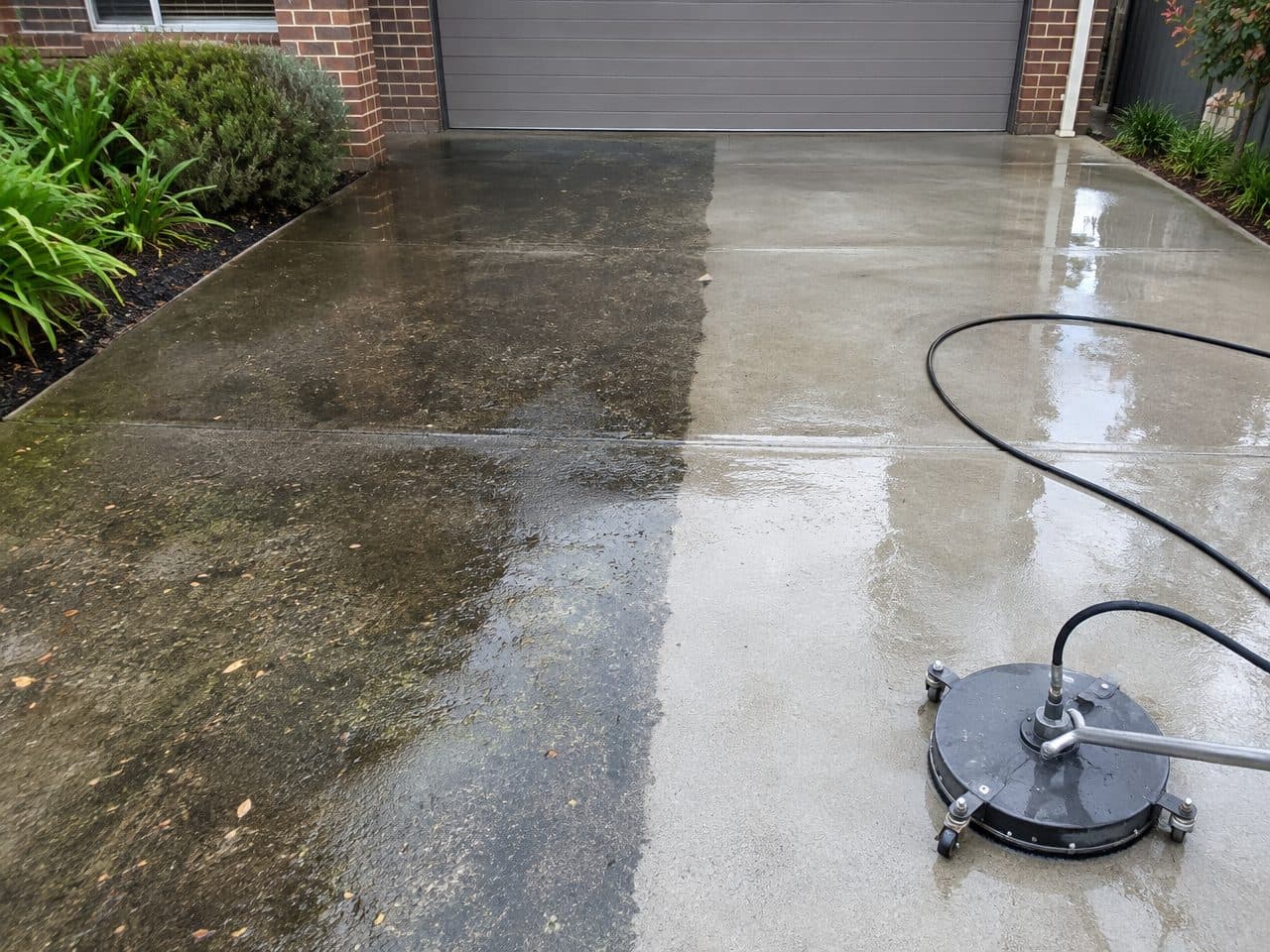
A fresh clean is the best time to decide, because the surface is as bare as it will ever be. Pressure cleaning often lifts tired sealer along with the dirt, which is why a newly cleaned aggregate driveway can look patchy until it is resealed. This guide picks up where the clean ends; for the clean itself, see our step-by-step guide to pressure cleaning paths and paving.
Sealing is not a cure for every problem. It will not fix cracks, lifted pavers, poor drainage or a path that stays wet because a gutter overflows onto it. Sort those first, or the sealer simply locks the problem in.
What a sealer actually does
Concrete, pavers and most natural stone are full of tiny pores. Water, oil, tannin from leaves and the spores behind moss and mould move into those pores, which is why stains go deep and grime comes back.
A sealer either lines the pores with a repellent or covers them with a thin coat. Either way, spills sit on top for longer, so they can be wiped or rinsed off before they soak in. A sealed surface also holds less moisture near the top, which gives moss and algae less to work with on a shaded path.
What types of sealer are there, and which suits which surface?
There are two broad families: penetrating sealers that soak in, and film-forming sealers that sit on top. The surface, the look you want and how the area is used decide between them.
Penetrating sealers (often called impregnating sealers) soak into the pores and cure there. The surface keeps much the same colour and texture, and its grip changes little. They suit natural stone, porous concrete pavers, pool surrounds and plain concrete, and some versions are made to deepen colour slightly.
Film-forming sealers (often acrylic, sometimes polyurethane or a two-pack coating) dry as a thin coat on the surface. They give the wet look and richer colour many people expect on exposed aggregate and coloured concrete. The trade-off is that the coat wears in wheel tracks and walkways, can turn cloudy if moisture gets under it, and is slipperier when wet.
| Penetrating sealer | Film-forming sealer | |
|---|---|---|
| Where it sits | In the pores | On the surface |
| Look | Natural, little change | Wet look, satin or gloss |
| Grip when wet | Close to the bare surface | Lower, unless an anti-slip additive is used |
| How it wears | Fades gradually | Wears in traffic areas, can peel |
| Lets moisture out | Yes | Less so |
| Best on | Stone, porous pavers, pool areas, plain concrete | Exposed aggregate, coloured and stamped concrete |
Within film-forming sealers, solvent-based products usually give a deeper, glossier finish and stronger fumes, while water-based products have a lower sheen and less odour. Neither is better everywhere. What matters is that the new sealer is compatible with whatever is already on the surface, which the product label and a test patch will tell you.
A side-by-side cross-section of two paver faces. On the left, a penetrating sealer is drawn as a faint tint inside the pores just below the surface; water drops bead on top, while a dotted arrow shows water vapour still escaping upwards. On the right, a film-forming sealer is drawn as a thin glossy layer across the top; water beads on it too, but a small pocket of trapped moisture under the film turns cloudy, and a worn patch in a wheel track shows the bare paver beneath. A shoe sole above each side shows good grip on the left and a slip warning on the right when wet.
How long after cleaning can you seal?
Only once the surface is dry right through, which is longer than it looks. The top can be dry to the touch within hours on a warm day while the paving underneath is still damp, and sealer over trapped moisture turns milky or lifts.
The sealer's label sets the minimum, and it always wins. As a practical guide, sunny, breezy paving in late spring or summer may be ready within a day or two of cleaning. Shaded courtyards, south-facing paths and driveways on heavy clay in Melbourne's north and west can stay damp for several days in the cooler months.
A simple check is to tape a square of clear plastic, about 30 cm across, flat on the paving overnight. If the underside fogs or the paving under it has darkened by morning, moisture is still coming up, so wait and test again.
- Clean the surface and let it start drying.
- Re-sand paver joints with dry jointing sand once the surface is dry, and sweep off the excess.
- Check for white salt bloom, loose stones and any leftover stains.
- Test for moisture with the plastic square.
- Seal on a suitable day, then keep everyone off for as long as the label says.
When is the best time of year to seal in Melbourne?
Late spring and early autumn usually give the best mix of warmth, drying time and steady weather. Midsummer is warm and dry but brings hot surfaces and sudden wind changes; winter brings frequent rain and cold, damp evenings.
The Bureau of Meteorology (opens in a new tab)'s averages for Melbourne (Olympic Park) show why. From June to August, rain of 1 mm or more falls on about 9 days a month and average top temperatures sit around 14 to 16°C, so paving dries slowly and many labels' minimum temperatures are only just met. February has the fewest rain days, but very hot paving can make a sealer skin over too fast and trap bubbles.
| Month | Mean maximum (°C) | Mean days of rain of 1 mm or more |
|---|---|---|
| January | 26.8 | 5.4 |
| February | 25.9 | 3.6 |
| March | 24.3 | 5.2 |
| April | 20.9 | 7.5 |
| May | 17.6 | 8.5 |
| June | 14.9 | 8.6 |
| July | 14.5 | 9.0 |
| August | 15.6 | 9.3 |
| September | 18.1 | 7.9 |
| October | 20.6 | 9.1 |
| November | 22.2 | 8.0 |
| December | 24.7 | 6.3 |
Source: Bureau of Meteorology, Melbourne (Olympic Park) climate statistics, records 2013 to 2026. Your own spot will differ: the outer east and the Dandenongs are wetter and cooler, and a sheltered, shaded courtyard dries far slower than an open driveway.
On a hot day, seal in the morning or late afternoon, never on paving that is too hot to touch with the back of your hand. Most labels also ask for no rain for a set number of hours afterwards, so check the forecast and the label together.
How do you apply sealer to pavers and concrete?
Apply thin, even coats with a roller or low-pressure sprayer, work in manageable sections and never let sealer pool. Most problems come from putting on too much at once.
- Read the label and safety data sheet before you open the tin, and check the surface it is made for, coverage, temperatures, times between coats and drying times.
- Protect walls, doors, garage seals, garden edges and lawn with masking tape and drop sheets. Cover any drain and stormwater pit nearby.
- Cut in the edges with a brush along walls, steps and garden edging.
- Roll or spray in sections, keeping a wet edge so laps do not show, and back-roll sprayed areas to spread the sealer evenly.
- Lift puddles straight away, especially in low spots, joints and the textured hollows of exposed aggregate.
- Apply the second coat only when the label's time between coats has passed, usually at right angles to the first.
- Keep foot traffic and cars off for the times the label gives; cars usually need the longest wait.
On pavers, a sealer that soaks into the top of the joint sand helps hold it in place, so the next rain or clean washes out less. That only works if the sand was dry and the joints full before sealing.
Anti-slip additives and wet-weather grip
Film-forming sealers can make a smooth surface slippery when wet, which matters on sloping driveways, steps, pool surrounds and the path to the front door. Many sealer makers offer a fine grit that is mixed into the final coat to restore grip.
Slip resistance of new paving materials is classified in Australia under Standards Australia's AS 4586, and a paver maker may quote a rating. A sealer changes that surface, so check what the sealer label says about grip, and test a small area with a wet shoe before you commit the whole job. Around a pool, a penetrating sealer is usually the safer choice; our article on cleaning around the pool covers slip safety in more detail.
What goes wrong when sealing, and how do you avoid it?
Most failures trace back to moisture, thickness or an incompatible product. These are the mistakes worth avoiding.
- Sealing damp paving. Trapped water turns the coat white and can lift it in patches.
- Sealing over salt bloom. White efflorescence on pavers or brick needs brushing off dry and time to settle first, or the sealer locks it in.
- One thick coat instead of two thin ones. Thick sealer stays soft, scuffs, bubbles and clouds.
- Puddles in joints and hollows. These dry as shiny, cloudy spots, often along the low edge of a driveway.
- Mixing sealer types. A water-based coat over a solvent-based one, or the reverse, can wrinkle or peel.
- Sealing over stains. Sealer fixes a stain in place, so treat oil and rust before the clean, not after.
- Rushing back onto it. Tyres on a soft coat leave marks that are hard to fix.
- Rain or a cold evening on a fresh coat. Check the forecast for the whole drying window, not just the afternoon.
If sealer does go cloudy, do not add another coat on top. Let it dry out in warm weather first, as light blushing sometimes clears, and if it stays white, follow the label for removal or ask a professional.
Stripping old sealer before resealing
A worn film that is still sound can usually be cleaned and given a fresh coat of a compatible product. A film that is peeling, flaking, yellowed or cloudy across large areas usually needs removing, or the new coat will fail with it.
Pressure cleaning lifts loose and flaking sealer but rarely removes a well-bonded coat evenly. Full removal usually means a chemical stripper made for that sealer type, used exactly as the label directs, with the residue collected rather than washed into the drain. On coloured or stamped concrete, stripping can also change the colour, so test a hidden area first.
Call a professional for solvent-based or two-pack sealers, stripping an old coat, coloured or stamped concrete, large or sloping driveways, or any job near a pool. Solvent sealers give off strong, flammable fumes, so they need good ventilation and no ignition sources nearby, and the safety data sheet sets the protective gear. The clean before sealing has its own risks: WorkSafe Victoria (opens in a new tab) warns that "the water jet may pierce the skin" and that "flying debris may hit and injure a person (including eye injuries)".
How do you keep sealing within Melbourne's water and stormwater rules?
Sealing itself uses no water, but the clean before it does, and the waste afterwards matters. Under Victoria's permanent water saving rules, "Water must not be used to clean hard surfaces such as concrete, paths and driveways", with exceptions that include "if staining to the surface has developed and then only once a season."
When cleaning is allowed, Yarra Valley Water (opens in a new tab) states that a high-pressure cleaner must be used if one is available, and its "rate of delivery must be 9 litres per minute or less." A well-sealed surface stains less and cleans more easily, which helps keep you inside that once-a-season limit. The full detail is in our guide to high-pressure cleaning in Melbourne.
EPA Victoria (opens in a new tab) is clear that everyone must "prevent waste from entering stormwater drains so far as reasonably practicable. This includes wastewater." For sealing, that means:
- cover drains and pits while you clean and seal;
- never rinse rollers, trays or sprayers on the driveway or in the gutter;
- keep leftover sealer in its tin for touch-ups, or take it to a Paintback (opens in a new tab) drop-off site, which accepts sealers, stains and single-component varnishes;
- take thinners, solvents and two-pack products, which Paintback does not accept, to a council household chemical collection.
How often do sealed surfaces need resealing?
When the water drop test shows water soaking in across the busiest areas, not on a fixed calendar. Film-forming sealers in driveway wheel tracks and walkways usually wear first; penetrating sealers fade more evenly and tend to last longer between coats.
Sun, traffic and cleaning all wear a sealer. North-facing driveways get the most UV, which breaks down film sealers faster, while shaded paths keep their coat longer but grow moss sooner. Our guide to moss, mould and slippery paths covers the shaded side of the problem.
A sensible routine for most Melbourne homes is a sweep as needed, a gentle wash only when the water rules allow, and a drop test each spring. Apply a fresh coat when the test fails, following the label for how to prepare a previously sealed surface. Our driveway clean, before and after shows how much difference the clean alone makes, and where a reseal finishes the job.
Which surfaces should be sealed, and which left alone?
Seal surfaces that are porous, coloured or used where stains are likely; leave dense, naturally hard-wearing surfaces alone unless there is a clear reason. The facts table at the top of this page gives the short version.
- Exposed aggregate: usually sealed from new, and usually resealed once cleaning has lifted the old coat. Our guide to cleaning driveways by surface covers the clean that comes first.
- Coloured, stencilled and stamped concrete: sealed, because much of the colour and sheen sits in the sealer. Match the new coat to the old.
- Plain concrete: often left bare. Seal it if oil drips from cars are a regular problem, ideally with a penetrating sealer that keeps the grip.
- Concrete pavers: optional. A penetrating or low-sheen sealer helps with stains and holds the joint sand.
- Bluestone, sandstone and other natural stone: a penetrating sealer made for stone, as film coats spoil the look and grip.
- Clay brick pavers: usually left unsealed unless the maker advises otherwise.
- Outdoor living areas: patios and entertaining areas get the most spills; our post on getting the deck and patio ready for summer fits sealing into the wider spring routine.
What changes the quote for cleaning and sealing
Every quote is based on the job. The things that change it are the area in square metres, the surface (concrete, pavers, stone or aggregate), how much moss, mould or oil staining there is, whether old sealer needs removing, access for equipment and water and how wash water can be contained. Action Garden does the clean only; sealing is not part of the service. Photos of the whole area and close-ups of any stains or peeling sealer help us quote accurately.
Is it worth handing the clean and seal over?
It is worth handing over when the area is large or sloping, the surface is coloured or stamped, an old sealer is failing, or you would rather not handle solvents and a high-pressure machine near the house. Our high-pressure cleaning service matches pressure and method to each surface, uses biodegradable detergents only where plain water is not enough, and cleans up fully afterwards. More on paths, walls and decks is in our outdoor cleaning guides.
When you are ready, request a free quote with a few photos of the paving.
Your Garden. Our Promise.
Frequently asked
What is the difference between a penetrating sealer and a film-forming sealer?
Why has the sealer on my pavers turned white or cloudy?
Can I put a water-based sealer over an old solvent-based one?
How can I tell when sealed paving needs a new coat?
Does sealing pavers stop weeds growing in the joints?
Is bluestone paving worth sealing?
Should clay brick pavers be sealed after cleaning?
What should I do with leftover sealer and dirty rollers?
Sources and further reading
- Stormwater (EPA Victoria)
- Permanent water saving rules (Yarra Valley Water)
- Climate statistics, Melbourne (Olympic Park) (Bureau of Meteorology)
- What Paintback accepts from households (Paintback)
- High-pressure water jetting safety alert (WorkSafe Victoria)
Caring for Melbourne gardens since 2019. Updated 18 November 2026.