


Outdoor cleaning guide
Cleaning driveways: concrete, pavers and exposed aggregate
By the Action Garden team · Updated · 11 min read
Checked against: Water Victoria, Yarra Valley Water, EPA Victoria, WorkSafe Victoria
TL;DR
- Work out the surface first, because plain concrete, exposed aggregate and pavers each need a different pressure, nozzle and finish.
- On exposed aggregate, the risk is loosened stones and patchy sealer, so use a wide fan or rotary surface cleaner and keep away from edges.
- Pavers lose their joint sand to the jet; angle across the joints and brush dry sand back in once the surface is dry.
- Driveway cleaning with drinking water fits Victoria's rules only for a hazard, staining once a season, or construction.
- Sweep first, protect the stormwater pit and collect the sludge, so only rain ever reaches the street drain.
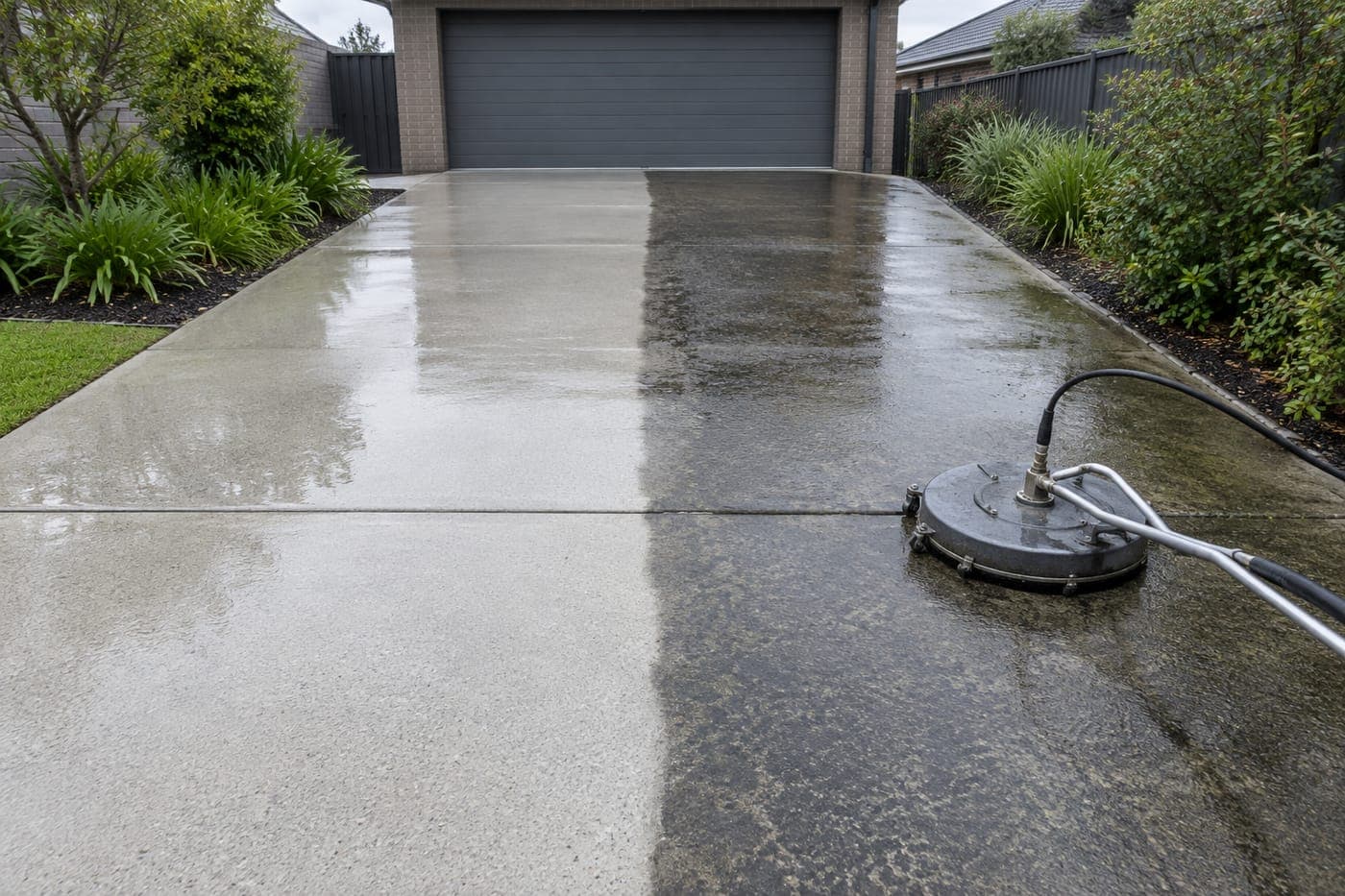
| Surface | Pressure and tool | After cleaning |
|---|---|---|
| Plain or broom-finished concrete | Firm pressure, rotary surface cleaner | Check for etched lines in low light |
| Exposed aggregate (sealed) | Moderate pressure, wide fan or surface cleaner | Check edges for loose stones, then reseal if the sealer has lifted |
| Coloured, stencilled or stamped concrete | Low to moderate pressure, wide fan | Usually resealed, as the colour sits in the sealer layer |
| Concrete pavers | Moderate pressure, jet angled across joints | Re-sand joints once fully dry |
| Clay brick pavers | Low to moderate pressure, wide fan | Re-sand joints and watch for white salt bloom |
How do you clean an exposed aggregate driveway?
Sweep it, protect the drain, test a hidden corner, then clean at moderate pressure with a wide fan or a rotary surface cleaner, working from the top of the slope down. The jet should lift grime off the stones without cutting into the cement between them. Once the driveway is dry, check the edges for loose stones and reseal if the old sealer has lifted.
Exposed aggregate is the most common driveway finish on newer Melbourne homes, and it is also the one most easily damaged by a careless clean. Plain concrete and pavers need their own approach, so this guide takes each surface in turn. For the wider picture on machines, nozzles and safety, start with our complete guide to high-pressure cleaning in Melbourne.
Why exposed aggregate behaves differently
Exposed aggregate is made by washing the top layer of cement paste off fresh concrete so the stones show. The stones are held only by the cement around their lower half, and that cement is thinnest along edges, saw cuts and cracks.
A narrow, close jet erodes that cement, and once enough is gone the stone pops out. Most aggregate driveways are also sealed, and the sealer gives the stones their deeper, wet-look colour. A hard clean strips the sealer in patches, which is why a well-cleaned driveway can look worse until it is resealed.
How do you tell which driveway surface you have?
Look at the surface closely and do a water drop test. The finish decides the pressure, the nozzle and what happens after the clean.
| What you see | Surface | What it means for cleaning |
|---|---|---|
| Smooth or fine-lined grey concrete | Plain or broom-finished concrete | Toughest surface; takes firm pressure |
| Rounded or crushed stones showing across the surface | Exposed aggregate | Moderate pressure; protect edges and sealer |
| Even colour, sometimes with a printed pattern | Coloured, stencilled or stamped concrete | Gentle; colour often sits in the sealer |
| Separate blocks with sand-filled joints, grey or tinted | Concrete pavers | Moderate pressure; joints need re-sanding |
| Separate red, brown or blended clay blocks | Clay brick pavers | Gentle to moderate; watch for salt bloom |
To check for a sealer, sprinkle a little water on a clean, dry patch. If it beads and sits on top, the surface is still sealed; if it darkens the concrete and soaks in within a minute, the sealer has worn off or was never applied. Unsealed surfaces stain more easily, so oil and leaf stains go deeper and take longer to lift.
Is cleaning a driveway allowed under Melbourne's water rules?
Only in the situations the rules list. Water Victoria (opens in a new tab)'s page says: "Water must not be used to clean hard surfaces such as concrete, paths and driveways. Exemptions apply when cleaning is needed to address a hazard, surface staining or during construction."
Yarra Valley Water (opens in a new tab) lists the same exceptions: "where cleaning is required as a result of an accident, fire, health hazard, safety hazard or other emergency", "if staining to the surface has developed and then only once a season", and "in the course of construction or renovation." When cleaning is allowed, a high-pressure cleaner must be used if one is available, and its "rate of delivery must be 9 litres per minute or less."
A driveway that is just dusty is a job for a broom. A driveway with moss, oil or tannin staining can be cleaned once a season. Our explainer on pressure cleaning and Melbourne's water rules covers the exceptions, the device limit and tank water in detail.
How do you clean an exposed aggregate driveway without loosening stones?
Keep the pressure moderate, the spray wide and the height steady, and leave the edges for last with the gentlest setting. A rotary surface cleaner is the best tool, because it holds the jets at a fixed height and spreads the force evenly.
- Sweep and scrape. Clear leaves and grit, and scrape moss out of saw cuts and expansion joints with a weeding knife.
- Test near the garage. Start with a 40 degree tip about 30 cm off the surface. Move in slowly until the grime lifts, and stop if any stone moves.
- Clean the field. Run the surface cleaner in straight, overlapping passes from the garage towards the street, at a steady walking pace.
- Finish the edges by hand. Use a 40 degree tip angled away from the edge, never straight down into it, along garden edges, joints and cracks.
- Collect the sludge. Shovel up grit and moss at the low point before it reaches the kerb.
- Inspect when dry. Walk the edges and joints in low morning or evening light, looking for loose stones, bare patches and stripes.
A cross-section of an exposed aggregate slab. Rounded stones sit half-buried in grey cement, with a thin clear sealer coat over the top. Above it, a round surface cleaner hood holds two spinning jets at a fixed height, spreading their force across the stones. To the side, a single 0 degree pin jet is shown too close to the slab, cutting a groove in the cement beside a stone, which then lifts out. Arrows show dirty water moving downhill to a covered drain.
If the sealer comes off in white, flaky sheets, that is an old sealer failing rather than damage from the clean. It still needs stripping and resealing to look even again, and the product label for the new sealer sets out the preparation it needs.
How do you clean a plain concrete driveway?
Plain and broom-finished concrete is the toughest driveway surface, so it takes firmer pressure, but it still needs an even technique. A rotary surface cleaner gives the most even result; a 25 degree tip held at a steady distance and kept moving is the alternative.
- Keep the wand moving. Stopping in one place etches a mark that never washes out.
- Overlap every pass by about a third so there are no light and dark stripes.
- Clean whole bays. Finish a full slab between saw cuts before you move on, so the colour stays even.
- Pre-treat stains. Oil, rust and tyre marks need their own treatment before the clean; water and pressure alone rarely shift them.
Old, broom-finished concrete that has weathered for years can come up noticeably lighter after a clean. That is the original surface showing, not damage. A newly laid driveway should not be pressure cleaned until it has fully cured, so ask the concreter how long to wait.
Oil, rust and leaf stains on concrete
Fresh oil should be soaked up with an absorbent as soon as possible, swept up and put in the bin. Older oil soaks deep into concrete and usually needs a degreaser left to work, then scrubbing and a hot or careful wash. Our guide on how to remove oil stains from concrete covers the method in full.
Rust marks from pot plants, steel furniture and garden fertiliser granules need a cleaner made for rust, used exactly as the label directs. Leaf and tannin marks often fade on their own in sun, and a moderate clean lifts most of what is left.
How do you clean concrete and clay paver driveways?
Clean pavers at moderate pressure with the jet angled across the joints, then brush dry jointing sand back in once the surface is dry. The pavers themselves clean easily; the joints are where the damage happens.
- Pull weeds and moss from the joints with a weeding knife before any water goes on.
- Angle the jet across the joints, at about 30 to 45 degrees, rather than pointing it straight down into them.
- Use a surface cleaner where you can; it washes out far less sand than a hand wand.
- Let the pavers dry fully, then sweep dry jointing sand across them until the joints are full to just below the top edge.
- Sweep off the excess and leave it a day before driving on it.
Clay pavers are softer than concrete pavers and older ones can be worn on the surface. Treat them like brick: lower pressure, a wider fan and a test patch first. White salt bloom, called efflorescence, often appears as clay pavers dry, and is brushed off dry rather than washed again.
Full joints lock the pavers together, stop them shifting under car tyres, and slow the weeds and moss that move into empty gaps. A driveway with weeds in the joints is often the first sign the sand has washed out.
Which cleaning method suits each driveway surface?
The method follows the surface and the stain. Pressure cleaning suits most driveways, but it is not always the gentlest or the only answer.
Side by side
Driveway surfaces compared
| Surface | Best method | Pressure | Main risk | Usually sealed afterwards? |
|---|---|---|---|---|
| Plain concrete | Rotary surface cleaner | Firm | Stripes and etched lines | Optional |
| Exposed aggregate | Surface cleaner or wide fan | Moderate | Loose stones, patchy sealer | Usually, once dry |
| Coloured or stamped concrete | Wide fan, low to moderate | Low to moderate | Stripped sealer and faded colour | Yes |
| Concrete pavers | Surface cleaner, jet across joints | Moderate | Joint sand washed out | Optional; re-sand always |
| Clay brick pavers | Wide fan, gentle | Low to moderate | Worn faces, salt bloom | Rarely; re-sand always |
Sealing is a separate job from cleaning and has its own timing. Once a sealed surface is dry, a fresh coat brings back the colour, makes the next clean easier and slows staining. A gloss sealer on a sloping driveway can be slippery when wet, so check the label for an anti-slip option before you buy.
What mistakes damage a driveway during cleaning?
Most damage comes from a narrow nozzle held too close, or from hurrying the edges and joints. These are the mistakes to avoid on every driveway surface.
- Using the red 0 degree tip. It cuts lines into concrete and strips cement from around aggregate.
- Pointing the jet into joints and edges. That is where stones and sand come out.
- Cleaning from the bottom up. Dirty water runs back over clean areas and leaves tide marks.
- Skipping the sweep. Grit thrown by the jet scratches surfaces and fills the drain with sludge.
- Sealing too soon. Trapped moisture turns the sealer cloudy.
- Letting wash water into the street gutter. EPA Victoria (opens in a new tab) states that everyone must "prevent waste from entering stormwater drains so far as reasonably practicable. This includes wastewater."
- Forgetting the fence and the car. Spray drifts onto timber, render and paintwork; a fence beside the driveway needs the gentler approach in our timber fence care article.
Call a professional for a large or steep driveway, a sealed or coloured surface you cannot afford to strip unevenly, heavy oil staining, or any job where wash water cannot be kept out of the street drain. WorkSafe Victoria (opens in a new tab)'s high-pressure water jetting alert warns that "the water jet may pierce the skin" and that "flying debris may hit and injure a person (including eye injuries)". Wear safety glasses, enclosed shoes and long trousers at a minimum, and seek medical help for any skin injury from the jet, however small it looks.
What changes the quote for a driveway clean
Every quote is based on the job. The things that change it are the area in square metres, the surface and whether it is sealed, how much moss, oil or tannin staining there is, access for equipment and water, how the wash water can be contained, and whether re-sanding or sealing follows the clean. Photos of the whole driveway and close-ups of any stains help us quote accurately.
What else is worth cleaning while the gear is out?
Paths, patios and pool surrounds usually share the same grime and the same water rule exception, so they are often done on the same visit. The approach changes with the surface, though.
- Shaded side paths tend to grow moss and algae; our guide to moss, mould and slippery paths covers cleaning and keeping it away.
- Timber decks and fences need low pressure and long strokes along the grain, as set out in pressure cleaning timber decks and fences.
- Pool surrounds and coping need slip safety and care with pool water chemistry; see cleaning around the pool.
More on paths, walls and decks is collected in our outdoor cleaning guides.
Is it worth handing the driveway over?
It is worth handing over when the driveway is large, sealed or coloured, heavily stained, or when you would rather not handle a high-pressure machine near the car and the house. Our high-pressure cleaning service matches pressure and nozzle to each surface, uses biodegradable detergents only where plain water is not enough, and cleans up fully afterwards.
When you are ready, request a free quote with a few photos of the driveway.
Your Garden. Our Promise.
Frequently asked
What pressure setting suits an exposed aggregate driveway?
Why is my exposed aggregate driveway losing stones after cleaning?
Can I clean a coloured or stamped concrete driveway with a pressure washer?
What is the white powder on my brick pavers after cleaning?
How do I clean the driveway apron and the footpath crossing?
Do tyre marks come off a concrete driveway?
Should I seal my driveway straight after cleaning it?
Sources and further reading
- Permanent water saving rules (Water Victoria)
- Permanent water saving rules (Yarra Valley Water)
- Stormwater (EPA Victoria)
- High-pressure water jetting safety alert (WorkSafe Victoria)
Caring for Melbourne gardens since 2019. Updated 18 November 2026.