


Outdoor cleaning guide
Pressure cleaning timber decks and fences without damage
By the Action Garden team · Updated · 11 min read
Checked against: Water Victoria, NSW EPA, WorkSafe Victoria, EPA Victoria, Victorian Government
TL;DR
- Timber is softer than concrete, so a jet that cleans a driveway will raise furry fibres and gouge a deck in seconds.
- Use a 40 degree or wider tip, low pressure, a steady distance and strokes along the grain, and test a hidden board first.
- Check for loose boards, raised nails, old film coatings and older treated pine before you start.
- Victoria's water rules list timber decking as a hard surface, so drinking water cleaning fits only the listed exceptions.
- Let timber dry right through before oiling or staining; the coating's label sets the minimum wait.
| Timber | Pressure and tip | Watch for |
|---|---|---|
| Hardwood decking (spotted gum, blackbutt, jarrah, merbau) | Low to moderate, 40 degree tip | Tannin bleed on merbau and new hardwood |
| Treated pine decking | Low, 40 degree or wider | Soft early wood furs up quickly |
| Cypress and other softwoods | Low, wide fan from a distance | Gouges easily, especially at board ends |
| Timber paling fences | Low, wide fan, downward strokes | Thin palings split; spray reaches the neighbour's side |
| Composite decking | Low, follow the maker's care guide | Some warranties limit pressure cleaning |
Can you pressure clean a timber deck without damaging it?
Yes, if you use low pressure, a wide tip, a steady distance and long strokes along the grain. Most damage to decks comes from treating timber like concrete: a narrow jet held close tears up the soft wood between the growth rings and leaves the boards fuzzy or gouged.
Timber is made of alternating bands of hard late wood and soft early wood. A strong jet cuts the soft bands faster than the hard ones, which is why a damaged deck feels ridged and furry. The same applies to fences, pergolas and timber steps, though thin fence palings are even easier to split. For the basics of machines, nozzles and safety, see our complete guide to high-pressure cleaning in Melbourne.
Do Melbourne's water rules cover cleaning a deck?
Yes. Timber decking is named in the rules as a hard surface. Water Victoria (opens in a new tab)'s wording is that water can only be used to clean hard surfaces "(including, driveways, paths, concrete, tiles, timber decking) when" cleaning follows an accident or hazard, "if staining to the surface has developed and then only once a season", or during construction or renovation.
A high-pressure cleaner must be used if one is available, and it must deliver "9 litres per minute or less." In practice, a grey, stained or slippery deck usually fits the staining or safety exception once a season. Our explainer on pressure cleaning and Melbourne's water rules covers fences, tank water and the device limit in more detail.
What pressure, nozzle and distance suit timber?
Use the lowest setting that lifts the grime, a 40 degree or wider tip, and a distance of about 30 to 60 cm. Never use the red 0 degree tip or the yellow 15 degree tip on timber; both cut.
| Timber | Hardness | Approach | What goes wrong |
|---|---|---|---|
| Spotted gum, blackbutt, ironbark | Hard | Low to moderate, 40 degree tip | Rarely furs; can still mark at board ends |
| Jarrah and merbau | Hard | Low to moderate, 40 degree tip | Tannin bleeds onto paving and render |
| Treated pine | Soft | Low, 40 degree or wider, from a distance | Furs up fast; early wood erodes |
| Cypress and western red cedar | Soft | Very low, wide fan | Gouges and splinters easily |
| Composite boards | Varies | Follow the maker's care guide | Surface marks; warranty limits |
A soap or black tip, the widest and lowest-pressure nozzle, is useful for wetting the deck and applying a timber cleaner. Let the cleaner work for the time on its label, then rinse with the 40 degree tip.
A close-up cross-section of a deck board showing alternating light, soft early-wood bands and dark, hard late-wood bands. On the left, a narrow jet held close and moving across the board cuts into the soft bands, leaving ridges and raised fibres. On the right, a wide 40 degree fan held further back moves along the length of the board, lifting the grey surface layer evenly and leaving the bands intact. Arrows show the wand travelling from one end of the board to the other.
How do you check a deck or fence before cleaning it?
Walk it, look closely and fix the hazards first. A pressure cleaner will find every weak board and loose nail, often by throwing splinters.
- Loose and rotten boards. Push a screwdriver into suspect boards, especially near the house and around pots. Soft timber needs repair, not cleaning.
- Raised nails and screws. Punch nails below the surface and tighten screws; a raised head catches the wand and your feet.
- The existing coating. Oils soak in and weather away evenly. Film-forming stains and paints sit on top and peel; a jet lifts the loose edges and leaves a patchwork.
- Older treated pine. Pine treated before the mid-2000s may be CCA treated. NSW EPA (opens in a new tab) notes CCA "is a water-borne solution of up to 25% copper, up to 45% chromium and up to 37% arsenic", and that the APVMA advised "existing structures made from CCA treated timber do not need to be removed." Treat it gently, never burn offcuts, and keep run-off out of gardens and drains.
- What is below. On a raised deck, check where the water and grime will fall: onto a storage area, a garden bed, or a neighbour's property.
Why old CCA pine needs extra care
CCA was the standard treatment for outdoor pine for decades. The APVMA's review led to restrictions on its use for decking, garden furniture and play equipment, and NSW EPA states that "From July 2012, CCA was declared a restricted chemical product."
Existing decks can stay, but harsh cleaning that erodes the surface releases treated wood fibre into the wash water. For decks used by young children, NSW EPA's advice is to paint the surfaces with an oil-based polyurethane product or paint. Most importantly: "If the timber is burnt, however, the smoke and ash contain high concentrations of arsenic." Offcuts go to waste, never the fire pit.
How do you pressure clean a timber deck, step by step?
Prepare, test, then clean one or two boards at a time along their full length. Rushing across the deck in short, sweeping arcs is what leaves stripes and furring.
- Clear and sweep. Move furniture and pots, sweep the boards, and scrape out the gaps with a putty knife so water can drain.
- Protect. Sheet plants and render next to the deck, especially below merbau or jarrah. Keep wash water away from the stormwater pit.
- Wet the deck. Use the soap tip to wet the boards evenly. If you are using a timber cleaner, apply it now and let it work for the time on the label.
- Test a hidden board. Start about 60 cm away with a 40 degree tip, then move in slowly until the grey lifts without the grain rising.
- Clean board by board. Work along the length of one or two boards at a time, from one end to the other, overlapping slightly. Keep the wand moving and the distance steady.
- Rinse. Rinse the whole deck to remove loosened grime and cleaner, working towards the edge where water drains.
- Let it dry and inspect. Once dry, look along the boards in low light for furring, stripes and missed areas.
How do you clean a timber fence without damaging it?
Clean fences with low pressure and a wide tip, working downwards along the palings, and protect the other side. Fence palings are thin, often weathered, and fixed with only a nail or two, so they split and loosen far more easily than deck boards.
- Talk to the neighbour first. Spray, grime and cleaner come through the gaps onto their side.
- Work top to bottom, along each paling, so dirty water runs down over areas still to be cleaned.
- Go gently near the bottom rail and the ground, where timber is often softest from moisture.
- Watch the capping and rails. Water forced into joins and nail holes speeds up rot.
- Expect mould on the shaded side. The south side of a fence often greens up again within a season unless plants are trimmed back from it.
Ivy and creepers need to come off before any clean. Fence care beyond cleaning, such as fixing loose palings and choosing an oil, is covered in our article on timber fence care.
Painted fences, lead paint and steel fences
A painted fence can be washed gently before repainting, but blasting old paint off is a different job. Paint on older Victorian homes may contain lead, and lead flakes and dust are a health hazard, so get advice on safe preparation before stripping it.
Steel sheet fences clean easily at low pressure with a wide tip. Avoid scratching the coating, and do not use abrasive pads or harsh products, which can damage the finish.
When is timber dry enough to oil or stain?
When it has dried right through, not just on the surface. In Melbourne that usually takes several dry, mild days after cleaning, and longer in winter or in shade.
A simple check is to sprinkle water on a board: if it soaks in quickly, the timber is ready to take oil; if it beads, there is still an old coating on top. Many deck oils set a minimum drying time and conditions on their label, and that label is the rule to follow. Oiling damp timber traps moisture, and the coating can blotch, stay sticky or fail within a season.
If the deck feels fuzzy once dry, sand it lightly along the grain before oiling. Sweep and dust off the sanding dust, and wear a dust mask, especially on older treated pine.
What mistakes ruin a deck or fence clean?
Most damage comes from too much pressure, the wrong tip or the wrong direction. Avoid these and the timber comes up clean and smooth.
- Using a concrete setting on timber. Start low and only go up if the grime will not lift.
- Cleaning across the grain. It leaves stripes and lifts fibres; always work along the board.
- Holding the wand too close at board ends. End grain splinters fastest.
- Ignoring tannin. Merbau and jarrah bleed onto paving and render. Clean the deck first and the paving after, and rinse splashes at once.
- Blasting peeling stain. It leaves a patchwork that needs stripping anyway.
- Letting wash water run to the drain. EPA Victoria (opens in a new tab) states that everyone must "prevent waste from entering stormwater drains so far as reasonably practicable. This includes wastewater."
- Oiling too soon. Patience saves a recoat.
For hard surfaces next to the deck, see our guide to cleaning rendered walls, brick and retaining walls, and for barbecue drips on concrete, how to remove oil stains from concrete.
Call a professional for raised and second-storey decks, balconies, any cleaning off a ladder, and decks or fences with soft or rotten timber. WorkSafe Victoria (opens in a new tab)'s high-pressure water jetting alert warns that "the water jet may pierce the skin" and that kickback and flailing hoses can injure the operator. Get advice before cleaning old painted timber that may contain lead, and never pressure clean fibro or cement sheeting that may contain asbestos.
When is it worth handing it over?
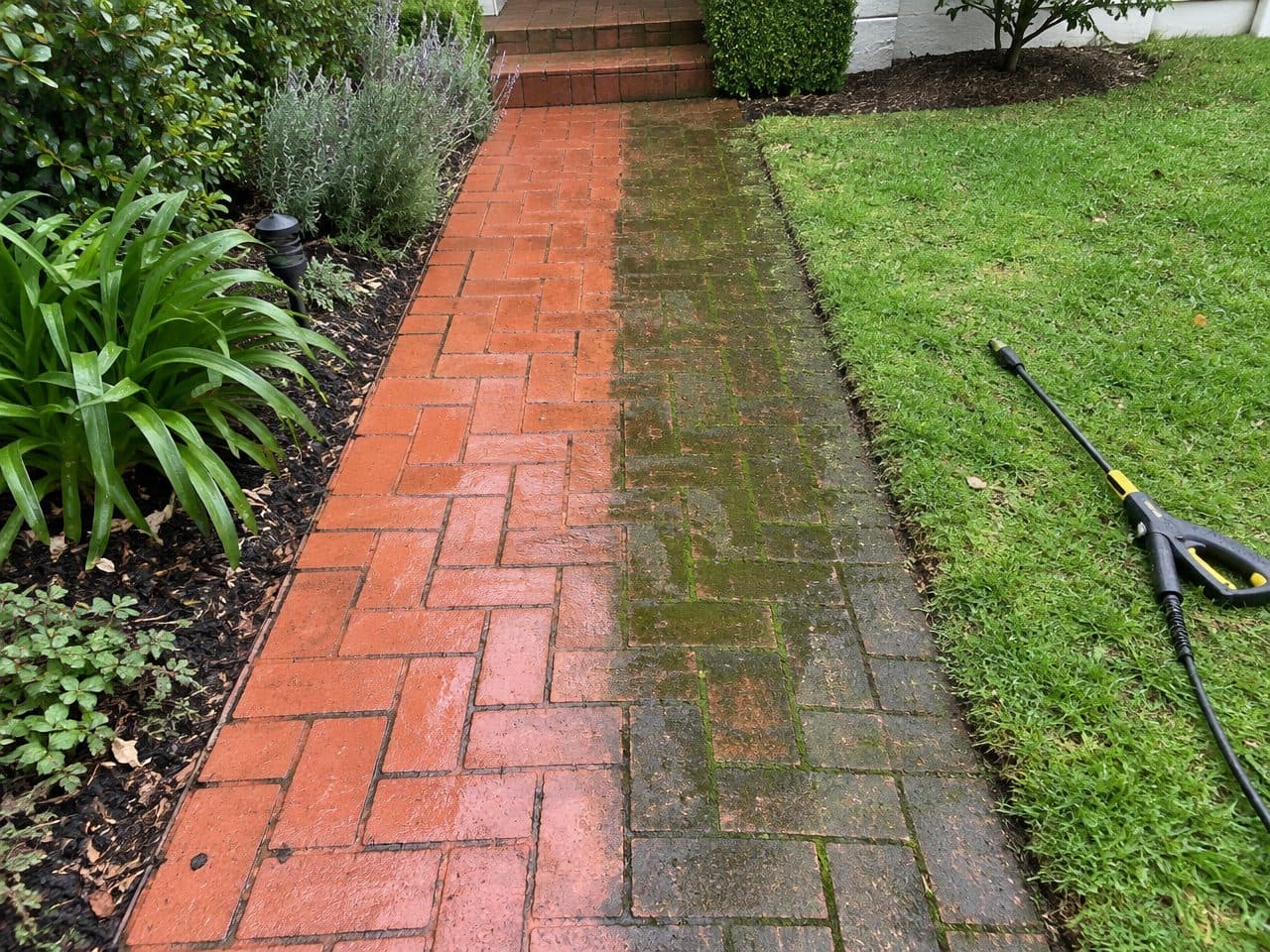
It is worth handing over when the deck is large or raised, the timber is soft or old, the fence is long, or you want it oiled straight after the right drying time. Our high-pressure cleaning service sets pressure and nozzle for each surface and uses soft-wash methods on anything delicate. You can see what a careful clean does to a hard surface in a driveway clean, before and after, and more surfaces are covered in our outdoor cleaning guides.
When you are ready, request a free quote with photos of the deck or fence.
Your Garden. Our Promise.
Frequently asked
Why is my deck fuzzy after pressure cleaning?
Can old treated pine decks be pressure cleaned?
How do I stop merbau bleeding red stains onto my paving?
Do I need my neighbour's permission to pressure clean our shared fence?
How long after cleaning can I oil my deck?
Can I pressure clean a painted fence before repainting?
What is the safest way to clean a deck around a spa or pool?
Sources and further reading
- Permanent water saving rules (Water Victoria)
- Copper chrome arsenate treated timber (NSW EPA)
- High-pressure water jetting safety alert (WorkSafe Victoria)
- Stormwater (EPA Victoria)
- Fencing in Victoria (Victorian Government)
Caring for Melbourne gardens since 2019. Updated 18 November 2026.