


Gutters and exterior
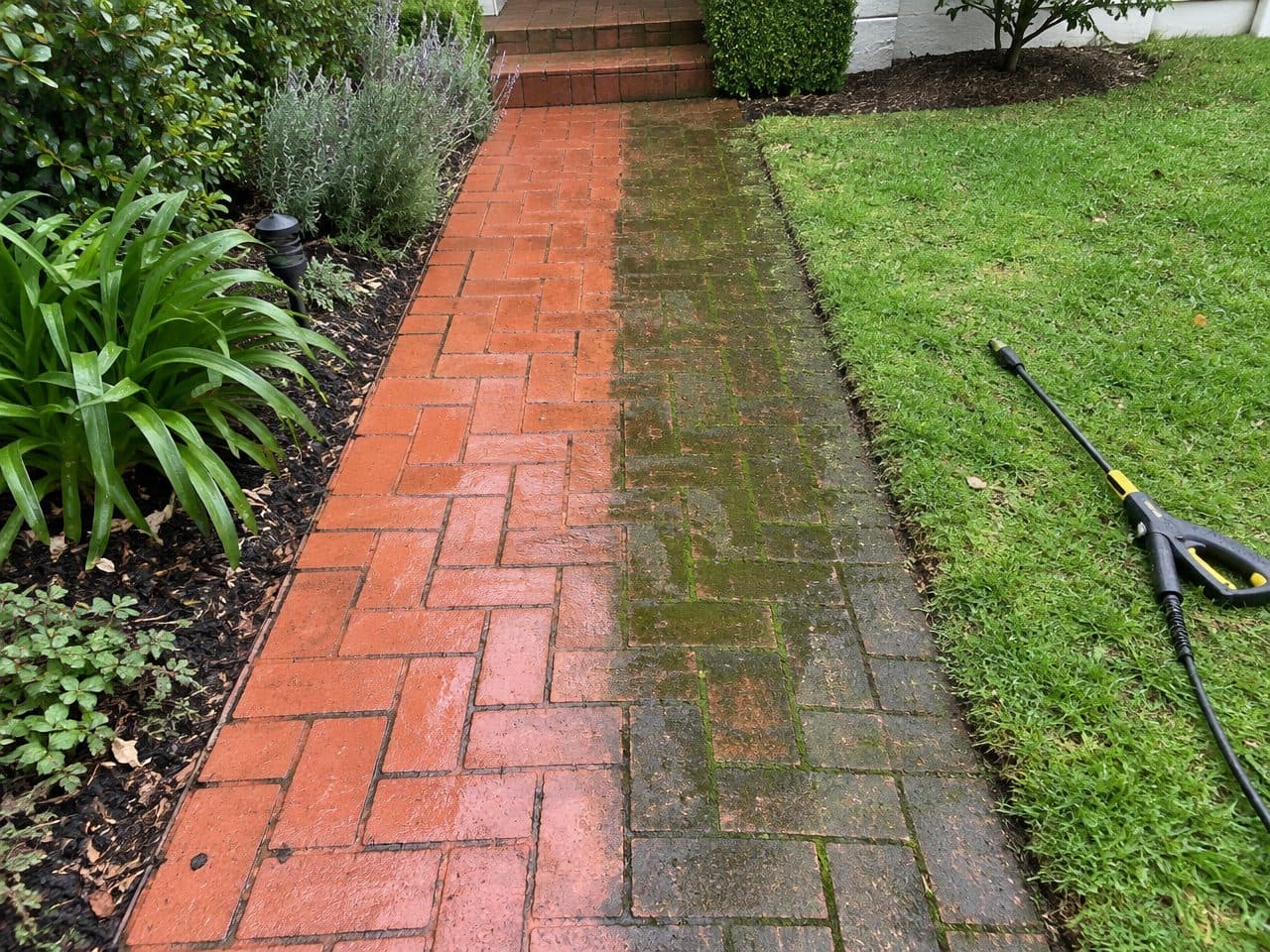
A driveway clean, before and after
By the Action Garden team · Updated · 11 min read
Checked against: Water Victoria, Yarra Valley Water, EPA Victoria, WorkSafe Victoria
TL;DR
- The quote starts with the driveway's rough size, surface type, the stains you can see and a few photos, including one of where water runs off.
- Before any water goes on, the crew checks for cracks, loose pavers, drains, garden beds, doors and cars, and works out where the wash water will go.
- Stains are swept and pre-treated with biodegradable detergent, then the surface is cleaned in overlapping passes at a pressure set for that surface.
- Victoria's permanent water saving rules allow hard surfaces to be cleaned with drinking water only in set situations, such as staining once a season.
- On the day you get a photo of the finished driveway; most surfaces look patchy until they dry, and a few old stains fade rather than disappear.
What does a driveway clean look like from start to finish?
A professional driveway clean follows the same six stages every time: the first message with photos, the quote, the checks on the day, the pre-treatment, the clean itself, and the handover with aftercare. What changes from job to job is the surface, the stains and where the water can go.
This article walks through those stages in order, so you know what to expect before you book and what the crew is doing while they are on your driveway. It describes how Action Garden approaches a driveway clean on jobs across metropolitan Melbourne.
Melbourne driveways get dirty in a predictable way. Winter rain and short days let black mould and moss creep in along the shaded side and in the joints, autumn leaves stain pale concrete with tannin, and cars leave oil drips where they park. Our complete guide to high-pressure cleaning in Melbourne covers every surface; this piece is about what happens on the day.
A driveway drawn in perspective from the street, split into six bands that change from grimy grey to clean as the eye moves up towards the house. Band 1, a phone with a photo of a stained driveway (first message). Band 2, a tape measure and a clipboard (quote). Band 3, a magnifying glass over a crack, a drain grate and a garden bed edge (checks). Band 4, a broom and a spray bottle over an oil drip (sweep and pre-treat). Band 5, a surface cleaner moving in overlapping passes, with arrows showing water flowing to the lawn, not the drain (the clean). Band 6, a clean, dry driveway with a camera icon (photo and handover).
How is a driveway clean quoted?
A driveway clean is quoted from a few plain facts: the rough size, the surface, the stains you can see and the access. With those and a couple of photos, most quote requests get a reply within a few hours or by the next day, with either a price or a time for a quick site visit.
You can send the details through the quote form, by WhatsApp with photos, or by phone. These are the details that matter most:
- Rough size. Single or double width, and roughly how long. Pacing it out is fine.
- Surface. Plain concrete, exposed aggregate, coloured or stamped concrete, concrete pavers, clay pavers or stone.
- What is on it. Black or green growth, moss in the joints, oil drips, rust marks, leaf stains, tyre marks.
- Where the water runs. A photo looking down the slope shows whether runoff heads to the street, a pit or the lawn.
- Extras. Paths, the front porch, the garage floor or the nature strip crossing.
What affects the quote on a driveway clean
There are no set prices on this site, because no two driveways are the same. The quote reflects the area in square metres, the surface (concrete, pavers, timber or render), how much mould, moss or oil staining there is, and whether the surface is sealed after cleaning.
Area matters most on a lightly soiled driveway. On a heavily stained one, the stains matter more: oil needs a dwell time with a degreaser, and moss packed into paver joints takes longer to lift than grime on a flat slab.
Access and runoff come next. A steep driveway that drains straight to the gutter needs more work to keep wash water out of the stormwater system than a flat one bordered by lawn.
What gets checked before the water goes on?
Before any water touches the driveway, the crew walks the whole surface and works out what could be damaged, what needs protecting and where the wash water will go. Five minutes of checking prevents most of the problems people associate with pressure cleaning.
- Surface type and condition. Exposed aggregate, old concrete and soft clay pavers need a gentler setting than a sound concrete slab. Crumbling patches and loose stones are noted before work starts.
- Cracks and lifted edges. Water forced into an open crack can wash out the bedding under it. Cracks are cleaned around, not into.
- Pavers and joints. Loose pavers are flagged, and joint sand that will wash out is noted so it can be topped up afterwards.
- Drains and pits. Driveway grates and the kerb are covered or bunded so sludge stays on site.
- Things that splash badly. Garage doors, weatherboards, windows, car paint and the front door all catch spray.
- Garden beds and lawn edges. Plants beside the driveway are rinsed with clean water before and after if any detergent is used nearby.
WorkSafe Victoria (opens in a new tab)'s high-pressure water jetting alert warns that "the water jet may pierce the skin" and that kickback and flailing hoses can injure the operator. Hire machines can be far more powerful than a home unit. Hand the job over if the driveway is steep, has old fibro or cement sheeting nearby that may contain asbestos, slopes towards a basement or garage door, or sits beside a busy footpath where spray and slippery surfaces affect passers-by.
Is a driveway clean allowed under Melbourne's water rules?
Yes, in set situations. Under Victoria's permanent water saving rules, drinking water cannot be used to clean hard surfaces such as driveways, except for an accident or hazard, during construction or renovation, or "if staining to the surface has developed and then only once a season." Water Victoria (opens in a new tab) adds that in these situations "a high pressure water cleaning device must be used if one is available." Our guide to pressure cleaning and Melbourne's water rules sets out the exceptions in full.
How are oil, mould and moss treated before the clean?
Stains are treated before the main clean, because pressure alone moves dirt around without lifting what has soaked in. The driveway is swept first, then each type of stain gets its own pre-treatment.
| Stain | Pre-treatment | What to expect |
|---|---|---|
| Black mould and green algae | Biodegradable detergent applied and left to dwell | Lifts well; returns in shade if leaves and moisture stay |
| Moss in paver joints | Scraped and swept out, then cleaned | Joints usually need fresh sand afterwards |
| Fresh oil drips | Degreaser worked in, then a thorough rinse | Most fresh drips lift well |
| Old oil stains | Degreaser with a longer dwell, repeated if needed | Often fade rather than vanish |
| Leaf and tannin stains | Detergent and a thorough clean | Usually lift with the surface grime |
| Rust marks | Needs a separate product, used as its label directs | Not lifted by water and detergent alone |
On Action Garden jobs, only biodegradable detergents are used, and only where plain water is not enough. Any product, ours or one you buy, is used exactly as its label directs.
How is the driveway actually cleaned?
The driveway is cleaned in overlapping passes from the top of the slope to the bottom, at a pressure and nozzle set for that surface, so the finish is even and the dirty water always runs onto ground that is still to be cleaned. On Action Garden jobs, the pressure and nozzle are set for each surface, and soft-wash methods are used on anything delicate.
Here is how that plays out on a typical driveway:
- Edges and corners first. The strips along the garage door, walls and garden beds are cleaned with a narrow fan held at a low angle, pointing away from the wall.
- The main surface in passes. The slab or pavers are cleaned in steady, overlapping strips, working with the slope. Even overlap is what stops the stripy look.
- Stains revisited. Treated stains get a second pass once the surrounding surface is clean, so you can see what is left.
- Joints on pavers. Moss and weeds in the joints are flushed out without blasting the sand from every joint.
- The final rinse. Sludge is pushed to a collection point on site, not into the street, and then rinsed from the edges, walls and doors.
Action Garden uses a commercial pressure washing machine on every driveway.
Where the wash water goes
EPA Victoria (opens in a new tab)'s stormwater guidance says everyone must "prevent waste from entering stormwater drains so far as reasonably practicable. This includes wastewater." Street drains run straight to creeks and the bay, not to a treatment plant.
On a driveway, that means covering the grate in the driveway and the side entry pit at the kerb, bunding the bottom of the slope, and pushing sludge onto a lawn or garden area that can absorb it, or collecting it. Moss, grit and leaf matter are swept up once the surface has drained.
What does the finished driveway look like?
A finished driveway has an even colour from edge to edge, clean joints and expansion cuts, no sludge at the bottom of the slope, and clean walls, doors and garden edges beside it. On the day it can look blotchy while wet; judge it once it has dried.
The handover is simple. You do not need to be home; the crew sends a photo of the finished work, and the invoice follows after the job. Property managers receive invoices with the property address and photos attached, which helps for rentals and owners corporations. If something is not right, tell us within 48 hours and we come back and fix it at no charge. The support centre covers payments, rescheduling and what happens if anything needs attention.
What a clean cannot do
A clean shows a driveway's true condition, and sometimes that includes things that were hidden under the grime: cracks, worn patches, faded colour on coloured concrete, or old repairs that never matched. Pressure cleaning does not fix those, and very old oil stains often fade rather than vanish. It is better to know that before you book than to be surprised afterwards.
What should you do in the weeks after a driveway clean?
After a clean, keep the driveway dry, swept and free of leaf build-up, and deal with new oil drips while they are fresh. The first few weeks decide how long the result lasts.
- Sweep or blow off leaves weekly in autumn. Wet leaves left on pale concrete stain it and feed mould.
- Top up joint sand on pavers. Fresh, dry joint sand swept in once the pavers are dry helps keep weeds and moss out.
- Catch oil early. A drip tray under an older car, and an absorbent on fresh drips, saves the next clean a lot of work.
- Trim back overhanging plants. Shade and constant drips from shrubs are what bring black mould back first.
- Decide on sealing. Sealing is optional and is not part of an Action Garden clean; if you arrange it, the surface has to be fully dry first, and the sealer label sets the drying and curing times.
- Mind the water rules between cleans. A broom, a blower or a bucket for a spill keeps the driveway tidy without hosing the hard surface.
Our guide to how often outdoor surfaces need cleaning sets out typical intervals by surface and aspect. Once a year keeps most Melbourne driveways free of moss and grime; shaded areas may need it twice, within what the water rules allow.
Why the driveway is often the start of a bigger clean
Once the driveway is clean, the surfaces around it suddenly look dirtier by comparison: the path to the front door, the porch tiles, the brick or rendered wall beside the garage, and the fence along the boundary.
That is why many driveway jobs grow to include paths and the porch. For walls, see our guide to cleaning rendered walls, brick and retaining walls; for the boundary, our article on timber fence care; and for the back of the house, cleaning around the pool.
When is it worth handing a driveway clean over?
A driveway clean is worth handing over when the driveway is large, steep, heavily stained or made of a surface that marks easily, or when the result matters on a date, such as before a sale, a rental inspection or an event. Those are the jobs where the wrong pressure, uneven passes or runoff to the drain cause problems that are hard to undo.
It is also worth handing over when you simply want it done properly in one visit, with the stains pre-treated, the edges and walls left clean, the sludge kept out of the drain and a photo of the result. Our high pressure cleaning service covers driveways, paths, patios, walls and fences, and more articles like this one are in the gutters and exterior section of the blog.
If your driveway has gone green on one side or has a few stubborn oil drips, send a couple of photos through the free quote form and we will take it from there.
Your Garden. Our Promise.
Frequently asked
How long does a professional driveway clean usually take on the day?
Do I need to move my car and wheelie bins before the driveway is cleaned?
Why does my driveway look patchy right after it has been cleaned?
Which stains might still show after a professional driveway clean?
How soon can I drive on a driveway after it has been pressure cleaned?
Do I need to be home on the day my driveway is cleaned?
Can I use the after photos of my driveway in a sale or rental listing?
Sources and further reading
- Permanent water saving rules (Water Victoria)
- Permanent water saving rules (Yarra Valley Water)
- Stormwater (EPA Victoria)
- High-pressure water jetting safety alert (WorkSafe Victoria)
Caring for Melbourne gardens since 2019. Updated 18 November 2026.