


Outdoor cleaning guide
How often outdoor surfaces need cleaning
By the Action Garden team · Updated · 10 min read
Checked against: Water Victoria, South East Water, Bureau of Meteorology, EPA Victoria, Better Health Channel
TL;DR
- A yearly deep clean suits most sunny driveways and paths; shaded, damp or leafy areas usually need two.
- Decks are best cleaned in spring, before oiling; walls and fences only when growth or grime shows.
- Shade, trees, aspect, foot traffic, pools and sealing change the interval more than the surface does.
- Victoria's water rules allow drinking water for stain cleaning only once a season, so a broom does the work in between.
- Late spring is the best time for most cleans; autumn suits a second clean once the leaves have dropped.
| Surface | How often | Notes |
|---|---|---|
| Sunny concrete driveway or path | Yearly | Late spring, with a dry sweep every week or two |
| Shaded path, side passage or south-facing paving | Twice a year | Late spring and again in autumn |
| Timber deck | Yearly, in spring | Clean, dry fully, then oil or stain |
| Pool surround and coping | Twice a year or as needed | Watch for slippery algae at the edges |
| Rendered and brick walls | As needed, often every two to three years | Before painting, or when mould shows |
| Timber and metal fences | As needed | Before staining or painting |
| Commercial entrances and car parks | Scheduled | Set by traffic, spills and safety |
How often should outdoor surfaces be cleaned in Melbourne?
Once a year suits most sunny driveways and paths, and twice a year suits shaded, damp or leafy ones. That matches the schedule on our high-pressure cleaning service page: driveways and paths yearly, decks in spring, walls and fences as needed, and commercial sites on a schedule.
Those are starting points, not rules. Two driveways of the same concrete can need very different care: one in full sun on an open street may look fine after two years, while one under a gum tree on a south-facing slope goes green and slippery every winter.
The table below is a practical guide for a typical Melbourne home. Read it alongside the factors in the next section, which shift each interval up or down.
| Surface | Typical deep clean | Light care in between |
|---|---|---|
| Sunny concrete driveway | Once a year | Sweep or blow every week or two |
| Shaded path or side passage | Twice a year | Sweep weekly in autumn and winter |
| Exposed aggregate | Once a year, then reseal as needed | Sweep; spot clean oil promptly |
| Concrete or clay pavers | Once a year | Sweep; pull weeds from joints |
| Sandstone and soft stone | Every one to two years, gently | Sweep; keep leaves off |
| Timber deck | Once a year, in spring | Sweep; clear leaves from gaps |
| Pool surround and coping | Twice a year or as needed | Sweep and check for slime monthly in summer |
| Rendered or brick walls | As needed, often every two to three years | Trim plants back; keep gutters clear |
| Fences | As needed, before painting or staining | Clear plants and soil from the base |
A circular year wheel divided into twelve months. A shaded band from May to September marks the cool, damp months when moss, algae and mould grow fastest on shaded paving. A green marker in October and November shows the main cleaning window, before summer. A smaller marker in April and May shows the autumn clean once leaves have fallen. Small icons around the wheel show a broom on every month, a deck in spring, and a leaf pile in autumn.
What makes some surfaces need cleaning more often?
Shade, moisture and organic litter decide the interval far more than the material does. Anything that keeps a surface damp, or drops leaves and sap on it, shortens the time between cleans.
- Shade and aspect. South-facing paving, side passages and areas under eaves get little winter sun and stay damp for months, so moss, algae and black mould take hold first.
- Trees overhead. Leaves, flowers, berries and sap stain paving, and tannin from wet leaves leaves brown prints. Gum trees, liquidambars and fruit trees are frequent culprits.
- Water sources. Overflowing gutters, leaking taps, sprinkler overspray and pool splash keep patches permanently wet.
- Traffic. Driveways collect tyre marks and oil; busy paths and entrances collect grime faster.
- Surface texture. Rough, porous surfaces such as unsealed concrete and sandstone hold dirt and spores; smooth, sealed surfaces shed them.
- Location. Bayside homes get salt and sand; homes near busy roads get more traffic grime; leafy suburbs in the east get more leaf staining in autumn.
| Month | Days with 1 mm of rain or more (Melbourne, Olympic Park) |
|---|---|
| January | 5.4 |
| February | 3.6 |
| March | 5.2 |
| April | 7.5 |
| May | 8.5 |
| June | 8.6 |
| July | 9.0 |
| August | 9.3 |
| September | 7.9 |
| October | 9.1 |
| November | 8.0 |
| December | 6.3 |
Source: Bureau of Meteorology, climate statistics for Melbourne (Olympic Park), station 086338.
How do the water rules affect how often you can clean?
They cap how often you can use drinking water for stain cleaning. Under Victoria's permanent water saving rules (opens in a new tab), water can be used to clean hard surfaces "if staining to the surface has developed and then only once a season", and "In these situations, a high pressure water cleaning device must be used if one is available."
Other exceptions cover cleaning needed after "an accident, fire, health hazard, safety hazard or other emergency", and cleaning during construction or renovation. South East Water (opens in a new tab) and the other Melbourne water corporations publish the same rules for their customers. The rules apply to drinking water only, not rainwater from a tank.
In practice, this shapes a sensible routine:
- Dry methods most of the time. A broom or blower every week or two, without water.
- A deep clean when staining has developed, no more than once a season.
- A safety clean when needed, for a path that has become slippery.
Our explainer on pressure cleaning and Melbourne's water rules covers the exceptions and the 9 litre per minute device limit in detail.
When is the best time of year to clean each surface?
Late spring suits most surfaces, because winter growth comes off and paving dries fast before summer. Autumn suits a second clean on shaded or leafy areas, once the leaves are down.
| Season | What to clean | Why |
|---|---|---|
| Spring (October to November) | Driveways, paths, decks, pool surrounds | Removes winter growth before summer use; surfaces dry quickly for oiling or sealing |
| Summer | Spot cleans, pool areas, oil stains | Avoid heatwaves: cleaners dry too fast and timber can crack |
| Autumn (April to May) | Shaded paths, leafy driveways | After leaf fall, before the wet months set in |
| Winter | Only slippery paths and steps | Surfaces dry slowly and growth returns fast |
Spring also lines up with other jobs. Decks need cleaning and two or three dry days before oil or stain goes on, and pavers should be fully dry before they are sealed. Our guide to sealing pavers and concrete after cleaning explains how long to wait.
Planning cleans around a sale, lease or event
A clean is one of the most visible jobs before a property goes on the market, an end-of-lease inspection or a big event at home. Book it far enough ahead that the paving has dried to its true colour and any sealer has cured, usually a week before photos or the inspection. If the garden also needs work, do the pruning and mowing first, so clippings do not land on freshly cleaned paving.
What are the signs a surface is due for a clean?
A surface is due when a sweep no longer makes it look clean or feel safe. Look for these signs:
- Green, black or orange patches that do not brush off.
- A slippery feel underfoot when the surface is wet, especially on steps and slopes.
- Dark tyre tracks and oil spots on the driveway.
- Dirt lines along joints and weeds growing between pavers.
- Grey, furry or silvered timber on a deck or fence.
- Black streaks on walls under gutters, sills and eaves.
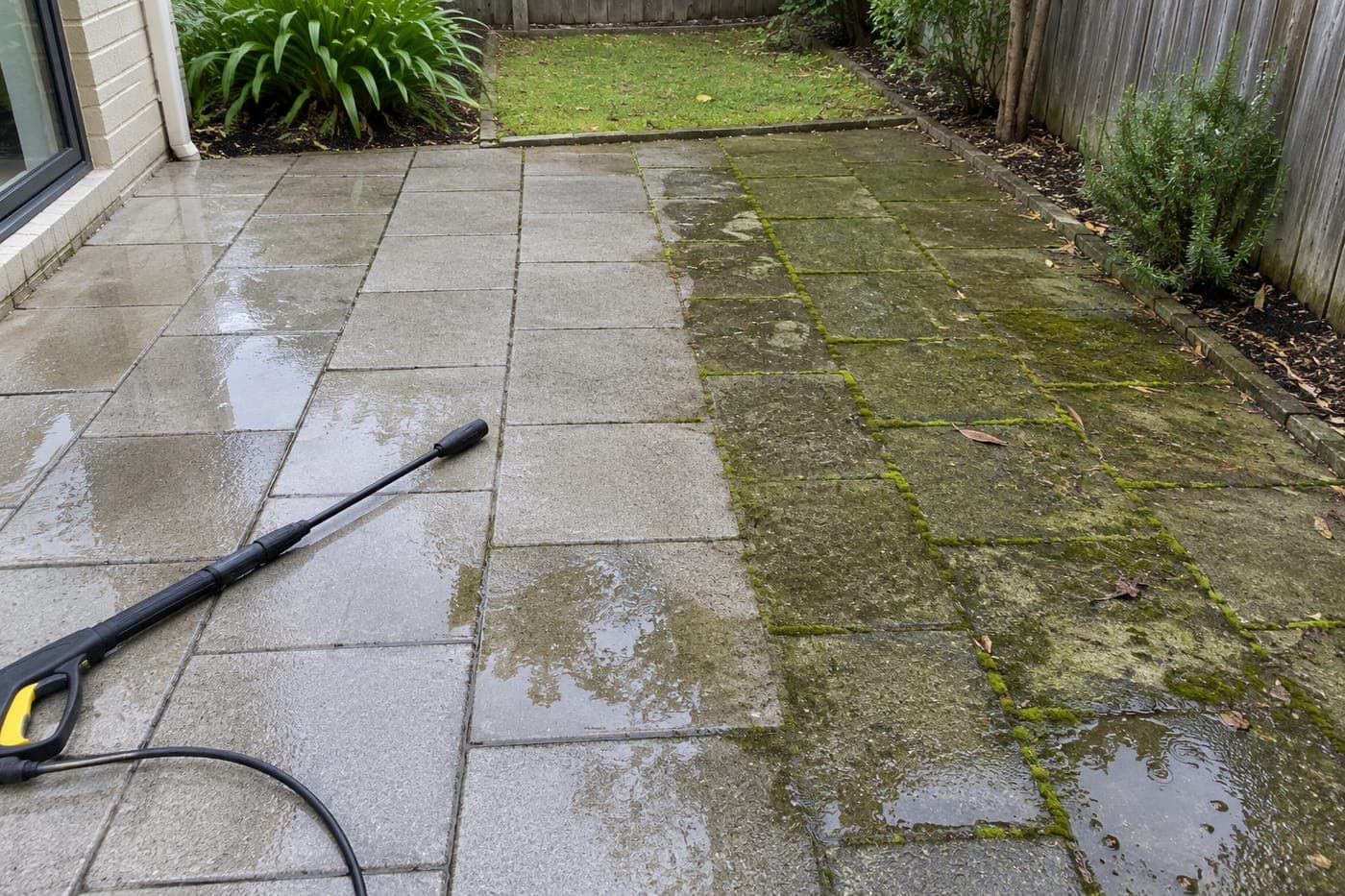
- The water test. Wet one small patch: if it dries noticeably lighter than the rest, the whole area has built up grime.
Slippery paving deserves the quickest response. The Better Health Channel (opens in a new tab)'s falls prevention advice is to "Remove leaves, mosses, fungi and lichen that make garden paths slippery when wet" and to "Keep paths well swept." A damp, algae-covered step is one of the easiest hazards to fix, and our guide to moss, mould and slippery paths covers the safety side in more detail.
How does each surface hold up between cleans?
Each surface wears and soils differently, so the routine between cleans matters as much as the clean itself.
Driveways and paths
Concrete is tough and handles a yearly clean well, but exposed aggregate and coloured concrete also need resealing every few years. Deal with oil drips the same day, because fresh oil soaks deeper into concrete every hour it sits.
Pavers
Paver joints lose sand with every clean and every heavy rain, which lets weeds and ants in. Top up the joint sand after cleaning and pull weeds while they are small.
Timber decks and fences
Timber greys and roughens in Melbourne's summer sun and grows mould in winter shade. A yearly spring clean before oiling keeps a deck sound; fences are cleaned when they are due for stain or paint. See timber fence care for the fence routine.
Pool surrounds
Pool areas get wet every day of the swimming season and grow slippery algae faster than any other paving. Our planned piece on cleaning around the pool covers coping, pavers and slip safety.
Walls
Render and brick need cleaning far less often than paving, mostly when mould appears or before painting. Keeping gutters clear and plants trimmed back is the best way to space out wall cleans.
Why a gentle method lets you clean less often
A harsh clean can leave a surface rougher than before: etched concrete, pitted sandstone and furry timber all hold more dirt and spores, so they go green again sooner. Matching pressure to the surface, and using a soft wash on delicate materials, leaves a smoother face that stays clean longer. Our guide to pressure washing vs soft washing explains the difference, and our step-by-step guide to pressure cleaning paths and paving shows the method for paving.
What can you do between cleans to stay ahead?
Sweep, clear and fix the causes. A little regular care is the difference between a yearly clean and a quarterly one.
- Sweep or blow weekly or fortnightly, more often in autumn. Put leaves in the green waste bin, not the gutter; EPA Victoria (opens in a new tab)'s advice is to "sweep the footpath and put the waste into a bin rather than using a hose".
- Clear leaf litter before it sits wet. Leaves left on paving through a wet week leave tannin prints.
- Trim overhanging plants so sun and air reach the surface.
- Fix water sources: overflowing gutters, dripping taps and sprinklers hitting paving.
- Pull weeds from joints while they are small, and re-sand empty joints.
- Spot clean small marks with a bucket and brush.
- Reseal suitable surfaces when water stops beading on them.
How should commercial and strata sites schedule cleaning?
On a fixed cycle, set by traffic and safety, with checks in between. Entrances, ramps, steps and car park walkways see far more use than a home driveway, and a slippery entrance is a real risk for visitors.
A good schedule names each area, how often it is cleaned, and who checks it between cleans. High-traffic entrances may be cleaned far more often than a quiet side path, and spills or slippery patches are cleaned as safety hazards when they appear. Owners corporations can fold this into the wider grounds maintenance schedule, so cleaning is checked alongside mowing, gardens and gutters.
Get help for large areas, double-storey walls, roofs, steep driveways, delicate stone and anything that needs a ladder. Never use a pressure cleaner from a ladder. Fibro or cement sheeting on homes built before 1990 may contain asbestos and should never be pressure cleaned. If a path is so slippery that someone could fall, clean it promptly or keep people off it until it is done.
How do you set a cleaning routine that suits your property?
Walk the outside of the property once in late winter, note which areas are green, stained or slippery, and set each one on its own cycle. Sunny areas go on a yearly clean; shaded and leafy ones go on twice a year; decks go on the spring list; walls and fences go on the "when needed" list.
For more on each surface, see our complete guide to pressure cleaning in Melbourne and the rest of our outdoor cleaning guides.
Is it worth handing the routine over?
If you have a lot of paving, shaded areas that go green every winter, or a deck and fences on top, a scheduled clean saves you planning around weather and water rules. We can set a cleaning cycle for each area and match the method to each surface. When you are ready, request a free quote with a few photos.
Your Garden. Our Promise.
Frequently asked
Can cleaning paving too often damage it?
What can I do between cleans without breaking the water rules?
Does a pool surround need cleaning more often than a driveway?
Do sealed pavers need cleaning less often?
Does living near the bay change how often surfaces need cleaning?
Should I clean paving before or after the autumn leaves drop?
How often should a body corporate clean common paths and entrances?
How do I know when my driveway is due for a clean?
Sources and further reading
- Permanent water saving rules (Water Victoria)
- Permanent water saving rules (South East Water)
- Climate statistics, Melbourne (Olympic Park) (Bureau of Meteorology)
- Reduce stormwater pollution (EPA Victoria)
- Falls prevention at home (Better Health Channel)
Caring for Melbourne gardens since 2019. Updated 18 November 2026.