


Outdoor cleaning guide
Pressure washing vs soft washing explained
By the Action Garden team · Updated · 10 min read
Checked against: Water Victoria, WorkSafe Victoria, EPA Victoria, Better Health Channel
TL;DR
- Pressure washing relies on force: a narrow, fast jet that strips grime from hard surfaces.
- Soft washing relies on chemistry: a cleaner, time to work, then a low-pressure rinse.
- Concrete, pavers and sound brick suit pressure; render, paint, timber, sandstone and roofs suit a soft wash.
- Soft wash solutions must be used exactly as their labels direct, with plants protected and run-off kept out of drains.
- Many jobs use both, such as a soft wash on the walls and a pressure clean on the driveway below.
| Question | Pressure washing | Soft washing |
|---|---|---|
| What does the cleaning | Force of the water jet | Cleaning solution and dwell time |
| Pressure at the surface | High | Low, close to a garden hose |
| Best for | Concrete, pavers, sound brick, block | Render, paint, timber, soft stone, roofs |
| Main risk | Etching, stripes, blown paint, washed-out joints | Overspray on plants, run-off, chemical handling |
| Under the water rules | The device the rules prefer for hard surfaces | Rinse often done with the same device on a low setting |
What is the difference between pressure washing and soft washing?
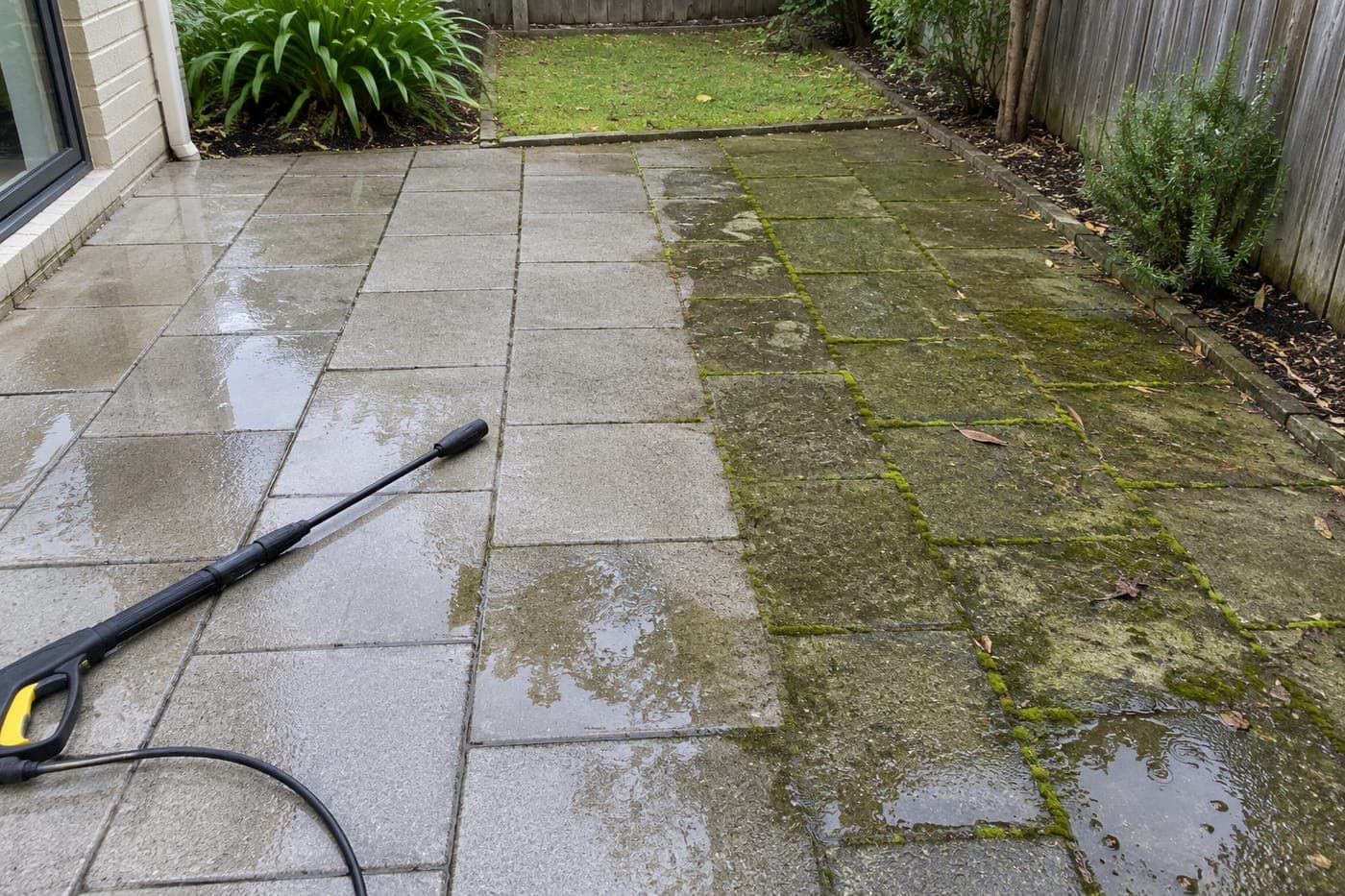
Pressure washing cleans with force; soft washing cleans with chemistry. A pressure washer fires a narrow, fast jet that strips dirt off the surface, while a soft wash applies a cleaning solution at low pressure, leaves it to break down the growth, then rinses it away gently.
In Australia, "pressure cleaning", "pressure washing" and "high-pressure cleaning" all mean the same thing: a machine that pushes a small volume of water through a narrow nozzle at high speed. "Soft washing" describes a method rather than a machine. It is often done with the same pressure cleaner fitted with a low-pressure tip, or with a pump sprayer and a hose.
The two are not rivals so much as tools for different surfaces. A good outdoor clean often uses both: a soft wash on the rendered walls, and a pressure clean on the concrete driveway below.
Two side-by-side panels. On the left, a pressure washer nozzle fires a narrow jet at a concrete slab; the dirt layer is blasted off and arrows show the force concentrated on a small strip. On the right, a wide, gentle spray applies a cleaning solution to a rendered wall; a clock icon shows the dwell time, the mould layer softens and lifts, and a second gentle spray rinses it away from a distance. Under each panel, a small gauge shows high pressure on the left and low pressure on the right.
How does pressure washing work?
A pressure washer pumps water through a narrow nozzle so it strikes the surface hard. The force breaks dirt, moss and grime off the face of tough materials, and the water carries it away.
Two numbers describe the machine: pressure, in PSI or bar, which decides how hard the jet hits, and flow, in litres per minute, which decides how fast the loosened dirt is carried off. Under Victoria's permanent water saving rules, the flow is the number that matters: Water Victoria (opens in a new tab) says a high-pressure water cleaner's "rate of delivery must be 9 litres per minute or less."
The nozzle changes the force more than the machine does. A 0 degree pin jet concentrates everything on a tiny spot and cuts; a 25 degree fan spreads it for concrete and pavers; a 40 degree fan is gentler again. A rotary surface cleaner holds spinning jets at a fixed height for even, stripe-free results on flat paving. Our complete guide to pressure cleaning in Melbourne has the nozzle chart in full.
Pressure washing is fast and needs no cleaning product on most dirt. Its weakness is that the force does not know when to stop: held too close or too long, it etches concrete, pits stone, raises timber grain and lifts paint.
How does soft washing work?
A soft wash applies a cleaning solution at low pressure, gives it time to work, then rinses it off gently. The solution loosens or kills mould, algae, lichen and the grime they hold, so very little force is needed to rinse them away.
- Protect the surrounds. Cover windows, vents and power points, wet nearby plants and protect the stormwater pit.
- Apply the solution. Spray it on at low pressure, usually from the bottom up on walls so it does not streak.
- Let it dwell. Leave it for the time on the label, out of strong sun so it does not dry on the surface.
- Agitate if needed. A soft brush helps on stubborn patches.
- Rinse gently. Rinse from the top down with a wide, low-pressure spray held well back from the surface.
- Rinse the plants. Give nearby beds a final rinse with clean water.
The solutions vary. Many are based on sodium hypochlorite, the active ingredient in household bleach, while others use different biocides or detergents. Whatever the product, use it only for the surfaces and dilutions on its label, wear eye protection and gloves, and never mix it with other cleaners. On our jobs we use biodegradable detergents only, and only where plain water is not enough.
How do they compare side by side?
Pressure washing wins on speed and on heavy grime on hard surfaces; soft washing wins on delicate surfaces and on organic growth. The table sums up the trade-offs.
Side by side
Pressure washing and soft washing
| Pressure washing | Soft washing | |
|---|---|---|
| What does the cleaning | Force of the jet | Cleaning solution and dwell time |
| Pressure at the surface | High | Low |
| Best surfaces | Concrete, pavers, sound brick, block, exposed aggregate (moderate) | Render, painted surfaces, timber, sandstone, roofs, delicate stone |
| Best on | Grime, mud, tyre marks, moss on hard paving | Mould, algae, lichen, black spots on walls |
| Speed | Fast on flat areas | Slower, because of dwell time |
| Main risks | Etching, stripes, pitting, blown paint, washed-out joints, water forced into cracks | Overspray on plants, run-off, handling chemicals |
| Products needed | Often none; detergent for stains | Always a cleaning solution |
| Regrowth | Can be quicker if spores remain in the pores | Usually slower, as growth is treated in the pores |
| Water rules | The device the rules prefer for hard surfaces | Rinse often done with the same device on a low setting |
Neither method is "better" overall. The right choice comes from the surface first, then what is on it.
Which surfaces suit each method?
Hard, durable, uncoated surfaces suit pressure washing; soft, coated or fragile ones suit a soft wash. When in doubt, start gentle: you can always add pressure, but you cannot undo etching.
| Surface | Method | Why |
|---|---|---|
| Plain concrete driveways and paths | Pressure washing, ideally with a rotary surface cleaner | Tough enough for the force, and gives an even finish |
| Exposed aggregate | Moderate pressure, sometimes after a soft wash pre-treatment | Too much pressure loosens stones and strips sealer |
| Concrete and clay pavers | Moderate pressure, angled across the joints | Joint sand blasts out easily |
| Sandstone and soft stone | Soft wash | A jet pits the face permanently |
| Face brick, sound mortar | Low to moderate pressure, or a soft wash | Old, soft mortar washes out |
| Acrylic and painted render | Soft wash | Pressure chips coatings and drives water behind cracks |
| Timber decks and fences | Low pressure along the grain, or a soft wash | High pressure raises a furry grain |
| Roofs | Soft wash, by a professional | Tiles crack and coatings lift under a jet |
| Fibro and cement sheeting | Neither: leave it alone | May contain asbestos |
Our step-by-step guides show each method in practice: pressure cleaning paths and paving, cleaning driveways by surface and cleaning rendered walls, brick and retaining walls.
What about hot water pressure cleaning?
Hot water pressure cleaning heats the water before it leaves the nozzle. Heat softens oil, grease and chewing gum far better than cold water, so it is the usual choice for oil-stained driveways, garage floors, bin areas and commercial car parks. It is still pressure washing, with the same risks on soft surfaces, and it needs specialist equipment. On delicate surfaces, hot water does not replace a soft wash.
Which method should you choose for your job?
Choose by the surface first, then by what you are removing. Work down the questions below and stop at the first "yes".
Quick decision guide
Pressure wash or soft wash?
- Could the surface be fibro, cement sheeting or anything that may contain asbestos? Do not clean it with either method; get advice first.
- Is it a roof, an upper wall or anything you would need a ladder for? Call a professional; never use a pressure cleaner from a ladder.
- Is it render, paint, timber, sandstone or a heritage surface? Soft wash, with a low-pressure rinse.
- Is the main problem mould, algae or lichen on a wall? Soft wash, and fix the moisture source.
- Is it concrete, pavers, sound brick or block with grime, mud or moss? Pressure wash, with the right nozzle and a test patch.
- Is it oil or grease on concrete? Absorb and degrease first, then a pressure clean, ideally with hot water.
- Still unsure? Start with the gentlest method and test a hidden patch.
The answer often changes from one part of the property to the next. A typical home might need a soft wash on a south-facing rendered wall, a gentle clean on the timber deck, and a full pressure clean on the concrete driveway, all on the same day.
What do the water and stormwater rules mean for each method?
Both methods fall under the same rules when they use drinking water on hard surfaces. Victoria's permanent water saving rules say: "Water must not be used to clean hard surfaces such as concrete, paths and driveways. Exemptions apply when cleaning is needed to address a hazard, surface staining or during construction." They add: "In these situations, a high pressure water cleaning device must be used if one is available."
Stain cleaning is allowed "if staining to the surface has developed and then only once a season". The rules apply only to drinking water, not to tank water, and they name hard surfaces such as driveways, paths, concrete, tiles and timber decking rather than walls; ask your water corporation if your job does not fit neatly.
Stormwater rules matter even more for soft washing, because the run-off carries cleaning solution. EPA Victoria (opens in a new tab) describes stormwater as run-off that "travels through gutters and drains into our waterways", untreated, and lists detergents among its main pollutants. With either method:
- Sweep first and bin the debris.
- Protect the stormwater pit before any water or solution goes on.
- Keep solution off lawns and garden beds, and rinse plants afterwards.
- Collect sludge at the low point and bin it.
Is either method safe to do yourself?
On a flat, ground-level surface with the right gear, a careful home owner can do either. The risks differ: pressure washing can injure, and soft washing means handling chemicals.
WorkSafe Victoria (opens in a new tab)'s high-pressure water jetting alert warns that "the water jet may pierce the skin", that "contaminated material may be injected into the body", and that "flying debris may hit and injure a person (including eye injuries)". Wear safety glasses, enclosed shoes and long trousers, and never point the wand at anyone.
For a soft wash, read the whole label before you start. Wear eye protection and gloves, work on a still day so the spray does not drift, keep children and pets away until the area is rinsed and dry, and never mix cleaning products. The Better Health Channel (opens in a new tab)'s mould advice is to "make sure there is good ventilation and wear protective clothing" when removing mould.
Call a professional for roofs, upper walls and anything off a ladder, for large areas of render or paint, for heritage stone and brick, and for any surface that may contain asbestos. The Better Health Channel notes that "Australian homes built before 1990 may contain asbestos", including exterior fibro cladding and eave linings, so never pressure clean or soft wash those without advice. If the jet breaks the skin, even slightly, seek medical attention promptly.
What mistakes do people make choosing between them?
Most mistakes come from using one method for everything.
- Pressure washing render and paint. It chips coatings and forces water into cracks.
- Using the pin jet to "finish" a stain. It etches lines that never wash out.
- Soft washing without protecting plants. Overspray can scorch leaves and soak the soil.
- Letting solution dry on the surface. It can streak and mark.
- Expecting either to fix the cause. Shade, overflowing gutters and poor drainage bring growth back.
- Pressure washing paver joints. The sand goes, and the weeds follow; see weeds between pavers for keeping joints clear.
- Skipping the test patch. Every surface reacts differently.
Sealing after either method
Once a surface is clean and fully dry, sealing can slow staining and regrowth on concrete, pavers and some stone. It suits pressure-cleaned paving more often than soft-washed walls, which are usually painted or left breathable. Our guide to sealing pavers and concrete after cleaning explains when it helps and how long to wait.
When is it worth handing the job to Action Garden?
When the job mixes surfaces, involves render, paint or delicate stone, or covers a large area, it is worth handing it over. Our team sets the pressure and nozzle for each surface and uses soft-wash methods on anything delicate, as our high-pressure cleaning service page describes.
For black mould on render and fences, our planned piece on black mould on exterior walls goes into causes and fixes, and our outdoor cleaning guides cover every surface. When you are ready, request a free quote with a few photos.
Your Garden. Our Promise.
Frequently asked
Is soft washing just pressure washing on a low setting?
Does soft washing kill mould better than pressure washing?
Will soft wash solutions harm my lawn and garden beds?
Can soft washing be used on a driveway?
Why does mould come back so fast after pressure washing a wall?
Does soft washing use less water than pressure washing?
Is soft washing safe around pets and children?
Can roof tiles be pressure washed?
Sources and further reading
- Permanent water saving rules (Water Victoria)
- High-pressure water jetting safety alert (WorkSafe Victoria)
- Stormwater (EPA Victoria)
- Mould and your health (Better Health Channel)
- Asbestos in the home (Better Health Channel)
Caring for Melbourne gardens since 2019. Updated 18 November 2026.