


Outdoor cleaning · Complete guide
High-pressure cleaning in Melbourne: the complete guide
By the Action Garden team · Updated · 14 min read
Checked against: Water Victoria, Yarra Valley Water, EPA Victoria, WorkSafe Victoria, Bureau of Meteorology
TL;DR
- Victoria's permanent water saving rules ban using drinking water to clean hard surfaces, except for hazards, staining once a season, and construction or renovation.
- When cleaning is allowed, a high-pressure water cleaning device must be used if one is available; it must deliver 9 litres per minute or less.
- EPA Victoria's guidance means only rain should reach the stormwater drain: sweep first and keep detergent, oil and grit out of the gutter.
- Every surface needs its own pressure, nozzle and distance: concrete takes the most, sandstone, timber and render the least.
- Eye protection, enclosed shoes and a dry exit path are not optional; the jet can cut skin, throw grit and leave surfaces slippery.
| Surface | Approach | Watch for |
|---|---|---|
| Broom-finished concrete | Rotary surface cleaner, firm pressure | Stripes and etching if the wand stops moving |
| Exposed aggregate | Moderate pressure, wide fan | Loosened stones and stripped sealer |
| Concrete and clay pavers | Moderate pressure, angled across joints | Joint sand blasted out; re-sand afterwards |
| Sandstone and soft stone | Low pressure or soft wash only | Pitting and a permanently rough face |
| Timber decks | Low pressure, wide fan, along the grain | Raised, furry grain and gouges |
| Rendered and painted walls | Soft wash, low pressure from a distance | Blown paint, water forced into cracks |
When is pressure cleaning allowed under Victoria's water rules?
Pressure cleaning with drinking water is allowed only in the situations Victoria's permanent water saving rules list. Water Victoria (opens in a new tab)'s page says: "Water must not be used to clean hard surfaces such as concrete, paths and driveways. Exemptions apply when cleaning is needed to address a hazard, surface staining or during construction." It then adds: "In these situations, a high pressure water cleaning device must be used if one is available. Otherwise, a hand-held hose or a bucket can be used."
The detailed wording, in Water Victoria's commonly asked questions, is that water can only be used to clean hard surfaces "(including, driveways, paths, concrete, tiles, timber decking) when:"
- "cleaning is required as a result of an accident, fire, health hazard, safety hazard or other emergency"
- "if staining to the surface has developed and then only once a season"
- "in the course of construction or renovation, and then only by means of a high pressure water cleaning device, or if such a device is not available, a hand-held hose or a bucket."
The same page defines the device: "A high-pressure water cleaner is an electric or petrol-powered device that connects to a hose, forcing water out at high pressure for more effective cleaning. The rate of delivery must be 9 litres per minute or less." Yarra Valley Water (opens in a new tab) publishes the same rules for its customers in Melbourne's north and east.
In plain terms, a dirty but unstained path is a job for a broom, not a hose. A path stained with moss, algae, oil or tannin can be cleaned once a season with a high-pressure cleaner, and a slippery surface that has become a safety hazard can be cleaned when needed.
How does high-pressure cleaning work, and why does it use less water?
A pressure cleaner pushes a small volume of water through a narrow nozzle, so the water hits the surface hard instead of flowing over it. The force does the work that a running hose cannot, which is why the rules prefer it. An open garden hose can run well past the 9 litre limit while doing less cleaning.
Two numbers describe a machine: pressure (usually in PSI or bar) and flow (litres per minute). Pressure decides how hard the jet strikes; flow decides how quickly the loosened dirt is carried away. Under Victoria's rules the flow is the number that matters, and it is printed on the machine's rating plate or in its manual.
The nozzle changes everything. Most machines come with colour-coded tips:
| Nozzle | Spray angle | Typical use |
|---|---|---|
| Red | 0 degrees (pin jet) | Avoid on paths, timber, render and stone; it cuts |
| Yellow | 15 degrees | Spot work on hard concrete only, from a distance |
| Green | 25 degrees | General cleaning of concrete and pavers |
| White | 40 degrees | Timber, painted surfaces, softer stone |
| Black | Wide, low pressure | Applying detergent and rinsing |
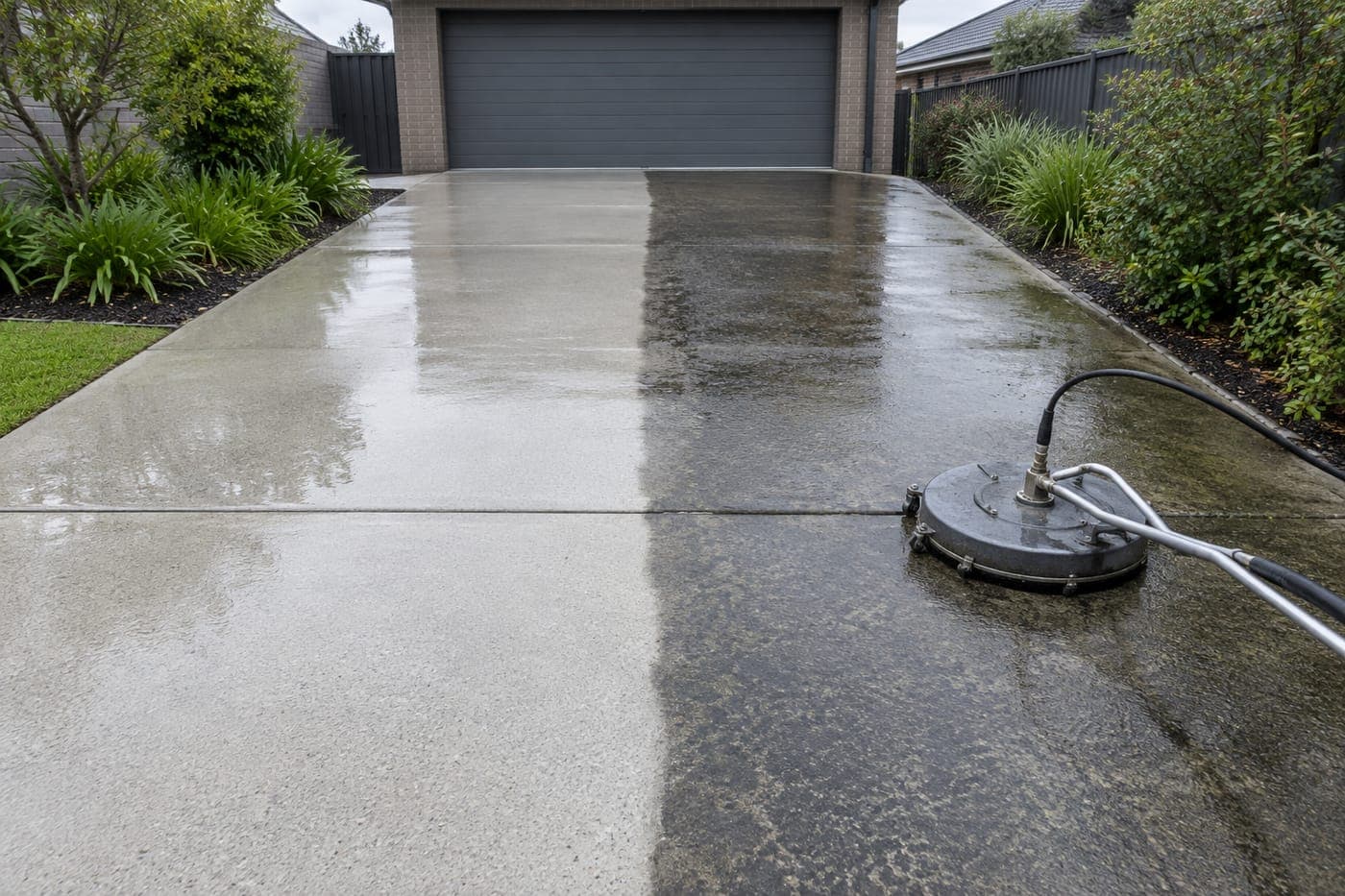
A rotary surface cleaner, the round hood that spins two jets under a cover, is the best tool for flat areas. It keeps the jets a fixed distance from the surface, prevents stripes, and cuts down spray drift onto walls, windows and plants.
A side view of a nozzle above a path. A narrow 0 degree jet makes a small, deep mark; a 25 degree fan spreads the same force over a wider strip; a rotary surface cleaner hood holds two spinning jets at a fixed height. Arrows show dirty water moving downhill, away from cleaned areas and towards a protected drain where grit is held back.
How should each Melbourne surface be cleaned?
Each surface takes a different pressure, nozzle and distance, and the softer the material, the gentler the approach. The rule we follow on every job is the one on our service page: set the pressure and nozzle for each surface, and use soft-wash methods on anything delicate. Always test a small, hidden patch first.
Plain and broom-finished concrete
Concrete driveways and paths are the toughest surface and take the most pressure. A rotary surface cleaner gives an even finish; a hand wand held at a steady distance and kept moving is the alternative. Stopping in one spot leaves an etched mark that never washes out.
Exposed aggregate
Exposed aggregate is concrete with the stones showing, usually sealed. Too much pressure can loosen stones at the edges and strip the sealer in patches. Use a moderate setting with a wide fan, and plan to reseal once it is clean and dry.
Concrete and clay pavers
Pavers clean well, but the sand in the joints is easily blasted out. Angle the jet across the joints, not into them, and keep a broom and fresh jointing sand ready. Re-sanding afterwards locks the pavers in and slows the weeds that love an empty joint.
Sandstone, bluestone and natural stone
Sandstone is soft and porous, and a strong jet pits the face, which then holds more dirt and grows mould sooner. Bluestone is harder, but its smooth-cut face can still mark. Use low pressure, a wide fan and a soft-wash approach with a suitable cleaner, following the product label.
Timber decks and fences
Timber cleans with low pressure, a 40 degree tip and long strokes along the grain. Too much pressure raises the fibres into a furry surface and gouges softer boards. Let the deck dry fully, usually a couple of dry days, before oiling or staining.
Render, paint and brick walls
Rendered and painted walls need a soft wash, not a blast. High pressure can lift paint, open hairline cracks and force water behind render or under window frames. Brick handles a little more, but old, soft mortar erodes quickly, so test first.
Why soft washing suits delicate surfaces
Soft washing uses low pressure with a cleaning solution that loosens mould, algae and lichen, followed by a gentle rinse. The chemistry does the work, so the surface is not worn away. It suits render, painted weatherboards, sandstone and roofs, where a hard jet would damage the surface or drive water in. Any product used must suit the surface and be applied exactly as its label directs, with run-off kept away from garden beds and drains.
How do you keep wash water out of the stormwater drain?
Keep it out by removing what pollutes it before you start, then protecting the drain while you work. In Melbourne, stormwater pits and street gutters are separate from the sewer. EPA Victoria (opens in a new tab) describes stormwater as run-off that "travels through gutters and drains into our waterways", untreated.
EPA Victoria lists oil, detergents, sediment, leaves and garden clippings among the sources of stormwater pollution. It states that everyone must "prevent waste from entering stormwater drains so far as reasonably practicable. This includes wastewater." For the home, its advice includes sweeping the footpath and putting the waste in a bin rather than using a hose.
In practice, the only thing that should go down the stormwater drain is rain. A good pressure cleaning job follows this order:
- Sweep leaves, grit and loose moss into the bin before any water goes on.
- Soak up oil stains with an absorbent, sweep it up and bin it.
- Protect the stormwater pit or gutter outlet so dirty water and sludge are held back.
- Use plain water first; reach for a biodegradable detergent only where water alone will not lift the stain.
- Direct clean rinse water onto lawn or garden where it can soak in, never detergent or oily water.
- Shovel up the sludge left at the low point and put it in the bin.
On our jobs we use biodegradable detergents only, and only where plain water is not enough. The team uses a commercial pressure washing machine.
A dry sweep with a stiff broom shifts most loose grime on its own. Doing it first means less water, a shorter clean and far less sludge heading for the drain.
Is pressure cleaning safe to do yourself?
It can be, on a flat, ground-level path with the right gear, but the jet is strong enough to cut skin and throw grit at speed. WorkSafe Victoria (opens in a new tab)'s safety alert on high-pressure water jetting lists the main risks: "the water jet may pierce the skin", "contaminated material may be injected into the body", "flying debris may hit and injure a person (including eye injuries)", and a flailing hose or separated coupling striking someone.
The same alert says "Personal eye protection should always be worn when an employee is near jetting operations", and that the person controlling the water should, as a minimum, wear safety glasses and a face shield. That is workplace guidance, but it is a sensible floor for anyone holding a wand at home.
- Eyes: safety glasses or a face shield, never ordinary sunglasses.
- Feet and legs: enclosed, non-slip shoes and long trousers. Never point the jet at feet, pets or people.
- Hands: both hands on the wand, and the trigger lock on whenever you put it down.
- Electricity: keep electric machines, leads and power points dry and use an outdoor safety switch.
- Slips: wet algae is slippery. Clean from the top of a slope downwards and keep a dry path to walk out on.
- Ladders: never use a pressure washer from a ladder; the kickback can push you off.
Call a professional for anything off the ground, such as roofs, upper walls and second-storey windows. Anything that may contain asbestos, such as fibro sheeting or old cement roof sheets, should never be pressure cleaned. Large commercial areas, heavily oil-stained car parks, delicate heritage stone and any job where wash water cannot be kept out of a drain are also best left to a professional. If the jet has broken the skin, even slightly, seek medical attention promptly; injection injuries can be far worse than they look.
What a jet can do to skin
Water at high pressure can pass through skin and carry dirt, detergent or bacteria into the tissue underneath. The entry wound may look like a small cut, which is why safety agencies treat any injection injury as serious. WorkSafe Victoria's alert also lists noise, chemical exposure and electric shock as hazards around jetting equipment.
What goes wrong most often?
Most damage comes from too much pressure, too close, held too long. The marks it leaves are permanent on concrete and stone, and hard to fix on timber and render.
- Zebra stripes: uneven passes leave light and dark bands. A rotary surface cleaner or steady, overlapping passes avoid them.
- Etching and wand marks: the jet stopped in one place or was held too close.
- Furry timber: pressure too high, or working across the grain.
- Empty paver joints: the jet pointed into the joints and nobody re-sanded.
- Blown paint and wet walls: a hard jet on render or around window seals.
- Detergent burn on plants: spray drifting onto beds without a rinse or a cover.
- Water in the wrong place: spray forced under doors, into weep holes or into an open garage.
- Grime in the drain: sludge rinsed into the gutter instead of collected.
Rust, tannin from leaves, and old oil soaked deep into concrete often do not lift with water and pressure alone. They need a specific treatment first, and very old stains may fade rather than vanish.
How often do outdoor surfaces need pressure cleaning in Melbourne?
For most homes, a clean once a year keeps driveways and paths free of moss and grime, and shaded areas may need it twice. That matches the schedule on our high-pressure cleaning service page and sits within the rule allowing stained surfaces to be cleaned once a season.
Melbourne's weather explains the pattern. Bureau of Meteorology (opens in a new tab) figures for Melbourne (Olympic Park) show July as the coldest month, with a mean maximum of 14.5 degrees, and July and August with the most rain days, about 9 a month. Cool, damp, shaded surfaces in those months are where moss, algae and black mould take hold.
Melbourne rain days and cool months (Olympic Park)
| Month | Mean max (°C) | Mean min (°C) | Days with 1 mm of rain or more |
|---|---|---|---|
| January | 26.8 | 16.5 | 5.4 |
| April | 20.9 | 12.2 | 7.5 |
| July | 14.5 | 7.6 | 9.0 |
| August | 15.6 | 8.1 | 9.3 |
| October | 20.6 | 11.0 | 9.1 |
Source: Bureau of Meteorology, climate statistics for Melbourne (Olympic Park), station 086338.
- Late spring: the most popular time. Winter growth comes off before summer entertaining, and surfaces dry fast.
- Before a sale or end of lease: a clean path and driveway lift first impressions; see our pre-sale garden tidy-up checklist.
- After gutters overflow: dark stains under gutters often point to a blockage. Our guide on how to clean gutters safely covers the cause.
- Body corporates and commercial sites: entrances and car parks are best on a planned cycle, alongside the grounds work in our body corporate grounds schedule.
How does pressure cleaning compare with other methods?
Pressure cleaning is the strongest option, but not always the right one. The choice depends on the surface, the stain and the water rules.
| Method | Best for | Limits |
|---|---|---|
| Dry sweeping and scraping | Loose dirt, leaves, light moss | Will not lift ingrained grime or stains |
| Bucket and stiff brush | Small areas, steps, spot stains | Slow on large areas |
| High-pressure cleaning | Concrete, pavers, aggregate, brick | Can damage soft surfaces; needs a rule exception |
| Soft washing | Render, paint, sandstone, roofs | Relies on the right product and dwell time |
| Hot water pressure cleaning | Oil and grease on concrete | Specialist equipment |
A pressure cleaner with a rotary surface cleaner is usually the fastest and most even way to clean a large driveway. For a single stained step, a bucket and a stiff brush may be all you need. Our step-by-step guide to pressure cleaning paths and paving walks through a home job from sweep to seal.
What affects the time and the quote
Every quote is based on the job, not a set list. The things that change it are the area in square metres, the surface (concrete, pavers, timber or render), how much mould, moss or oil staining there is, access for equipment and water, whether wash water needs extra containment, and whether sealing follows the clean. Sending photos with your request helps us quote accurately.
When is it worth handing pressure cleaning to Action Garden?
It is worth handing over when the area is large, the surface is delicate, the stains are stubborn or you would rather not handle a high-pressure machine. Our team matches pressure, nozzle and method to each surface, uses biodegradable detergents only where water is not enough, and cleans up fully after every job.
Many clients pair a seasonal clean with other work, such as gutter cleaning before winter or regular grounds care through our maintenance plans. More reading is collected in our outdoor cleaning guides.
If you would like a clean driveway, path or deck without the risk of damage, you can request a free quote with a few photos and we will come back to you.
Your Garden. Our Promise.
Frequently asked
Is pressure cleaning a driveway allowed under Melbourne's water rules?
What counts as a high-pressure water cleaning device in Victoria?
Do the hard surface rules apply if I clean with tank water?
Can pressure cleaning wash water go into the stormwater drain?
Is pressure cleaning safe on sandstone?
Does exposed aggregate need resealing after pressure cleaning?
Can fibro or old cement sheeting be pressure cleaned?
Why do moss and algae come back quickly on some Melbourne paths?
Sources and further reading
- Permanent water saving rules (Water Victoria)
- Permanent water saving rules (Yarra Valley Water)
- Stormwater (EPA Victoria)
- High-pressure water jetting safety alert (WorkSafe Victoria)
- Climate statistics, Melbourne (Olympic Park) (Bureau of Meteorology)
Caring for Melbourne gardens since 2019. Updated 17 November 2026.
Related reading