


Gutters and exterior
Getting the deck and patio ready for summer
By the Action Garden team · Updated · 13 min read
Checked against: CFA, Energy Safe Victoria, Better Health Channel, Yarra Valley Water, Bureau of Meteorology
TL;DR
- Do the work in late October to early December, after the spring rain and before the hot, dry weeks when timber oils and sand behave best.
- Clear leaves from between deck boards, under raised decks and along patio edges first; they hold damp in spring and become fuel in summer.
- Under the permanent water saving rules, paving and decking may be cleaned with drinking water only for staining once a season, a hazard or construction.
- A deck that soaks up a splash of water instead of beading it is due for a clean and re-oil, once the timber is dry right through.
- The CFA advises removing doormats, outdoor furniture and other flammable items from decks before bad fire days; Energy Safe Victoria advises a soapy water test on gas barbecues.
| Area | Summer prep job | Why it matters |
|---|---|---|
| Deck boards and gaps | Sweep, clear gaps, check fixings | Trapped leaves hold moisture and rot timber edges |
| Under a raised deck | Clear leaves and rubbish | Dry debris under a deck is fuel in fire season |
| Timber finish | Water bead test, then clean and oil if needed | Bare grey timber cracks and splinters in summer sun |
| Patio paving | Weed joints, re-sand, clean stains | Clean, full joints stay tidy and safe underfoot |
| Overhead and edges | Pergola gutters, branches, shade sails | Leaves from above refill the deck in a week |
| Barbecue, pots and furniture | Gas check, empty standing water, clear clutter | Fire and mosquito season both start in summer |
What does a summer-ready deck and patio look like?
A summer-ready deck and patio is clean, dry, sound underfoot and clear of anything that burns or holds water. The boards are swept and the gaps are open, the timber still sheds water, the paving joints are full, and the barbecue has passed a leak check.
Getting there is mostly a checklist, not a big project. The order matters: clear and check first, clean second, finish timber last, then set the area up for summer living and the fire season.
A simple plan view of a house with a timber deck off the back door and a paved patio beyond it. Five numbered zones are marked: 1, the deck surface and board gaps; 2, the space under the raised deck; 3, the patio paving and its joints; 4, overhead, including the pergola gutter and an overhanging branch; 5, the edges, with pots, a barbecue and outdoor furniture. Short arrows show leaves falling from above into the gaps, and a dashed circle marks a 3 metre clear zone around the barbecue.
When should you get the deck and patio ready in Melbourne?
Late October to early December suits most Melbourne homes. The spring rain is easing, timber and paving can dry out between showers, and the job is done before the first hot spell and the Christmas gatherings.
Summer itself is a harder time to start. The Bureau of Meteorology (opens in a new tab)'s Olympic Park figures show a January mean maximum of 26.8°C and average February rainfall of only 26.3 mm, and hot days well above that are common. Oils and stains can dry too fast in direct sun, and the fire season is under way.
A simple timeline
- Late October: sweep, clear gaps and under the deck, check boards, fixings and pavers.
- Early November: weed and re-sand paving joints, clean moss and stains where the water rules allow.
- Mid to late November: re-oil timber on a dry, mild run of days, once the boards are dry right through.
- Early December: set up furniture and the barbecue, empty water traps, and do the fire season clear-out.
What goes on the deck checklist?
The deck checklist is about keeping water out of the timber and keeping the surface safe. Work from the gaps and fixings to the surface finish.
Deck checklist
- Sweep the boards and clear the gaps between them with a putty knife or gap tool.
- Clear leaves, twigs and rubbish from under a raised deck where you can reach it safely.
- Check every board for movement, splits and soft spots, especially at the ends and near downpipes.
- Re-drive or replace screws and nails that have lifted above the surface.
- Look underneath for timber touching soil, and for damp, dark or crumbling bearers and joists.
- Test the finish with a splash of water: beading means it is still working, soaking in means it is due.
- Clean grey, stained or mouldy boards with a method that suits timber, within the water rules.
- Let the timber dry thoroughly, then oil or stain as the product label directs.
- Check steps, handrails and balustrades for movement before guests lean on them.
The water bead test, done properly
Choose a section of boards in full sun that has been dry for at least a day. Sprinkle a small handful of water across a few boards and watch for a minute or two.
If the water forms tight beads and runs off, the finish is doing its job and a wash may be all the deck needs. If the boards darken and the water soaks in, the oil has worn through and the timber is open to sun and rain. Do the test in a few places, because the most exposed boards and the steps usually wear first.
Timber needs a gentler clean than concrete. A jet that is too close or too strong raises the grain and leaves the boards furry. Our guide to pressure cleaning timber decks and fences without damage sets out the pressure, nozzle and drying time to use.
What goes on the patio and paving checklist?
The patio checklist is about a clean, even, safe surface. Weeds, moss, lifted pavers and blocked drains are the usual problems after a Melbourne winter.
Patio checklist
- Sweep the paving and the edges where leaves and soil gather.
- Weed the joints by the root and refill them with dry jointing sand.
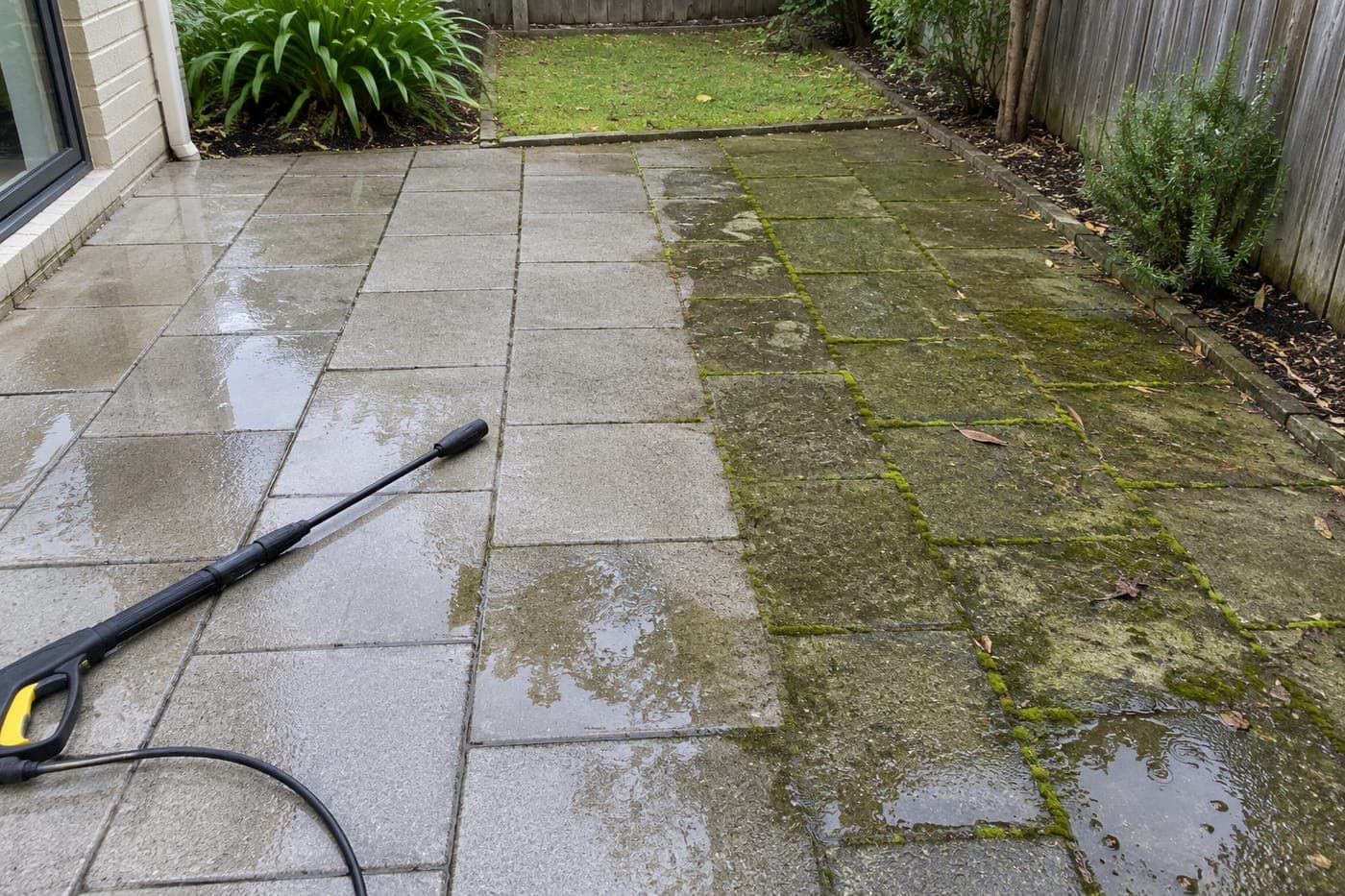
- Clean moss, algae and black mould from shaded paving, where the water rules allow.
- Treat oil, rust and barbecue fat stains before the surface is cleaned.
- Check for lifted, rocking or sunken pavers that trip people or hold puddles.
- Clear the grate and pit of any patio drain, and check downpipes do not discharge across the paving.
- Check that the paving falls away from the house so summer storms drain off quickly.
- Look for termite mud tunnels or damp patches where paving meets the house wall.
Weeds in the joints are the most common patio job. Lift them by the root and refill the joints straight away, or they return within weeks. Barbecue fat and car oil are the most common stains; for those, see how to remove oil stains from concrete.
How do the water rules affect cleaning before summer?
Victoria's permanent water saving rules ban using drinking water to clean hard surfaces, and that includes paving, tiles and timber decking. Cleaning is allowed for staining once a season, for an accident, health or safety hazard, or during construction or renovation.
In those cases, Yarra Valley Water (opens in a new tab) says "a high pressure water cleaning device must be used if one is available", and the device's rate of delivery "must be 9 litres per minute or less". A hand-held hose or bucket can be used only if no such device is available.
In practice, that means:
- A mossy, slippery path or deck is a safety hazard and can be cleaned.
- A stained patio, with moss, algae, oil or tannin marks, can be cleaned once a season.
- A dull but unstained surface gets a broom and a blower, not a hose.
Rainwater, bore water and recycled water are not covered by the rules, but the stormwater rules still apply to dirty wash water. Our guide to pressure cleaning and Melbourne's water rules explains each exception in detail.
What needs doing overhead and around the edges?
Look up before you clean down. Leaves and flowers from overhanging trees, pergola gutters and climbing plants will cover a freshly cleaned deck within a week.
Overhead and edges checklist
- Clear the gutter on any pergola, verandah or carport that drains onto the deck or patio.
- Trim plants and climbers that touch the deck, the house or the pergola posts.
- Note overhanging branches that drop leaves, bark or fruit onto the area; leave anything large or near power lines to professionals.
- Check shade sails for wear, sagging and loose fittings before the first strong wind.
- Clear soil, mulch and garden beds that have built up against deck timbers or the house wall.
- Clean outdoor light fittings of cobwebs and dead insects.
The gutters above an outdoor area matter twice over: blocked gutters overflow onto the deck in storms, and dry leaves in them are fuel in fire season. Clear them before you clean the surfaces below.
How do you get the outdoor area ready for the fire season?
Clear anything that burns from the deck and patio, keep leaves off and under the deck, and know the barbecue rules. Embers land in corners, on mats and in gaps, which is why the CFA (opens in a new tab) focuses on those spots.
The CFA's property advice is to "remove flammable items from decks and verandahs, like boxes, outdoor furniture and doormats", to "remove fallen leaves from where they gather around your home", and to "keep woodpiles away from the house". Its video notes that houses "have been known to catch fire from an ember landing on a doormat".
Fire season checklist
- Clear leaves from deck gaps, the area under the deck and the corners of the patio.
- Store spare timber, cardboard, firewood and gas bottles away from the house.
- Bring doormats, cushions, dog beds and light furniture inside before bad fire days.
- Keep a hose with a trigger nozzle connected and long enough to reach the deck.
- Know the barbecue rules for the Fire Danger Period and Total Fire Ban days.
The barbecue on hot days
The CFA's Can I or can't I guidance allows a gas or electric barbecue on a Total Fire Ban day only when its conditions are met, including that "the area within a distance of 3 metres from the outer perimeter of the barbecue is clear of flammable material". Solid fuel, such as wood or heat beads, cannot be used on those days.
Before the first cook-up, Energy Safe Victoria (opens in a new tab) advises a soapy water test: turn the gas on, spray washing-up liquid and water over the hose, regulator and connections, and look for bubbles. If bubbles appear, turn off the gas, recheck the connections and test again. A cracked or perished hose must be replaced before the barbecue is used.
Mosquitoes around the outdoor area
Summer evenings outside bring mosquitoes, and many breed within a few metres of the deck. The Better Health Channel (opens in a new tab) advises that mosquitoes "can breed even in the tiniest amounts of water" and recommends removing stagnant water.
Empty or sand-fill pot saucers, tip out buckets and toys, clear water from blocked pergola gutters, and change the water in pet bowls, bird baths and vases at least once a week, as the checklist advises. Check that rainwater tank screens are intact.
What mistakes spoil summer deck and patio prep?
The usual mistakes are doing the jobs in the wrong order, or doing them in the wrong weather. Both waste effort and can damage the surface.
- Oiling before the timber is dry. Oil over damp boards stays tacky, looks blotchy and wears quickly.
- Cleaning before clearing overhead. The first windy day drops the next layer of leaves on a clean deck.
- Hosing a dull patio. Without staining or a hazard, it breaks the water rules and sends grit to the drain.
- Pressure cleaning timber like concrete. It raises the grain and leaves furry, splintery boards.
- Leaving the gaps blocked. Leaves between boards hold water against the timber edges and rot them.
- Forgetting the paving joints. A clean patio with empty joints is a weedy patio by January.
- Storing firewood and boxes under the deck. That is fuel right under the house in fire season.
When is it worth handing the job over?
It is worth handing it over when the area is large, the timber is in poor shape, or you would rather spend the spare weekends using the deck than preparing it. Cleaning timber and stone without damage takes the right equipment and some practice.
Our high pressure cleaning service covers patios, decks, paths, driveways, walls and fences, with pressure and biodegradable detergents matched to each surface. The service covers the clean only; oiling and sealing are not included.
If the area includes a pool, the surround needs extra care with water, chemicals and slip resistance; see cleaning around the pool. For the rest of the outside of the house, our articles on a driveway clean, before and after and timber fence care follow the same approach, and there is more in our gutters and exterior articles. The complete guide to high-pressure cleaning in Melbourne covers every surface in one place.
When you are ready for summer to start, get a free quote and let us know what the deck and patio need.
Your Garden. Our Promise.
Frequently asked
How do I know if my deck needs re-oiling before summer?
Can I pressure clean the patio just because it looks dull before Christmas?
Should leaves be cleared from under a raised deck before summer?
Do pot plant saucers on the patio breed mosquitoes?
How much clear space does a gas barbecue need on a Total Fire Ban day?
How do I check a gas barbecue hose before the first cook-up?
What should I do about a springy or loose deck board?
Are outdoor cushions and doormats a fire risk on the deck?
Sources and further reading
- How to prepare your property (CFA)
- Can I or can't I? (CFA)
- Know the drill before you grill (Energy Safe Victoria)
- Mosquitoes, protect your home checklist (Better Health Channel)
- Permanent water saving rules (Yarra Valley Water)
- Melbourne (Olympic Park) climate statistics (Bureau of Meteorology)
Caring for Melbourne gardens since 2019. Updated 18 November 2026.