


Outdoor cleaning guide
Moss, mould and slippery paths: how to clean and prevent them
By the Action Garden team · Updated · 11 min read
Checked against: Better Health Channel, Royal Horticultural Society, Bureau of Meteorology, Yarra Valley Water, EPA Victoria
TL;DR
- Green and black growth on Melbourne paths is usually moss, algae, lichen or mould, and all of it needs shade and moisture.
- The Better Health Channel advises removing leaves, mosses, fungi and lichen that make garden paths slippery when wet.
- Start dry with a scraper and stiff broom, then clean once a season or for a safety hazard, as Victoria's water rules allow.
- Soft surfaces such as sandstone, old brick and timber need low pressure or a soft wash, never a narrow jet.
- Regrowth stops only when the path gets more light and drains faster, so the cause matters more than the clean.
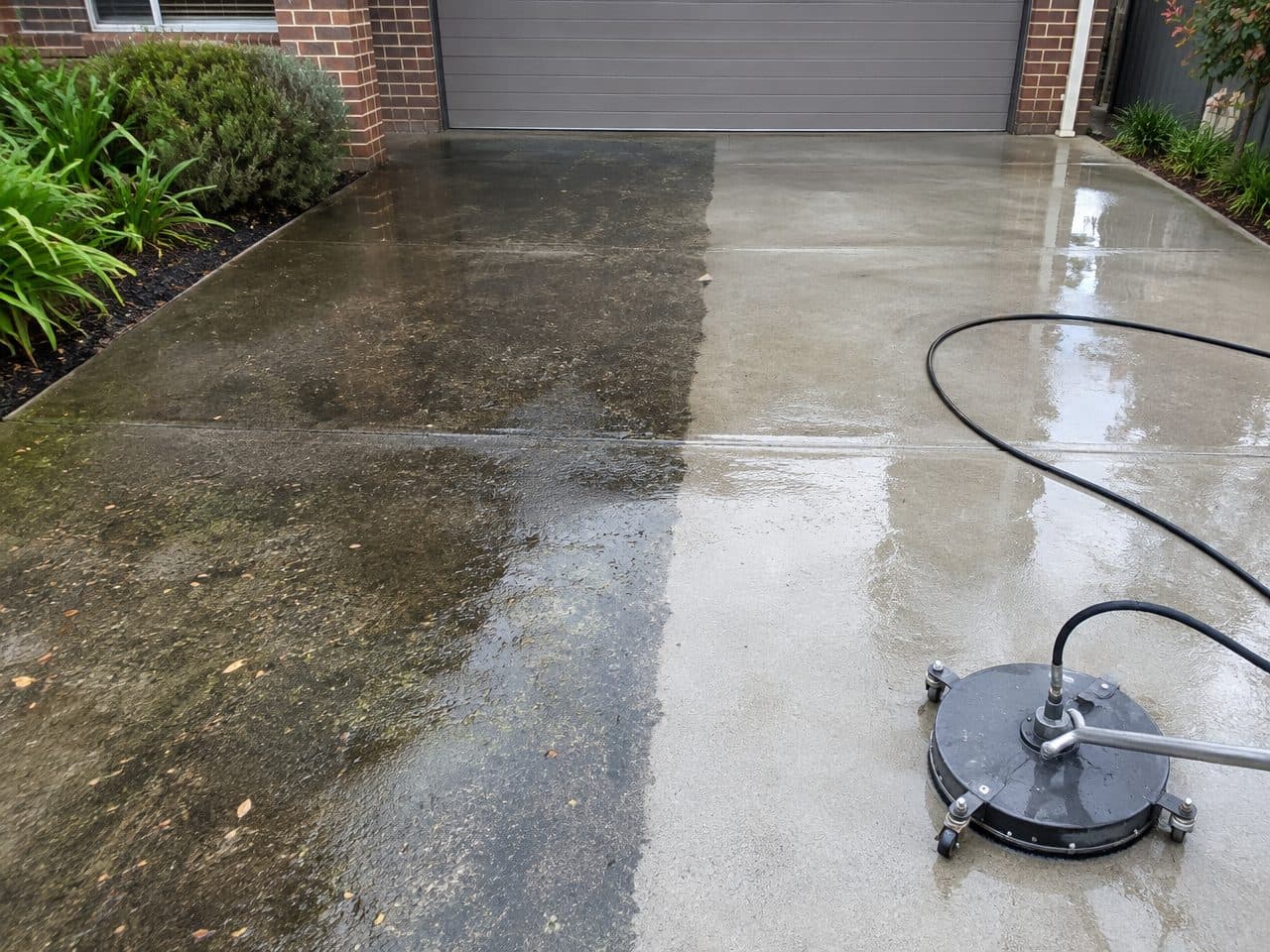
Why do Melbourne paths go green, black and slippery?
Paths go green and black because moss, algae, lichen and mould grow wherever a hard surface stays damp and shaded for weeks at a time. Melbourne's long, cool, wet season gives them that window every year. When wet, the growth forms a slick film that makes paths and steps slippery underfoot.
Bureau of Meteorology (opens in a new tab) averages for Melbourne (Olympic Park) show rain falling on 8 to 9 days a month from May to August, with July's mean maximum just 14.5°C. Short, cool days mean wet surfaces dry slowly, especially where the sun never reaches. By the end of winter, south-facing paths, side passages and areas under trees are often coated.
Days of rain in Melbourne by month (Olympic Park)
| Month | Days with 1 mm of rain or more |
|---|---|
| Jan | 5.4 |
| Feb | 3.6 |
| Mar | 5.2 |
| Apr | 7.5 |
| May | 8.5 |
| Jun | 8.6 |
| Jul | 9.0 |
| Aug | 9.3 |
| Sep | 7.9 |
| Oct | 9.1 |
| Nov | 8.0 |
| Dec | 6.3 |
Source: Bureau of Meteorology, climate statistics for Melbourne (Olympic Park), station 086338.
Rain alone is not the whole story. Spring is also wet, but warmer days and longer sun dry paths out between showers, which is why growth peaks in late winter and starts to brown off by late spring. Spots that stay damp all year, such as under a dripping gutter or beside a leaking tap, stay green in summer too.
How do you tell moss, algae, lichen and mould apart?
Look at the colour, the texture and how it behaves when wet. Each one points to slightly different conditions, though the cleaning approach is much the same.
| Growth | What it looks like | Where it grows | How slippery |
|---|---|---|---|
| Moss | Soft green cushions or carpet, often in joints | Shaded, damp joints, cracks and edges | Slippery, and it traps soil |
| Green algae | Thin green film or powder | Damp, shaded faces of pavers and concrete | Very slippery when wet |
| Black algae or slime | Dark, slick film, crusty when dry | Spots that stay wet, low points, under drips | The most slippery of all |
| Lichen | Flat grey, yellow or orange rosettes, firmly stuck | Older stone, brick and concrete with some light | Slippery when wet; slow to return |
| Mould and mildew | Grey or black speckles | Timber, render and shaded walls more than paths | Less slippery; mostly a stain |
The Royal Horticultural Society (opens in a new tab) notes that "algae thrive in wet conditions, and growth may be faster in shady areas with poor air circulation", and that lichens "do not damage what they are growing on" but make surfaces slippery. Mould on house walls and fences behaves a little differently; our article on black mould on exterior walls and fences covers it.
Liverworts and the jelly-like growth on gravel
Liverworts are flat, green, leaf-like plants that spread over permanently damp soil and the edges of paths, often near downpipes and taps. They are a strong sign that the ground stays wet.
A dark, jelly-like growth that swells after rain on compacted gravel or the edge of a path is usually a colony of blue-green algae. It looks alarming but is a drainage problem first: loosen the gravel, improve the fall and it struggles to return.
Is a slippery path a hazard worth cleaning now?
Yes, where people walk on it, especially older people, children, steps and slopes. The Better Health Channel (opens in a new tab)'s falls guidance is plain: "Remove leaves, mosses, fungi and lichen that make garden paths slippery when wet", and "Keep paths well swept."
Victoria's permanent water saving rules allow drinking water to be used on hard surfaces "where cleaning is required as a result of an accident, fire, health hazard, safety hazard or other emergency", as well as "if staining to the surface has developed and then only once a season." In either case, a high-pressure cleaner must be used if one is available. Our explainer on pressure cleaning and Melbourne's water rules sets out the exceptions in full.
Until the path is cleaned, put a temporary mat or sand on the worst spots and warn visitors. The RHS also suggests spreading coarse sand over garden steps to improve grip.
How do you clean moss and mould off a path?
Start dry, clean gently, then deal with the cause. Most of the growth comes off with a scraper and a stiff broom before any water is used.
- Scrape and brush. Lift thick moss with a flat scraper, then brush hard with a stiff broom. Bin what comes off rather than leaving it to wash into beds or the drain.
- Clear the joints. Run a weeding knife or old blade along paver joints and cracks.
- Treat only where needed. If black algae or lichen is still stuck fast, apply a product labelled for moss and algae on hard surfaces, following the label on dilution and dwell time. Keep it off lawn edges and plants.
- Protect the drain. Cover the stormwater pit or gutter outlet before any water goes on.
- Clean with a wide spray. Use a 40 degree tip or a rotary surface cleaner on concrete, working downhill. Use low pressure on soft stone, brick and timber.
- Collect the sludge. Shovel up the green slurry at the low point and bin it.
- Re-sand the joints. On pavers, brush dry jointing sand back in once the path is fully dry.
The RHS points out that a pressure washer works quickly but adds water, so use it carefully where drainage is poor. On a badly drained path, finishing with a dry stretch of weather matters as much as the clean.
A plan view of a house with a path running down the south side, between the wall and a timber fence. The sun's arc passes to the north, and shading falls across the whole path from June to August. A gutter above drips onto one section, and a low point near the gate holds a puddle. Moss is shown thickest in the shade line, under the drip and at the low point, and absent on the sunny north-side paving.
Which path surfaces need a gentler approach?
Soft and older surfaces need low pressure or a soft wash, because a narrow jet wears them away and leaves a rougher face that grows back faster. Test a hidden corner on every surface first.
- Sandstone: soft and porous. Use a wide fan at low pressure or a soft wash only; a strong jet pits it.
- Old clay brick and mortar: faces and old lime mortar erode quickly. Low pressure, wide fan, and brush mortar joints rather than blasting them.
- Bluestone: hard, but the sawn face can mark. Moderate pressure at a distance.
- Concrete pavers and plain concrete: the most forgiving. A rotary surface cleaner gives an even finish without stripes.
- Timber boardwalks and steps: low pressure along the grain. Our guide to pressure cleaning timber decks and fences covers timber in detail.
Moss is not the only stain on a damp path. Rust from pot stands and oil near the garage need their own treatment before the clean; see our guide on how to remove oil stains from concrete.
What a soft wash is, and when it suits a path
A soft wash uses a cleaning solution at low pressure to loosen algae, lichen and mould, then a gentle rinse. The product does the work, so the surface is not worn away.
It suits sandstone, painted concrete, old brick and any path where a hard jet would cause damage. The product must suit the surface and be applied exactly as its label directs, with plants covered and run-off kept away from beds and drains.
How do you stop moss and mould coming back?
Change the conditions: more light, more air and faster drainage. Cleaning without fixing the cause buys a season at most.
- Let the light in. Trim overhanging shrubs and hedges so sun and wind reach the path. Even a few hours of winter sun makes a difference.
- Fix drips and overflows. A blocked or overflowing gutter is one of the most common reasons one section of a path stays green; our guide on how to clean gutters safely covers the cause.
- Check the fall. Paths should shed water. The RHS advises: "Ensure surfaces slope slightly to prevent standing water." A puddle that sits for days needs a drainage fix.
- Keep joints full. Re-sanded joints give moss less room and less moisture.
- Sweep regularly. Leaves and soil left on a path hold water and feed growth. A weekly sweep in autumn and winter helps more than any product.
- Seal where it suits. A sealer on pavers or concrete makes the surface less porous and easier to clean, though it does nothing for joints.
Weeds and moss in paver joints often go together. Our article on weeds between pavers covers removal and prevention without harsh products.
Clean, treat or fix the cause?
Most paths need a clean now and a small fix to keep it clean. Work through the questions below to decide what your path needs.
Quick decision guide
Clean, treat or fix the cause?
- Is the path slippery where people walk, or on steps? Clean it now, and sand or mat the worst spots until you do.
- Is the growth thin and green on a sunny section? Brush it off dry; it may not need water at all.
- Is it thick black slime or lichen that will not brush off? Use a product labelled for hard surfaces, then a gentle clean.
- Is one section always green while the rest is clear? Look up: check the gutter, downpipe or tap above it.
- Does water sit on the path for days? It needs a drainage or levelling fix; cleaning alone will not last.
- Is it sandstone, old brick or timber? Choose a soft wash or low pressure, and test first.
What mistakes make moss and mould worse?
Most mistakes either damage the surface, so growth has more to grip, or send the problem into the drain. Avoid these.
- Blasting soft stone and mortar. A rough, pitted face holds water and grows back faster.
- Washing moss into the garden or drain. Collect it and bin it. EPA Victoria (opens in a new tab) lists sediment, leaves and detergents among stormwater pollutants.
- Using products not labelled for the job. Household cleaners can kill lawn edges and plants and harm waterways.
- Leaving the joints empty. Moss and weeds move straight back in.
- Ignoring the gutter or drip above. The path stays wet, so the growth returns.
- Walking on a freshly cleaned path in socks or smooth soles. Clean, wet paving can still be slippery until it dries.
Call a professional for steep paths, long flights of steps, slippery access used by older people or tenants, or delicate heritage stone. Anything off the ground, such as a balcony, roof or upper wall, needs the right access equipment, not a pressure washer on a ladder. If a path is slippery because of a leaking pipe or failed drainage, a plumber or drainage contractor is the right first call.
When is it worth handing it over?
It is worth handing over when the path is large, steep or delicate, when moss keeps returning, or when someone in the household is at risk of a fall. Our high-pressure cleaning service matches the method to the surface and uses biodegradable detergents only where plain water is not enough, and it can be booked alongside hedge trimming for the shrubs that shade the path.
The complete guide to high-pressure cleaning in Melbourne covers machines and safety, and the outdoor cleaning guides cover each surface. When you are ready, get a free quote with a photo of the path.
Your Garden. Our Promise.
Frequently asked
What is the black slime on my concrete path in winter?
Does lichen damage pavers and paths?
Can I use bleach to kill moss on my path?
Why does moss grow between my pavers but not on them?
Is a slippery path a safety hazard I can clean under the water rules?
How do I make outdoor steps less slippery after cleaning?
Will sealing my path stop moss from coming back?
Sources and further reading
- Preventing falls at home (Better Health Channel)
- Algae, lichens, liverworts and moss on hard surfaces (Royal Horticultural Society)
- Climate statistics, Melbourne (Olympic Park) (Bureau of Meteorology)
- Permanent water saving rules (Yarra Valley Water)
- Stormwater (EPA Victoria)
Caring for Melbourne gardens since 2019. Updated 18 November 2026.