


Lawn care guide
How to edge a lawn for a sharp, clean finish
By the Action Garden team · Updated · 13 min read
Checked against: Royal Horticultural Society, EPA Victoria, Bureau of Meteorology
TL;DR
- Edging is two jobs. Re-cutting the edge face once or twice a year, and trimming the overhang after each mow.
- Mark the line first with a string line for straight edges or a garden hose for curves, and cut straight down about 75 mm.
- Along paths and driveways, turn the line trimmer on its side and walk slowly, keeping the line just off the concrete.
- Kikuyu and couch runners cross any edge that is not checked regularly; a deep, firm edging strip slows them but does not stop them.
- Wear eye protection, keep people and pets clear, and stay inside Victoria's noise hours for powered tools.
| Item | Guide figure | Notes |
|---|---|---|
| Depth of a cut edge | About 75 mm | The drop from lawn to bed suggested by the RHS |
| Trimming the overhang | After every mow in the growing season | Weekly in spring for kikuyu and couch |
| Re-cutting the edge face | Once or twice a year | Spring and early autumn suit Melbourne lawns |
| Powered tool hours, weekdays | 7am to 8pm | 9am to 8pm on weekends and public holidays |
What does edging a lawn actually involve?
Edging is two separate jobs: cutting the boundary where the lawn meets a bed or path, and trimming the grass along that boundary after each mow. Get both right and even an average lawn looks finished.
The first job, cutting or re-cutting the edge, makes a clean vertical face with a small drop down into the garden bed. The Royal Horticultural Society (opens in a new tab) suggests a drop of about 7.5 cm from lawn to border, which "helps keep plants off the grass and grass out of the border". You only need to do this once or twice a year.
The second job, trimming, removes the grass that leans over the edge or grows against a path where the mower cannot reach. That is done after every mow in the growing season.
Lawn edges come in two kinds, and each needs a slightly different approach:
| Edge type | Examples | How it is kept sharp |
|---|---|---|
| Soft edge | Lawn against a garden bed, mulch or a tree ring | Re-cut with a half-moon edger, trim with shears or a line trimmer |
| Hard edge | Lawn against a path, driveway, kerb or fixed edging strip | Trim with a line trimmer on its side or a wheeled edger |
Which tool should you use to edge a lawn?
For cutting a soft edge, a half-moon edger is the best hand tool, with a sharp flat spade as the alternative. For trimming after each mow, use long-handled edging shears on small lawns and a line trimmer that turns on its side for larger ones.
| Tool | Best for | Notes |
|---|---|---|
| Half-moon edger | Cutting and re-cutting soft edges, especially curves | Stand on the top of the blade to push it in fully |
| Flat-backed spade | Straight soft edges | Mark 75 mm on the blade with tape; keep it sharp |
| Long-handled edging shears | Trimming the overhang on small lawns | Quiet, precise, slow on long edges |
| Line trimmer with a rotating head | Trimming hard and soft edges on most lawns | Turn the head to cut vertically |
| Wheeled or stick edger | Long straight edges along concrete | A spinning blade cuts a crisp line beside paths |
The RHS lists a garden hose, rope or string for marking curved edges, "half-moon edger or flat-backed spade for cutting edges", and a spade for lifting unwanted turf. Whatever you use, keep blades sharp. A blunt edger tears the turf and leaves ragged roots hanging over the drop.
Battery or petrol for edging tools
Edging is mostly short, precise work close to the house, which suits battery line trimmers and edgers: they are lighter, quieter and start instantly. Petrol tools hold up better on long runs of thick, tough grass, such as a large kikuyu lawn or a long rural frontage.
Check how far the trimmer head rotates before you buy. Some only tilt, which makes a clean vertical cut along a path much harder.
How often should you edge a lawn in Melbourne?
Trim the edges after every mow while the lawn is growing, and re-cut the edge face once or twice a year. In spring that can mean weekly trimming for kikuyu and couch.
The RHS suggests trimming with edging shears after each mow, which may be "as often as once a week when grass is in full growth", and redefining edges once a year, which "makes trimming the edge easier". In Melbourne, warm-season lawns grow fastest from late spring through summer, as the Bureau of Meteorology (opens in a new tab)'s averages show mean maximums rising from 20.6°C in October to 26.8°C in January.
| Season | Trimming | Re-cutting the edge |
|---|---|---|
| Spring (September to November) | Every mow, weekly as growth peaks | Good time for the main re-cut |
| Summer (December to February) | Every mow | Only to tidy; avoid in heatwaves |
| Autumn (March to May) | Every mow, slowing down | Good time for a second re-cut |
| Winter (June to August) | Occasional tidy | Possible on dry days; clay may be too wet |
Edging frequency follows mowing frequency. Our guide to how often to mow in Melbourne sets out the rhythm for each season.
How do you cut a new or overgrown lawn edge, step by step?
Mark the line, cut straight down about 75 mm, lift out the strip, then shape the bed side so there is a clean drop. On a typical front yard this takes an hour or two.
- Mow first. A freshly mown lawn shows exactly where the edge sits and where grass has crept.
- Mark the line. Use a string line between pegs for straight edges. For curves, lay a garden hose and adjust it until the curve flows.
- Stand back and check. Look from the house and the street. It is far easier to move the hose than to fix a wobbly cut.
- Cut straight down. Place the half-moon edger on the line and stand on the top of the blade to push it in fully. The RHS advice for a spade is to "mark a depth of 7.5cm (3in) on the blade using tape and insert to that depth".
- Overlap each cut. Move along by a little less than the blade width so there are no uncut gaps.
- Lift the strip. From the bed side, slide a spade under the cut strip of turf and lift it out.
- Shape the bed side. Rake the soil in the bed down into a shallow slope away from the lawn, leaving a clear drop.
- Trim and clean up. Trim any grass still leaning over, and sweep clippings off paths.
On an overgrown edge, find the original line first. Probe with a spade where the old bed or path edge sits, because grass often covers 100 mm or more of a path or bed before anyone notices.
A side-on cross-section where a lawn meets a garden bed. On the left, grass sits on topsoil with roots running down. At the boundary, a straight vertical cut drops about 75 mm, marked with a measuring scale. On the right, the bed soil slopes gently down and away from the cut, with a layer of mulch sitting below the lawn level. An arrow shows a grass runner reaching toward the bed and being stopped at the open drop. A second small panel shows the same edge with a steel edging strip set into the soil, its top at lawn height.
How do you trim edges along paths and driveways?
Turn the line trimmer head on its side so the line spins vertically, hold it just off the concrete and walk at a steady pace. The aim is to cut the grass that leans over, not to dig into the soil.
- Set up the trimmer. Rotate the head so the line spins vertically. Fit the guard and check the line is the length and type the manual specifies.
- Pick your direction. Walk so that clippings and grit are thrown onto the lawn or bed, not toward you, windows or cars.
- Keep the line just clear. Let the tip of the line do the cutting. Pushing it into the concrete wears line fast and throws chips.
- Hold the head vertical. Tilting it scalps the lawn and leaves a brown strip along the path.
- Walk steadily. Stopping in one place lets the line dig a groove into the soil.
- Clean up. Blow or sweep clippings back onto the lawn. Do not wash them into the gutter, where they end up in the stormwater drain.
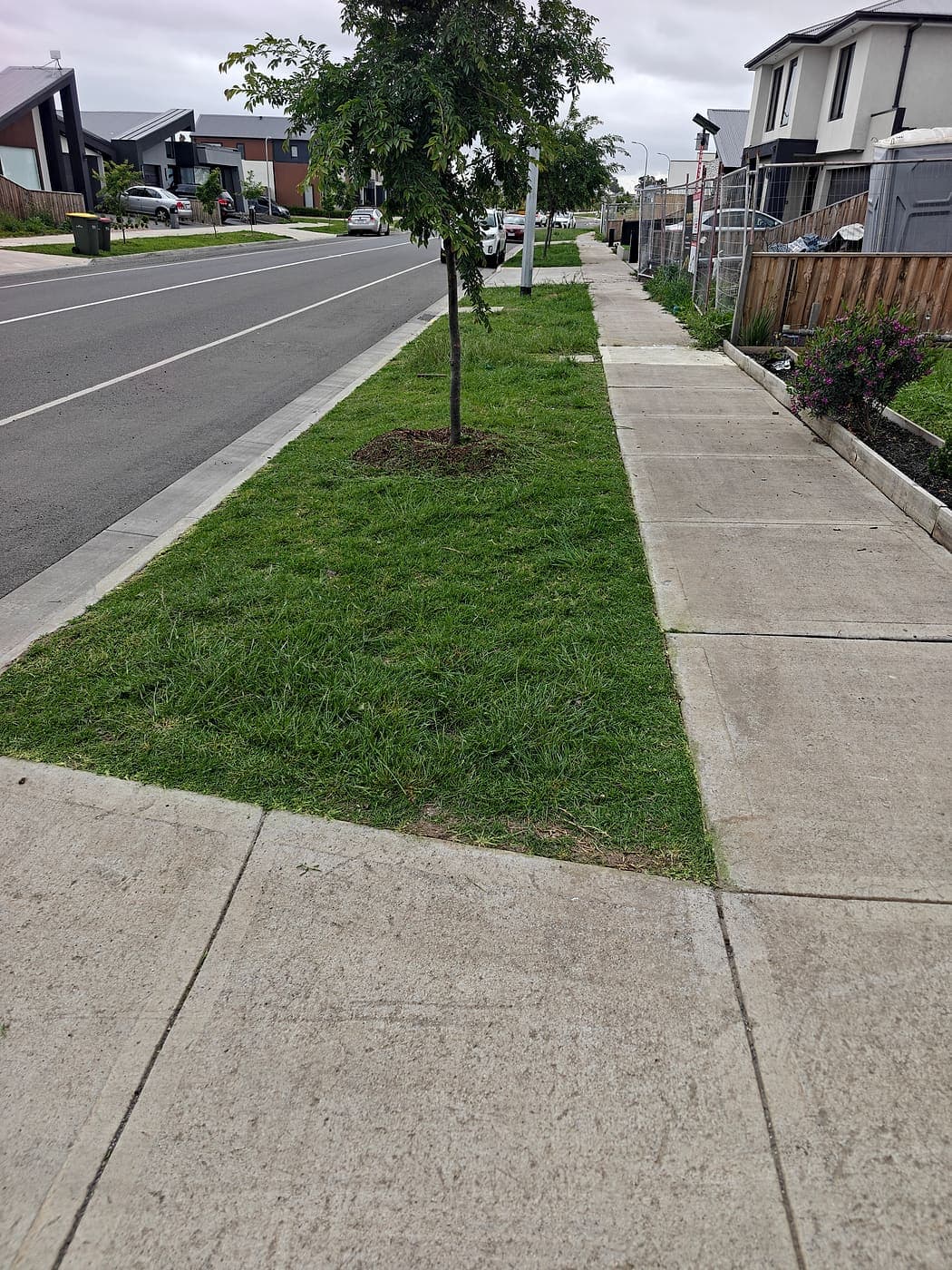
Along a nature strip, trim the grass back from the footpath and the kerb the same way. If the strip has a tree, trim around it with the line well clear of the bark: line trimmers strip bark easily and can ringbark young trees.
How do you stop kikuyu and couch creeping across the edge?
Keep a firm, deep edge and cut runners off every time you mow. Kikuyu and couch spread by runners above and below ground, so no edge holds them back on its own; it just makes them easier to see and cut.
- Check every visit. Pull or cut runners as soon as they cross into a bed. A runner left for a month roots in and is much harder to remove.
- Keep the drop open. Runners often stop at an open drop because they have nothing to root into. Mulch heaped up to lawn level gives them a bridge.
- Use deep edging. A fixed edging strip set at least 100 mm into the soil slows runners that travel just under the surface. Some still pass underneath or over the top.
- Pull, do not dig. Lift runners out of beds by hand where you can. Chopping them into pieces with a spade can leave sections that regrow.
If you are not sure whether you have kikuyu, couch or buffalo, our guide to identifying the grass in your lawn shows how to tell them apart. Buffalo creeps too, but its thick surface runners are far easier to see and cut.
Grass that keeps invading beds
If a bed beside a kikuyu lawn is constantly full of runners, the bed itself may be the problem. A narrow bed with thin mulch and plenty of light is ideal ground for kikuyu. A wider bed, denser planting and a deeper edging strip all help.
Some households decide the fight is not worth it and shrink the lawn instead. Our post on lawn alternatives using native grasses and groundcovers covers options that need no edging at all.
Is permanent lawn edging worth installing?
Often, yes. A fixed edge holds its line for years, cuts down weekly trimming, and slows runner grasses. The best choice depends on the shape of the edge, the soil and how the lawn is mown.
Side by side
Permanent lawn edging options
| Steel or aluminium strip | Treated timber | Brick or concrete mowing strip | |
|---|---|---|---|
| Suits curves | Yes, bends smoothly | Only gentle curves | Yes, in short sections |
| Holds back runners | Moderately, if set deep | Moderately | Well above ground, less below |
| Mowing | Mow over if set at lawn height | Mow over if level with lawn | Mower wheel runs on it, little trimming |
| Lifespan | Long | Shorter, timber breaks down in soil | Long |
| Look | Almost invisible | Rustic | Formal, defined border |
A mowing strip is a band of bricks, pavers or concrete set flush with the lawn along the bed. It does most of the trimmer's work, because the mower wheel runs on it and cuts right to the edge.
Line trimmers and powered edgers throw stones and grit at speed. Wear safety glasses, closed shoes and long trousers, keep children and pets well clear, and stop if anyone comes near. Before you dig a trench or drive edging pegs in, find where irrigation pipes, garden lighting cables and services run; Before You Dig Australia is the free service for underground assets. If you find old fibre cement sheet used as edging in an older garden, do not cut, break or dig it out: it may contain asbestos, so call a licensed asbestos removalist.
Noise hours for powered edging tools
In Victoria, the EPA lists "lawnmowers or other grass-cutting devices" and electrical gardening tools as residential noise that is restricted "weekdays before 7 am and after 8 pm" and on "weekends and public holidays before 9 am and after 8 pm". Hand shears and half-moon edgers are quiet, so they suit an early start.
What lawn edging mistakes should you avoid?
Most messy edges come from cutting without a line, cutting at an angle, or letting the trimmer dig in. Avoid these and the edge stays sharp all season.
- Cutting freehand. Without a string line or hose, straight edges wander and curves turn into wobbles.
- Cutting at an angle. A sloped cut lets grass lean straight over it. Keep the blade vertical.
- Re-cutting too often. Each re-cut takes a little more lawn. Once or twice a year is plenty; trim the rest of the time.
- Tilting the trimmer. This scalps a brown strip into the lawn.
- Mulch up to lawn level. It fills the drop and gives runners a bridge into the bed.
- Edging a shaded edge too hard. Thin grass in shade crumbles at the edge; fix the light first. Our guide to growing a lawn in shade explains how.
- Leaving clippings on paths. They stain pale concrete and wash into drains.
Mowing height matters too. Grass cut much shorter on the lawn than along the edge leaves a shaggy fringe. Our guide to mowing heights for each grass type shows the right range for your lawn.
Is it worth handing the edging over?
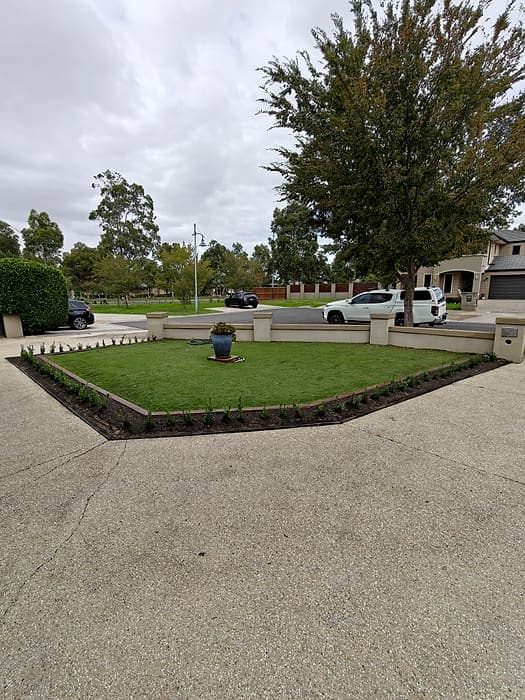
Sharp edges are one of the quickest ways to make a property look cared for, whether it is your own home or a house sitting empty between tenants or before a sale. Our post on keeping a vacant house looking cared for shows how much regular mowing and edging does from the street.
Edge trimming is part of every visit with our lawn mowing service, along with clipping removal and a cut height set to your grass. For the full seasonal picture, see our complete guide to lawn mowing in Melbourne and the other lawn care guides.
When you are ready, get a free quote.
Your Garden. Our Promise.
From our jobs
Frequently asked
What is the difference between edging and trimming a lawn?
Can I edge a lawn with an ordinary garden spade?
Why does my line trimmer leave a brown, scalped strip along the path?
How deep should metal lawn edging go into the ground?
Should the lawn edge be cut before or after mowing?
How do I keep a curved lawn edge smooth?
Is it worth edging the nature strip along the kerb and footpath?
Sources and further reading
- How to maintain lawn edges (Royal Horticultural Society)
- How to create a lawn edge (Royal Horticultural Society)
- Residential noise (EPA Victoria)
- Melbourne (Olympic Park) climate statistics (Bureau of Meteorology)
Caring for Melbourne gardens since 2019. Updated 18 November 2026.