


Real estate
Property managers: setting up garden care across a rental portfolio
By the Action Garden team · Updated · 13 min read
Checked against: Consumer Affairs Victoria, Rental Dispute Resolution Victoria, Water Victoria
TL;DR
- Audit the garden at every property once, so you know which ones have tall hedges, big trees, gutters under canopy or irrigation.
- Sort properties into a few service levels instead of managing each garden as a one-off.
- Consumer Affairs Victoria advises getting written authority from each rental provider to spend on their behalf, with set limits.
- Plan one portfolio calendar around Melbourne's seasons, with an autumn gutter round and a spring hedge round.
- Ask for photos after every visit and an invoice per property, so each owner sees only their own rental.
| Step | What you do | What it prevents |
|---|---|---|
| Audit | Record garden features and risks at each property | Surprises at inspections and vacates |
| Tier | Assign each property a service level | Every garden being handled as a one-off |
| Authorise | Written spending authority and limits from each owner | Delays waiting for approval |
| Schedule | One seasonal calendar, visits inside the entry rules | Missed gutter rounds and hedge trims |
| Report | Photos and a per-property invoice after every visit | Disputes with owners and renters |
How do you set up garden care across a rental portfolio?
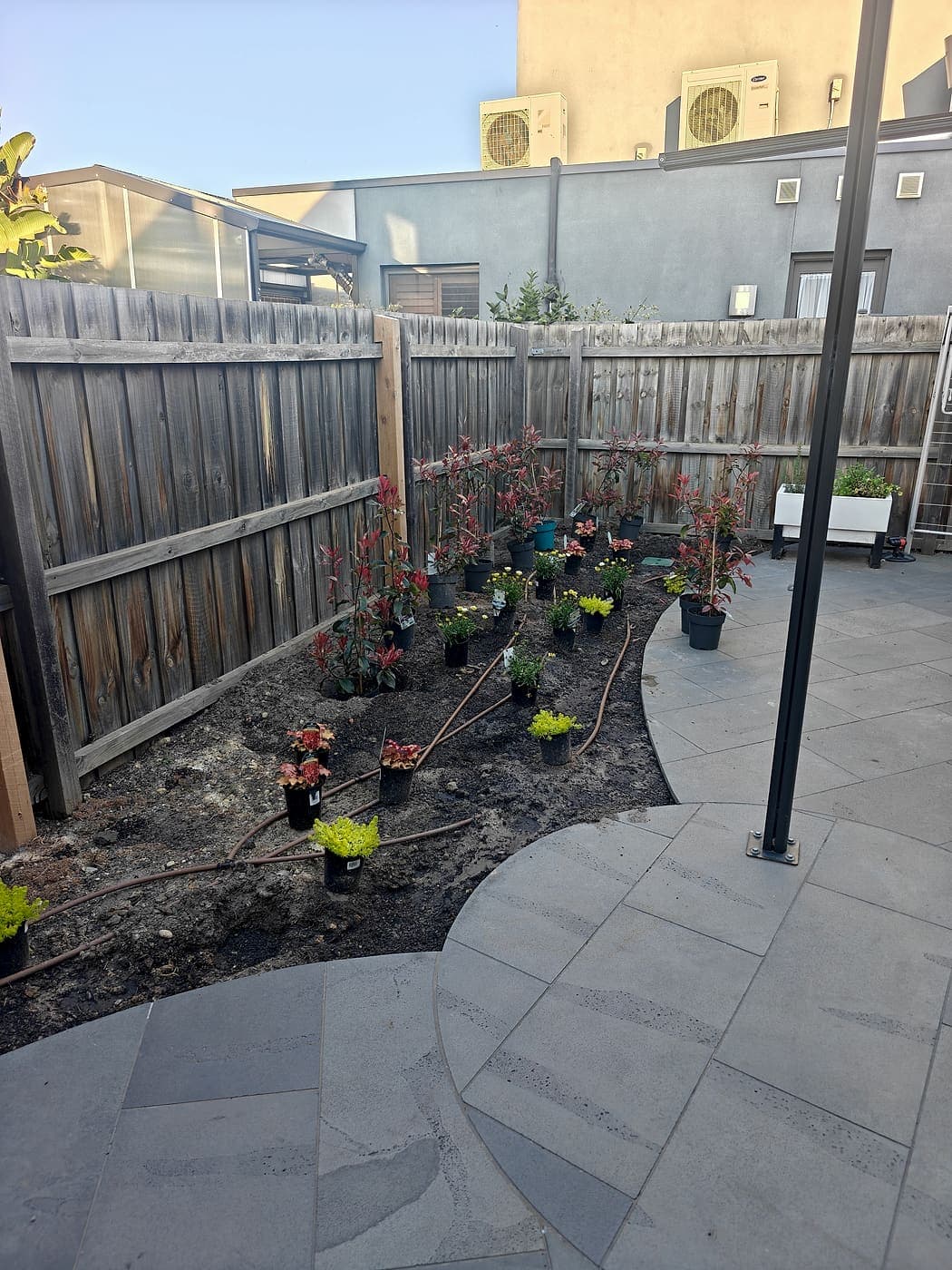
Treat it as one system, not dozens of separate gardens. Audit every property once, sort the gardens into a few service levels, get written spending authority from each owner, then run one seasonal calendar and one reporting format across the whole rent roll.
Most property managers inherit garden care property by property: a gutter clean booked after a leak, a hedge cut after a renter complains. That works for five rentals. Across fifty or more, it means the same problems arrive at the same time every autumn and spring, with no plan behind them.
The steps below follow the order that works in practice. They draw on Consumer Affairs Victoria (opens in a new tab) (CAV) guidance for property managers and on the CAV maintenance guideline that splits garden work between renters and rental providers.
A horizontal flow of five rounded steps joined by arrows: "Audit each garden", "Sort into service levels", "Written authority from each owner", "One seasonal calendar" and "Photos and invoice per property". A curved arrow loops from the last step back to the first, labelled "review each year and at every vacate".
What should a garden audit of the rent roll record?
It should record the features that create work and risk, not a description of the garden. One short visit or a walk-through at the next routine inspection is enough for each property.
| What to record | Why it matters |
|---|---|
| Lawn area and number of edges | Sets how long mowing takes and whether a renter can keep up |
| Hedges, with rough height and length | Anything above head height is a rental provider job |
| Trees within a few metres of the house | Branches over the roof and gutter leaf load are the rental provider's |
| Gutters under or near tree canopy | These may need more than one clean a year |
| Single or double storey | Height changes the access needed for gutters |
| Irrigation system and controller | Becomes the rental provider's to maintain if supplied |
| Gravel or paving without weed matting | RDRV says constant weeding there is unreasonable to expect of a renter |
| Access: side gates, pets, steps, slopes | Shapes every visit and every quote |
| Who does the lawn under the agreement | Decides whether the property needs regular visits or seasonal ones |
Photograph each item from a fixed spot and store the photos with the property file. The same angles can be reused at each routine inspection and at the vacate, so changes are easy to see.
A one-line code for each property
Some agencies give each property a short code made from the audit, such as "L2 H1 G-canopy I" for a large lawn, one tall hedge, gutters under canopy and irrigation. It is not a formal system, just a fast way to sort a spreadsheet of a rent roll into groups that need the same type of visit. Whatever method you use, the point is that a new property manager can see what each garden needs without visiting it first.
How do you sort properties into service levels?
Group them by who does the everyday work and how much rental provider work the garden creates. Three or four levels cover most rent rolls.
Side by side
Service levels across a rental portfolio
| Service level | Typical property | What the programme covers | Visits |
|---|---|---|---|
| Rental provider jobs only | Units, townhouses, small courtyards | Gutters, hedges out of reach, tree checks | Once or twice a year |
| Rental provider jobs plus seasonal | Houses with hedges or trees and a renter doing the lawn | The above, plus a spring and autumn garden check | Two to four a year |
| Full service | Large blocks, executive homes, gardens written into the agreement | Lawn, beds, hedges and all rental provider jobs | Weekly to monthly by season |
| Vacant or listing | Between tenancies, on the market | A reset tidy-up, then regular visits until leased or sold | As needed |
The CAV maintenance guideline gives the renter regular gardening, with weeding, pruning and lawn mowing as examples. It gives the rental provider major pruning, removing trees, shrubs and plants, clearing gutters, fences and water tanks. Every property sits in at least the first level, because those rental provider jobs exist whoever does the lawn.
What written authority do you need from each owner?
You need written authority to spend on the owner's behalf, with limits. CAV's best practice tips for property managers say to get written authority from the rental provider to spend money for urgent and non-urgent repairs, including the amounts they are willing to let you spend, and that the authority must comply with the Estate Agents Act 1980.
For garden care, it helps to write the recurring items into that authority as named jobs:
- A yearly gutter clean, with a second visit allowed for properties under canopy.
- Hedge trimming for hedges above head height, once or twice a year.
- A tree check, with any pruning or removal quoted to the owner before work starts.
- A vacate tidy-up between tenancies.
- Any regular service the rental agreement includes.
CAV also suggests agreeing a backup approval process for non-urgent repairs in case the owner cannot be reached for a long period, and keeping owners' contact details current so urgent approvals are quick. A garden programme fits neatly inside that process.
Non-urgent garden repairs and the 14-day rule
CAV's guidance for property managers says non-urgent repairs must be completed within 14 days of the renter notifying the rental provider, and that renters can apply to VCAT if they are not. A blocked gutter, a broken fence or a failed drain reported by a renter falls into this kind of request. Having the authority and the contractor already in place is what makes 14 days realistic in a busy autumn.
How do you schedule visits around renters and entry rules?
Schedule inside the entry rules and tell renters early. CAV lists 24 hours' written notice for entry to carry out repairs or other legal duties, and 7 days for a general inspection, which can happen only after the first 3 months of an agreement and at most once every 6 months.
Entry is allowed between 8am and 6pm on any day except a public holiday, unless the renter agrees otherwise, and every notice must be in writing with the reason for entry. Where a regular garden service is part of the rental agreement, agree the visit pattern at the start of the lease so the renter is not surprised.
A few habits make a portfolio run smoothly:
- Batch by area. Send the contractor the whole round at once, so visits can be planned suburb by suburb.
- Pair visits with inspections. A garden visit a few days before a routine inspection means the inspection photos show the property at its best.
- Pass on access notes. Pets, gate codes, lockboxes and the renter's preferred contact belong with every booking.
- Keep one channel. One email address or message thread per property keeps the record in one place.
Agencies call or email Action Garden with their properties. The team collects keys from the agency office and returns them after the visit, then sends photos and the invoice so it can be paid in the agency's next payment run.
What should a portfolio garden calendar look like?
It should follow Melbourne's growing year, so each round lands before the problem does. One calendar for the whole rent roll is easier to run than a reminder for each property.
| When | Portfolio round | Which service levels |
|---|---|---|
| March to May | Gutter round after leaf fall; prune branches over roofs; autumn hedge trim | All levels |
| June to August | Structural pruning of deciduous plants; check fences, edging and drainage after heavy rain | Seasonal and full service |
| September to November | Spring hedge trim; check irrigation; mulch thin beds; step up mowing on full service | Seasonal and full service |
| December to February | Heat checks on gardens with irrigation; clear dry debris near houses; pest checks | Full service, plus any property with irrigation |
Summer is when irrigated rentals fail. Under Victoria's permanent water saving rules (opens in a new tab), watering systems can only run between 6pm and 10am, and controllers are often reset or switched off by accident. Our guide to garden care before, during and after a heatwave covers what to check on the hottest weeks.
Spring and early summer also bring pest questions from renters. Our guide to common garden pests in Melbourne helps you tell a renter's problem from a rental provider's one, such as a hedge dying back from an infestation.
What should come back after every visit?
Photos, a short note of anything the owner needs to decide, and an invoice for that property only. That gives you something to forward to the owner and a dated record for the property file.
Action Garden quotes each property separately, photographs finished work, and can invoice property managers with the property address and photos attached. Invoices can go to the owner, the agency, or the agency on the owner's behalf.
Agencies with several properties can also pay through a single monthly statement.
Useful items for a visit note:
- Areas covered on this visit, matching the agreed scope.
- Anything outside the scope that was noticed, such as a leaning tree, a cracked downpipe or a fence board down.
- Any renter-side issue seen, written neutrally, so you can raise it at the next inspection.
- Before and after photos of the main areas, taken from consistent angles.
Gutters on two-storey homes, trees over roofs or near power lines, and hedges that need a platform are not jobs for a renter, a property manager on an inspection, or an owner on a weekend. If a tree is cracked, leaning or dropping large limbs, ask for an assessment before anyone works on it. Action Garden's own team does tree work, quoted to the owner after a site visit.
How do you handle vacates, listings and empty properties?
Use the gap between tenancies for the heavy work. With no renter in place, the garden can be reset, photographed for the new listing and the new condition report, and handed over in a known state.
A vacate tidy-up usually means mowing and edging, weeding beds and paths, trimming hedges, clearing gutters if they are due, and removing green waste. Action Garden's work for real estate and property managers includes fast turnaround tidy-ups for listings and vacates, with rubbish removal included where needed. Action Garden has a team of people, so several vacates in the same week are organised across the team.
If a property sits empty for weeks, a garden that grows out signals that nobody is looking after it. Our article on keeping a vacant house looking cared for covers what to keep up while a property is empty, and properties let as short-stay accommodation have their own rhythm, set out in keeping a short-stay rental garden guest-ready.
When a rental is sold to an owner-occupier, the new owner inherits whatever the programme left behind. Our article on the first month of garden jobs in a new home is a useful link to pass on at settlement.
What do property managers get wrong with portfolio gardens?
Most problems come from reacting instead of planning.
- No audit. Without one, nobody knows which properties have gutters under canopy until they overflow.
- One rhythm for every garden. A courtyard unit and an acre block do not need the same visits.
- Authority sought job by job. Each delay waiting for approval pushes the round back, and autumn does not wait.
- Lease and scope that disagree. If the agreement says the renter mows and the service also mows, someone is paying twice.
- Photos taken from random angles. Consistent angles make start, middle and end of lease easy to compare.
- Leaving vacates to the last day. A tidy-up booked after the new listing photos is a tidy-up nobody sees.
When is it worth handing the rent roll's gardens to one team?
It is worth it once garden requests take more of your week than the gardens themselves deserve. One team working from a portfolio calendar, with one quote and one invoice per property and photos after every visit, turns garden care from a stream of requests into a schedule.
Our gardening services cover regular maintenance, pruning, mulching and overgrown garden revivals, and our complete guide to garden maintenance in Melbourne sets out the seasonal work behind the calendar above. There is more for agents and owners in the real estate section of the blog, and answers on bookings, plans and invoices in our support centre.
When you are ready, send a list of addresses with the scope for each, and we will quote each property separately.
Your Garden. Our Promise.
From our jobs
Frequently asked
Should every rental in a portfolio be on the same visit frequency?
What spending authority should an owner give for garden work?
What if an owner cannot be reached to approve a gutter clean?
How do you stop the renter and the gardener both doing the lawn?
What garden details belong in a routine inspection report?
How early should the autumn gutter round be booked?
How do you explain a garden programme to a reluctant owner?
Sources and further reading
- Working with your clients: best practice tips for property managers (Consumer Affairs Victoria)
- Information for property managers, repairs and maintenance (Consumer Affairs Victoria)
- Rental providers' entry rights and responsibilities (Consumer Affairs Victoria)
- Guideline 1: Maintenance, Director's Guidelines under the Residential Tenancies Act 1997 (Consumer Affairs Victoria)
- Who maintains gutters, gardens and pools in a rental (Rental Dispute Resolution Victoria)
- Permanent water saving rules (Water Victoria)
Caring for Melbourne gardens since 2019. Updated 18 November 2026.