


Gardening
Native plants that thrive on clay in Melbourne's north
By the Action Garden team · Updated · 14 min read
Checked against: Merri-bek City Council, City of Whittlesea, Australian Plant Society Victoria, Australian Plant Society, Merri Creek Management Committee, Water Victoria
TL;DR
- Plants that grew naturally on the northern basalt plains are already built for heavy clay that is wet in winter and cracked in summer.
- Tussock grasses, mat-rushes, flax-lilies, saltbush and everlastings are the most reliable, followed by shrubs such as sweet bursaria, correa and bottlebrush.
- Most Western Australian natives, grevilleas, banksias and other proteas struggle on heavy clay unless the bed is raised well above the surrounding soil.
- Plant in autumn after the first heavy rain, dig the hole wide rather than deep, and soak new plants deeply about once a week while they settle.
- Buy local provenance tubestock where you can, and check your council's indigenous plant guide for the plant community your street sits in.
| Job | When | Notes |
|---|---|---|
| Planting | After the first heavy autumn rain | Whittlesea's indigenous garden guide names this the best time for dry or exposed sites; spring suits frost-prone spots |
| Watering new plants | A deep soak about once a week while establishing | More often in hot, dry spells; hand watering is allowed at any time under Victoria's water rules |
| Mulching | Before planting, topped up yearly | Coarse wood chip or aged green waste mulch, kept clear of stems |
| Pruning | Lightly, after flowering | Shrubs such as correa, parrot-pea and everlastings respond well |
| Feeding | Rarely | Local plants evolved on these soils; rich fertiliser does more harm than good |
Which native plants thrive on clay in Melbourne's north?
The natives that thrive on northern clay are, above all, the plants that grew there before the suburbs did. The basalt plains that run from the Plenty River westward carried grassland and grassy woodland, and those species are already adapted to soil that is waterlogged in winter and dry and cracked by late summer.
Merri-bek Council's indigenous gardening booklet makes the point directly: many local plants will flourish in the heavy clay of the northern suburbs, and soil treatment is usually unnecessary. Whittlesea's "Your indigenous garden" guide describes the Basalt Plains Grassland community as rich in grasses and wildflowers, with scattered trees on rocky rises and along creeks.
In practice, the most reliable groups on northern clay are:
- Tussock grasses: kangaroo grass, common tussock-grass and wallaby grasses.
- Strappy plants: spiny-headed mat-rush and the flax-lilies.
- Groundcovers: berry saltbush, kidney-weed and running postman.
- Wildflowers: common and clustered everlasting, bluebells and grass trigger-plant.
- Shrubs and small trees: sweet bursaria, grey parrot-pea, rock correa, lightwood and river bottlebrush.
The Australian Plant Society (opens in a new tab) adds a wider list of groups that grow better in heavier soil, including melaleucas, callistemons, lilly pillies, indigofera and some wattles. Our complete guide to garden maintenance in Melbourne shows where planting and bed care sit across the year.
Why is clay in the north so hard on some natives?
Northern clay is hard on natives that evolved in sand or gravel, because it holds water around their roots in winter and sets like brick in summer. Plants from sandy heathland or the west of the continent are built for the opposite conditions.
Australian Plant Society Victoria (opens in a new tab) describes heavy grey-brown volcanic soils west of Darebin Creek to the mouth of the Yarra, and notes that it is difficult to grow a wide variety of natives in them. East of Darebin Creek, the older sedimentary soils have broken down into light grey loams over clay, which drain a little better at the surface.
The same society notes that clay holds plenty of moisture and nutrients, but is hard to dig once it dries and cracks. That is the trade-off: a plant that tolerates both wet and dry extremes does very well, and one that needs sharp drainage rots in its first wet winter. Our explainer on Melbourne soils, from basalt clay to sand covers how to tell which clay you have.
A cross-section of a clay garden bed in winter. On the left, a narrow hole dug deep into grey clay fills with water like a bucket, and a small native sits with its roots in the pooled water, drawn in pale, drooping lines. On the right, a wide, shallow hole is dug only a little deeper than the pot, the plant sits slightly proud of the surface on a low mound, coarse mulch covers the bed, and arrows show rain running off and away from the root ball. A small label marks 25 cm for a raised bed where drainage is poor.
Which local natives make the best choices for clay gardens?
The best choices for a northern clay garden are long-lived local species that handle both wet and dry seasons. The profiles below draw on the City of Whittlesea (opens in a new tab)'s guide and the Merri Creek Management Committee (opens in a new tab)'s top ten plants for a local garden.
Plant profiles
Native plants for clay in Melbourne's north
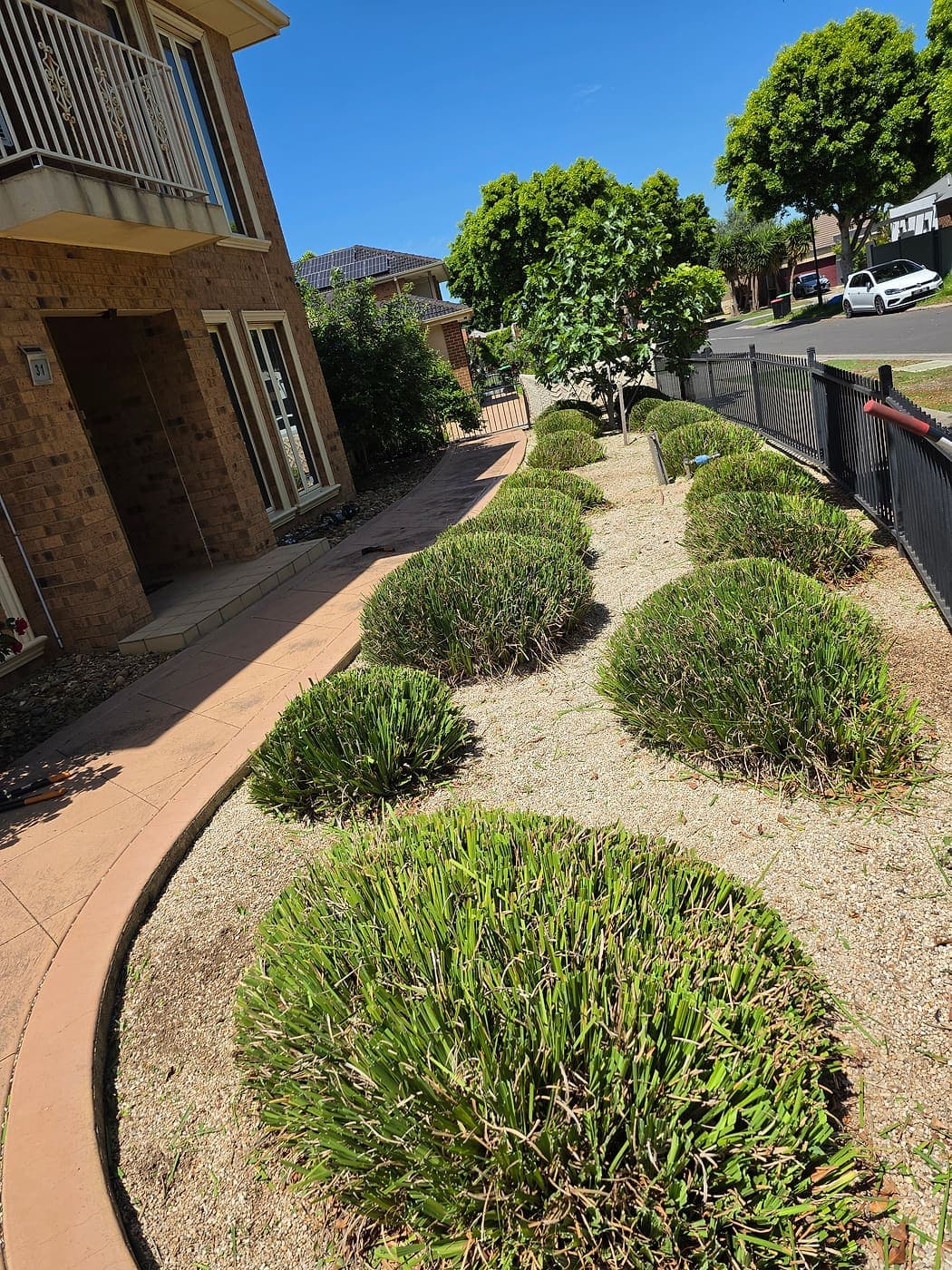
Kangaroo grass (Themeda triandra). A tussock about 40 cm tall and 80 cm wide with rust-coloured flower heads from December to March. The signature grass of the basalt plains. Prefers sun and is best mass planted, cut back or thinned every few years to keep it vigorous.
Common tussock-grass (Poa labillardierei). A soft blue-green tussock to about 70 cm, flowering October to February. Grows in most soils with reliable moisture, so it suits lower, wetter parts of a clay bed.
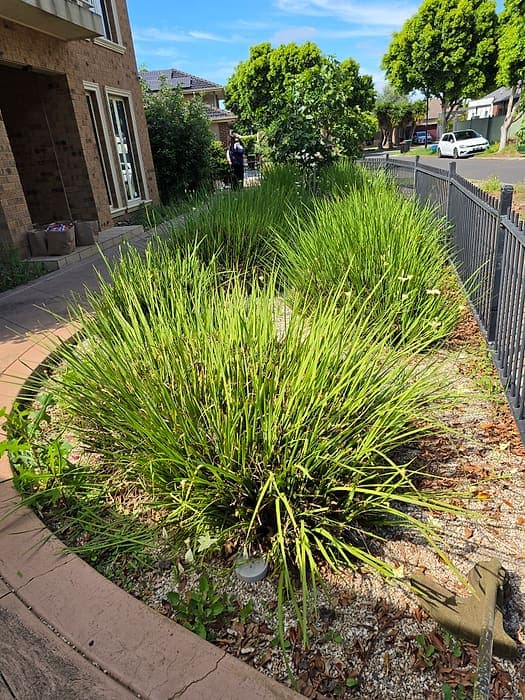
Spiny-headed mat-rush (Lomandra longifolia). A hardy, fast tussock to about a metre high and wide. Whittlesea's guide rates it for difficult spots such as embankments and rockeries, and it grows in most soil types in sun or part shade.
Black-anther flax-lily (Dianella admixta). A long-lived, spreading tussock with blue flowers from August to May, then purple berries. Easy to maintain and suited to sun or part shade.
Berry saltbush (Atriplex semibaccata). A low, spreading groundcover up to about 3 m wide with small red fruit in summer. Establishes well under trees and covers bare clay that would otherwise crack and weed up.
Common everlasting (Chrysocephalum apiculatum). A low grey groundcover with bright yellow button flowers, mainly September to December. Tolerates dry once established; trim to encourage new growth.
Clustered everlasting (Chrysocephalum semipapposum). Taller and spreading, with golden flowers from August to March. Responds well to a trim after flowering.
Sweet bursaria (Bursaria spinosa). A prickly large shrub or small tree with masses of cream flowers in summer. A favourite of butterflies and a refuge for small birds, and on both the Whittlesea and Merri Creek lists.
Rock correa (Correa glabra). A tough, dense shrub with green bell flowers in the cooler months. On the Merri Creek top ten and a good low screen on clay.
Lightwood (Acacia implexa). A graceful, long-lived wattle to about 6 m, with pale yellow flowers in spring. Thrives in dry, sunny spots with shallow soils.
River bottlebrush (Callistemon sieberi). A weeping shrub, often 3 m or more, with cream to pink flowers from November to May. Adaptable, and happiest in moist to wet ground, so it suits the low corner where water collects.
Most of these are sold as tubestock by indigenous nurseries. Buying plants grown from local seed, which nurseries call local provenance, gives the best match to your soil and climate.
How should you prepare a clay bed for natives?
For local natives, preparing a clay bed is mostly about weeds, drainage and mulch, not about changing the soil. Merri-bek's booklet notes that soil treatment is usually unnecessary for plants that evolved in this clay.
- Clear the weeds first. Whittlesea's guide advises controlling weeds before planting, to cut competition and make later maintenance easier. Perennial grasses such as couch and kikuyu are the hardest to remove once natives are in.
- Watch where water sits after rain. A spot that pools for a day after heavy rain needs wet-tolerant plants, a raised bed or drainage.
- Raise the bed for fussy plants. The Australian Plant Society suggests raising a bed at least 25 cm to help drainage on heavy clay, using good topsoil rather than lumps of subsoil.
- Mulch before planting. Whittlesea's guide suggests spreading good quality mulch before planting, and notes that green waste mulch should be well composted to kill weed seeds.
- Leave the clay intact below. Deep digging and rotary hoeing bring sticky subsoil up and create a smeared layer that water cannot pass.
Should you add gypsum to northern clay before planting natives?
Only if the clay disperses. Gypsum helps sodic clay, which clouds a glass of rainwater when a dry crumb is dropped in, by helping the fine particles clump together. Clay that sits intact in clear water will not respond much.
Where gypsum is used, apply it at the rate on the product label, and Australian Plant Society Victoria suggests ripping the soil so it penetrates. For most local natives, organic mulch on top does more over time, as worms and roots work it into the surface.
When and how should natives be planted on clay?
Plant natives on northern clay in autumn, after the first heavy rain has softened the ground. Whittlesea's guide names this the best time for dry or exposed sites, suggests spring for frost-prone spots, and advises against summer planting.
Autumn planting gives roots the whole wet season to spread before the first hot, dry spell. Clay that has cracked over summer is almost impossible to dig until it has had a good soaking, so wait for the rain rather than fighting it with a crowbar.
- Water the tubestock in its pot an hour before planting.
- Dig a hole wide rather than deep. The Australian Plant Society suggests only slightly deeper than the pot and at least twice as wide, so roots spread sideways into the clay.
- Remove the plant from its pot by tapping the rim. Whittlesea's guide notes that good quality tubestock does not need its roots teased out.
- Set the plant at the right level. On free-draining sites it can sit a little lower than the original soil, as Whittlesea suggests; on heavy, wet clay, keep the top of the root ball level with or slightly above the surface.
- Firm the soil back in, breaking up lumps, and water in well to settle it around the roots.
- Pull the mulch back to leave a small gap around each stem.
Planting into cracked summer clay
If you must plant in late spring or summer, soak the area slowly over a day or two first. Run a hand-held hose with a trigger nozzle, which Victoria's permanent water saving rules (opens in a new tab) allow at any time, or use a drip line between 6pm and 10am.
Expect to water every few days through the first summer. Late plantings on clay often survive the heat only to struggle when the cracks close and winter rain arrives, so pick the toughest species for any out-of-season planting.
How do you water natives on clay without drowning them?
Water new natives deeply but not often, and stop once they are established. Whittlesea's guide suggests a good deep soak about once a week while plants establish, particularly in dry periods.
Clay holds water for a long time, so the risk is overwatering more than underwatering. Push a finger or trowel into the soil beside the plant: if it is still damp a few centimetres down, wait another few days.
Under Victoria's permanent water saving rules, gardens can be watered with a hand-held hose, watering can or bucket at any time, while watering systems such as drip lines and sprinklers can only run between 6pm and 10am. Once local natives have been through one full summer, most need water only in long dry spells or heatwaves.
| Plant type | First summer | After establishment |
|---|---|---|
| Tussock grasses and mat-rushes | Weekly deep soak in dry spells | Rarely; only in long dry spells |
| Groundcovers and everlastings | Weekly, more in heat | Occasional deep soak in heatwaves |
| Shrubs such as bursaria and correa | Weekly deep soak | Monthly in long dry summers |
| Bottlebrush in a low, damp spot | Check before watering | Usually none |
The table is a starting point, not a rule. A shrub in the rain shadow of a fence or eaves needs more than one in the open, and the same plant on the higher part of a mounded bed dries faster than one at the bottom.
Which natives should you avoid or protect on clay?
Avoid or protect plants that need sharp drainage. The Australian Plant Society lists most Western Australian plants, banksias, grevilleas and most other proteas as poor choices for heavy clay, and some tea-trees and Banksia spinulosa as plants that may survive but grow slowly.
That does not mean a northern garden can never have a grevillea. It means planting it on a raised bed or mound, choosing hardy eastern species, and keeping it on the highest, driest part of the garden.
- Plants to avoid on flat, heavy clay: most Western Australian natives, kangaroo paws, many grevilleas and banksias, and heathland plants from sandy coastal areas.
- Plants to try only on a mound or raised bed: hardy eastern grevilleas, emu bushes and other dry-country shrubs.
- Plants that welcome the wet spots: river bottlebrush, common tussock-grass, spiny-headed mat-rush, and the sedges of a rain garden.
Our article on plants that cope with Melbourne summers covers the dry-country plants in more detail, and the ones that need drainage to survive a wet winter.
Why local provenance matters on basalt clay
Two plants of the same species can behave differently if one was grown from seed collected on the basalt plains and the other from a sandy coastal population. The local form has generations of adaptation to wet winters, cracking summers and the local frost.
Indigenous nurseries record where their seed comes from. Northern councils such as Whittlesea also group local plants into communities, so you can match plants to the community your street originally sat in.
How do you keep a clay native garden looking good?
A native garden on clay stays tidy with a few small jobs a season: weeding, a light trim after flowering, a mulch top-up and the occasional cut-back of tussock grasses. It needs far less feeding and watering than an exotic garden, but it is not no-maintenance.
- Weed little and often, especially in the first two years before groundcovers close over the soil. Couch, kikuyu and onion grass are the usual invaders on northern clay.
- Trim shrubs after flowering. Whittlesea's guide notes that correa, parrot-pea, everlastings and wattles respond well to pruning after they flower.
- Refresh tussock grasses. Kangaroo grass and tussock-grass build up dead thatch; cutting or thinning old clumps every few years keeps them green.
- Top up the mulch yearly, keeping it clear of stems and well below any weep holes on the house.
- Go easy on fertiliser. Local plants evolved on these soils, and rich, high-phosphorus feeds can harm some natives.
Our guide to caring for Australian native plants in Melbourne gardens goes deeper into pruning and feeding. If you only have a small paved space, the same principles apply on a smaller scale in our article on making a small courtyard garden easy to keep.
When is it worth getting help with a clay native garden?
It is worth handing over the heavy parts: clearing a weedy bed, building up raised areas, spreading mulch, and planting a large number of tubestock in the short autumn window. Clay is hard, physical work when it is either too dry or too wet to dig.
A one-day garden bed refresh is often the easiest way to turn a tired bed into one ready for natives. If you travel a lot, our guide to looking after the garden while you are away covers how to keep new plantings alive through their first summer.
Our gardening services cover weeding, soil preparation, planting and mulching, and we can supply plants and mulch or work with what you have bought. When you are ready, get a free quote and tell us a little about your soil. For more articles on beds, soil and plants, browse the gardening section of our blog.
Your Garden. Our Promise.
From our jobs
Frequently asked
Which native grasses grow well on heavy basalt clay in Melbourne's north?
Can grevilleas grow in the clay soils of Melbourne's northern suburbs?
Do native plants on clay need gypsum before planting?
Why do new native plants die over winter on northern clay?
Which natives cope with a low spot that stays wet in a clay garden?
Where can I buy local native plants suited to Melbourne's north?
How big should native tubestock be when planted into clay?
Sources and further reading
- Gardening with indigenous plants in Merri-bek (Merri-bek City Council)
- Your indigenous garden (City of Whittlesea)
- Soil types in Victoria (Australian Plant Society Victoria)
- Growing plants in clay soils (Australian Plant Society)
- Top ten plants for a local indigenous garden (Merri Creek Management Committee)
- Permanent water saving rules (Water Victoria)
Caring for Melbourne gardens since 2019. Updated 18 November 2026.