


Garden beds, soil and plants guide
Melbourne soils explained: clay, basalt and sand, and how to improve them
By the Action Garden team · Updated · 12 min read
Checked against: Agriculture Victoria, Corangamite soil health knowledge base, Sustainable Gardening Australia, Merri-bek City Council, Bureau of Meteorology
TL;DR
- The north and west mostly sit on basalt clays that shrink, swell and crack; the south-east and bayside mostly sit on sand.
- Organic matter is the fix for every Melbourne soil, worked into the top layer and topped with mulch each year.
- Gypsum helps only clay that disperses in water, so run a simple jar test before you buy it.
- Never dig, rotary hoe or walk on clay beds when they are wet and sticky; wait until they crumble.
- Sandy soil needs compost, deep watering and a check for water repellence before mulching.
| Soil | Where it is common | What helps most |
|---|---|---|
| Basalt clay (cracking clay) | North and west, on the basalt plains | Organic matter, gypsum only if it disperses, raised beds for plants that hate wet feet |
| Clay over sedimentary rock | Eastern and north-eastern suburbs | Compost each year, mulch, avoid digging when wet |
| Sand | South-east and bayside | Compost every year, deep watering, fix water repellence |
| Improved loam | Older, well-kept gardens everywhere | Keep adding organic matter and mulch so it stays that way |
What soil types does Melbourne have?
Melbourne has three broad garden soils: heavy clay over basalt in the north and west, clay over older sedimentary rock in the east, and sand in the south-east and along the bay. Within any suburb, decades of building, fill and gardening mean your own beds can differ from the street next door.
The split follows the rock underneath. The western and northern suburbs sit on the volcanic basalt plains, which weather into dark, heavy clays. The east sits on older siltstones and mudstones, which tend to give a thinner topsoil over a yellow, brown or grey clay subsoil, while the south-east and bayside sit on sand deposits.
| Area of Melbourne | Typical garden soil | How it behaves |
|---|---|---|
| North and west (basalt plains) | Dark grey, brown or black cracking clay, often with a sodic, alkaline subsoil | Wet and sticky in winter, cracks wide open in summer, slow to drain |
| East and north-east | Thin loam or clay loam over yellow or brown clay | Topsoil drains, then water sits on the clay below; hard setting if left bare |
| South-east and bayside | Grey or yellow sand | Drains fast, warms quickly, holds little water or nutrient, can turn water repellent |
| Hills and older gardens | Deeper, friable loams | The easiest soil, as long as organic matter keeps going in |
New estates are a special case. Topsoil is often stripped during construction and the house sits on compacted subsoil or imported fill, so a new build garden can behave worse than the natural soil of the area. Treat it as clay, test it, and build it up.
Why is the clay in the north and west so heavy?
Basalt weathers into very fine clay particles that pack tightly together, so water and air move through slowly. Agriculture Victoria (opens in a new tab) describes these cracking clays, called vertosols, as soils that shrink and swell as they dry and wet.
That shrink and swell cycle explains most of what gardeners notice. In winter the clay swells, closes its cracks and holds water around roots, which is when plants that need drainage rot. In a Melbourne summer it dries and shrinks, opening cracks wide enough to lose a trowel in and tearing fine roots.
Agriculture Victoria also notes that subsoils on the basalt plains are often sodic, and can be calcareous (containing lime) at depth. Sodic means the clay carries too much sodium compared with calcium. When it gets wet, the clay particles separate instead of holding together in crumbs.
Sodic soil: what it looks like in a garden
The Corangamite soil health guide lists the signs. Topsoil turns soupy when wet and sets hard with a surface crust when dry. Puddles stay milky after rain, and a dense layer below the surface can perch water so a bed stays waterlogged.
In a garden, that shows up as seedlings that struggle to break through a crust, water that sits on the surface for hours, and cloudy run-off onto paths. A planting hole dug into sodic clay can act like a pot without a drainage hole, filling with water every winter.
Sodic clay responds to gypsum and organic matter. Clay that is simply heavy, but not sodic, responds to organic matter and patience.
How can you tell which soil you have?
A few simple tests tell you more than any map. Our complete guide to garden maintenance in Melbourne includes a quick squeeze test for texture; the three tests below go further, showing how the soil drains and whether it will respond to gypsum.
The drainage test
- Dig a hole about 30 cm deep and 30 cm wide in the bed you want to plant.
- Fill it with water and let it drain completely. This wets the surrounding soil.
- Fill it again and time how long the water takes to drain away.
If the second fill has gone within a few hours, drainage is fine for most plants. If water is still sitting there the next day, you are on heavy clay or have a compacted layer below, and that bed needs raising or planting with species that cope with wet roots.
The dispersion (jar) test
- Collect a few pea-sized crumbs of dry soil from the surface and from about 20 cm down.
- Gently drop them into a clear glass of rainwater or distilled water. Do not stir.
- Leave the glass undisturbed and check it after a few hours and again the next day.
The Corangamite soil health guide puts it simply: "Cloudy or muddy water is an indication that the soil is dispersive and could respond to gypsum." If the crumbs sit there intact in clear water, the clay is not sodic, and gypsum will do little.
The pH test
A home pH kit gives a reading in minutes. Test both the surface and the subsoil, because on the basalt plains the subsoil can be far more alkaline than the topsoil. Most garden plants grow well in slightly acidic to neutral soil, while azaleas, camellias and blueberries want it more acidic.
Gypsum, lime, sulphur and soil wetters each fix one specific problem. Run the jar test and a pH test first, then buy only what the soil needs, and use it at the rate on the label.
How do you improve clay soil?
Add organic matter every year, keep it mulched, and only add gypsum if the clay disperses. Clay soil improves slowly, from the top down, as compost, roots and worms build a crumbly structure.
- Compost and well-rotted manure: spread a layer over the bed and fork it lightly into the top 10 to 15 cm. Sustainable Gardening Australia (opens in a new tab) recommends compost and mulch to improve heavy clay over time, as the material breaks down and opens up the soil.
- Mulch on top, all year: a coarse mulch stops the surface crusting, keeps the clay from drying and cracking, and feeds the soil as it breaks down. A coarse layer 50 to 75 mm deep, kept clear of stems, suits most beds.
- Gypsum, only where the jar test shows dispersion: Sustainable Gardening Australia describes gypsum as "used to break up the solid mass of clay into a more crumbly structure". The Corangamite guide notes that gypsum counters sodicity in the short run and works better alongside organic matter.
- Raised beds and mounds: for roses, vegetables, lavender and other plants that need drainage, build up rather than dig down. A mound 20 to 30 cm high keeps the root zone above the wettest clay.
- Plant choice: natives and other plants that cope with wet winters and dry summers save years of soil work. Our article on native plants that thrive on clay covers the options.
Agriculture Victoria advises that cracking clays should only be worked when they are drier than their plastic limit. In plain terms: if a handful of clay rolls into a sticky sausage, it is too wet to dig. Digging or walking on wet clay squeezes out the air and sets it like brick when it dries.
Why planting holes in clay can drown plants
Dig a deep hole in heavy clay and fill it with rich potting mix, and you can create a sump. Water drains out of the loose mix but cannot drain out of the clay walls, so the hole fills up every winter and the roots sit in water.
Better practice is to dig a hole about twice as wide as the root ball but no deeper, rough up the sides with a fork so roots can push out, and backfill mostly with the soil you removed, mixed with some compost. On sodic or very wet clay, plant on a low mound instead.
How do you improve sandy soil?
Sandy soil needs organic matter to hold water and nutrients, plus deep, less frequent watering. Sustainable Gardening Australia notes that on light sandy soil "the drainage is probably too good", and that compost reduces how quickly it loses moisture.
- Add compost every year. Sand burns through organic matter faster than clay, so a yearly layer of compost or manure, forked into the top layer, keeps it holding water.
- Check for water repellence. If water beads and runs off, or the soil is still dry a few centimetres down after watering, it has become water repellent. Fork in compost and use a soil wetter if needed, following the label.
- Mulch after watering. Mulch on sand slows drying, but only after the soil underneath is properly wet.
- Water deeply, less often. A long soak reaches deeper roots; light sprinkles wet only the surface of sand and evaporate.
- Feed little and often. Nutrients wash through sand quickly, so slow-release or organic fertilisers suit it better than one large dose.
The upside of sand is that it never gets sticky. You can work a sandy bed the day after rain, it warms early in spring, and plants that hate wet feet, such as many Mediterranean herbs, grow well in it.
When is the best time to work Melbourne soil?
Autumn and spring are the best times, when the soil is moist enough to dig but not wet and sticky. That matters most on clay, which is too hard to dig in a dry summer and too wet to work after a run of winter rain.
Melbourne mean rainfall by month
| Month | Mean rainfall (mm) |
|---|---|
| Jan | 53.3 |
| Feb | 26.3 |
| Mar | 36.4 |
| Apr | 63.0 |
| May | 46.5 |
| Jun | 42.1 |
| Jul | 41.0 |
| Aug | 47.0 |
| Sep | 41.0 |
| Oct | 68.0 |
| Nov | 64.4 |
| Dec | 50.2 |
Source: Bureau of Meteorology (opens in a new tab), climate statistics for Melbourne (Olympic Park), station 086338, 2013 to 2026.
The Bureau of Meteorology's figures for Melbourne (Olympic Park) show February as the driest month on average at 26.3 mm and October as the wettest at 68.0 mm. Rain falls on more days through winter, so clay rarely dries out between June and September even when monthly totals are modest. In practice that gives two windows for soil work on clay.
- Autumn (March to May): after the first good rains soften baked clay. Add compost and gypsum where needed, then plant so roots establish over winter.
- Spring (September to November): once beds are no longer sticky. Fork in compost before the main spring planting, then mulch to hold moisture going into summer.
- Summer: fine for sand, but clay is usually too hard. Water a clay bed deeply a day ahead if you must dig.
- Winter: keep off clay beds. Sandy beds can be worked any time they are not waterlogged.
If you are planning what goes in once the soil is ready, our guide to what to plant each season in Melbourne lines up with these windows.
What soil mistakes make Melbourne gardens worse?
Most soil problems come from working it at the wrong time or adding the wrong thing. These are the mistakes to avoid.
- Digging or rotary hoeing wet clay. It destroys the structure and sets into clods. Wait until it crumbles.
- Adding sand to clay. It takes huge volumes to change anything, and small amounts can make clay set harder.
- Spreading gypsum without a test. It only helps clay that disperses.
- Leaving soil bare. Bare clay crusts and cracks, and bare sand dries out and repels water. Keep it planted or mulched.
- Building soil or mulch up against the house. Keep beds below the slab edge and weep holes, so termite inspections can see the slab.
- Changing pH by guesswork. Lime on soil that is already alkaline, common in basalt subsoils, makes things worse.
- Compacting beds. Lay a plank or stepping stones to work from, rather than standing in the bed.
Weeds are often the first sign of soil trouble: some thrive in compacted, wet clay and others in dry, hungry sand. Our step-by-step guide on how to weed garden beds and keep them clear covers clearing a bed before you improve it.
Termites, slabs and raised soil levels
Raising beds is one of the best fixes for clay, but keep it away from the house. Soil, mulch or garden edging built up against a slab hides the slab edge and can bridge over a termite barrier.
Leave a clear gap between raised beds and the house, keep weep holes and vents clear, and check any termite management notes for your home before changing soil levels near the building.
How does soil type change everyday garden care?
Soil type sets how often you water, when you can weed and what you can plant. Getting those three right saves more work than any product.
| Job | On clay | On sand |
|---|---|---|
| Watering | Slowly and less often, so water soaks in rather than running off | Deeply, and more often in summer |
| Weeding | Easiest a day or two after rain, before the clay sets hard | Easy most of the year; roots pull out cleanly |
| Planting | Autumn or spring, on a mound if drainage is poor | Almost any time, with compost in the hole |
| Feeding | Less often; clay holds nutrients | Little and often; nutrients wash through |
| Mulching | Keeps clay from cracking in summer | Slows drying; check water gets through first |
Fruit trees are a good example. On heavy clay they need a raised planting position and good winter drainage, while on sand they need more water and feeding through summer. Our guide to pruning fruit trees in Melbourne covers the next step once they are established.
An overgrown bed is the other common starting point. If the soil is hidden under years of weeds and leaf litter, clear it first with our guide on how to rescue an overgrown garden, then test and improve the soil you uncover.
Is it worth getting help with your soil?
For a single bed, the tests and fixes above are well within reach. For a whole garden on heavy clay, or a new build on compacted fill, it can be worth handing over the heavy lifting of clearing, forking in compost and mulching.
Our gardening services include soil preparation and mulching as part of regular care or a one-off bed reset, and the other garden beds, soil and plants guides cover the jobs that follow. If you want beds ready for summer guests, see our notes on getting the garden ready for Christmas.
When you are ready, get a free quote.
Your Garden. Our Promise.
From our jobs
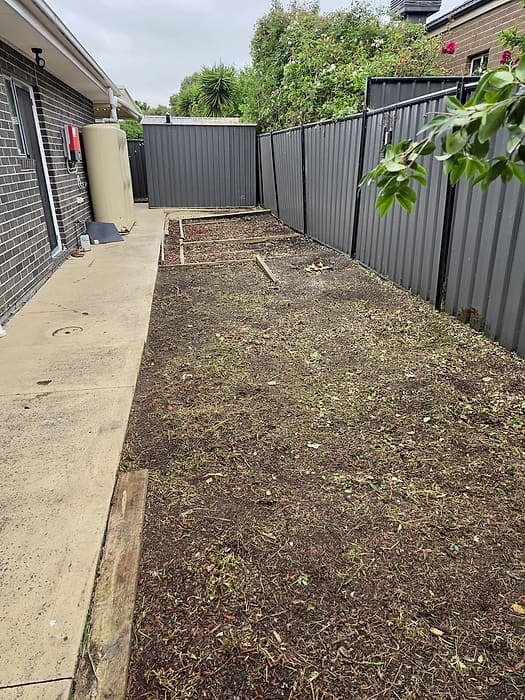
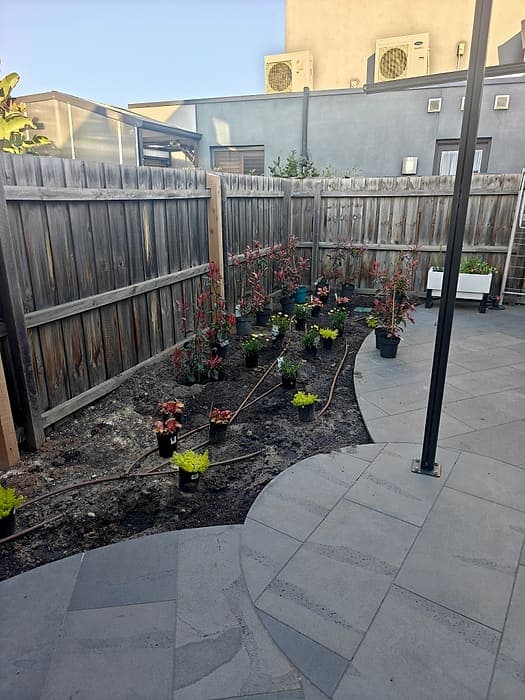
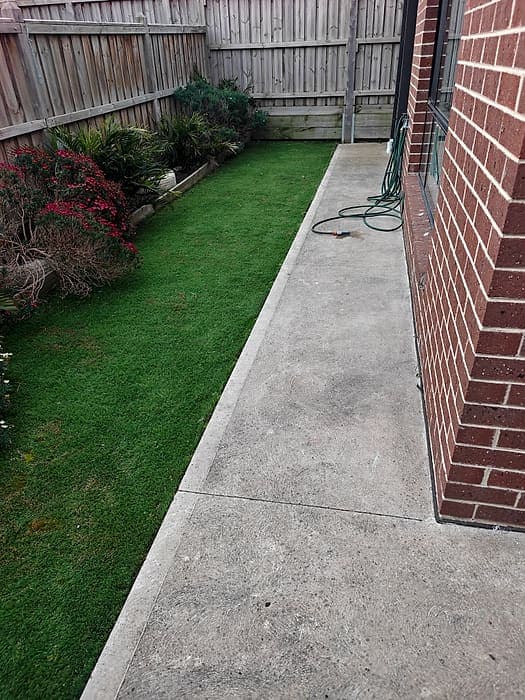
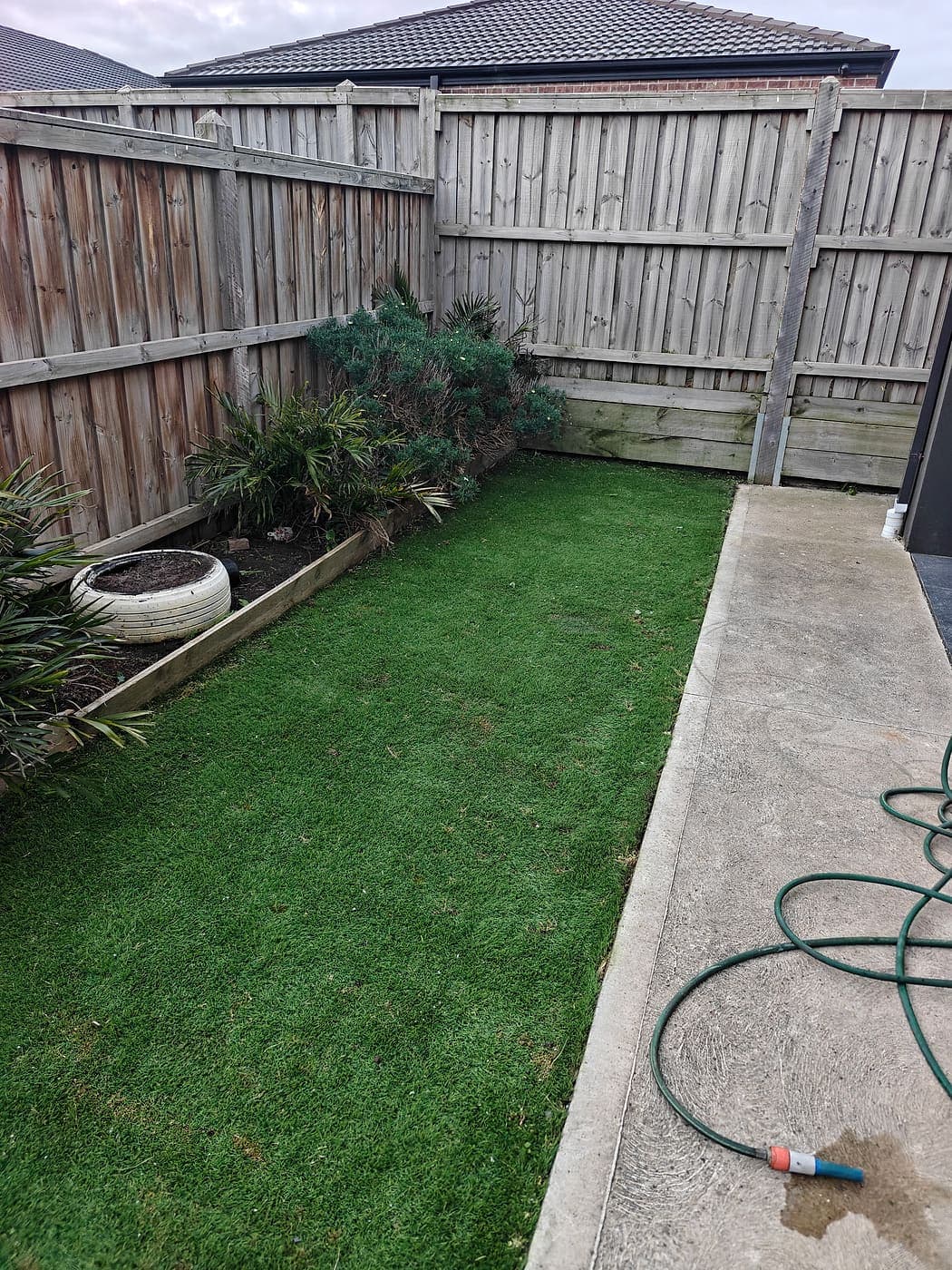
Frequently asked
Does gypsum work on every clay soil?
Should I add sand to heavy clay to improve drainage?
How long does it take to improve clay soil with compost?
What does a milky puddle after rain mean in my garden?
Is basalt clay soil fertile?
Should I buy bulk garden soil to raise beds on heavy clay?
How do I know if my soil is too acidic or alkaline?
Sources and further reading
- Victorian Resources Online, soils of Victoria (Agriculture Victoria)
- Sodic soils (Corangamite soil health knowledge base)
- Soil conditioners (Sustainable Gardening Australia)
- Gardening with indigenous plants in Merri-bek (Merri-bek City Council)
- Melbourne (Olympic Park) climate statistics (Bureau of Meteorology)
Caring for Melbourne gardens since 2019. Updated 18 November 2026.