


Lawn care
How lawn stripes are made, and whether they matter
By the Action Garden team · Updated · 13 min read
Checked against: National Association of Landscape Professionals, Sustainable Gardening Australia, Purdue University Turfgrass Science, WorkSafe Victoria
TL;DR
- Stripes come from grass bent in alternate directions; the light bounces off each band differently.
- You need something that bends the grass, such as a rear roller, a cylinder mower or a striping kit.
- Soft, fine grasses like fescue and ryegrass stripe easily; stiff kikuyu and buffalo show fainter bands.
- Change the mowing direction every couple of weeks so the grass does not lie flat and wheels do not rut the soil.
- Never drop the cut height to sharpen a stripe; longer grass bends further and stripes better anyway.
| Grass | How well it stripes | Notes |
|---|---|---|
| Tall fescue and ryegrass | Strong, easy stripes | Soft, upright leaves bend readily under a roller and hold the pattern for days. |
| Couch | Good when kept fine | Stripes well under a cylinder mower at a low, even height; fainter under a rotary. |
| Kikuyu | Moderate | Coarse leaves and runners resist bending; a roller helps, and the pattern fades sooner. |
| Soft-leaf buffalo | Faint | Broad, stiff leaves spring back; expect a subtle sheen rather than bold bands. |
| Zoysia | Moderate | Dense and wiry; stripes show best under a cylinder mower kept sharp. |
How are lawn stripes actually made?
Lawn stripes are made by bending the grass, not by cutting it differently. As the mower moves, a roller behind it pushes the leaves over in the direction of travel, and on the next pass the leaves are pushed the opposite way. The result is a series of bands that lean in alternating directions.
What you see is reflected light. The National Association of Landscape Professionals (opens in a new tab) explains it simply: blades bent away from you reflect more light and look lighter, while blades bent towards you look darker, and the position of the sun changes how strong the effect is. Every band is the same grass at the same height.
That is also why a stripe changes when you walk around it. Stand at the far end of the lawn and the light bands turn dark and the dark bands turn light, because you are now looking at the same leaves from the other side.
A side view of two neighbouring bands of grass with a viewer standing on the left. In the first band the blades lean away from the viewer, so the broad, shiny face of each leaf faces up and back towards the eye, and the band shows pale green. In the second band the blades lean towards the viewer, so the eye sees the tips and the shaded undersides, and the band shows dark green. A sun in the corner moves slowly across the scene, and the contrast between the bands grows and fades as the angle changes.
What equipment do you need to stripe a lawn?
You need something that bends the grass and holds it over. There are three common ways to do that, and each suits a different lawn.
- A rotary mower with a rear roller. Many mowers sold for home lawns have a full-width roller at the back instead of rear wheels. It presses the grass flat behind the cut and gives clear stripes on most lawns.
- A cylinder (reel) mower. These cut with a spinning reel against a fixed bottom blade, like scissors, and they have front and rear rollers. They give the sharpest stripes and the cleanest cut on fine, low lawns such as couch and some bowling-green style finishes.
- A striping kit. A weighted roller, brush or rubber flap that hangs behind a standard rotary deck. It adds stripes to a wheeled mower, though the effect is softer than a full roller.
A plain four-wheel rotary mower can leave a faint pattern on soft grass, mostly from the wheels and the airflow under the deck. It will not give the bold bands you see on sports grounds.
Why cylinder mowers stripe so well
A cylinder mower does two things at once that suit striping. The reel shears each leaf cleanly at a set height, so the top of the lawn is very even, and the heavy rear roller bends the freshly cut leaves over immediately.
They need a firm, level lawn and a low cut to work properly, which is why they are common on couch, zoysia and fine ornamental lawns and less common on long, soft kikuyu. They also need their reel and bottom blade kept sharp and set correctly: a blunt or badly adjusted reel chews the leaf instead of cutting it, and the stripe goes dull and grey. Our post on why sharp mower blades matter explains what a torn cut does to the grass.
Which Melbourne lawn grasses stripe best?
Soft, fine grasses stripe best, and stiff, coarse grasses stripe least. The landscape association notes that cool-season grasses bend more easily and stripe more readily, while warm-season grasses usually need a roller or striping kit to show a pattern.
In Melbourne that splits the common lawns roughly in two. Tall fescue and ryegrass, often grown in shadier and cooler gardens, take a stripe easily. Kikuyu, couch, buffalo and zoysia, the warm-season grasses that cover most sunny suburban lawns, need more pressure and lose the pattern sooner.
The key facts table on this page sets out what to expect from each. If you are not sure which grass you have, our guide to mowing heights by grass type shows the right cut for each one, which also decides how well it can stripe.
How do you mow a striped lawn, step by step?
You mow straight, overlapping passes in opposite directions, after framing the edges. The order below works for most rectangular Melbourne front and back lawns.
- Edge first. Trim the edges along paths, beds and the kerb so the stripes run into a clean frame. A ragged edge spoils a good stripe.
- Mow a header lap. Go once or twice around the whole perimeter. This gives you room to turn at each end without scuffing the stripes.
- Pick a straight line. Start along the longest straight edge, such as a driveway or path, and aim at a fixed point at the far end, not at the ground in front of the mower.
- Mow the first pass, then turn and come back. Overlap the previous pass by a few centimetres so no uncut grass sits between the bands.
- Turn on the header lap. Ease the mower around at each end so the wheels do not twist the grass or tear the turf.
- Finish with one more header lap. This tidies the turning marks at both ends.
Keep the speed steady. Rushing makes the mower bounce and the lines wander, and slowing down on each turn keeps the ends neat. If you want the edges themselves to look sharp, our guide on how to edge a lawn covers the tools and the line.
Can striping harm the lawn?
Striping itself is harmless, but how you do it can cause problems. The two risks are grass that starts to lie flat in one direction, and wheel ruts and compaction from mowing the same lines every week.
The landscape association's advice is to change the pattern about every two weeks so the grass does not lie flat in one direction, and to switch patterns to prevent tyre tracks and compacted strips. In practice, alternate between lengthways, crossways and diagonal stripes rather than repeating one direction all season.
The bigger risk is cutting too short to make the stripe pop. Sustainable Gardening Australia (opens in a new tab)'s advice is that in most instances a lawn should not be cut closer than 50 mm, because grass grows from the base and very short lawns use more water. The usual rule is to take no more than a third of the leaf in a single mow.
Grain: when grass learns to lie one way
Mow the same direction for months and many grasses start to grow leaning that way. This is called grain. It makes the lawn look patchy from some angles and causes the mower to cut unevenly, because the blade slides over leaves lying flat instead of lifting and cutting them.
The fix is simple: rotate the direction at each mow or every second mow. On a lawn that already has a strong grain, a couple of cross cuts at right angles, at the normal height, will lift the leaves and even out the surface again.
Do lawn stripes matter, or are they just for show?
Stripes are cosmetic, but they are a useful sign. A clean stripe only shows on a lawn with an even height, a sharp blade, a regular mowing interval and grass dense enough to bend as a mass. A lawn that is scalped, patchy or torn will not hold a good stripe, whatever roller you use.
They also help presentation where first impressions count. On a property being sold or leased, a body corporate frontage or a commercial entrance, a straight, even pattern makes the grass look cared for in photos and from the street. Stripes highlight problems too, so bare patches and weeds stand out more, not less.
What stripes do not do is make the grass healthier. The health of the lawn still comes down to the right height for the grass, deep and occasional watering, feeding at the right time of year and fixing compaction. Our complete guide to lawn mowing in Melbourne covers all of those in one place.
What patterns can you mow besides straight stripes?
Once straight stripes come easily, the same method makes several other patterns. Each is just a set of straight or curved passes laid down in a planned order.
| Pattern | How it is mown | Best for |
|---|---|---|
| Straight stripes | Parallel passes in alternating directions | Most front lawns, nature strips, rectangles |
| Chequerboard | Stripes in one direction, then a full second set at right angles | Larger, open lawns with a good flat surface |
| Diagonal | Stripes at about 45 degrees to the house or fence | Square lawns that look small with straight stripes |
| Diamond | Two sets of diagonal stripes crossing each other | Large, flat, low lawns of fine grass |
| Curved | Wide arcs following a curved bed edge | Lawns with sweeping garden beds |
Chequerboards and diamonds need two complete mows over the same ground, so they suit a firm, dry surface. On soft soil, the double pass is more likely to leave ruts than a pattern.
Stripes on a nature strip
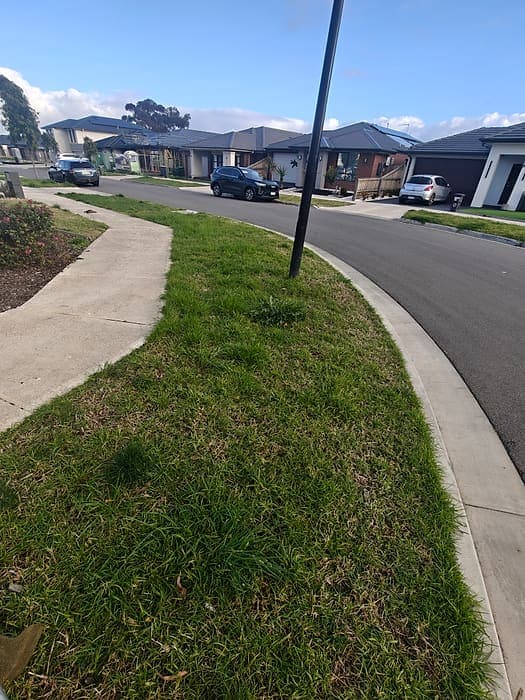
Nature strips are long, narrow and often slope towards the kerb, with street tree roots and service pits in the way. Stripes that run lengthways along the strip look neatest from the road and mean fewer turns near the kerb and traffic.
Turn on the strip side, away from the kerb, watch for pit lids and tree roots that can catch the blade, and blow clippings off the footpath and gutter afterwards. A crisp edge along the footpath does as much for the look of the strip as the stripe itself.
Why do some lawns never hold a stripe?
Most lawns that will not stripe have a problem underneath the pattern. The common causes are a blunt blade, grass cut too short, uneven ground, or a grass that simply does not bend much.
- Blunt blades. Purdue University's turf specialists note that dull blades rip the leaf and leave ragged tips that give the lawn a whitish cast from a distance, so the reflected light is patchy instead of a clean band.
- Too short. Short leaves have too little length to bend. The landscape association notes that taller grass is more flexible and holds a stripe better.
- Bumps and hollows. The roller rides over high spots and misses low ones, so the band breaks up. Top-dressing levels the surface over time.
- Thin cover. Patchy grass from compaction, shade, pests or wear has gaps that show through. Our post on the lawn problems seen most in Melbourne's northern suburbs covers several of those causes.
- Season. In winter, warm-season grasses go semi-dormant and sometimes yellow, which flattens the contrast. Our article on why lawns go yellow in a Melbourne winter explains when that is normal.
Steep banks, retaining-wall edges and large sloping blocks are where mowing injuries happen. WorkSafe Victoria (opens in a new tab) warns that ride-on mowers have a high risk of rollover on steep slopes and uneven ground such as embankments. If a slope feels unsafe to walk across with a mower, or you need a ride-on to manage it, have it mown by people with the right gear and experience.
The same applies to big open areas. A large, rough block that has grown out is a slashing and clean-up job first, not a striping job: our guide to vacant block maintenance explains how those sites are brought back under control.
When is it worth handing the stripes over?
If you like a striped lawn but not the weekly routine behind it, a regular mowing visit keeps the height, the interval and the edges consistent, which is what a stripe really needs. Our lawn mowing service covers weekly, fortnightly and one-off visits, with the cut height set to your grass and a full tidy-up each time.
You will find more articles in the lawn care section of the blog. When you are ready, you can get a free quote.
Your Garden. Our Promise.
From our jobs
Frequently asked
Do lawn stripes mean the grass has been cut at two different heights?
Can a normal rotary mower without a roller make stripes?
How long do lawn stripes last after mowing?
Why do my lawn stripes look different from the street and from the house?
Is it worth striping a lawn before selling or leasing a property?
Can stripes be mown into a lawn in winter?
Sources and further reading
- Technically speaking: the art of mowing patterns (National Association of Landscape Professionals)
- Can't see the trees for the lawns (Sustainable Gardening Australia)
- Sharpen mower blades (Purdue University Turfgrass Science)
- Preventing ride-on lawn mower rollover (WorkSafe Victoria)
Caring for Melbourne gardens since 2019. Updated 18 November 2026.