


Sustainable gardening
Hedges that shelter small birds
By the Action Garden team · Updated · 13 min read
Checked against: BirdLife Australia, Birds in Backyards, City of Yarra, Victorian Government
TL;DR
- The 1 to 3 metre shrub layer is the layer most often missing from urban green spaces, and it is the one small birds depend on for cover and nesting.
- Birds in Backyards surveys found superb fairy-wrens were less likely at sites with under 25 percent shrub cover, and less likely where noisy miners were present.
- The best bird hedge is dense to the ground, twiggy or prickly inside, and mixes several local native shrubs rather than one clipped species.
- Formal clipped hedges still give cover if the base is kept full; a hedge bare at the bottom gives small birds little.
- Trim lightly and in stages, check for active nests and possum dreys first, and avoid environmental weeds such as privet and cotoneaster.
| Hedge feature | What small birds get | How to keep it |
|---|---|---|
| Dense to the ground | Cover from cats and larger birds when feeding low | Keep a wider base than top so light reaches the bottom |
| Prickly or twiggy interior | Safe nest sites that predators cannot reach | Trim the outside only; leave the inner branches |
| Height of 1 to 3 metres | The shrub layer small birds use most | Hold it at a height you can trim from the ground |
| Several species mixed | Insects, nectar and seed through the year | Trim each species after it flowers |
| Connected to other planting | A safe route between gardens for territorial birds | Link the hedge to beds, trees and neighbouring shrubs |
Why do small birds need hedges and dense shrubs?
Small birds need dense shrubs because they feed, rest and nest close to cover, where cats, currawongs, ravens and noisy miners cannot easily reach them. A hedge is often the only continuous band of shrubs in a suburban garden, so its shape and planting decide whether small birds can live there.
BirdLife Australia (opens in a new tab) calls the 1 to 3 metre shrub layer the most commonly missing layer in urban green spaces. It reports a 2025 study that found bird diversity in urban parks rose strongly with vegetation complexity, with no significant link to tree cover or water cover. Pardalotes, silvereyes, scrubwrens, fairy-wrens, the eastern spinebill and some honeyeaters are among the birds affected when that layer is lost.
Many Melbourne gardens have exactly that gap: lawn on the ground, a few trees above, and nothing in between except a fence. A hedge or shrub border is the simplest way to put the middle layer back.
What makes a hedge good for small birds?
A good bird hedge is dense from the ground up, twiggy or prickly inside, between about 1 and 3 metres tall, and planted with more than one species. It also connects to other shrubs, so birds can move without crossing open ground.
Birds in Backyards (opens in a new tab) surveys found that superb fairy-wrens were less likely to be found at sites with little or no small plants and with under 25 percent shrub cover. They were also less likely where noisy miners were present, and where water was never or rarely provided. Tree cover was not a major factor for fairy-wrens, which stay low and close to shrubs.
Noisy miners matter because they are an aggressive native honeyeater that chases small birds out of open gardens. They favour open spaces with little understorey. Dense, layered shrubs make a garden harder for them to dominate and easier for small birds to use.
A side view of a hedge about 2 metres tall and over a metre deep. The outline is wider at the base than the top, so sunlight reaches the lower branches and the hedge stays leafy to the ground. Inside, a tangle of twiggy and prickly branches holds a small cup nest at about chest height. In front, low groundcovers and leaf litter give foraging space, and a shallow bird bath sits a few metres away, close enough for birds to dash back into cover. A cat at the edge of the drawing cannot reach through the prickly outer layer.
Why a prickly hedge is worth the scratches
Spiny and sharply twiggy shrubs are among the safest nesting sites in a suburban garden, because cats and larger birds cannot push into them. Birds in Backyards notes that small nectar feeders such as eastern spinebills and New Holland honeyeaters generally nest in dense shrubs, and that wattles and tea-trees are useful for insect eaters such as fairy-wrens and pardalotes. Put the prickliest plants where nobody walks past every day, along the back fence or behind a softer front row, and use gloves and long sleeves when trimming.
Which plants make the best hedges for small birds in Melbourne?
The best choices are local native shrubs that grow dense, take light trimming, and have small flowers or prickly foliage. Mixing three or four species gives insects, nectar and seed across the year, and if one plant fails, the hedge does not open up.
Plant profiles
Shrubs for a bird-friendly hedge in Melbourne
Prickly tea-tree (Leptospermum continentale). Local native with small, sharp leaves and white flowers in late spring. Dense and twiggy; takes trimming. A good core plant for small birds.
Sweet bursaria (Bursaria spinosa). Local native with spiny branches and masses of small cream flowers in summer that bring insects. Grows into a dense shrub or small tree.
Hedge wattle (Acacia paradoxa). Local native with sharp spines and bright yellow spring flowers. Very dense and protective. Plant away from paths.
Prickly Moses (Acacia verticillata). Local native wattle with needle-like leaves and soft yellow flowers. Thick, prickly cover for small birds. Prefers moist sites and some shade.
Correas (Correa alba, Correa reflexa and others). Native shrubs with small bell flowers through autumn and winter that feed small honeyeaters such as spinebills. Dense and easy to clip.
Coast rosemary (Westringia fruticosa). Native to the New South Wales coast, tough and dense, and clips into a neat informal hedge. Small flowers and good cover; useful where a tidier look is needed.
Kunzea and other tea-trees. Dense native shrubs with small flowers that attract insects. Check which species is local to your area.
Silver banksia (Banksia marginata). Local native that can be kept as a large shrub. Nectar for honeyeaters; plant at the end of a hedge line rather than through it.
Local nurseries and council indigenous nurseries can tell you which of these grew naturally in your area. Heavy basalt clay in the north and west and sandy soils in the south-east suit different species; plant to your soil, not to a catalogue.
Which hedge plants should you avoid?
Avoid hedge plants that are environmental weeds in Victoria, even if birds use them. Birds eat the berries and spread the seed into parks, creeks and bushland, where the plants smother native shrubs.
- Privet (Ligustrum species). Dense, clips well and is common in old Melbourne hedges, but large-leaf privet's black berries are spread by birds.
- Cotoneaster. Red berries that birds spread into bushland; several species are environmental weeds.
- Sweet pittosporum (Pittosporum undulatum). Native to eastern Victoria and New South Wales, but a serious weed around Melbourne, spread by birds eating its berries.
- Boxthorn. Very prickly and once planted as a hedge, but a declared noxious weed in Victoria.
If an existing hedge is one of these, there is no need to rip it out at once. Removing it in sections and replanting with natives as you go keeps cover in the garden while the new plants grow.
Replacing a weedy hedge without losing all the cover
Take out one section at a time, starting where birds use it least, and plant the replacement natives in that gap straight away. Cut fruiting branches off the remaining weedy plants before the berries ripen, so birds do not spread the seed while the change happens. Over two or three years the old hedge is gone and the new one has filled in, with birds never left without cover. Dispose of the weedy cuttings in green waste, not over the back fence.
Can a formal clipped hedge still shelter birds?
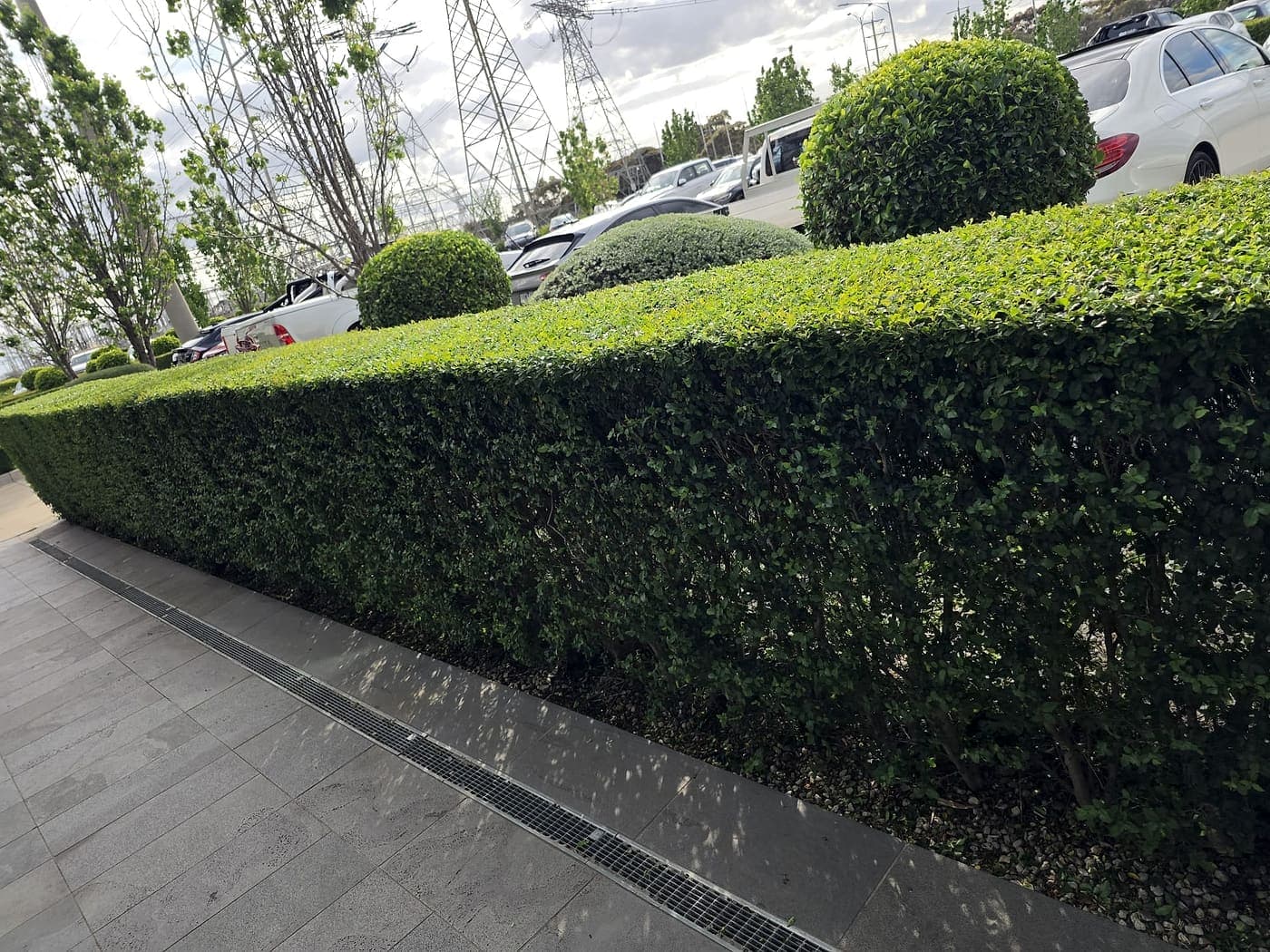
Yes, if it is dense all the way to the ground and wide enough to have a sheltered interior. A tightly clipped hedge gives good cover, though very little food, because frequent clipping removes most of the flowers.
The most important thing is the shape. A hedge clipped narrower at the top than at the base lets light reach the lower branches, which keeps them leafy. A hedge that is wider at the top shades its own base until the bottom goes bare, and a bare base gives small birds nothing. Our guide on how to shape a formal hedge with a wider base explains the taper.
To make a formal hedge better for birds, plant a band of small native shrubs and groundcovers in front of it or at the ends. The formal line stays neat, and the hedge gains a layer of flowers, insects and low cover.
How should a bird hedge be trimmed?
Trim little and often from the outside, never cut every side hard at once, and leave the inner branches alone. The aim is to keep the hedge dense while making sure birds always have cover somewhere in the garden.
- Check first. Look and listen for active nests before trimming, especially in spring and early summer, and check dense growth for ringtail possum dreys, as the City of Yarra (opens in a new tab) advises before heavy pruning.
- Trim natives after they flower. Cutting correas or tea-trees just before flowering removes the flowers that bring insects and nectar.
- Use hand shears or secateurs on informal hedges. They allow a lighter, more natural cut than a powered trimmer.
- Keep the taper. Make the base slightly wider than the top on every trim.
- Cut hard in stages. If a hedge is overgrown, reduce one side or one section a year, so cover is never removed all at once.
- Leave the clippings out of the hedge. Clear them from the top and base so they do not smother lower growth.
If a hedge has grown far too big, our guide to rejuvenating an overgrown hedge sets out how to bring it back in stages. The complete guide to hedge trimming in Melbourne covers timing for common species.
Get help for hedges taller than you can reach from the ground, for long boundary hedges that need a platform or long-reach trimmer, and for spiny species that are hard to handle safely. Do not work from a ladder on soft or sloping ground beside a hedge. If you find an active nest of a native bird and the hedge must be cut for safety, contact the Victorian wildlife regulator for advice first.
What else helps small birds use the hedge?
Water, safe ground and a connection to other planting all help. A hedge works best as part of a layered garden, not on its own.
- A shallow bird bath close to the hedge, low and near cover. Birds in Backyards found fairy-wrens were less likely where water was never or rarely provided.
- Leaf litter and groundcovers at the base, where insect eaters feed.
- No insecticide on the hedge. Small birds feed on the insects it hosts.
- Cats kept inside or contained, especially at dawn and dusk.
- Links to neighbours. Fairy-wrens are territorial and need a tight web of shrubs across gardens; a hedge that joins a neighbour's shrubs or a park is worth more than an isolated one.
Our article on gardens for birds and bees covers the full habitat garden, from groundcovers to trees.
How do you plant and water a new bird hedge?
Plant in autumn, into well prepared soil, closer together than a single specimen would need, then mulch and water deeply through the first summer. Close spacing helps the hedge knit together into one dense band.
On heavy clay, loosen a wide strip rather than digging individual holes, so roots can spread sideways. If water lies in the strip for days after rain, choose species that cope with wet feet, or plant on a low mound; our article on soggy backyards and rain gardens on clay explains how to test drainage first.
Native shrubs need regular deep watering in their first summer and much less once established. A drip line under the mulch is efficient, but under Victoria's permanent water saving rules, watering systems may only run between 6pm and 10am; hand watering with a trigger nozzle can be done at any time. Our article on a water-wise garden in Melbourne has more on getting new plants through summer.
When is it worth getting help with a bird-friendly hedge?
Help is worth it when a hedge needs a careful staged cut, when a weedy hedge is being replaced section by section, or when a long hedge simply needs regular trimming that keeps its shape and base.
Action Garden's hedge trimming and pruning service covers precise trimming, selective pruning and formal or natural shaping on a seasonal schedule, with a full clean-up afterwards. If you want the hedge kept bird-friendly, say so when you ask for a quote, and trimming times and a lighter, staged approach can be noted in the job plan. For more on lower-impact care, read our article on lower-impact garden maintenance or browse the sustainable gardening articles.
Your Garden. Our Promise.
From our jobs
Frequently asked
Which native hedge plants have prickly foliage that protects small birds?
Do fairy-wrens use hedges in suburban Melbourne gardens?
Is a clipped box or photinia hedge any good for birds?
How wide should a bird-friendly hedge be?
Will a bird-friendly hedge bring more noisy miners into the garden?
How should a bird hedge be trimmed so it keeps its cover?
Are native birds' nests in a hedge protected in Victoria?
Sources and further reading
- The missing shrub layer that's costing our woodland birds (BirdLife Australia)
- Birdata species in focus: superb fairy-wrens (Birds in Backyards)
- Know what different birds need (Birds in Backyards)
- Living with wildlife (City of Yarra)
- Regulating the protection of wildlife (Victorian Government)
Caring for Melbourne gardens since 2019. Updated 18 November 2026.