


Hedges and pruning guide
How to bring back an overgrown hedge with rejuvenation pruning
By the Action Garden team · Updated · 12 min read
Checked against: Royal Horticultural Society, Australian Plants Society Victoria, Bureau of Meteorology, Water Victoria, Dispute Settlement Centre of Victoria, vic.gov.au, WorkSafe Victoria
TL;DR
- Check the species first; most broadleaf hedges reshoot from old wood, but most conifers and some natives do not.
- Stage the work over two or three seasons, one side then the other, then the top, so the hedge always keeps some leaves.
- Start evergreen hedges in mid to late spring in Melbourne, when they are growing strongly and frost has passed.
- Water deeply, mulch and feed lightly after each stage, and expect the cut face to look bare for several months.
- Thick trunks, power lines, tall hedges and boundary hedges are where a staged renovation needs professional help.
| When | Stage | Notes |
|---|---|---|
| Year 1, mid to late spring | Cut one side back hard; trim the other side normally | Leave the height alone |
| Year 1, late summer | Light tidy of the regrowth on the cut side | Tip the new shoots so they branch |
| Year 2, mid to late spring | Cut the other side back hard | Only if the first side has regrown well |
| Year 3, mid to late spring | Lower the top below the target height | Then trim to shape from the regrowth |
What is rejuvenation pruning, and when does a hedge need it?
Rejuvenation pruning is a deliberate hard cut, back into old wood, that forces an overgrown hedge to grow a new, dense face closer to its main stems. A hedge needs it when ordinary trimming can no longer bring it back to size, or when it has gone bare and woody inside with all its leaves on the outer shell.
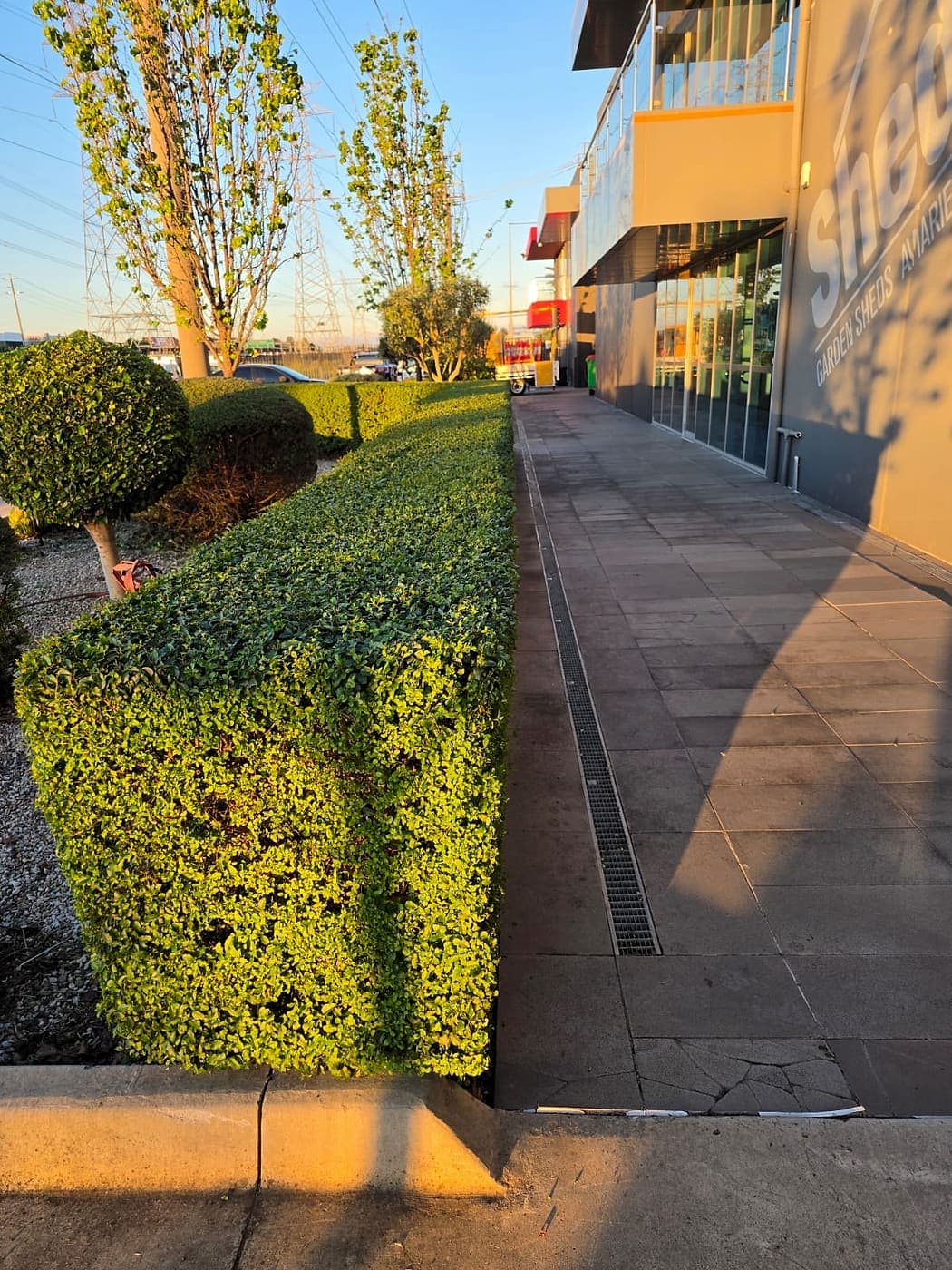
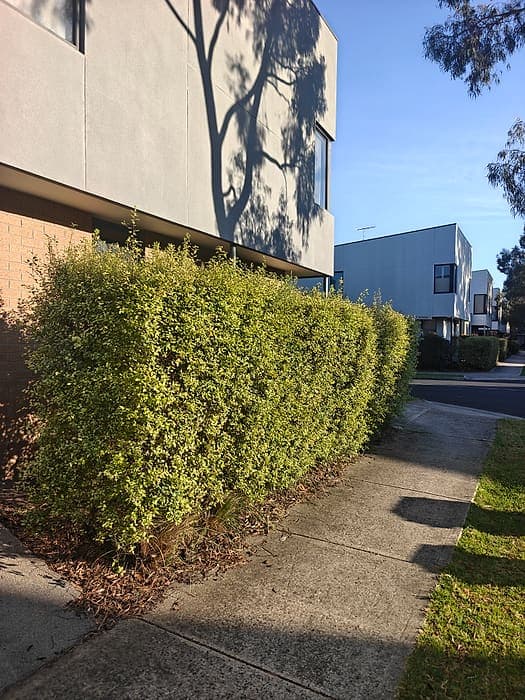
The usual signs are a hedge that has crept a metre or more over a path or lawn, one that is now well above the height you want, or one with a thin green skin over a hollow, twiggy core. Regular trimming that always cuts back to last time's leaves causes all three over the years.
Rejuvenation is different from shaping. It is about getting the hedge back, and the neat profile is built on the regrowth afterwards. For timing and technique for ordinary trims, see our complete guide to hedge trimming in Melbourne.
Will your hedge grow back from a hard cut?
Most broadleaf hedges grow back well: lilly pilly, photinia, viburnum, pittosporum, box, privet and camellia all reshoot from old wood. Most conifers do not. The Royal Horticultural Society (opens in a new tab) notes that most conifers apart from yew "do not respond well to renovation", which covers Leighton green and other cypresses common in Melbourne.
Side by side
How common Melbourne hedges respond to a hard cut
| Hedge | Reshoots from old wood? | Approach |
|---|---|---|
| Lilly pilly, Acmena and Syzygium | Yes, readily | Full staged renovation |
| Photinia | Yes | Full staged renovation; good airflow afterwards |
| Sweet viburnum, Viburnum tinus | Yes | Full staged renovation |
| Box (Buxus) | Yes, slowly | Staged, with patience; keep it watered |
| Pittosporum | Usually | Staged, test one section first |
| Murraya | Usually | Spring only, in a warm spot |
| Westringia, correa | Variable | Light reductions; test first |
| Leighton green and other cypresses | No | Only trim green growth, or replace |
| Banksias, leptospermums, melaleucas | Often not | Follow native pruning advice; test first |
The Australian Plants Society Victoria (opens in a new tab) warns that hard pruning into old wood "may kill some plants" among leptospermums, melaleucas and hakeas, and that banksias will not reshoot from a leafless stem. Some natives with a lignotuber, a woody swelling at or below ground level, can regrow from the base, but that is no help if you want a hedge in the same shape next year.
If you are not sure how your hedge will respond, cut one short section back hard in spring and wait a few weeks. New shoots on the bare stems mean the rest of the hedge can follow. No shoots means change the plan before you cut the whole run.
When is the best time to rejuvenate a hedge in Melbourne?
Start evergreen hedges in mid to late spring, roughly October to November in Melbourne, when they are growing strongly and the risk of frost has passed. Deciduous hedges can be renovated in midwinter while they are dormant and leafless, as the RHS advises.
Spring timing gives the cut stems a full warm season to reshoot and harden before winter. The Bureau of Meteorology (opens in a new tab)'s Olympic Park averages show October is Melbourne's wettest month on average, at 68.0 mm, which helps the hedge recover, while January and February are the hottest and driest. A hedge cut hard in late summer has to push new growth through the heat and then sit bare through winter.
Check carefully for nests before a spring cut. Spring is breeding season for many native birds, and a dense, overgrown hedge is exactly where they build. Leave an active nest section until the chicks have gone.
How do you cut back an overgrown hedge in stages?
Cut one side hard in the first season, the other side the following season, and lower the top in the third. The RHS advises staging any reduction of more than half over two or three years, so the hedge always has a leafy face feeding the roots.
- Year one: cut one face back hard towards the main stems. Leave the height alone and trim the other face as normal.
- Year two: if the first face has regrown well, cut the other face back the same way.
- Year three: lower the top to below the height you finally want, cutting harder where the top is patchy, so the new growth can fill in to the finished line.
On the cut face, use a pruning saw and loppers, not a hedge trimmer. Cut each branch cleanly just above a side branch or a bud where you can, and avoid leaving long, ragged stubs. Remove dead wood and anything rubbing as you go.
Three end-on views of the same hedge side by side. In year one, the left face is cut back close to the main stems, shown as bare stubs, while the right face and the top still carry leaves. In year two, the left face has filled with short new shoots and the right face is now cut back. In year three, both faces are leafy and the top is lowered below a dotted target line. A small arrow on each view shows where the next cut goes.
Why you leave one side in leaf
Leaves feed the roots. Strip the whole hedge back to bare wood at once and the plant has to regrow from stored reserves alone, which can fail on an older or stressed hedge.
Leaving one face and the top in leaf keeps the hedge feeding, shades the base of the cut stems, and keeps some privacy while the work is under way. It also means that if the hedge responds poorly, you have lost one side, not the whole hedge.
How do you care for a hedge after rejuvenation pruning?
Water deeply through dry spells, mulch the root zone, and let the new shoots grow before you trim them. The first season after each cut decides how well the hedge recovers.
- Water deeply once or twice a week in dry weather rather than a little every day. Under Victoria's permanent water saving rules (opens in a new tab), watering systems can only run between 6pm and 10am, while a hand-held hose with a trigger nozzle can be used at any time.
- Mulch the root zone with compost or a coarse mulch, keeping it a hand width clear of the stems.
- Feed lightly in spring if the soil is poor or sandy, following the product label. The RHS suggests feeding only if regrowth is poor.
- Let new shoots grow to a hand length or so, then tip them so they branch. Trimming the regrowth flat too early gives a thin face.
- Watch for pests and disease. Soft regrowth is attractive to lilly pilly psyllid, and photinia can develop leaf spot in crowded, humid growth. Our guide to box blight and photinia leaf spot shows what to look for.
What else should you check before a big hedge cut?
Check the boundary, the footpath and any pool fence before you start. An overgrown hedge often reaches over all three, and each has its own rules.
- Boundary hedges. The Victorian Government's Trees in Victoria page explains that you can cut back branches that cross your boundary at your own cost, and that the cuttings stay your neighbour's property unless you agree otherwise. Talk first. Our guide to hedges and neighbours in Victoria covers where to get advice.
- Footpaths. Councils set clearance rules for plants over footpaths and nature strips. Our post on overhanging plants on footpaths explains what they usually ask for.
- Pool fences. A hedge growing against a pool barrier can make it climbable. See our post on plants near pool fences before you replant or reshape near one.
- Permits. Ordinary hedge work rarely needs a permit, but if your "hedge" is really a row of trees, check your council's local laws and planning overlays first.
When the hedge is really a row of trees
A hedge left for many years can turn into a line of small trees, with trunks thicker than your wrist and heights well beyond a ladder. At that point the job is tree work. The Action Garden team does tree work, and the council permit question becomes much more important.
Signs you have crossed that line include single trunks rather than many stems, heights well beyond a ladder, branches over the house or wires, and roots lifting paths.
What mistakes stop an overgrown hedge from recovering?
The mistakes that most often fail are cutting a conifer into brown wood, cutting the whole hedge at once, cutting at the wrong time and neglecting the water afterwards.
- Cutting a conifer hard. Leighton green will not come back from bare wood. Test, or plan to replace.
- Doing it all in one season. A healthy hedge may survive, but an old or stressed one may not.
- Cutting in late summer or winter. The cut face sits bare for months.
- Using a hedge trimmer on thick wood. It shreds the stems and leaves ragged ends that die back.
- Forgetting to water. The regrowth needs moisture most in its first summer.
- Trimming the regrowth too soon. Let the shoots grow, then tip them.
Rejuvenation pruning uses saws and loppers on thick, springy wood, often from a ladder. Get help if the hedge is above head height, near power lines, on a steep or retaining-wall edge, or if trunks are thicker than your wrist. The volume of cuttings from an overgrown hedge is also often far more than a green bin can take.
Is it worth handing a hedge rescue over?
A staged renovation is a two or three year plan, and the first cut is the heaviest. Our hedge trimming and pruning service covers selective pruning, seasonal schedules and a full clean-up, and can include fertiliser as an add-on. You can read more in our hedges and pruning guides, or send a few photos of the hedge from each side through our free quote form.
Your Garden. Our Promise.
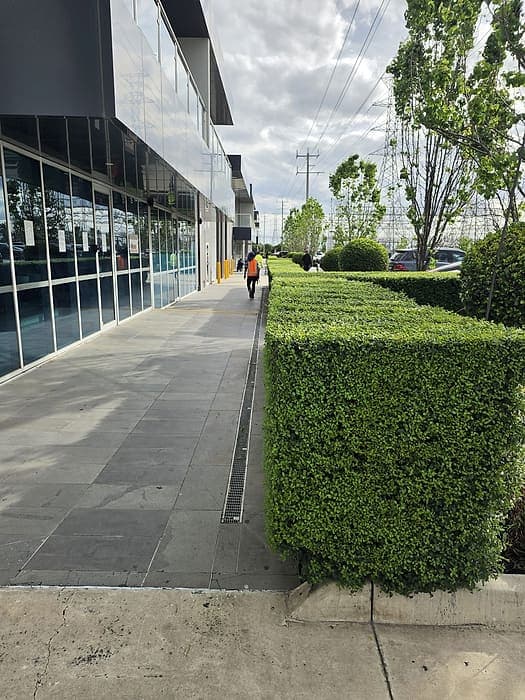
From our jobs
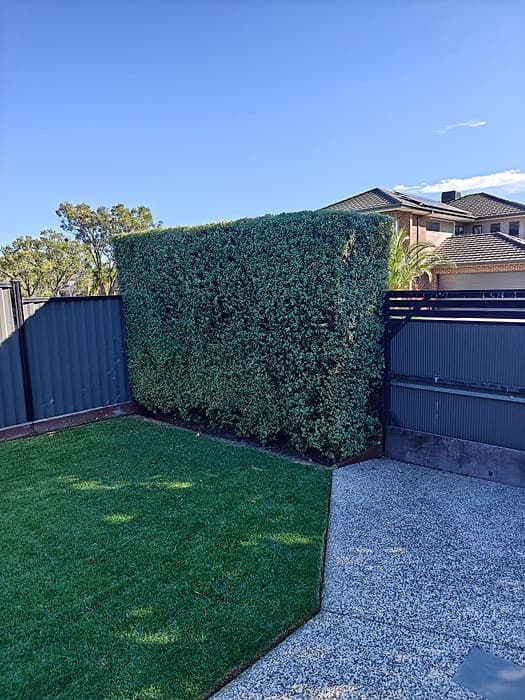
Frequently asked
Which hedges will not grow back after a hard rejuvenation cut?
How long does an overgrown hedge take to recover after hard pruning?
Can I cut both sides and the top of a hedge in one go?
Should I feed an overgrown hedge after cutting it back hard?
Is it better to rejuvenate or replace an old hedge?
Why is my hedge regrowth weak after a hard cut?
Can I rejuvenate a hedge in a Melbourne winter?
Sources and further reading
- Hedge renovation (Royal Horticultural Society)
- Pruning Australian native plants (Australian Plants Society Victoria)
- Melbourne (Olympic Park) climate statistics (Bureau of Meteorology)
- Permanent water saving rules (Water Victoria)
- Trees in Victoria (Dispute Settlement Centre of Victoria, vic.gov.au)
- Using portable ladders in the workplace (WorkSafe Victoria)
Caring for Melbourne gardens since 2019. Updated 18 November 2026.