


Local rules and safety
Overhanging plants on footpaths: council clearance rules
By the Action Garden team · Updated · 11 min read
Checked against: City of Monash, Knox City Council, City of Whittlesea, Whitehorse City Council, Darebin City Council
TL;DR
- Cut hedges, shrubs and ground covers back to the property line so nothing spreads onto the footpath.
- Keep a clear height of 2.5 metres above the footpath in most councils; Darebin sets 2.4 metres.
- Branches over the road need 4 metres in Whittlesea and 5 metres in Knox; signs and street lights must stay visible.
- Councils usually start with a letterbox card, then a notice to comply, then may do the work and pass on the cost.
- The owner is responsible; trim your own plants and leave council street trees to the council.
| Council | Footpath clearance | Roads and notices |
|---|---|---|
| Monash | Back to the property line; 2.5 m height clearance | Advisory card, then a Notice to Comply, often 14 days |
| Knox | 2.5 m above the footpath | 5 m above a road; card asks for work within two weeks |
| Whittlesea | 2.5 m above the footpath | 4 m above a road; street lights and signs kept clear |
| Whitehorse | Back to the property line; 2.5 m above the footpath | At least 1 m from power lines and other services |
| Darebin | No lower than 2.4 m | Boundaries kept clear of obstructions |
What do Melbourne councils require for plants over the footpath?
Two things: nothing past your property line at ground level, and a clear height of about 2.5 metres above the footpath. Monash, Knox, Whittlesea and Whitehorse all use 2.5 metres, and Darebin says branches must be no lower than 2.4 metres.
The rules come from each council's local law, so the wording and enforcement differ. The aim is the same everywhere: a person walking, pushing a pram, using a wheelchair or a mobility scooter, or walking with a cane, should not have to duck or step onto the road.
The owner of the land the plant grows on is responsible. That covers hedges, shrubs, climbers, ground covers and branches from trees inside your boundary.
How much clearance do you need, council by council?
Most councils agree on the footpath figure and differ on roads. This table sums up what five councils say on their own pages.
| Council | Over the footpath | Over the road | Other points |
|---|---|---|---|
| Monash | 2.5 m; ground covers cut to the property line | Not stated for private plants | Plants through or over fences trimmed to the line |
| Knox | 2.5 m | 5 m | Traffic control devices kept clear |
| Whittlesea | 2.5 m | 4 m | Street lights, traffic signs and traffic lights kept clear; no build-up of dropped fruit or leaves |
| Whitehorse | 2.5 m, back to the property line | Must not interfere with traffic | At least 1 m from power lines and other services |
| Darebin | No lower than 2.4 m | Not stated on the page | Boundaries kept clear of obstructions |
If your council is not listed, search its website for "overhanging vegetation" or "local law". The figure is usually in the same place as the rules for nature strips and fire hazards.
A side view of a front fence, a hedge and the footpath beside it. A dashed vertical line rises from the property boundary. A shaded box over the footpath, 2.5 metres tall, is labelled "keep clear". A hedge first bulges past the boundary and hangs into the box; on scroll, a trimming line sweeps down the face and the hedge settles back behind the boundary, with its top branches lifted above the box. A second, taller box over the road is labelled "4 to 5 m, check your council".
What happens if the council finds overhanging plants?
Most councils start with a friendly warning and step up from there. Monash and Knox describe almost the same steps.
- Inspection. Council officers inspect streets on a cycle, or after a complaint.
- Letterbox card. For minor cases you get a card asking you to cut back the growth, often within two weeks.
- Re-inspection. If nothing changes, an officer comes back.
- Notice to comply. A formal notice sets a deadline, which Monash says may be 14 days depending on the risk.
- Council does the work. If the notice is ignored, the council may clear the plants itself, pass the costs to the owner and issue a fine.
Whitehorse and Monash also say repeat lapses can bring a fine sooner. If you need more time, Knox says to contact the officer named on the notice before it expires.
Why councils take footpath clearance seriously
An overhanging branch is a hazard first and an eyesore second. Whittlesea notes that growth over footpaths and roads limits movement and visibility for pedestrians and drivers.
People with low vision can walk straight into a branch at head height, and a hedge that pushes walkers onto the road puts them beside traffic. Councils carry the risk for their footpaths, which is why the response is usually a notice rather than a suggestion.
Dropped fruit and berries count too. Whittlesea says they must not build up on the footpath in a way that causes an obstruction or a danger.
Which plants cause the most footpath complaints?
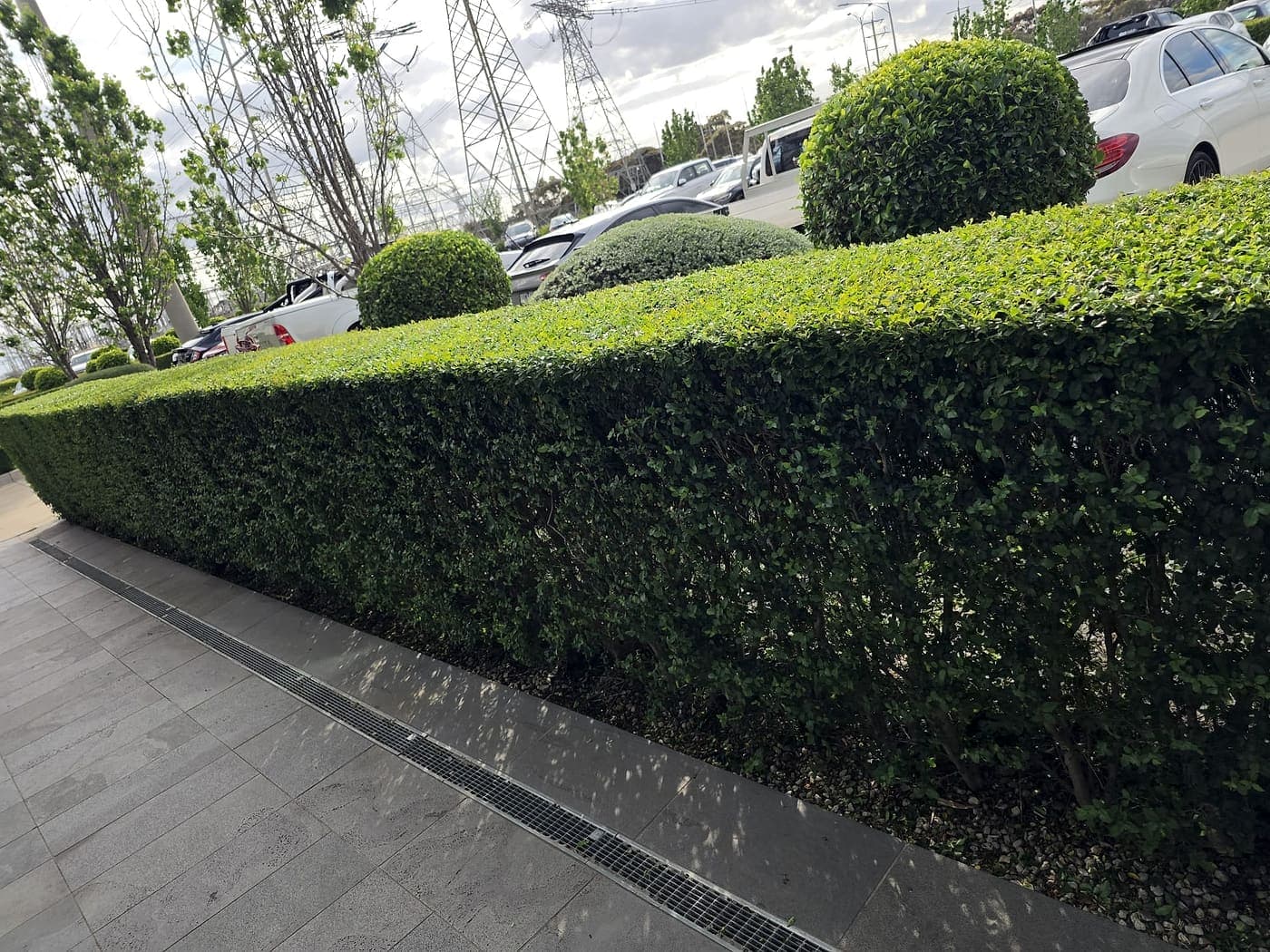
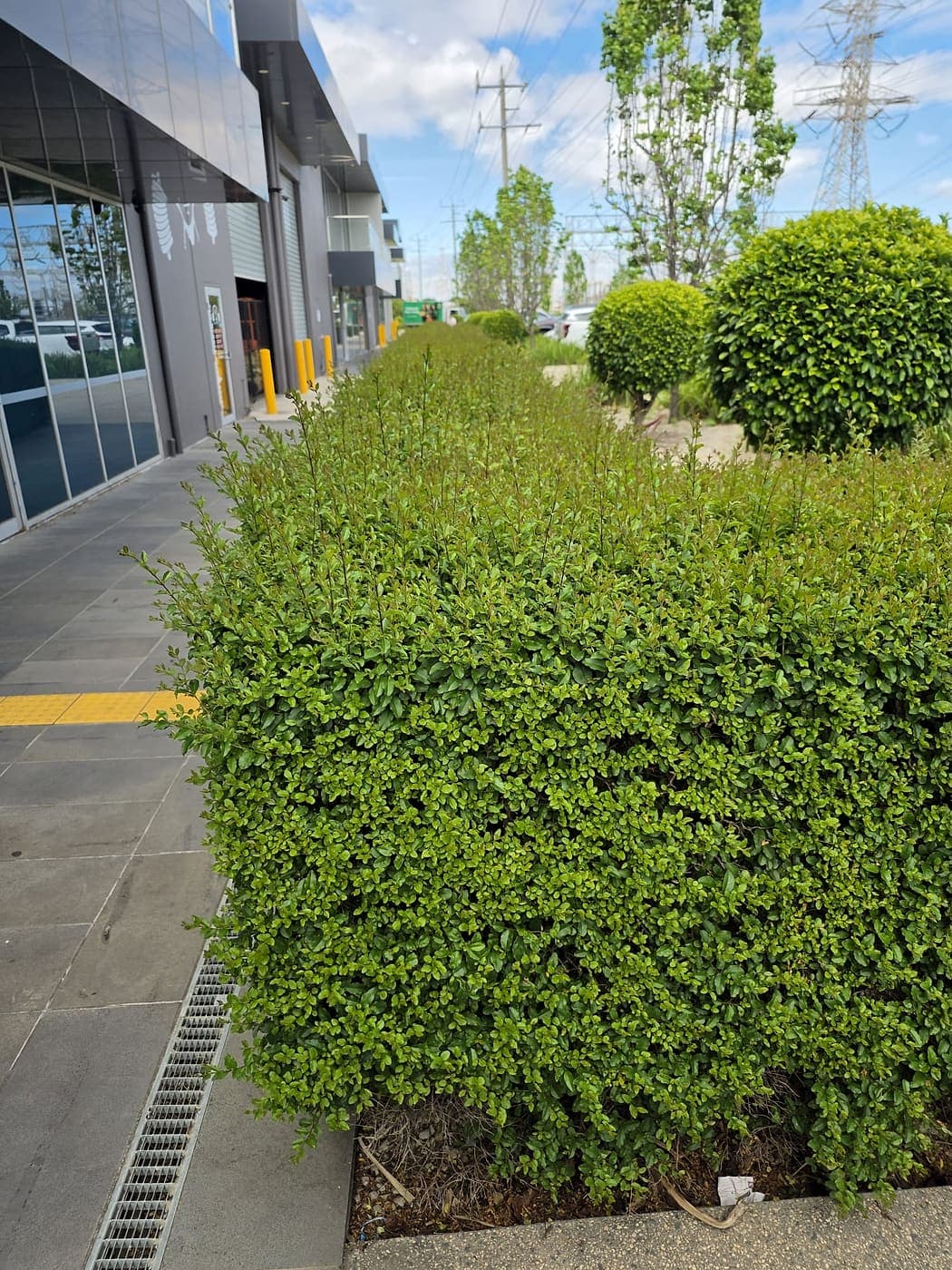
Fast hedges and spreading shrubs. Lilly pilly, photinia, viburnum, pittosporum and murraya can put on a lot of growth between a spring and an autumn trim, and the street face is easy to forget.
Other common culprits:
- Climbers on front fences, such as star jasmine and ivy, which push through palings and pickets.
- Ground covers and grasses that creep across the footpath edge, such as gazanias and spreading rosemary.
- Low limbs on front garden trees, especially ornamental plums, cherries and silver birches, which arch over the path as they mature.
- Roses and other prickly shrubs near the boundary, which catch clothing even at modest heights.
Hedges with leaf problems recover more slowly after a hard cut. If your lilly pilly has blistered new leaves, read our guide to lilly pilly psyllid before trimming the street face hard.
How do you trim a hedge back to the boundary properly?
Cut back to the line, keep the street face slightly tapered, and lift the canopy to the clearance height. A hedge that is narrower at the top than the base keeps light on the lower leaves, so it stays dense right down to the footpath.
- Find the boundary. Use the fence line or survey pegs; the footpath edge is not always the boundary.
- Check for nests and wires. Look for nesting birds before you start, and stay well clear of any power or service lines.
- Trim the face. Cut the street face back to just inside the line, angling it in slightly towards the top.
- Lift the canopy. Remove low branches so nothing hangs below the clearance height over the path.
- Check signs and lights. Make sure street lights, signs and the view from your driveway are clear.
- Clean up. Sweep the footpath and the nature strip; clippings left on the path are their own trip hazard.
Our hedge trimming guide for Melbourne covers timing, tools and species in more depth.
What if cutting back to the line leaves bare wood?
A hedge that has grown well past the boundary may have no leaves on the inside, so a cut back to the line can leave a bare face for a season. Many species, including lilly pilly and photinia, reshoot from bare wood in spring, but conifers such as cypress usually do not.
For those, a staged approach works better: cut back as far as the council needs now, then reduce the rest over one or two seasons. If the lower half of the hedge is already thin, our guide to a hedge that is bare at the bottom explains why it happens and how to fix it.
Whatever the species, the council's deadline comes first. If the notice requires a hard cut, make it, and plan the recovery afterwards.
What about plants near power lines, driveways and corners?
These need extra care. Whitehorse asks for branches to be at least 1 metre clear of power lines and other services, and says residents should not prune near power lines themselves.
Driveways and corners are about sight lines. A hedge that blocks the view of the footpath as you reverse out puts children on bikes and scooters at risk, so keep it low near the driveway edge or trim it back further than the boundary there.
Any branch within reach of a power line or the service line to the house is a job for a qualified professional, and Energy Safe Victoria warns that only trained and authorised people can prune within set distances of power lines. Tall hedges that need ladders over a footpath, heavy limbs over the road, and work beside traffic also need the right equipment and traffic awareness. If the overhanging branch belongs to a council street tree, report it to the council instead.
Is the overhanging branch yours or the council's?
Check where the trunk is. If the plant grows inside your boundary, it is yours to trim; if it grows on the nature strip, in a park or on the road reserve, it is the council's.
Council trees have their own rules: residents generally cannot prune them, even where they hang over a footpath or your driveway. Our article on council street trees and what you can and cannot do explains how to lodge a pruning request.
Branches from a neighbour's tree over your side of the fence are a third case, governed by neighbour rules rather than footpath rules. The guide to hedges and neighbours in Victoria covers that.
Quick decision guide
Whose job is this branch?
- Is it touching or near a power line? Do not touch it: call the council for a street tree, or your electricity distributor for advice on a private tree.
- Does the trunk stand on the nature strip or in a park? Council tree: lodge a request with a photo.
- Does it grow inside your boundary? Your plant: trim it back to the line and lift it to the clearance height.
- Does it grow on a neighbour's land and overhang the footpath? Talk to your neighbour, or report it to the council, which will contact the owner.
- Have you received a notice? Meet the deadline, or contact the officer named on it before it expires.
What should you do with the cuttings?
Take them away or put them in the green bin. Leaving clippings on the footpath or nature strip creates the hazard the notice was about, and piles of branches can attract a dumping complaint of their own.
Small trims fit the green waste bin. A full cut-back of a long hedge usually does not, and burning the cuttings is restricted across most of Melbourne; our article on burning off garden waste explains why.
Footpath rules are one of several council rules that touch the front garden. The rest are collected in our local rules and safety articles.
When is it worth handing the job over?
If a notice has arrived, or the street face of a long hedge is more than an afternoon's work, a hedge trimming and pruning service cuts it back to the boundary, lifts the canopy over the path and takes every clipping away. You can request a free quote whenever it suits.
Your Garden. Our Promise.
From our jobs
Frequently asked
How high do branches need to be above a footpath in Melbourne?
How long do I have to act on a council notice about overhanging plants?
Do the footpath rules cover plants growing through my front fence?
Can the council cut back my hedge itself if I ignore the notice?
Who is responsible for overhanging plants at a rental property?
How do I report branches blocking a footpath in my street?
Do overhanging branches need to clear street lights and signs?
Sources and further reading
- Overhanging vegetation (City of Monash)
- Overhanging tree branches (Knox City Council)
- Overhanging branches on roads and footpaths (City of Whittlesea)
- Overhanging vegetation (Whitehorse City Council)
- Property maintenance (Darebin City Council)
Caring for Melbourne gardens since 2019. Updated 18 November 2026.