


Garden beds, soil and plants guide
How to plan a low-maintenance garden
By the Action Garden team · Updated · 11 min read
Checked against: Sustainable Gardening Australia, Water Victoria, CFA, Australian Plants Society Victoria
TL;DR
- Start by listing the jobs that eat your time, then design them out; the usual culprits are lawn edges, fast hedges and bare soil.
- Choose plants for their size at maturity, not in the pot, so nothing needs constant cutting back.
- Group plants by water need and run a timed drip system within Victoria's 6pm to 10am rule for watering systems.
- Cover all soil with mulch or dense groundcover and give beds a hard edge so grass and mulch stay where they belong.
- Low maintenance is not no maintenance; plan for a few seasonal visits for pruning, mulch top-ups and weeding.
| Feature | Upkeep it creates | Lower-upkeep option |
|---|---|---|
| Large lawn with curved edges | Mowing and edging every 1 to 2 weeks in spring and summer | A smaller, simple-shaped lawn with a mowing strip |
| Fast formal hedge | Several trims a year | Informal screen of slower shrubs at their natural size |
| Bare soil between plants | Constant weeding | Mulch now, dense groundcovers over time |
| Many pots | Daily watering in summer | A few large pots on drip, or plants in the ground |
| Mixed plants with mixed water needs | Hand watering by plant | Beds grouped by water need on separate drip zones |
What makes a garden low maintenance?
A low-maintenance garden is one designed so the jobs that repeat every week or fortnight are few and quick. It is not a garden with no plants, and it is not a garden that never needs care. It is one where most of the work is seasonal, not constant.
The jobs that take the most time in a typical Melbourne garden are predictable: mowing and edging lawn, weeding bare soil, trimming fast hedges into formal shapes, watering pots and thirsty plants by hand, and cutting back plants that have outgrown their space. A good plan removes or shrinks each of those.
Sustainable Gardening Australia (opens in a new tab)'s first design principle is to "design a landscape that minimises the requirement for energy inputs", meaning fuel, water, chemicals and fertiliser. It notes that gardens with a high proportion of lawn need far more of those inputs than mixed plantings of shrubs and perennials. Less input usually means less work.
How do you start planning a low-maintenance garden?
Start with what you do now, not with a plant list. Spend two or three weeks noting every garden job and how long it takes; the list shows you exactly what to design out.
- List the regular jobs. Mowing, edging, weeding, watering, trimming, sweeping. Note which ones you dread.
- Map the site. Sketch the garden and mark full sun, part shade and deep shade, wet spots after rain, dry spots under eaves, and slopes.
- Check the soil. Heavy clay in the north and west of Melbourne holds water in winter; sand in the south-east drains fast and dries quickly. Plant choice follows soil.
- Decide how you use the space. Where do children play, where does the dog run, where do you sit, where do bins and clotheslines go? Paths should follow the routes people actually walk.
- Mark what stays. Healthy trees, established shrubs that suit their spot and good hard surfaces are worth keeping.
- Then design. Shrink the high-work features, group plants by need and choose plants that fit.
It is usually better to improve an existing garden in stages than to clear it and start again. Every stage removes some regular work, and you learn what the garden needs before spending on the next stage.
A worked example: a typical suburban backyard
Picture a backyard with a large lawn with curved edges, a narrow bed of mixed shrubs along each fence, a fast-growing hedge across the back and a dozen pots on the patio. The regular work is mowing and edging fortnightly in the growing season, trimming the hedge several times a year, hand weeding gaps in the beds, and watering pots daily in summer.
A low-maintenance plan might keep a smaller, rectangular lawn with a brick or concrete mowing strip, widen the fence beds and plant them densely with shrubs and groundcovers grouped by water need, replace the formal hedge with an informal screen of slower shrubs at their natural size, and keep three large pots on a drip line instead of twelve small ones. The same garden ends up with fewer, shorter jobs and is still green and usable.
Should you keep the lawn?
Keep some lawn if you use it, but make it smaller and simpler to mow. Lawn is the biggest single time cost in most Melbourne gardens, and SGA notes that lawn-heavy gardens need far more fuel, water and fertiliser than mixed planting.
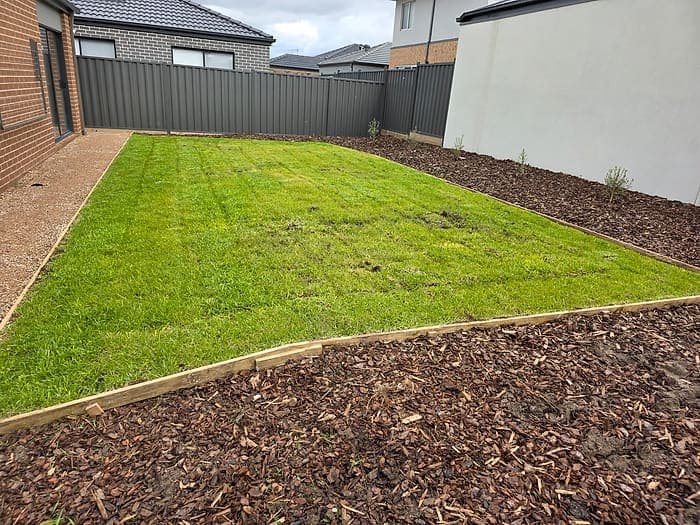
A useful middle ground is a lawn with a simple shape and a hard edge. Rectangles and gentle curves are faster to mow than tight curves and corners. A flush mowing strip of brick, concrete or steel lets the mower run one wheel along the edge, which removes most of the edging work.
Choose a grass that suits the conditions, since the wrong grass in the wrong spot needs constant patching. Where lawn struggles in deep shade or under trees, replace it with mulch and shade-tolerant groundcovers rather than fighting it.
Side by side
Ground surfaces compared for upkeep
| Lawn | Mulched planting | Gravel | Dense groundcover | |
|---|---|---|---|---|
| Regular work | Mowing and edging every 1 to 2 weeks in the growing season | Weeding gaps until plants fill in; yearly mulch top-up | Pulling weeds that blow in; raking stone back from paths | Light trim or tidy once or twice a year once established |
| Water | High in summer | Low to moderate once established | Low, but reflects heat onto nearby plants | Low to moderate |
| Good for | Play, pets, sitting | Most beds and borders | Dry, sunny spots, paths, dry-country plants | Slopes, under trees, between stepping stones |
| Watch out for | Shade, heavy wear and clay waterlogging | Mulch against stems and walls | Heat in summer and leaves settling into the stone | Slow to fill; needs weeding in the first year or two |
Which plants keep maintenance low?
Plants that suit the soil, sun and rainfall, and that fit their space when fully grown. The Australian Plants Society Victoria (opens in a new tab) notes that plants too large for their site, needing constant heavy pruning, may be better replaced with smaller ones. That one idea saves more work than any other plant choice.
- Check the mature size on the label, not the size in the pot, and space plants for it.
- Choose plants for the conditions. SGA's rule is that "a plant's suitability for the job, the site and the position, is the rule for all plant selection in sustainable design."
- Favour shrubs and groundcovers over annuals. Annuals need replanting, feeding and deadheading every season.
- Use informal shapes. A shrub left at its natural shape needs one or two prunes a year; the same shrub kept as a tight box may need several.
- Plant densely. Close planting shades the soil, which suppresses weeds once the plants fill in.
- Avoid environmental weeds. Some easy plants spread into bushland. Check before you plant.
Many Australian natives suit this style once established, but not all, and they need the right drainage and pruning. Our guide to caring for Australian native plants covers what they need. Gravel and succulent plantings are another option for hot, dry spots; our article on gravel and succulent gardens weighs up how low-fuss they really are.
How do you cut down on watering?
Group plants by water need, then put each group on its own drip zone with a timer. SGA calls this zoning, noting that "plants can be zoned according to their water needs, so water isn't wasted," with thirsty plants placed down-slope where water collects.
A drip system on a timer removes the daily job of hand watering. Under Victoria's permanent water saving rules (opens in a new tab), watering systems such as drippers and sprinklers can only run between 6pm and 10am; a hand-held hose with a trigger nozzle can be used at any time. Set the timer for early morning, when evaporation is lowest.
Pots are the biggest watering burden in summer. Fewer, larger pots dry out more slowly than many small ones, and a drip line to each removes the daily round. Our article on pots and planters in summer covers keeping container plants alive through the heat. A vegie patch is a deliberate exception: it is a high-water, high-care zone, so put it close to the tap and keep it small; see starting a vegie patch in Melbourne.
A bird's-eye plan of a suburban backyard. Near the back door, a small high-water zone in blue holds the vegie patch and a few large pots, each on its own drip line. Around the middle, a moderate zone in green holds a compact lawn with a straight mowing strip and mixed shrub beds. Along the far fences, a low-water zone in sand colour holds dense native shrubs and groundcovers under mulch. A drip line runs from a tap with a timer, splitting into separate valves for each zone, with a clock symbol showing a 6am start.
What should cover the soil?
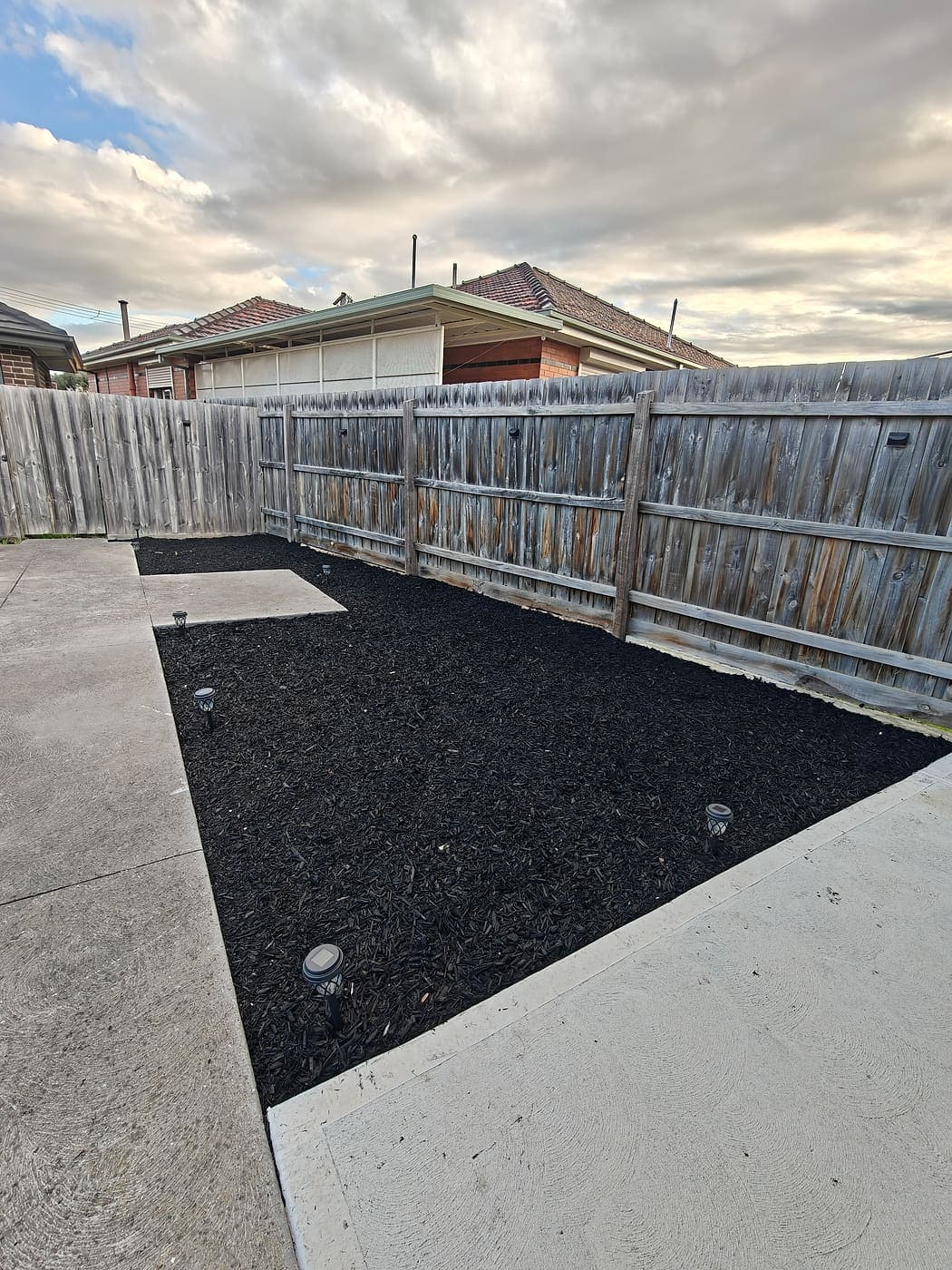
Mulch, then plants. Bare soil is where weeds start, so every bed should be covered with a coarse mulch while the plants grow, and planted densely enough that the plants eventually shade the soil themselves.
Coarse bark or wood chip at 50 to 75 mm suits most beds. Gravel suits dry-country plants and paths. Keep organic mulch below the house slab and away from weep holes. In bushfire-prone areas, CFA (opens in a new tab) advises using "pebbles or rocks in garden beds near your house. Not flammable mulch," which also suits a low-maintenance plan.
Our guide on how to mulch garden beds properly covers depth, timing and keeping mulch off stems.
Edging that does the work for you
A hard edge between lawn and bed stops grass creeping into the bed and mulch spilling onto the lawn. Flush edges of brick, concrete or steel let the mower run along them. Raised timber edges look neat at first but rot over time and can trap a strip of grass the mower cannot reach.
Wherever two surfaces meet, such as lawn and gravel or mulch and paving, an edge saves a weekly tidy. It is one of the few low-maintenance features that pays off from the first week.
What maintenance will a low-maintenance garden still need?
A few seasonal visits a year rather than weekly work. Once established, most low-maintenance gardens need roughly the following, adjusted to the plants and the size of the garden.
| Season | Jobs that remain |
|---|---|
| Spring | Weed before seeds set, top up mulch, check and flush the drip system, light prune of spring flowerers |
| Summer | Check drip lines and timers, deep water new plants in heatwaves, mow the smaller lawn |
| Autumn | Prune summer flowerers, clear leaves from beds, gravel and gutters, plant to fill any gaps |
| Winter | Structural prune of deciduous plants, check drainage on clay, plan any changes |
For the full seasonal picture, see our complete guide to garden maintenance in Melbourne and the other garden beds, soil and plants guides. A healthy, well-planned garden also has fewer pest problems; our guide to common garden pests in Melbourne explains why.
Get help for removing large shrubs or trees, regrading slopes, building retaining walls or anything that changes drainage near the house. Tree removal is work for trained people, and Action Garden's own team does it. Plumbing a new drip system into the mains, or near a backflow device, may need a licensed plumber. Some councils also protect trees and vegetation, so check before removing anything large.
Is it worth handing the change-over to a professional?
If you want to convert a high-work garden in stages, or simply hand over the few seasonal visits a low-maintenance garden still needs, it can be worth it. Our gardening services cover planting, mulching, edging, pruning and clear-outs, and can be set up as a regular, light-touch programme.
When you are ready, get a free quote.
Your Garden. Our Promise.
From our jobs
Frequently asked
What is the lowest-maintenance alternative to a lawn in Melbourne?
Is artificial turf low maintenance?
How long does a new low-maintenance garden take to become low maintenance?
Which plants make a garden harder to look after?
Should I put weed mat under gravel or mulch?
Can I make my existing garden lower maintenance without starting again?
Sources and further reading
- Sustainable garden design (Sustainable Gardening Australia)
- Permanent water saving rules (Water Victoria)
- How to prepare your property (CFA)
- Pruning Australian native plants (Australian Plants Society Victoria)
Caring for Melbourne gardens since 2019. Updated 18 November 2026.