


Lawn care guide
Spring lawn renovation: scarify, top-dress and feed in the right order
By the Action Garden team · Updated · 12 min read
Checked against: University of Western Australia Institute of Agriculture, Bureau of Meteorology, Sustainable Gardening Australia, Yarra Valley Water, South East Water, EPA Victoria
TL;DR
- Renovate warm-season lawns when they are growing strongly, usually mid October to November in Melbourne
- The order is mow low, scarify, clear, aerate, feed, top-dress, then water, because each step sets up the next
- Top-dress thinly with washed sand or a sandy loam, leaving leaf tips visible; fill deep hollows over several rounds
- Buffalo and zoysia need a gentler scarify than kikuyu and couch, and fescue is better renovated in autumn
- Water little and often while the lawn recovers, inside Victoria's permanent water saving rules
| Step | Guide figure | Notes |
|---|---|---|
| Timing | Mid Oct to Nov | Lawn growing strongly, no heatwave forecast |
| Mow before scarifying | Lowest safe height | Never below the floor for your grass |
| Top-dressing depth | Leaf tips still showing | Thin coats, several rounds for deep hollows |
| Recovery time | Two to four weeks | Faster for kikuyu and couch than buffalo |
When should you renovate a lawn in Melbourne?
Renovate a warm-season lawn of kikuyu, couch, buffalo or zoysia once it is growing strongly in spring, which in Melbourne is usually mid October to November. A cool-season fescue or rye lawn is better renovated in autumn. In both cases the grass must be growing fast enough to fill in what you take out.
Timing is the most important decision in the whole job. Renovate too early, while a warm-season lawn is still waking up in September, and it sits scalped and bare for weeks while weeds move in. Renovate too late and the recovery runs into the hottest, driest part of summer.
The Bureau of Meteorology (opens in a new tab)'s averages for Melbourne (Olympic Park) show the window. The mean maximum rises from 18.1 °C in September to 20.6 °C in October and 22.2 °C in November, and October is the wettest month on average at 68.0 mm. That combination of warmth and moisture is what a freshly renovated lawn needs.
Practical signs you are ready:
- You have been mowing every week for two or three weeks.
- New runners are pushing out at the lawn edges.
- The soil is moist but not soggy, and a screwdriver pushes in easily.
- No run of hot days is forecast for the following fortnight.
If you are not sure which grass you have, check before you start: a hard scarify that suits kikuyu can wreck buffalo, and each grass has its own lowest safe cut, set out in the table further down.
What does a lawn renovation actually fix?
Renovation fixes thatch, compaction, water repellence and an uneven surface. Each step targets one of those problems, which is why the order matters. A lawn with none of them only needs a feed and good mowing.
| Problem | Sign | Step that fixes it |
|---|---|---|
| Thatch | Spongy feel, brown layer of stems above the soil deeper than a finger width | Scarifying |
| Compaction | Hard ground, thin grass on paths and play areas, water pooling | Core aerating |
| Water repellence | Water beads and runs off, soil dry under green grass | Aerating plus a wetting agent |
| Bumps and hollows | Mower scalps high spots, puddles in low ones | Top-dressing |
| Thin, pale growth | Weak colour once the other problems are fixed | Feeding |
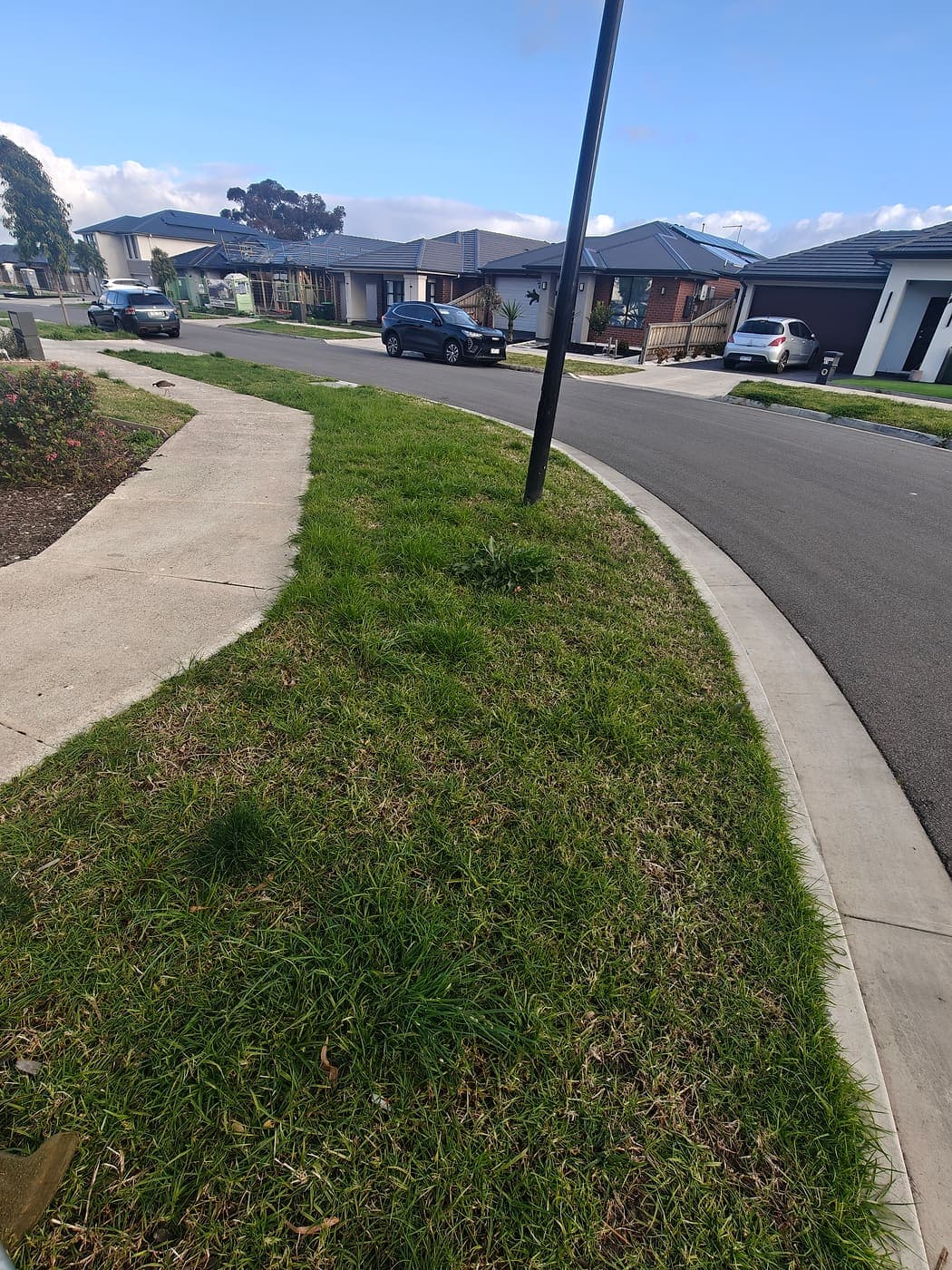
Not every lawn has every problem. Push a finger into the turf: if you feel a springy brown layer before you hit soil, that is thatch. Push a screwdriver in: if it will not go down a few centimetres in moist soil, the lawn is compacted. Our guide on why a lawn goes brown in patches covers patchy problems such as dry spots and pests, which renovation alone does not fix.
A cross-section of a lawn shown in seven frames. Frame one shows tall grass over a thick brown thatch layer and compacted soil. Frame two shows the grass mown low. Frame three shows scarifier blades slicing through the thatch, with loose debris lifted above. Frame four shows the debris gone and hollow tines pulling cores from the soil. Frame five shows fertiliser granules on the surface. Frame six shows a thin sand layer filling the holes and hollows with leaf tips showing. Frame seven shows water soaking down and new green shoots rising through the sand.
Why does the order of steps matter?
Each step prepares the ground for the next. Scarifying before aerating clears the thatch so the tines reach soil. Aerating before top-dressing opens holes for the sand to fill. Feeding before the top-dressing puts the fertiliser in contact with soil. Watering last settles everything in.
Get the order wrong and you waste work. Top-dress before scarifying and the scarifier throws the sand back out. Feed before scarifying and much of the fertiliser leaves with the thatch. Aerate through thick thatch and the tines bounce off a spongy mat.
Feed before or after top-dressing?
Guides differ on this. Feeding just before top-dressing lets the granules settle into the aeration holes and sit under a thin cover of sand, where they are less likely to wash off. Feeding just after top-dressing is also common and works well if the lawn is watered in straight away.
Either way, the feed belongs at the end of the renovation, not the start, and the label rate and watering-in directions apply. Our guide on when to fertilise your lawn in Melbourne explains the wider feeding calendar.
How do you renovate a lawn step by step?
Mow low, scarify, clear the debris, aerate, feed, top-dress, then water. Allow a full day for a typical suburban backyard, longer if you are hiring machines. Prepare the area first by marking sprinkler heads, shallow irrigation lines and any cables.
1. Mow low
Mow in two passes, the second at the lowest safe height for your grass, and catch the clippings. For kikuyu and couch that can be a hard cut, close to the runners; for buffalo and zoysia, stay just above the runners. Never scalp fescue.
2. Scarify
Run the scarifier in one direction, then across at right angles. The blades should slice into the thatch layer and just touch the soil surface. Test on a small patch first and check you are lifting dead material, not ripping out the green runners.
3. Clear the debris
Rake the loosened thatch into piles, then run the mower over the area with the catcher on to collect the rest. The volume is often surprising. Compost it, put it in your green waste or FOGO bin, or arrange removal.
4. Aerate
Core aerate compacted areas while the soil is moist, with hollow tines that pull out plugs. On small areas a garden fork pushed in and rocked back works. Leave the cores on the surface to break down, or rake them into the hollows.
5. Feed
Spread a lawn fertiliser at the label rate in two passes at right angles. If water was beading on the surface, apply a wetting agent now as well, following its label.
6. Top-dress
Tip small piles of washed sand or sandy loam across the lawn and spread them with a levelling rake or lute, working the material into the aeration holes and hollows. Leave the leaf tips showing. Deep hollows are filled over several rounds, a few weeks apart, never in one heavy layer.
7. Water and rest
Water deeply straight away, then little and often until the grass has grown through the sand. Keep traffic, pets and play off for two to three weeks.
Grass needs light to grow through top-dressing. A layer so thick that it buries the leaf smothers it, and the lawn yellows or dies in patches. If a hollow is deeper than the leaf is tall, fill it in two or three rounds, letting the grass grow through each time.
How should you water a renovated lawn?
Water deeply on the day, then lightly and often for the first two weeks, tapering back to deep, less frequent watering as the grass grows through. Under Victoria's permanent water saving rules, watering systems may run only from 6pm to 10am, and hand watering with a trigger nozzle is allowed at any time.
South East Water (opens in a new tab) states that "Watering systems for home and commercial gardens can only be used between 6pm and 10am", while "You can water gardens at any time using a hand-held hose, watering can or bucket." Yarra Valley Water (opens in a new tab) adds that "Hoses must be leak free with a trigger nozzle for all uses". On a hot afternoon in the first week, a short hand watering is allowed and can save a struggling patch.
Once the lawn has knitted together, move to the deep, infrequent pattern Sustainable Gardening Australia (opens in a new tab) recommends: an occasional soaking rather than regular shallow watering, which encourages deeper roots. Our guide on how to water a lawn in Melbourne within the water rules covers setting up that routine for summer.
How does renovation differ by grass type?
Kikuyu and couch take the hardest renovation and recover fastest. Buffalo and zoysia need a gentler scarify and recover more slowly. Fescue and rye have no runners, so they are not scalped or hard scarified; they are aerated, lightly raked and oversown, ideally in autumn.
| Grass | Mow before | Scarify | Recovery in warm weather |
|---|---|---|---|
| Kikuyu | Hard, close to runners | Aggressive, two directions | About two to three weeks |
| Couch | Hard, close to runners | Aggressive, two directions | About two to three weeks |
| Buffalo (soft leaf) | Just above runners | Light, highest setting | Four weeks or more |
| Zoysia | Just above runners | Light | Four weeks or more |
| Tall fescue and rye | Normal height, never scalp | Light rake only; oversow | Best done in autumn |
Why fescue is different
Fescue and rye grow from individual crowns, not runners, so they cannot spread sideways to fill scarified gaps. Scalping or hard scarifying a fescue lawn simply removes plants. Renovating it means aerating, lightly raking, top-dressing thinly and oversowing with fresh seed.
Autumn is the better time, because the soil is still warm and the cool, moist months that follow suit fescue. A spring oversow can work early in the season, but seedlings then face their first summer before they are established.
Many northern-suburb lawns combine kikuyu with heavy clay and plenty of compaction. Our post on lawn problems in Melbourne's northern suburbs covers the issues that are common there. And if a lawn stayed yellow through winter, check our post on why lawns go yellow in a Melbourne winter before deciding it needs a full renovation; often it only needs to warm up.
What renovation mistakes should you avoid?
The common mistakes are renovating too early, scarifying buffalo like kikuyu, top-dressing too thick and letting the lawn dry out while it recovers. Weeds are the other trap: renovating a weedy lawn spreads the weeds into the fresh, open surface.
- Starting in September. Warm-season grass is not growing fast enough to recover.
- Scalping fescue. It has no runners to regrow from.
- Using clay soil to top-dress. It sets hard and seals the surface.
- Burying the grass. Leaf tips must show through.
- Skipping watering. A scarified lawn dries out fast in a Melbourne November.
- Ignoring weeds. Deal with them first; our guide to common lawn weeds in Melbourne explains which ones need treating before renovation.
- Hosing sand off paths. Sweep it back onto the lawn. EPA Victoria (opens in a new tab) advises sweeping waste into a bin rather than using a hose, and Victoria's water rules do not allow hosing hard surfaces.
Hire scarifiers and core aerators are heavy, powerful machines that can kick back, throw debris and cause strain injuries. Get help if you are not confident handling them, if the lawn is on a slope, if irrigation lines or cables run shallow under the turf, or if the area is large. Wear eye and hearing protection and sturdy shoes, and keep children and pets well away.
Is it worth handing the renovation over?
It is worth handing over if you do not want to hire, transport and run heavy machines, deal with the volume of thatch, or move a load of sand by barrow. A renovation done once, in the right order and at the right time, sets the lawn up for the whole season.
Aeration and dethatching, fertiliser and weed control are add-ons to our lawn mowing service, so renovation can lead straight into regular mowing at the right height. For more on mowing through the year, see our complete guide to lawn mowing in Melbourne and the rest of the lawn care guides. When you are ready, get a free quote.
Your Garden. Our Promise.
From our jobs
Frequently asked
Can I renovate a buffalo lawn the same way as kikuyu?
What should I top-dress a lawn with?
How long before a renovated lawn looks good again?
Do I need to renovate every spring?
Is it too late to renovate a lawn in December?
Should I put a wetting agent on during renovation?
Can I mow straight after top-dressing?
Sources and further reading
- Suburban turf talk, University of Western Australia Institute of Agriculture
- Climate statistics for Melbourne (Olympic Park), Bureau of Meteorology
- Minimising water use on lawns and turf, Sustainable Gardening Australia
- Permanent Water Saving Rules, Yarra Valley Water
- Permanent Water Saving Rules, South East Water
- Reduce stormwater pollution, EPA Victoria
Caring for Melbourne gardens since 2019. Updated 18 November 2026.