


Lawn care guide
Common lawn weeds in Melbourne: bindii, clover, onion weed and winter grass
By the Action Garden team · Updated · 11 min read
Checked against: VicFlora, Royal Botanic Gardens Victoria, HortFlora, Royal Botanic Gardens Victoria, Agriculture Victoria, Yarra Valley Water
TL;DR
- Bindii germinates with the autumn rains: treat it in winter or early spring, before the prickly seeds harden
- White clover thrives in hungry lawns; regular feeding and a slightly higher cut help the grass crowd it out
- Onion weed spreads from tiny bulbils, so digging carelessly spreads it: lift the whole clump into a bag
- Winter grass seeds heavily from winter into spring and dies in summer heat, leaving bare gaps for next year
- Any herbicide must be labelled for your grass type; some selective products damage buffalo or other lawns
| Weed | When it shows | Notes |
|---|---|---|
| Bindii | Autumn to spring | Treat before seeds harden in late spring |
| White clover | Spring to summer flowering | Sign of a hungry lawn |
| Onion weed | Most of the year | Bulbils break off when dug |
| Onion grass | Late winter to spring | Pink flowers, wiry leaves, spreads by corms |
| Winter grass | Autumn to spring | Pale tufts, dies off in summer |
Which weeds are most common in Melbourne lawns?
Five weeds cause most of the trouble in Melbourne lawns: bindii, white clover, onion weed, onion grass and winter grass. Flatweed, dandelion, cudweed, oxalis and paspalum are the next most common. Most of them take hold in autumn and winter, when the warm-season grasses that make up many Melbourne lawns slow down and leave room.
Knowing which weed you have matters more than anything else, because each spreads differently. Bindii spreads by seed, clover by creeping stems, onion weed by bulbils, onion grass by corms and seed, and winter grass by masses of seed. A method that works on one can make another worse.
Plant profiles
Five common Melbourne lawn weeds
| Weed | Leaf | Flower | Spreads by | Season |
|---|---|---|---|---|
| Bindii (Soliva sessilis) | Low, feathery rosette, often with spreading runners | Tiny, green, flat to the ground | Spiny seeds | Germinates autumn, flowers September to February |
| White clover (Trifolium repens) | Three round leaflets, often with a pale band | White ball-shaped heads | Creeping stems that root, and seed | Grows most of the year, flowers spring and summer |
| Onion weed (Nothoscordum borbonicum) | Flat, strappy, smells of onion when crushed | White, star-shaped, in clusters | Bulbils around the bulb, and seed | Most of the year |
| Onion grass (Romulea rosea) | Thin, wiry, grass-like | Small, pink to purple, cup-shaped | Corms and seed | Late winter to spring |
| Winter grass (Poa annua) | Soft, pale green tufts, boat-shaped leaf tip | Whitish seed heads held low | Heavy seeding | Autumn to spring, dies back in summer heat |
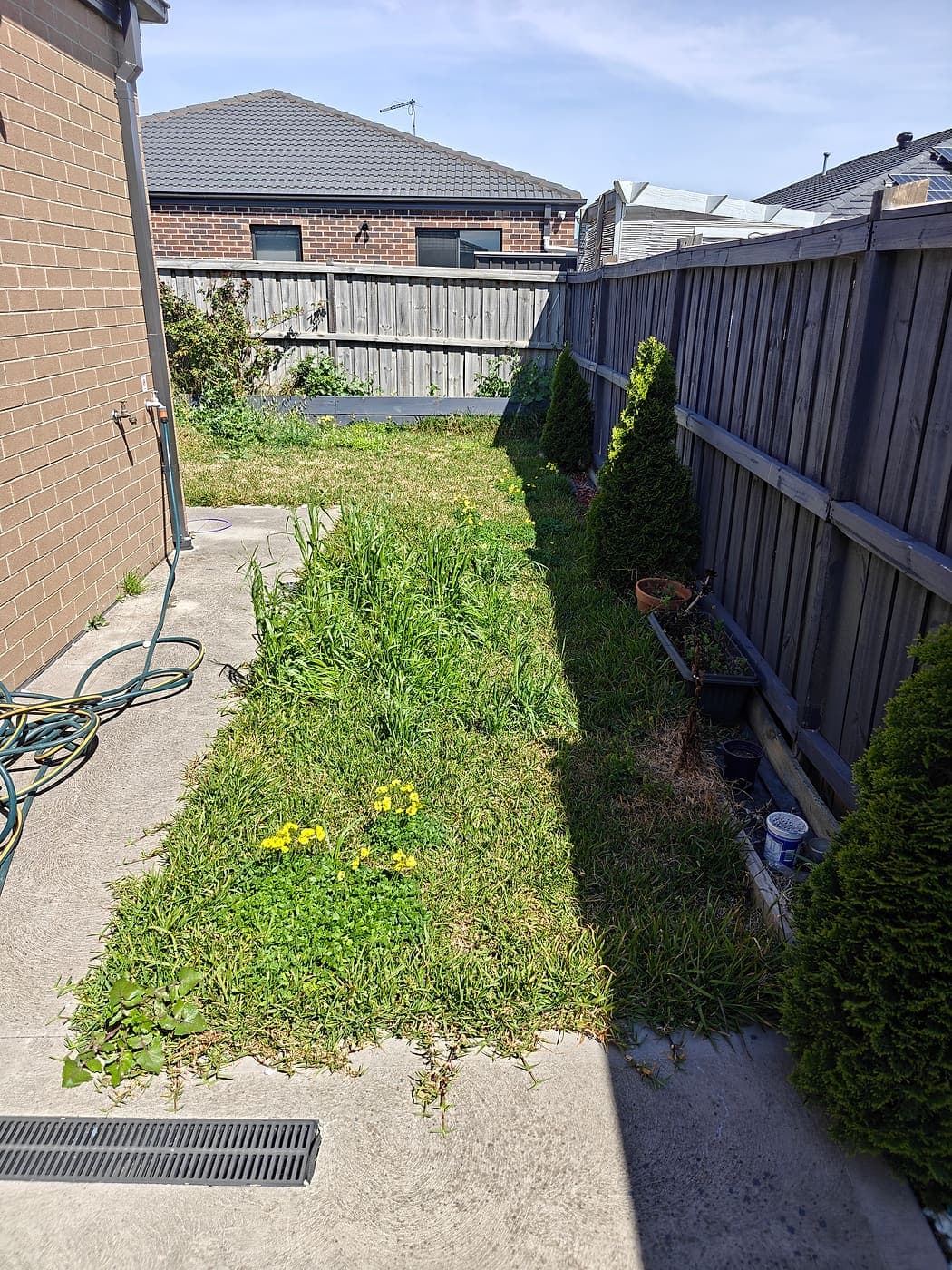
How do you identify and control bindii?
Bindii is the low, feathery rosette that grows those painful prickles in late spring. VicFlora, the Royal Botanic Gardens Victoria flora, describes it as a South American annual that is "now a widespread weed of disturbed ground and lawns throughout most of the State", flowering from September to February.
Timing is everything. Bindii germinates with the autumn rain and grows quietly through winter, which is when it is easiest to deal with. By late spring the seeds have hardened into prickles, and pulling or spraying then still leaves a season's worth of seed in the lawn.
- Look for it in winter, as small, ferny, pale green rosettes sitting flat in the grass.
- Dig small numbers out with a weeding knife, taking the root, before September.
- For a heavy infestation, a selective broadleaf herbicide labelled for your grass type and for bindii, applied in winter or early spring, is the usual approach. Follow the label rate exactly.
- Thicken the lawn in spring with a feed and the right mowing height, so the gaps that let bindii in close up.
If the prickles are already formed, mow with the catcher on to collect as many as possible, and treat early next winter.
Why is clover taking over the lawn?
Clover takes over lawns that are underfed, thin or mown short. Because clover makes its own nitrogen, it keeps growing well where the grass is hungry, then spreads by creeping stems that root as they go.
- Feed the lawn in the growing season so the grass outgrows the clover. Our complete guide to lawn mowing in Melbourne covers how feeding fits with the mowing year.
- Raise the cut. Clover sits low; a higher cut on the grass shades it out over time.
- Hand-pull small patches, following each creeping stem back to its roots.
- Spot-treat larger patches with a selective product labelled for clover and for your grass, if you want it gone completely.
Clover is not all bad. It feeds bees and stays green in dry spells. The trade-off is bee stings where people walk barefoot, and patchy colour in a lawn you want even.
How do you get rid of onion weed and onion grass?
Both are among the hardest lawn weeds to remove, because they grow from underground bulbs or corms that survive when the leaves are pulled. The fix is patience: remove the whole bulb where you can, and keep weakening what is left.
Onion weed
Onion weed has flat, strappy leaves, white star-shaped flowers and a distinct onion smell. VicFlora records it as scattered across Victoria, "mostly north and west of Melbourne". Its bulb is surrounded by tiny bulbils that snap off as you dig.
- Dig wide and deep with a narrow spade or trowel, well around the clump.
- Lift the clump in one piece and drop it straight into a bag.
- Do not compost it or put it in the lawn clippings. Bin it as your council directs.
- Pull or cut new leaves as soon as they appear. Repeatedly removing the leaves weakens the bulb over time.
Onion grass
Onion grass is a different plant with thin, wiry leaves and small pink flowers in late winter and spring. It spreads by corms and seed, and is common on nature strips and in older lawns. Dig out the corms in small areas, stop it flowering by mowing, and keep the lawn dense.
Why herbicides struggle with bulb weeds
Onion weed and onion grass have narrow, waxy or upright leaves that shed spray, and an underground bulb or corm that can regrow even after the top dies. Many general lawn products have little effect on them.
Where a product is labelled for these weeds, it usually needs repeat applications while the plant is actively growing. Read the label for your grass type, follow the timing it gives, and expect a project over more than one season rather than a single fix.
What is winter grass, and how do you stop it?
Winter grass is the pale, tufted grass that appears in autumn and throws up whitish seed heads through winter and spring. The Royal Botanic Gardens Victoria's HortFlora describes it as a "low growing, tufted annual or short-lived perennial grass", and in Melbourne it mostly dies back in the summer heat.
That sounds like the problem solves itself, but it does not. Each plant drops a large amount of seed before it dies, and the bare gaps it leaves are exactly where next autumn's seedlings come up.
- Catch the clippings when the seed heads are showing, so you are not spreading seed.
- Hand-pull small tufts before they seed. They come out easily in moist soil.
- Fill the gaps in summer. Once the winter grass dies back, top-dress and encourage your warm-season grass to spread into the spaces. Our guide to top-dressing and levelling a lawn explains how.
- Pre-emergent products are an option for persistent problems, applied before the autumn germination as the label directs.
Which other weeds turn up in Melbourne lawns?
A handful of other weeds are common enough to be worth knowing. Most are dealt with the same way: remove them young, take the root, and keep the lawn thick.
| Weed | How to spot it | What works |
|---|---|---|
| Flatweed (Hypochaeris radicata) | Flat rosette of hairy, lobed leaves, yellow flowers on tall stalks | Dig out the taproot; a selective herbicide labelled for it |
| Dandelion (Taraxacum) | Smooth, deeply toothed leaves, single yellow flower per hollow stalk | Dig out the whole taproot before it seeds |
| Cudweed | Small, silvery grey, woolly leaves in a low mat | Hand-pull young; thicken the lawn |
| Oxalis | Clover-like, heart-shaped leaflets, yellow or pink flowers | Lift with all bulbs or roots; repeated removal |
| Paspalum | Coarse, clumping summer grass with forked seed heads | Dig out the crown; it seldom spreads in a dense lawn |
How do you keep weeds out of a lawn for good?
The best weed control is a thick, healthy lawn. Weeds need light and space to germinate, and a dense lawn mown at the right height gives them neither.
- Mow at the right height. Kikuyu 30 to 50 mm, buffalo 40 to 60 mm, couch 20 to 40 mm and tall fescue 50 to 70 mm. Scalped lawns are weedy lawns.
- Feed in the growing season, so the grass is vigorous when weeds are trying to establish.
- Water deeply and less often, which grows deeper grass roots than the shallow-rooted weeds. Our guide to watering a lawn in Melbourne covers how, inside the water rules.
- Fix compaction. Hard ground favours weeds over grass. Our guide to aerating a compacted lawn on Melbourne clay shows how coring in spring opens it up.
- Catch clippings when weeds are seeding, and clean the mower before moving between lawns.
- Repair bare patches quickly, before weed seed lands in them.
Weeds on nature strips and vacant blocks
Nature strips, vacant blocks and the edges of commercial sites often carry the heaviest weed loads, because they are mown less often and the grass is under more stress from traffic and dry soil. Weeds there set seed that blows straight into the lawns next door.
Regular mowing that stops weeds from flowering does more than an occasional spray. Our post on keeping a vacant house looking cared for covers mowing and weed control between visits, and our account of a commercial grounds job from start to finish shows how larger sites are kept on a schedule.
When should you call in help with lawn weeds?
Call in help when weeds cover more of the lawn than grass, when you are not confident identifying them, or when the job needs herbicides you are not set up to handle safely. A lawn that is mostly weed often needs the soil and mowing fixed before any weed treatment will last.
Get advice before spraying if you are unsure of your grass type, if the lawn is new turf, or if the area is near ponds, drains, vegetable beds or where children and pets play. Always store, mix and apply products exactly as the label directs, wear the protective gear it lists, and never rinse equipment into a stormwater drain.
Our lawn mowing service includes mowing at the right height for your grass, edge trimming and clipping removal, with weed control and fertiliser available as add-ons. More on looking after the lawn is in our lawn care guides.
When you are ready, get a free quote.
Your Garden. Our Promise.
From our jobs
Frequently asked
How do I get rid of bindii without spraying the whole lawn?
Does clover in the lawn mean the soil is short of nitrogen?
Why does onion weed come back after I dig it out?
What is the difference between onion weed and onion grass?
Does winter grass die off on its own in summer?
Is weed and feed safe to use on a buffalo lawn?
Can raising the mowing height reduce lawn weeds?
Sources and further reading
- Soliva sessilis, bindii (VicFlora, Royal Botanic Gardens Victoria)
- Nothoscordum borbonicum, onion weed (VicFlora, Royal Botanic Gardens Victoria)
- Poa annua, winter grass (HortFlora, Royal Botanic Gardens Victoria)
- Weeds (Agriculture Victoria)
- Permanent water use rules (Yarra Valley Water)
Caring for Melbourne gardens since 2019. Updated 18 November 2026.