


Green waste and rubbish guide
How much green waste is it? Estimating loads in cubic metres
By the Action Garden team · Updated · 11 min read
Checked against: Moonee Valley City Council, Merri-bek City Council, Glen Eira City Council, Victorian Government, Knox City Council
TL;DR
- Volume in cubic metres is length times width times height, all in metres.
- A rounded heap fills only about half of the box around it, so halve the box figure for mounds.
- One cubic metre is 1,000 litres, about four 240 litre wheelie bins or eight 120 litre bins.
- Loose, springy prunings take far more room than the same material stacked and stamped down.
- Council collections set limits in cubic metres, so measure before you book or put anything out.
| Container or limit | Volume | Notes |
|---|---|---|
| 120 litre wheelie bin | 0.12 cubic metres | About 8 bins to a cubic metre |
| 240 litre wheelie bin | 0.24 cubic metres | About 4 bins to a cubic metre |
| Merri-bek bundled branch booking | At least 1 cubic metre | Taken from the 2 cubic metre yearly allocation |
| Moonee Valley hard waste pile | Up to 2 cubic metres | "2m long, 1m high and 1m wide" |
| Glen Eira bundled branches | Up to 3 cubic metres | Up to 20 bundles per collection |
How do you estimate green waste in cubic metres?
Imagine the smallest rectangular box the pile would fit inside, measure its length, width and height in metres, and multiply the three numbers. The answer is the volume in cubic metres. For a rounded heap rather than a squared-off stack, halve that figure.
A cubic metre is a box 1 metre long, 1 metre wide and 1 metre high. It is the unit councils use for hard waste and branch limits, and the one removal services and skip hire companies quote against, so it is worth getting a feel for it.
Three worked examples:
| Pile | Length | Width | Height | Box volume | Likely volume |
|---|---|---|---|---|---|
| Neat stack of hedge prunings | 2 m | 1 m | 1 m | 2.0 cubic metres | 2.0 (squared-off stack) |
| Rounded heap of weeds and leaves | 2 m | 1.5 m | 0.8 m | 2.4 cubic metres | About 1.2 (halve for a heap) |
| Long, low row of branches | 4 m | 1 m | 0.5 m | 2.0 cubic metres | 2.0 if stacked flat |
Write down the numbers and take a photo with a wheelie bin or a person beside the pile for scale. The measurement tells you the size, the photo shows what it is made of and how hard it is to reach.
For the wider choices of what to do with the pile once you know its size, our complete guide to garden rubbish removal in Melbourne covers every route from the FOGO bin to a removal service.
How big is a cubic metre in real life?
Bigger than most people expect. A cubic metre is 1,000 litres: a little over four 240 litre wheelie bins, or about eight 120 litre bins. Merri-bek council describes 1 cubic metre as "approximately equal to the size of two washing machines placed side by side."
Some everyday comparisons:
- Wheelie bins: a 240 litre bin holds 0.24 cubic metres, a 120 litre bin 0.12.
- A garden bag: a typical 50 to 70 litre reusable bag holds 0.05 to 0.07 cubic metres, so it takes 15 or more to fill a cubic metre.
- Two washing machines side by side, Merri-bek's comparison.
- A box the size of a small dining table, 1 metre deep.
Common bins and council limits, in cubic metres
| Container or limit | Volume (cubic metres) |
|---|---|
| 120 litre wheelie bin | 0.12 |
| 240 litre wheelie bin | 0.24 |
| Merri-bek minimum bundled branch booking | 1 |
| Moonee Valley hard waste pile limit | 2 |
| Glen Eira bundled branch collection limit | 3 |
Source: 1,000 litres equals 1 cubic metre; council limits from the Merri-bek, Moonee Valley and Glen Eira hard waste pages, November 2026.
The chart shows why a single green bin is the wrong tool for a big clean-up. A 2 cubic metre pile of hedge prunings is more than eight full 240 litre bins, which at one collection a fortnight is the best part of four months.
How do you measure an irregular pile?
Measure the box around it, then adjust for the shape. A squared-off stack fills most of its box, a rounded heap fills about half, and a cone-shaped pile fills about a third. Use the adjustment that best matches what you see.
| Pile shape | Share of the box it fills | Why |
|---|---|---|
| Squared-off stack with straight sides | Close to all of it | It is already roughly box-shaped |
| Rounded heap, highest in the middle | About half | A dome fills just over half of the box around it |
| Pointed cone, tipped from a barrow | About a third | A cone or pyramid fills a third of its box |
| Long row with sloping sides | About half to two thirds | Depends how steep the sides are |
These are geometry, not guesswork. A dome-shaped heap fills about 52 percent of the box drawn around it, and a pyramid fills one third. Rounding to a half and a third is close enough for booking a collection or asking for a quote.
How to measure in practice:
- Length: run a tape along the longest side of the pile at ground level.
- Width: measure across the widest point, at right angles to the length.
- Height: stand a broom handle or garden stake at the highest point and measure it against the tape.
- Multiply, then apply the shape adjustment.
- Add separate piles together, since most clean-ups end up as two or three heaps.
Measuring several small piles quickly
After a day of weeding and pruning, the waste often sits in five or six small heaps along the beds. Rather than measure each one, combine them into one or two stacks near the access point first. It saves measuring time, it makes loading faster, and a combined stack compacts better than lots of small heaps.
If you cannot move them, measure each heap roughly, round each to the nearest 0.1 cubic metres, and add them up. Small errors on small piles do not matter much; the big pile is the one to measure carefully.
Why does loose green waste take up more room than you expect?
Because most of a fresh pile of prunings is air. Springy branches and twiggy hedge clippings lock together and hold each other up, so the same material takes much less room once it is cut short, laid one way and pressed down.
Things that make a pile bigger than it needs to be:
- Long, uncut branches that cross at angles and leave large gaps.
- Twiggy hedge clippings tipped loosely, which hold a lot of air.
- Palm fronds, which are long, stiff and do not compress.
- Mixed material, where branches sit on top of leaves and nothing settles.
Things that make it smaller:
- Cut branches to similar lengths and lay them all the same way, thick ends together.
- Stamp down soft material such as leaves and weeds as you add it.
- Put leafy material on top of woody material so it fills the gaps.
- Chip or mulch prunings if you have a mulcher; the chips take far less room and can go back on the beds.
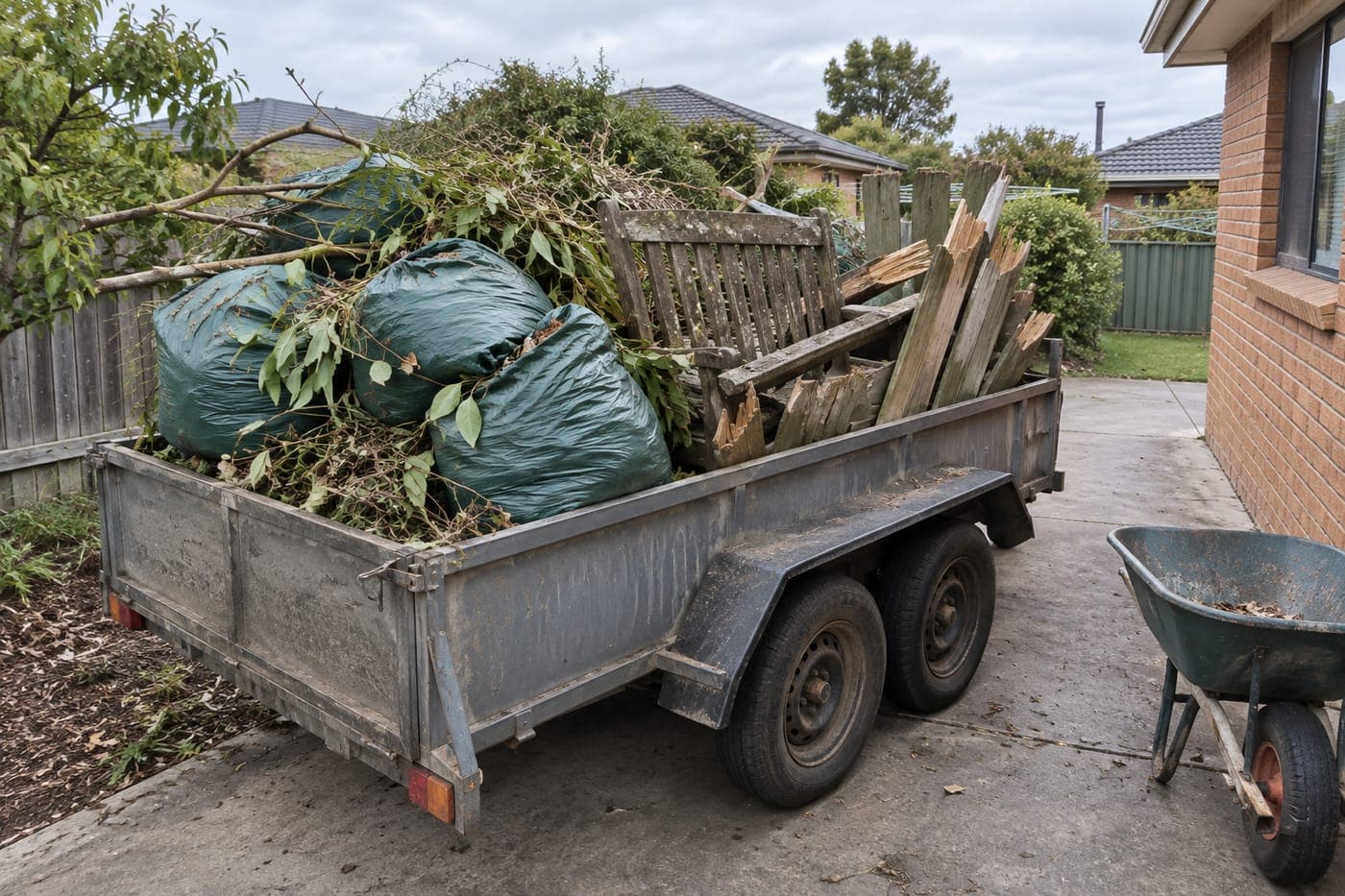
How much will a trailer or ute hold?
Measure the inside of the tray and multiply the same way: inside length times inside width times side height. A common 6 by 4 box trailer, about 1.8 m by 1.2 m inside with 0.3 m sides, holds about 0.65 cubic metres level with the sides.
| Vehicle | Inside length | Inside width | Load height | Volume |
|---|---|---|---|---|
| 6 by 4 box trailer, level with the sides | 1.8 m | 1.2 m | 0.3 m | About 0.65 cubic metres |
| Same trailer with a 0.9 m cage | 1.8 m | 1.2 m | 0.9 m | About 1.9 cubic metres |
| 7 by 5 box trailer with a 0.6 m cage | 2.1 m | 1.5 m | 0.6 m | About 1.9 cubic metres |
| Small ute tray | 1.5 m | 1.5 m | 0.4 m | About 0.9 cubic metres |
Measure your own trailer or ute, because sizes vary, and these figures are worked examples rather than standard sizes. Loose green waste piled above the sides needs to be netted or tied down before you drive, and the vehicle's load limit still applies whatever the volume.
Our team uses a commercial trailer and estimates jobs in trailer loads.
How can you estimate volume before the job is even done?
Work out the size of what will be cut or cleared. For a hedge, multiply the length by the height of the faces being cut and by the depth to be removed. For an overgrown bed, multiply the area by the average height of the growth. Then allow extra, because cut material bulks up.
A hedge trim
A hedge 20 m long and 2 m high, cut back 0.1 m on one face, is a band of 20 times 2 times 0.1, or 4 cubic metres of foliage in place. Not all of that is solid leaf, but once cut it springs into a loose pile, so treat the band as a rough guide to the loose volume. A hard rejuvenation cut, taking off 0.5 m or more, produces many times as much.
An overgrown bed or block
A bed 5 m by 2 m, with weeds and growth averaging 0.6 m high, is 6 cubic metres of space. Much of it is air between stems, so the pulled and stacked waste is usually a fraction of that, but the figure tells you whether to think in bins or in trailer loads.
Lawn and leaf clean-ups
Leaf drops and lawn clippings are harder to predict. Collect for one session, measure what you get, and multiply by the number of sessions you expect. That is often the most reliable way to plan a season.
Why the same job can produce different volumes
Two identical hedges can give very different loads. A hedge trimmed every few months gives thin, soft clippings; one left for a year or two gives thick, woody growth that does not compress. Species matter too: dense lilly pilly and photinia hedges produce more mass than a light, open screen.
Weather plays a part. Clippings cut in a dry spell are light and settle little; clippings cut after rain are heavy and pack down hard. When in doubt, round up, so the plan has room for the pile you actually get.
How does the volume decide the best disposal route?
Size points to the route. Under a quarter of a cubic metre per fortnight suits the green bin. One to three cubic metres of tied branches suits a council bundled branch booking, if the limits fit. Beyond that, or when the pile is mixed or urgent, a tip run, skip or removal service is usually the answer.
| Volume | Usual route | Check first |
|---|---|---|
| Up to 0.24 cubic metres per collection | FOGO or green bin | Branch size limits and bin rules |
| 1 to 3 cubic metres of tied branches | Council bundled branch booking | Bundle rules and how many bookings remain |
| A trailer load or two | Tip run to a transfer station or green waste facility | Hours, residency rules, accepted items |
| Several cubic metres over a few days | Skip bin | Permits on council land, restricted items |
| Any size, mixed or urgent | Removal service | What the operator takes |
Bundled branch limits differ widely. Moonee Valley asks for branches no wider than 75 mm and no longer than 1.5 m in bundles under 300 mm wide; Glen Eira allows up to 20 bundles and 3 cubic metres in total; Merri-bek takes each branch booking from a 2 cubic metre yearly allocation. Our guide to council hard rubbish or a private removal compares the two side by side, and the green waste disposal options in Melbourne guide covers each route in more detail.
Large, awkward material changes the sum. Palm fronds, stumps and big limbs take far more space than their weight suggests; our guide to palm fronds, branches and bulky garden waste covers how to cut and stack them. Burning is rarely a lawful shortcut on suburban blocks, as our post on burning off garden waste in Melbourne explains.
Does weight matter as much as volume?
For lifting and loading, yes. Volume decides how much space a pile needs; weight decides how hard it is to move and whether a trailer is overloaded. Wet clippings, soil-laden roots and old mulch are heavy for their size, while dry branches are light but bulky.
- Wet grass clippings: dense and heavy; spread them through the bin, not in one block.
- Roots with soil: knock off as much soil as you can; soil is excluded from green bins and adds a lot of weight.
- Old mulch and leaf litter: heavier than it looks once it has broken down and held water.
- Dry prunings and branches: light but bulky; volume, not weight, is the limit.
Keep bundles light enough to lift safely. Moonee Valley, for example, asks that each item can be lifted to shoulder height by one person.
What affects a removal quote, and when is it worth calling one in?
A removal quote depends on the volume, which our team estimates in trailer loads, the type of waste, the access and carry distance, and any sorting for recycling. Your measurements and a clear photo give us most of what we need. If you want to know what happens to the load afterwards, read where your green waste goes after it leaves the garden.
When the pile has outgrown the bin and the next council booking, our rubbish removal service takes garden waste and prunings, loaded by our team, with a sweep and tidy afterwards. More guides on bins, branches and bulky waste are in our green waste and rubbish guides.
Send a photo with a bin in shot and get a free quote.
Your Garden. Our Promise.
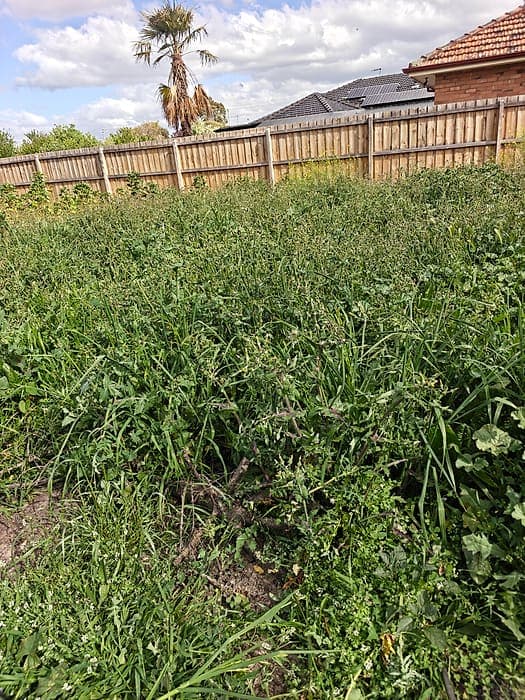
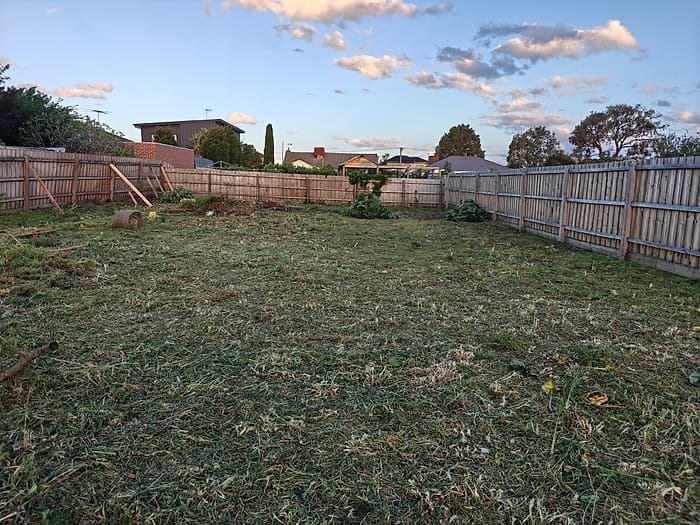
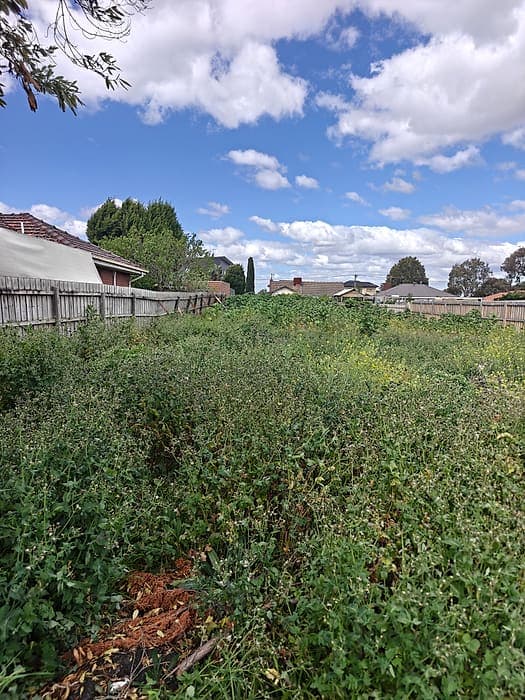
From our jobs
Frequently asked
How many green bins full of clippings make one cubic metre?
Does running prunings through a mulcher reduce the volume I need removed?
Should I measure a green waste pile before or after stacking it?
How do I estimate a pile that sits on a slope?
Why did my pile shrink after a week of rain?
How much space does trimming a long hedge produce?
Is a cubic metre of grass clippings heavier than a cubic metre of branches?
Sources and further reading
- Hard waste collection (Moonee Valley City Council)
- Hard waste collection (Merri-bek City Council)
- Hard rubbish, branches and cardboard (Glen Eira City Council)
- Standardising household recycling across Victoria (Victorian Government)
- Food and garden bin (Knox City Council)
Caring for Melbourne gardens since 2019. Updated 18 November 2026.