


Lawn care
Real lawn or synthetic turf? An honest comparison
By the Action Garden team · Updated · 13 min read
Checked against: Victorian Department of Education, Water Victoria, Sustainable Gardening Australia, City of Whittlesea, Bureau of Meteorology
TL;DR
- Real grass cools the space around it; Victoria's Department of Education notes synthetic turf absorbs sunlight and gives off heat.
- Drought-hardy grasses such as kikuyu and some buffalo varieties carry top water ratings and recover after dry spells.
- Synthetic turf is not maintenance-free; it needs brushing, leaf and weed removal, rinsing and a sound drainage base.
- Synthetic fibres can break off into waterways and old turf is hard to recycle, so most of it ends up in landfill.
- Synthetic makes sense in deep shade, tiny courtyards and spots grass cannot reach; check council rules before laying it on a nature strip.
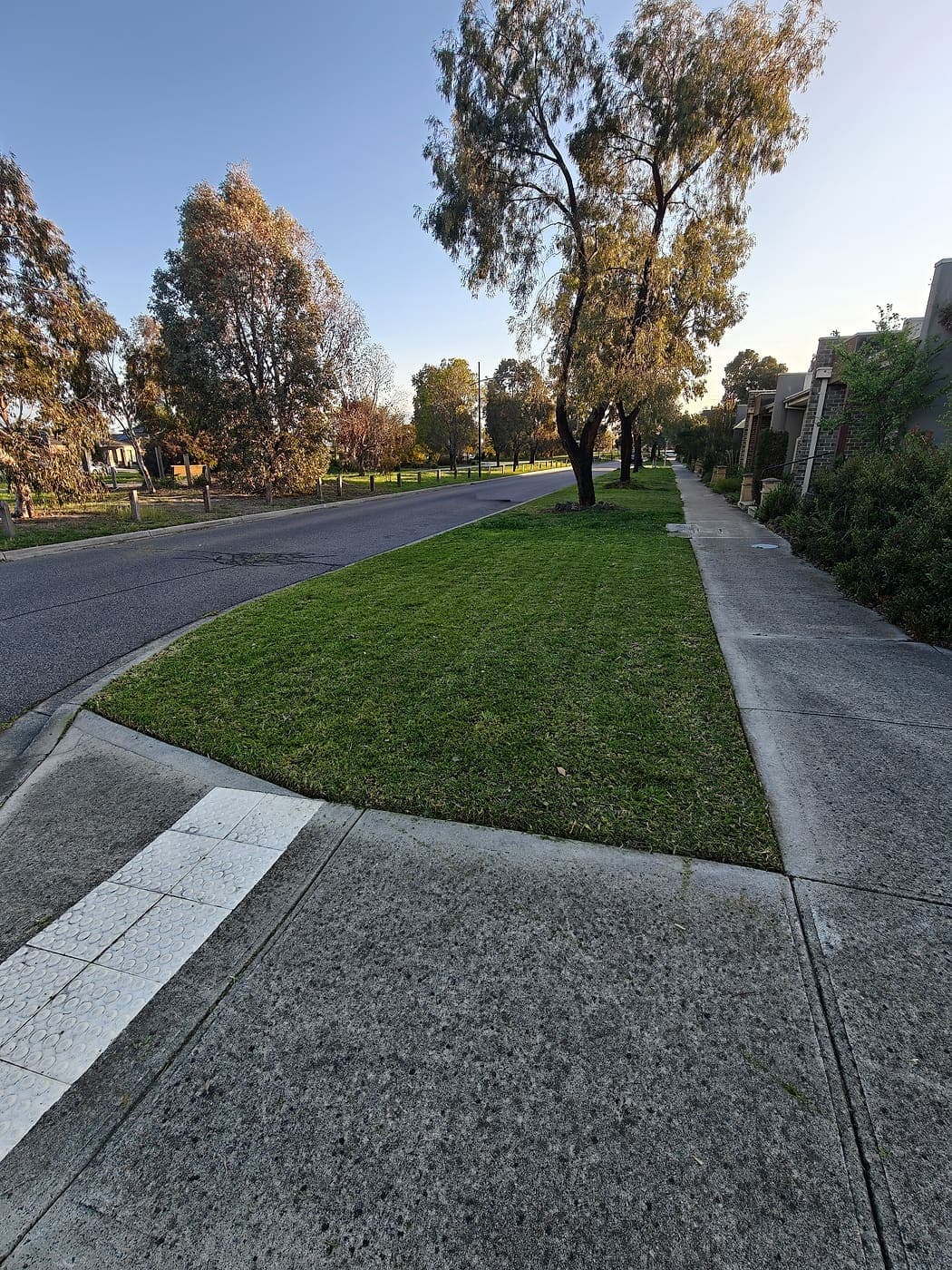
What is the real difference between a real lawn and synthetic turf?
A real lawn is a living plant that cools, drains and feeds the soil but needs mowing, feeding and some water. Synthetic turf is a plastic carpet laid over a compacted base: it never needs mowing, but it heats up in the sun, does nothing for the soil and eventually has to be pulled up and disposed of.
Most of the debate is about effort. Synthetic turf is sold as "no maintenance", and real grass is often blamed for the work of a lawn that was the wrong grass, in the wrong spot, cut at the wrong height. Get those three right and a real lawn is much less work than its reputation.
This piece compares the two on the things that matter in a Melbourne yard: heat, water, upkeep, drainage, environment, looks over time and where each one fits. It does not compare prices, because those depend on the site and the product.
How hot does synthetic turf get in a Melbourne summer?
Hot enough to matter. Victoria's Department of Education, in its guidance to schools, says synthetic turf "generally absorbs, rather than reflects sunlight, causing the emission of heat", while natural grass helps cool urban areas. It also notes that children face a higher risk than adults of heat stress and skin injuries such as blisters and burns.
Real grass stays cooler because it is alive. Water moves up through the roots and out through the leaves, and that evaporation takes heat away from the surface. Sustainable Gardening Australia (opens in a new tab) points out that lawns also cool the immediate surroundings of a home.
Melbourne summers make this a real issue rather than a theory. At the Bureau of Meteorology (opens in a new tab)'s Olympic Park station, January averages a 26.8°C maximum and February 25.9°C, and hot days well above those averages arrive every summer. On those afternoons, a synthetic surface in full sun is the part of the yard to keep children and pets off.
Which uses less water, and what do Melbourne's water rules allow?
Synthetic turf uses less water, but a well-chosen real lawn uses far less than most people think. Sustainable Gardening Australia lists kikuyu and Sir Walter buffalo as five-star water-rated grasses and Santa Ana couch as four-star, and notes that some grasses, like kikuyu, recover after browning off in a long dry spell.
The water rules leave plenty of room to keep a lawn alive. Under Victoria's permanent water saving rules (opens in a new tab), "Home and commercial gardens can only be watered between 6 pm and 10 am, if using watering systems", and "You can water gardens at any time using a hand-held hose, watering can or bucket." Hoses must be leak-free with a trigger nozzle.
The trick is how you water, not how often. Sustainable Gardening Australia's advice is that less frequent, deep watering is the best way to keep a healthy lawn, because it pushes roots deeper and makes the grass better at handling dry spells. For other habits worth unlearning, see our piece on common lawn care myths.
Synthetic turf is not entirely water-free either. It is often rinsed to clear dust, pollen and pet urine, and some owners hose it down to cool it on hot days.
What upkeep does each one really need?
Both need regular attention; the jobs are just different. A real lawn needs mowing, edging and some feeding; synthetic turf needs brushing, clearing and the occasional repair.
| Job | Real lawn | Synthetic turf |
|---|---|---|
| Cutting | Weekly in spring, every 3 to 4 weeks in winter | None |
| Edges | Trimmed along paths and beds | Checked for lifting seams and edges |
| Leaves and debris | Mulched or caught when mowing | Blown or raked off, often weekly under trees |
| Weeds | Crowded out by a thick lawn; spot weeding | Grow in seams, edges and blown-in dust |
| Feeding | Two or three feeds a year | None |
| Brushing | None | Cross-brushed to lift flattened fibres |
| Pets | Urine spots recover with water | Rinsed so urine does not build up and smell |
| Repairs | Bare patches reseeded or patched in spring | Burns, tears and lifted joins repaired |
The mowing load on a real lawn also changes through the year. Our complete guide to lawn mowing in Melbourne sets out how often to mow, at what height, for each grass type.
Why synthetic turf still gets weeds
Synthetic turf has drainage holes in its backing, so the base underneath stays damp. Dust, leaf litter and seed blow in and settle among the fibres, and weeds germinate there, especially along edges, joins and next to garden beds.
Running grasses are the worst offenders. Kikuyu and couch left in the ground before laying will push up through joins and around edges, which is why they must be fully removed before synthetic turf goes down. Our planned piece on kikuyu lawns in Melbourne explains how hard that grass is to get rid of.
What about drainage, soil and the environment?
This is where a real lawn has the clearest lead. Grass roots open up the soil and let rain soak in, while synthetic turf sits on a compacted base that has to be built to drain, and does nothing for the soil life underneath.
- Drainage. The Department of Education warns that without adequate drainage, water can pool on synthetic turf in heavy rain, damaging the turf and its base and creating a breeding ground for bacteria and insects. On Melbourne's heavy clay soils in the north and west, a poorly drained base is a real risk.
- Microplastics. The same guidance notes that synthetic fibres "can break off, polluting waterways", especially after heavy rain or flooding.
- End of life. It describes synthetic turf as difficult to recycle and likely to end up in landfill. A real lawn's clippings, by contrast, go back into the soil or the green waste bin.
- Soil life and wildlife. A real lawn feeds worms and soil microbes, and birds feed on it. Synthetic turf cuts the soil off from light, leaves and air.
A real lawn is not automatically green either. Sustainable Gardening Australia notes that most lawns are a single species and prefers Australian native grasses for the most sustainable lawn, with the next best being drought-hardy grasses that are mown before they seed and kept out of garden beds.
Two side-by-side cross-sections of a backyard. On the left, a real lawn: green blades above, a thatch-free root zone below with deep roots, worms and rain arrows soaking down into the soil, and small arrows of water vapour rising and carrying heat away. On the right, synthetic turf: plastic fibres with sand or rubber infill, a backing sheet with drainage holes, a thick layer of compacted crushed rock, and the original soil sealed off underneath; heat arrows radiate up from the surface and rain runs along the top in a downpour.
How do they compare side by side?
Real lawn wins on heat, soil, drainage and end of life; synthetic turf wins on deep shade, no mowing and a constant colour. The table pulls the trade-offs together.
Side by side
Real lawn and synthetic turf compared
| Real lawn | Synthetic turf | |
|---|---|---|
| Summer surface heat | Cooler; cools the area around it | Absorbs sunlight and gives off heat |
| Water | Needs some; drought-hardy grasses need little | Rinsing only |
| Upkeep | Mowing, edging, feeding | Brushing, clearing, rinsing, repairs |
| Colour in winter | Warm-season grasses pale or yellow; fescue stays green | Same colour all year |
| Shade | Thins out under deep shade | Works in deep shade |
| Drainage | Roots open the soil | Depends on the base built under it |
| Soil and wildlife | Feeds soil life and birds | Seals the soil off |
| Wear and repair | Recovers from wear in the growing season | Flattens and fades; damage needs patching |
| End of life | Clippings recycled; lawn can be renovated | Hard to recycle; most goes to landfill |
| Feel underfoot | Soft and cool | Firm; warm to hot in sun |
The winter row is the one that changes most minds. A kikuyu or couch lawn goes pale in a Melbourne winter, which is normal dormancy rather than a dying lawn, and our article on why lawns go yellow in winter explains what to expect.
Where does synthetic turf make sense, and where does real grass win?
Synthetic turf earns its place in a few specific spots; in the rest of the yard, a real lawn usually wins. Matching the surface to the spot is more useful than picking one for the whole property.
Synthetic turf can make sense in:
- deep shade where grass has failed more than once, such as under a dense evergreen or between close buildings;
- small courtyards and balconies with no soil, or with too little room to run a mower;
- narrow side passages and odd strips that are hard to mow and edge;
- spots where water cannot reach without hosing by hand.
A real lawn usually wins in:
- sunny backyards where children and pets play in summer;
- larger areas, where heat, drainage and end-of-life waste add up;
- yards with heavy clay, where a synthetic base can hold water;
- gardens where birds, soil life and summer cooling matter to you.
The nature strip is a special case. It is council land, and many councils do not allow synthetic grass on it. The City of Whittlesea (opens in a new tab), for example, lists synthetic grass among modifications that are not allowed, citing drainage and surface heat, so check your council's nature strip rules before buying anything.
If the lawn has failed, check the cause first
Many people choose synthetic turf after a lawn has failed, but the cause is often fixable. The usual reasons are too much shade, compacted clay, the wrong grass for the spot, mowing too low, or a summer of light, frequent watering that kept roots shallow.
Before replacing it, look at the pattern. Patches along paths and in the sunniest spots point to heat and dry soil; thinning under trees points to shade. Our guide to brown patches in a lawn helps narrow it down, and a spring lawn renovation of aerating, top-dressing and feeding fixes many tired lawns without starting again.
Which should you choose for your yard?
Work down the questions below for each part of the yard, and stop at the first "yes". You may end up with a lawn in the sun and something else in the shade, which is often the best result.
Quick decision guide
Real lawn, synthetic turf or something else?
- Is the area a nature strip? Check your council's rules first; many do not allow synthetic grass.
- Does the spot get less than about four hours of direct sun, even in summer? Grass will struggle. Consider mulched garden beds, shade-loving ground covers or, for a small area, synthetic turf with shade over it.
- Do children or pets play there on summer afternoons? Choose real grass, or plan shade before laying synthetic turf.
- Is the soil heavy clay that stays wet after rain? Real grass with aeration will usually cope better than a synthetic base; fix drainage either way.
- Is the area tiny, paved underneath or impossible to mow? Synthetic turf or pots and planters suit.
- None of the above? A real lawn of a drought-hardy grass suited to the sun and soil.
There is also a third option: less lawn. Native grasses, groundcovers and mulched beds can replace the hard-to-grow parts without plastic, and our planned article on lawn alternatives covers what grows well in Melbourne.
What does the honest verdict come down to?
For most Melbourne homes with a sunny yard, a real lawn is the better choice, and much of its "work" is simply mowing at the right height and interval. Synthetic turf is a tool for a few problem spots, not a no-maintenance fix for the whole garden.
If keeping up with the mowing is what is pushing you towards plastic, it may be easier to hand that part over. Action Garden's lawn mowing service covers mowing to the right height for your grass, edging, the nature strip and a full tidy-up, weekly, fortnightly or one-off, with add-ons such as aeration, a fertiliser programme and weed control for a tired lawn.
Read more in our lawn care articles, or get a free quote with a few photos of the lawn and we will tell you what it needs.
Your Garden. Our Promise.
From our jobs
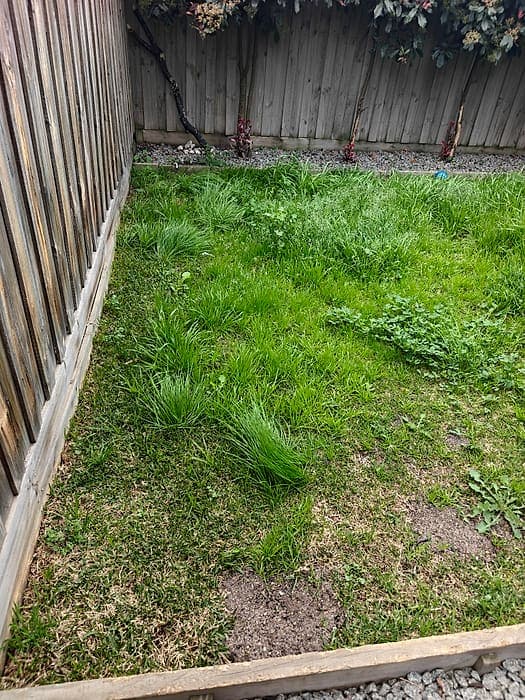
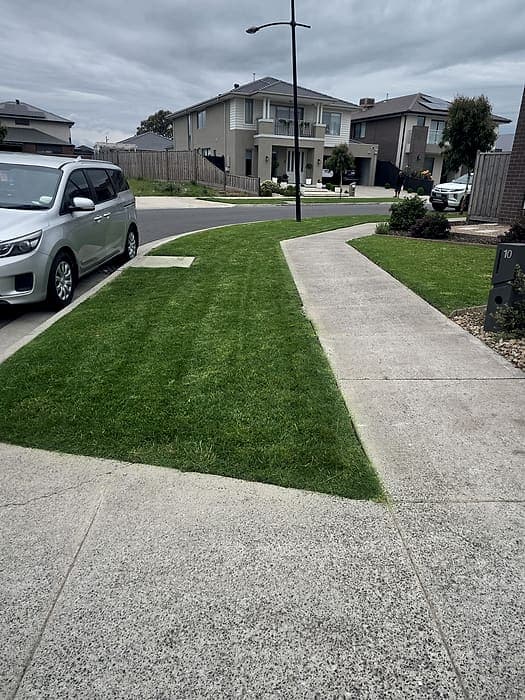
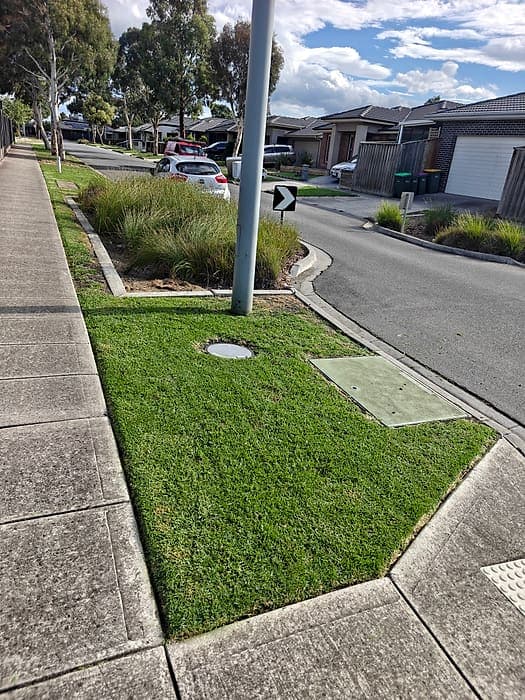
Frequently asked
Does synthetic turf get too hot for kids and pets in a Melbourne summer?
Is synthetic turf a good idea where dogs toilet?
How long does synthetic turf last before it needs replacing?
Can a real lawn survive Melbourne's water rules in summer?
Is a real lawn or synthetic turf better under trees?
Does synthetic turf need watering at all?
Does synthetic turf add value when selling a house?
Can I lay synthetic turf myself over an existing lawn?
Sources and further reading
- Use of synthetic turf (Victorian Department of Education)
- Permanent water saving rules (Water Victoria)
- Minimising water use on lawns and turf (Sustainable Gardening Australia)
- Native lawns (Sustainable Gardening Australia)
- Nature strips (City of Whittlesea)
- Melbourne (Olympic Park) climate statistics (Bureau of Meteorology)
Caring for Melbourne gardens since 2019. Updated 18 November 2026.